Have yourself a deadly l.., p.13
Have Yourself a Deadly Little Christmas,
p.13
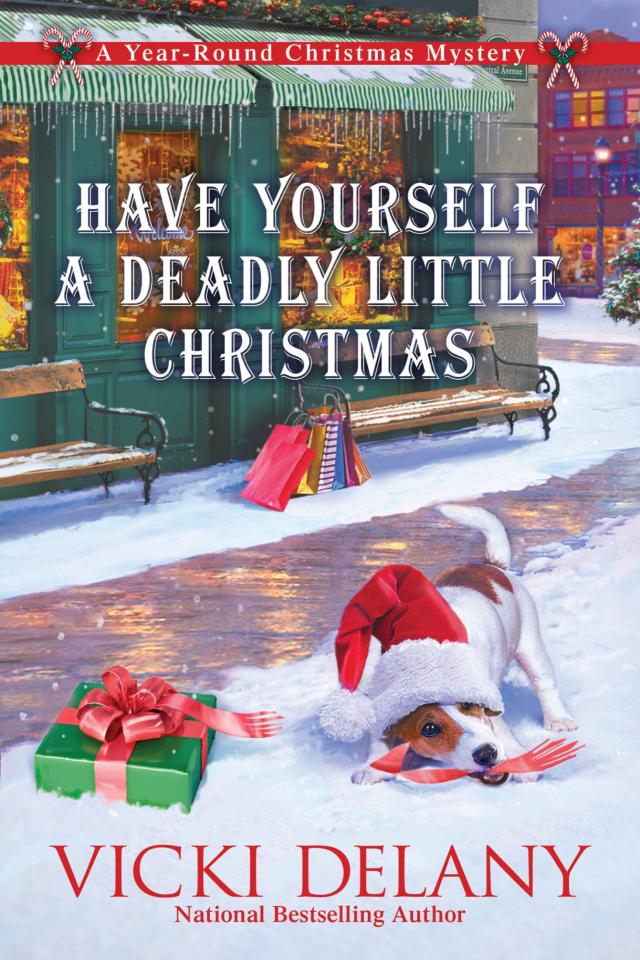


I always laugh to see them together.
After about a half an hour of walking, meandering up and down the trails, in no hurry to get anywhere, we reached the creek, gurgling happily as it flowed over rocks heading for the big lake. Alan had constructed a makeshift picnic table out of odds and ends of scarred or leftover wood and brought it here to create the perfect private picnic spot. In spring it was a riot of bright green vegetation and early wildflowers, in the summer thickly shaded in deep greens, in the fall a kaleidoscope of orange, scarlet, and rust. Even on the coldest winter days, the creek was so fast moving it rarely froze over.
Alan unpacked the picnic while Ranger explored the banks of the creek, Mattie rested from his endeavors, and I made myself comfortable and watched Alan work. He was a great picnic chef. Today he’d brought homemade onion soup, thick and fragrant, kept piping hot in Thermoses, hearty ham and cheese sandwiches, and crispy raw carrots accompanied by a spicy dip. Apples and chocolate chip cookies provided dessert and tea out of another Thermos our drinks. The dogs got water and a rawhide bone each. Even Ranger settled down to chew on his bone. Mattie made sure his was well protected.
“Want to talk about what happened?” Alan asked after we’d savored the first delicious sips of soup and bites of sandwiches.
“At the store yesterday? I feel like I’ve never stopped talking about it. First to Detective Simmonds, then to Mom and Dad, Vicky, and the half of Rudolph who didn’t hear the story from someone else.”
“I meant talk about how you’re feeling. Your dad called me this morning, you know.”
“I’m not surprised to hear that.”
“Mabel D’Angelo phoned me last night.”
“That I am surprised to hear. What did she want? How does she know your number anyway?”
“How does Mabel know anything? The secret network. Her and that bunch would put the CIA and the FBI to shame, if only they’d concentrate on facts rather than exaggeration and conjecture.”
“And if the Russian mob and international terrorists operated out of Rudolph.”
“That too.”
“What did you tell her?”
“I played dumb. It wasn’t hard.” I swatted him with my napkin. “I told her I didn’t know anything about it.”
He lowered his spoon and studied my face. “Are you okay, Merry?”
“Yes, Alan. I am. If I wasn’t, I know I have you with me.”
“And your parents. And Vicky and Mark. Jackie too, although you don’t know it. Half of Rudolph, come to that.”
My heart might have swelled, just a little bit.
“I’m fine,” I said when I could speak again. I scraped up the last of the soup. “I’m worried Jackie’s going to talk herself straight into a charge of murder and someone else is going to talk my mom into one.”
“What does all that mean?”
I told him my concerns.
“As for your mom,” he said. “Let them try. As for Jackie, you’re overthinking it, Merry. Simmonds knows how to read people like her, and she won’t make a move without solid, concrete evidence. No one saw Jackie going into the store after Paula, right?”
“So far, no one’s said so. As far as I know, anyway.”
He tossed the last bite of his sandwich into his mouth. “Ready to get back? I’d like to stay longer, but I have work to do. I have an extremely demanding customer to make happy.” He gave me a wink. “I’ll help you load those items you ordered into your car.”
Chapter Ten
“We’ve seen that one,” I said to Vicky.
“We have? Are you sure?”
“I’m sure. About six months ago. We both hated it.”
“Which,” she said, “is why it’s suitable for bad movie night.”
“Too suitable. Find something else.”
She pointed the control at the TV and flicked rapidly through the available offerings displayed on the screen. “How about this one?”
“No. It’s supposed to be good.”
“Is that a bad thing?”
“It is for bad movie night.”
Vicky threw the control at me. “You choose something.” She leaned back into the couch cushions, tucked her long legs under her, and picked up her glass of wine. Mattie snoozed in his bed on the floor, and Sandbanks, Vicky’s ancient golden lab, rested his head on her lap.
I scrolled idly through the movie offerings on the various streaming services. “How’s the old guy doing?”
“You mean Mark?”
“No, I mean Sandbanks and you know it.”
She rubbed his ears. He grunted. “He keeps going. He’s happy. He eats well, and sometimes he can summon enough energy to chase a bird out of the yard. If the bird’s not too big and not too determined to keep his place.”
I kept scrolling. The downstairs doorbell rang and I went to get it. As expected, it was the pizza delivery guy. He handed me the enormous cardboard box, warm from the food inside. I said, “Thank you,” gave him a handsome tip, and skipped back upstairs. I got plates and paper towels from the kitchen and dropped the box onto the coffee table. Vicky and I dug in, pulling long strands of gooey hot cheese onto our plates.
“Yummy.” Vicky said. “You don’t want to watch a movie tonight, do you?”
“Not really.”
“Things on your mind, I’d assume.”
“Can’t stop thinking about what happened.”
When Vicky first arrived, she’d told me the latest gossip as related by her customers to her staff and from them to her.
In short, nothing new. No one knew of any reason why someone would want to do away with Paula Monahan. She wasn’t a popular teacher, but there were worse, and no one had killed Mr. Saunderson, the math teacher. Not yet anyway. Paula and Kevin’s marriage was on the skids, but people generally liked Kevin more than Paula so his innocence was predetermined. A customer had mentioned that it was too bad young Eddie Monahan hadn’t been taken out instead of his mother and the abrupt silence falling over their table indicated the speaker had gone too far.
“Okay,” Vicky said around a mouthful of pizza piled high with the things she liked: mushrooms, onions, red peppers, hot peppers, pepperoni, and sausage. “As you can’t stop thinking about it, let’s talk about it. Have you considered it might not have mattered who the victim was? Could it have been a random thing?”
“You mean we have a deranged killer running loose in Rudolph? They attacked a woman in broad daylight in a Christmas-themed store on the main street of your Year-Round Christmas Destination in the weeks leading up to Christmas? No, I have not considered that, and you can be sure if you mention it to anyone else, Sue-Anne, along with my dad and all the other town councilors, probably helped by the police chief, will ensure you never see the light of day again. I’ve heard rumors the dungeon beneath town hall is soundproof and the food is not catered by the best restaurants.”
Vicky ignored my sarcasm. “That isn’t what I meant. I meant random as in randomly chosen from a select group. Such as the cast and crew of the theater players.”
“That makes no more sense than a random killer in general. Want another drink?”
She handed me her empty glass and helped herself to a third slice of pizza. “Hear me out,” she said as I went into the kitchen. “Paula didn’t have a particularly important role in the play. It’s a small-town, amateur effort. Not as though this is Broadway or the West End, where people specifically buy tickets to see Hugh Jackman or Benedict Cumberbatch and might not come if their star can’t put in the appearance. Meaning, no one had reason to kill Paula Monahan if they wanted to stop the play. But—” she paused dramatically, half-eaten slice of pizza in the air.
I put the refilled glass in her free hand and dropped onto the couch. “But?”
“Suppose someone did want to stop the play. Prevent it being put on. In order to do so, this nefarious person hoped to cause enough commotion and disruption the show would not go on.”
“But the show is going on.”
“That the plan failed to achieve its aim doesn’t mean it wasn’t attempted.”
I leaned against the cushions and thought. “I suppose that’s possible. But really, Vicky, who would go to that sort of trouble to sabotage an amateur theater production?”
“I can think of only one person—” She paused dramatically. “Or group of people.”
“No.”
“What do you mean, no? I haven’t told you what I’m thinking.”
“You have an obsession with the Muddites, Vicky. You see their hand behind every bad thing that ever happens in Rudolph. If we get freezing rain or an unexpected warm spell on Christmas Eve, you suspect they have a secret weather-changing installation hidden under town hall.”
“You exaggerate. Please remember the saying, ‘Just because you’re paranoid, doesn’t mean they aren’t out to get you.’ The Muddites hate us.”
Vicky was referring to the people of the neighboring town, the awkwardly named Muddle Harbor. Like Rudolph, Muddle Harbor had once been a thriving industrial and shipping town. Unlike Rudolph, it had not been able to find something else to keep business going and the community prosperous once the major industry closed down. In my dad’s opinion, the main reason Muddle Harbor couldn’t move on is rather than try to come up with intelligent solutions to a difficult, but not unusual these days, problem, they preferred to blame all their misfortune on the townsfolk of Rudolph. They have been known to refer to us as “those blasted deer-people.”
“Hate’s a strong word, Vicky. Mayor Baumgartner and some of the townspeople came to the theater picnic. They smiled and made friendly. Surely they know any overflow from Rudolph’s success will spill their way.”
“Knowing and knowing, are two different things. Baumgartner doesn’t want spillover. He wants Muddle Harbor to be the most important town in this part of the state. Remember the fiasco when they tried to fashion themselves as Easter Town?”
“Sadly yes. But—”
“No buts about it. It would be just like the Muddites to attempt to sabotage the centerpiece of Christmas week in Rudolph. Tomorrow’s Sunday. You don’t open the store until noon, and I can ask Marjorie to come in early. We ride for Muddle Harbor at dawn.”
“I can’t stop you from going, Vicky, but I won’t come with you. The idea’s ridiculous.”
She helped herself to another piece of pizza and said nothing more about it.
* * *
Not quite dawn, but at quarter to nine I was standing in a patch of weak winter sunlight on the sidewalk waiting for Vicky to pick me up. Temperatures had dropped further overnight, and Mrs. D’Angelo had been spreading de-icer on her path and driveway when I emerged, still grumbling. She’d spread so much de-icer, I wondered if the stores had enough left for everyone else.
“Good morning, Merry,” my landlady said cheerfully. She was thoroughly bundled up in a calf-length puffy pink coat, green woolen hat with a pom-pom on top, and purple mittens. “A cold but nice day. Always the best, I say.”
“Morning.”
“No snow in the forecast yet, but there’s still time to get some before Christmas arrives. It’s not Christmas without snow, I always say. You’re off bright and early, I see. Early for a Sunday, anyway. You normally like to have a nice relaxing morning on Sundays before going to the store. You must be pleased the police are allowing you to open again.”
I didn’t ask how she knew that. Mrs. D’Angelo had a “source” inside the police department, as well as at least one in town hall. Mrs. D’Angelo usually knows what’s going on in the corridors of what passes for power in our little town before the mayor or chief of police do.
“Don’t have Matterhorn with you, today? You mustn’t be heading off for a walk or going into the store,” she said, her eyes bright with interest.
“I’m meeting Vicky,” I confessed.
“Oh, yes. Dear Vicky Casey. Such a lovely girl. I’m pleased she turned out so well, considering the history of the Casey family in this area. Her father excepted, of course. Any further developments between her and Chef Mark?” Mrs. D’Angelo eyed me carefully, no doubt waiting for a twitch of the eyebrow or something else she could use to report to her friends that a wedding was in the air. I hated to disappoint her. Correct that: I didn’t hate to disappoint her in the least.
“Not that I know of,” I said.
She hid her disappointment well. “I myself am going shopping later. I need a new dress for the official party.” She waited for me to ask what party that might be.
“What party might that be?”
“Didn’t you hear, dear? The mayor and town council are putting on an official invitation-only event following the opening night performance of A Christmas Carol. Everyone who’s someone in town is going to be there. You haven’t been invited?”
“My invitation must be lost in the mail.”
“Donalda Schwartz got hers.” Mrs. D’Angelo’s face drooped ever so slightly at the confession, but then she perked up. “Naturally mine can’t be far behind. I’m so busy these days, I can’t wait for official notice before I search for something suitable to wear. Forewarned is forearmed.”
“Here Vicky comes now,” I said. “Have a nice day.”
I leapt into the bakery van before it had time to come to a full stop. Vicky pulled away in a squeal of tires.
The first time we’d gone to Muddle Harbor on one of Vicky’s “investigations,” we’d been incognito. Our identity had been uncovered within minutes of our arrival, so we no longer bothered. Thus she picked me up in the white van clearly marked with the Victoria’s Bake Shoppe name and logo.
I’d been adamant last night I was not going to stick my nose into the police investigation. So there. In particular I was not going to Muddle Harbor on some wild goose chase hoping to catch the mayor and town burgermeisters and burgermeistrsses plotting our demise.
Yet, here I was, tearing out of town on a freezing cold Sunday morning in a rickety (but pleasant smelling) old delivery van when I could have been asleep in my warm bed before rising to enjoy the luxury of a long leisurely breakfast.
Detective Simmonds had quite forcefully told me to stay out of it, and I’d been determined to do so. But such is easier said than done. The police investigation should be none of my business. Whatever happened in Paula Monahan’s life that someone would kill her, was none of my business. I scarcely knew the woman. But she’d been killed in my store—and that meant, in Vicky’s mind, anyway—the killer had made it my business.
I was forced to agree. As long as Jackie and my mother were under suspicion, however flimsy any case against them might be, it was my business.
Such was my reasoning to myself. Vicky never minds interfering in things that are none of her business.
“Okay,” I said now. “What’s the plan?”
“We’ll go in open-minded and work from there.”
“Meaning you don’t have a plan. I thought you were going to come up with a plan.”
“Spontaneous is always better.”
“Not in my life. Acting under the assumption we’re going to the Muddle Harbor Café, center of all activity in that town, I didn’t have breakfast.” Perhaps the only reason I agreed to come on this expedition was to have breakfast at the aforementioned café. They served a real American diner breakfast—fried foods, strong hot coffee, and plenty of both.
Vicky made a poor attempt to suppress a shudder. “I dare not think. I’ll have some of your toast, to be friendly like as we work our wiles on them.” Vicky, I knew, would have far more than my toast and would gobble up my bacon at the same time as she explained the relationship between heart disease and cholesterol and fat. A idea which, somehow, never seemed to occur to her when she was eating pizza.
The Muddle Harbor Café was gossip central in that town. If we were going to find out what was going on—not that I thought anything was—we’d start there.
Vicky began to slow as we approached Muddle Harbor. The sun was shining as it only can in winter, clearing the air and making the cold clean and invigorating. As we drove down Main Street, a bank of dark clouds passed overhead, turning the cold simply cold.
The shops were all closed, many of them permanently. “For rent” signs hung in papered-over windows, next to doors needing a good coat of paint. Limp wreaths and burnt-out bulbs hung from the scraggy trees, and many of the Christmas decorations in the store windows looked, to my experienced eye, cheap, tawdry, and too much used.
“I honestly don’t know why they bother,” Vicky said as she pulled into a parking spot. “Hey! I’ve got a fabulous idea. You could offer to help them spruce up the downtown. Hire yourself out as a design consultant.”
“Because they’ll be so favorably inclined toward me after I demand to know if they killed an innocent woman to make Rudolph look bad. Sometimes, Vicky, you don’t always think things through.”
“Sure I do. I also plan for contingencies. Judging by all these cars, my plan’s working. The café’s busy.”
She was right about that. In an otherwise empty street, the block in front of the restaurant was full of cars and pickup trucks. Vicky and I got out of the van and approached our destination. The windows of the Muddle Harbor Café were decorated for Christmas, and although the decor might not be to my taste, they’d gone to some trouble. The decorations weren’t covered in dust, and the blinking lights all worked.
We pushed open the door and were immediately enveloped in the scent of strong, hot coffee and frying bacon and pancakes. Winter coats were slung over the backs of chairs or hung on hooks by the door. The restaurant was almost full.
I’d like to say all conversation died and everyone turned narrow, suspicious eyes onto us. Instead they ignored us, except for the waitress who called, “If it isn’t the pride of Rudolph, Vicky Casey. And her friend. Sorry hon, I forgot your name.”
“Merry.”
“Merry, right. Noel Wilkinson’s daughter. Look Randy, John, Vicky, and Merry are here. The usual for you girls? Or would you prefer pancakes today? The Sunday special. A sky-high stack of buttermilk pancakes served with an extra side of bacon or sausage, plenty of butter, and enough real maple syrup to drown a duck.”