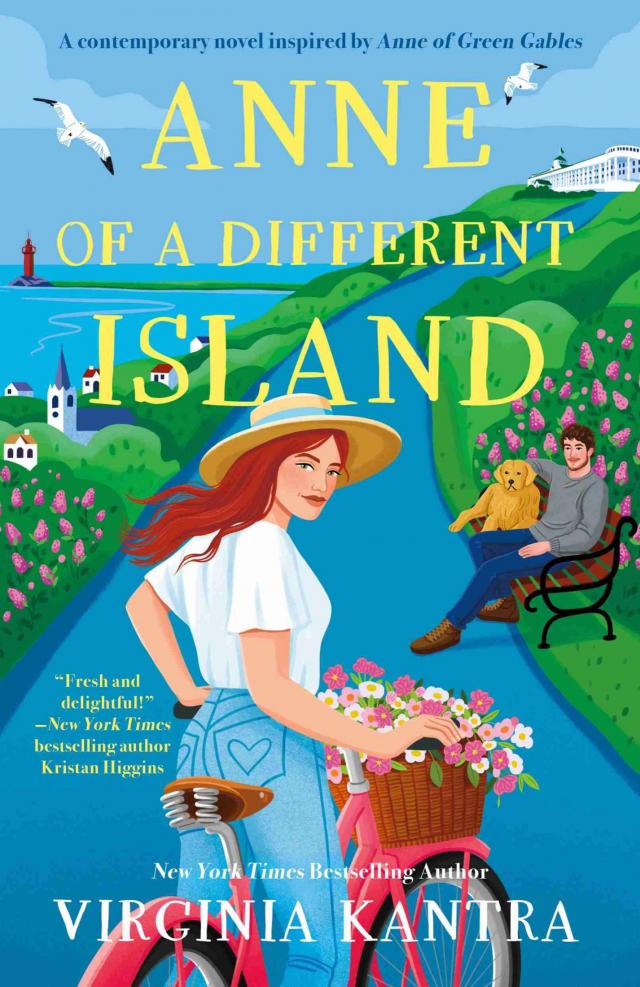
Anne of a different isla.., p.1
Anne of a Different Island,
p.1


Praise for
The Fairytale Life of Dorothy Gale
“The Fairytale Life of Dorothy Gale was [a] heartwarming and charming novel inspired by The Wizard of Oz, but a modern version. It was a fun, entertaining story of self-discovery mixed with just the right amount of romance.”
—First for Women
“Virginia Kantra excels at bringing fresh life to American classic heroines. Fans of Dorothy and her journey will adore the new Dee!”
—New York Times bestselling author KJ Dell’Antonia
“This might be my favorite Virginia Kantra book! Perfectly emotionally pitched and delicately fierce, I don’t know how Kantra manages to capture the ‘looking for home inside yourself’ spirit of The Wizard of Oz in such a contemporary way, but she does. I loved it!”
—Sonali Dev, USA Today bestselling author of There’s Something About Mira
“[A] vivid reimagining of Dorothy’s journey to the Emerald City…. The Fairytale Life of Dorothy Gale is a poignant novel about recovery from the deepest wounds, the true meaning of home, and the delicious satisfaction of regaining control of one’s own story.”
—Amy Poeppel, award-winning author of The Sweet Spot
“A romantic subplot and Dorothy’s believable journey to find her voice also make this a strong choice for readers who appreciate uplifting relationship fiction starring appealing female characters.”
—Booklist
Praise for Meg & Jo
“This family drama offers sharp insights into the tough choices women make.”
—People
“I don’t know of another author who could do justice to Little Women. In a warm, realistic, and humorous voice, Virginia Kantra knocks it out of the park with Meg & Jo in this rich retelling of the beloved classic.”
—New York Times bestselling author Kristan Higgins
“Kantra blends just enough of Alcott’s story of four close-knit sisters and their myriad tribulations with clever and timely new elements…. The imaginative storytelling and sparkling prose make this a winner.”
—Publishers Weekly
“A thought-provoking adaptation of a beloved classic.”
—Kirkus Reviews
“Meg & Jo is a must-read for anyone who grew up with Little Women and is a complex exploration of the power of time, place, and identity.”
—Deep South Magazine
“A beautiful continuation of the original classic.”
—Seattle Book Review
Berkley titles by Virginia Kantra
Home Before Midnight
Close Up
Meg & Jo
Beth & Amy
The Fairytale Life of Dorothy Gale
Anne of a Different Island
The Children of the Sea Novels
Sea Witch
Sea Fever
Sea Lord
Immortal Sea
Forgotten Sea
The Dare Island Novels
Carolina Home
Carolina Girl
Carolina Man
Carolina Blues
Carolina Dreaming
Carolina Heart
Novellas
Midsummer Night’s Magic
BERKLEY
An imprint of Penguin Random House LLC
1745 Broadway, New York, NY 10019
penguinrandomhouse.com
Copyright © 2026 by Virginia Kantra
Readers Guide copyright © 2026 by Virginia Kantra
Penguin Random House values and supports copyright. Copyright fuels creativity, encourages diverse voices, promotes free speech, and creates a vibrant culture. Thank you for buying an authorized edition of this book and for complying with copyright laws by not reproducing, scanning, or distributing any part of it in any form without permission. You are supporting writers and allowing Penguin Random House to continue to publish books for every reader. Please note that no part of this book may be used or reproduced in any manner for the purpose of training artificial intelligence technologies or systems.
BERKLEY and the BERKLEY & B colophon are registered trademarks of Penguin Random House LLC.
Cover design and illustration by Petra Braun
Book design by Ashley Tucker, adapted for ebook by Kelly Brennan
Library of Congress Cataloging-in-Publication Data
Names: Kantra, Virginia, author.
Title: Anne of a different island / Virginia Kantra.
Description: First edition. | New York: Berkley, 2026.
Identifiers: LCCN 2025013420 (print) | LCCN 2025013421 (ebook) | ISBN 9780593816493 (trade paperback) | ISBN 9780593816509 (ebook)
Subjects: LCGFT: Fiction | Romance fiction | Novels
Classification: LCC PS3561.A518 A84 2026 (print) | LCC PS3561.A518 (ebook) | DDC 813/.54—dc23/eng/20250602
LC record available at https://lccn.loc.gov/2025013420
LC ebook record available at https://lccn.loc.gov/2025013421
First Edition: January 2026
Ebook ISBN 9780593816509
The authorized representative in the EU for product safety and compliance is Penguin Random House Ireland, Morrison Chambers, 32 Nassau Street, Dublin D02 YH68, Ireland, https://eu-contact.penguin.ie.
prhid_prh_7.4a_154745601_c0_r0
Contents
Dedication
Chapter 1
Chapter 2
Chapter 3
Chapter 4
Chapter 5
Chapter 6
Chapter 7
Chapter 8
Chapter 9
Chapter 10
Chapter 11
Chapter 12
Chapter 13
Chapter 14
Chapter 15
Chapter 16
Chapter 17
Chapter 18
Chapter 19
Chapter 20
Chapter 21
Chapter 22
Chapter 23
Chapter 24
Chapter 25
Chapter 26
Chapter 27
Chapter 28
Chapter 29
Chapter 30
Chapter 31
Chapter 32
Author’s Note
Acknowledgments
Readers Guide
Questions for Discussion
About the Author
_154745601_
“Kindred spirits are not so scarce as I used to think. It’s splendid to find out there are so many of them in the world.”
—L.M. Montgomery, Anne of Green Gables
To my kindred
spirits
1
Anne
April 2022
“Name?” The barista’s marker poised above the cup.
“Anne. With an e,” I added.
I waited for the answering glimmer that would identify the girl at the airport coffee shop as a kindred spirit. Any sort of recognition, I told myself, would be a sign. A connection, like a message from my dad.
When I was eight, my father brought a copy of Anne of Green Gables home from the library’s used-book sale. I’d been sick for a week, some kind of flu that left me confined to the house, antsy and bored. My easygoing father was useless in the sickroom, my mother said. (Uselessness, in her eyes, was a sin, like greed or envy or forgetting to take off your shoes in the house.) He’d stood there awkwardly in the door of my small room, his big carpenter’s hand wrapped around a battered green paperback with a red-haired girl on the cover, and I’d been overwhelmed with love.
He was not a reader, my dad. But somehow he’d understood (or been told by my English teacher, Mrs. Powell) that I needed Anne Shirley in my life. She became my fictional best friend, my inspiration, reassurance that a strange girl with a big imagination and a bigger mouth could find her place in the world.
Of course, I could never truly be Anne. I wasn’t Canadian, for one thing. Or a natural redhead. Or an orphan. But as soon as I turned eighteen, I had an Anne Shirley quote tattooed on my right arm, paid for with savings from working in my mother’s fudge shop over the summer: Tomorrow is a new day with no mistakes in it yet.
“Looks like a mistake to me,” my mother said when I’d proudly revealed my new ink.
The barista scrawled on the cup. “Anything else?”
Her voice broke into my memories. I blinked, abruptly recalled to the present. Around us, the terminal rang with footsteps, rattling wheels, and echoing flight announcements bouncing off the cavernous ceiling. “Oh. No. Thanks.”
“Receipt?”
I shook my head wordlessly, stuffing a dollar into the tip jar. I was already running late. Again. I couldn’t miss my connecting flight. I grabbed my drink, glancing at the name written on the side of the cup. E-N-N.
Stupid tears pricked my eyes.
“Not everyone thinks Anne Shirley is a cultural icon,” Chris sometimes pointed out with gentle logic.
But Chris wasn’t here.
A lump lodged in my throat. Neither was Dad. Not here. Ever again. Gone. Another echo in the emptiness of my heart.
I was going home to my father’s funeral. Alone. Without my boyfriend.
It wasn’t Chris’s fault, I told myself as I sprinted for the gate, my carry-on bag banging behind me.
On Tuesday night, my mother had called, her voice uncharacteristically soft. Subdued. (“It’s your father. His heart…”) Chris had come straight from his shift, holding me as I ugly cried, plying me with mugs of tea and boxes of tissues. He’d rearranged his schedule so we could make the long drive together from Chicago to St. Ignace for the funeral. But then, at the last moment, one of his patients—a little boy with Ewing sarcoma—was readmitted to the hospital.
“I want to be there for you,” Chris had said in his best bedside manner, holding both my hands.
The but was unspoken, like so many things between us.
But my work comes first.
But my patients need me more than you do.
Chris was a pediatric oncologist. He treated children with leukemia. Teens with brain tumors. Only a monster would insist that his presence at the funeral of a man he’d barely met was somehow more important.
His hands were smooth and warm. A doctor’s hands, calm and capable. I’d squeezed them back. “It’s okay,” I lied. “I’ll be fine.”
I admired his dedication so much. But (also unspoken) I needed him, too. I wanted him with me this weekend. Or maybe, now that Dad was gone, I just wanted to feel like I came first with somebody.
The lump was back, a red-hot ache in my throat.
* * *
—
The Mackinac Island ferry loomed above the dock, its steel hull dirty white against the choppy gray water and leaden sky.
There were three kinds of people on Mackinac. The tourists and day-trippers who swarmed the island for six months every year, buying fudge and souvenirs, renting bikes and taking selfies. The wealthy part-timers with their private airplanes and Victorian-style summer homes overlooking the water. And the locals who waited on them, who cleaned their houses and hotel rooms, who carried their bags and watched their kids, who worked for the stables or the park service.
Oh, and the fourth kind. My kind. The ones who went away.
I surrendered my bag to a dockworker and scuttled inside the cabin, taking shelter from a raw wind that cut through my puffer jacket. The temperature was twenty degrees colder than in Chicago, the April sky heavy with the threat of snow.
By habit, I took a seat in one of the back rows with the rest of the locals. A dozen teenagers with athletic bags and water bottles milled around, accompanied by a handful of adults—the track team with their chaperones. I recognized Mrs. Mosley, who gave me detention for setting the snake in science class free, and Principal Olson.
I shrank into my coat. I was a teacher now, the grown-up in charge, the adult in the room. But without Chris beside me, I had nothing to show for my expensive college education and all my big talk of becoming a famous writer. Nothing to prove I had changed from the weird kid who refused to grow up, who stared out the window and talked too much in class, who invented elaborate histories for her dolls and played horses in the woods long after other girls had given up pretending.
The ship shuddered to life.
“Hey there, Annie.”
I extended my neck out of my jacket. “Mr. Bartok. Hi!”
George Bartok had been a ferryman since my dad used to take me to the mainland to practice for my driver’s license. His son was married to my best friend.
He took off his feed cap, running a hand over his thinning hair. “Terrible thing about Rob.”
Emotion rushed in and clogged my throat. I didn’t know what to say. Chris would know. He talked to patients’ families about death and grief all the time. I searched my jumbled brain for an appropriate response and finally came up with, “Thanks.”
The bridge slid away behind us. The engine rattled and throbbed underfoot. The ride to the island took twenty minutes in winter. I pulled out my phone to text Chris—my port in the storm, my refuge.
Landed!
My thumbs hovered over the screen. Smiley face? No. I was on my way to my father’s funeral. Kissy face? Maybe. Wish you were here? My mind skittered like a squirrel in traffic before I finally added a heart and hit send.
No reply. Which was totally fine. He was at the hospital, saving lives.
“Look, honey, a lighthouse!” a woman in a fur collar said to her companion.
Beyond it, the humped back of the island rose like a turtle from the great lake.
Home.
The word slid unbidden into my brain. It wasn’t my home. Not any longer. The island was my parents’ home. My breath hitched. My mother’s home.
My father was dead.
I huddled deeper into my seat, jiggling my leg along to the vibration of the boat. My mom made me take baths and do my homework. She fed me when I came in from playing, grubby and sweaty and covered with bug bites. She went to parent-teacher conferences and took me to doctors’ appointments. But during the summer months, she was gone—working at her fudge shop—from the time I woke up until she put supper on the table at six or seven o’clock. And when she was home, my constant fidgeting, my ability to lose track of time, and my tendency to blurt out whatever was in my head grated on her like fingernails on a chalkboard. “Less talking, more doing,” she would say as she nudged me to clear the table, to put away my shoes / book bag / mess, to sit down and be quiet.
But Dad listened. When Mom shooed me out from underfoot, he took me with him to his jobsites, nodding along as I chattered, grunting occasionally in encouragement. Now my anchor was gone. Who was I, without his belief in me? And how would Mom and I get along without his buffering presence?
The engines churned as the boat maneuvered into the harbor. I heard the freight doors rumble open and stood, clutching the back of my seat for balance, as the passengers filed ashore.
The dock was almost empty.
Motor vehicles were banned on Mackinac. There was a police car, of course. An ambulance, a couple of fire and utility trucks, and the snowmobiles we rode in winter when the roads became impassable for bikes.
But today, only a single carriage waited to take guests to the inn. A flatbed dray was being loaded with plastic-wrapped shopping totes, pallets of groceries, and cartons of summer merchandise. For the next few weeks, the island still belonged to the islanders. There was no waiting fleet of bicycle porters, strapping luggage to their handlebars with bungee cords. No line of horse-drawn taxis. No welcoming committee.
No Mom.
I grabbed my rollaway bag and bumped down the gangway, shivering a little with grief and cold.
A cream-colored dog with a heavy coat left the knot of workmen waiting around the freight ramp and approached, waving its fluffy tail.
“Well, hello,” I said. “Whose little girl are you?”
The dog bumped its head—warm, soft—against my fingers and then stuck its nose in my crotch.
“Honey! Heel.”
That voice…
The back of my arms prickled. I dropped my hand.
That guy, there, his long, rangy body obscured by heavy boots and a bulky jacket, a faded cap over his thick brown hair. A dark beard covered half his face, but I recognized him. Joe Miller, my father’s former apprentice and the bane of my childhood existence.
“Is that your special pet name? Or her actual dog name?” I asked.
“Dog name.” Was it possible he colored slightly under the beard? The dog left off sniffing me and trotted over to him. “My sister named her.”
He had a half sister, I remembered. Hannah? Hailey? She must be in her teens by now.
“What are you doing here?” I asked.
His deep brown eyes met mine. “Could say I came to meet you.” My jaw must have dropped, because his mouth curled in a near smile. “I’m picking up some windows for a job on Bogan Lane.”
Dad wasn’t an ordinary builder—he was a rebuilder, specializing in restoration carpentry. Memory stabbed me: eight-year-old me perching on somebody’s front porch steps, prattling away as my father painstakingly replaced rotted balusters while teenage Joe watched and handed him tools. He called me the Pest. I thought he was a jerk. Four years ago, Dad had made him a partner in the business.