

Lilies at dawn rossi dar.., p.1
Lilies at Dawn (Rossi Dark Romance Book 1),
p.1
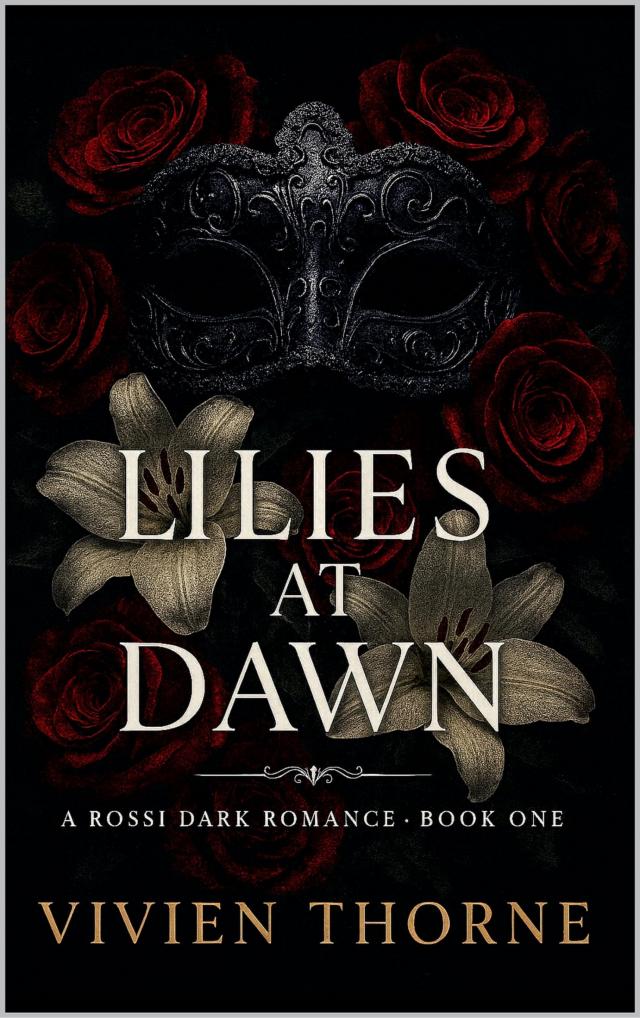


Lilies at Dawn
Vivien Thorne
Copyright © 2025 by Vivien Thorne
All rights reserved.
No portion of this book may be reproduced in any form without written permission from the publisher or author, except as permitted by U.S. copyright law.
Contents
A Note from the Author
1. Chapter 1: A Bride's Sacrifice
2. Chapter 2: Rules of Engagement
3. Chapter 3: Dangerous Desires
4. Chapter 4: Blood and Roses
5. Chapter 5: Gala of Betrayals
6. Chapter 6: Poisoned Petals
7. Chapter 7: Whispers and Shadows
8. Chapter 8: The Old Fox's Gambit
9. Chapter 9: Seduction and Strategy
10. Chapter 10: Betrayal's Kiss
11. Chapter 11: Secrets and Lies
12. Chapter 12: Dance with the Devil
13. Chapter 13: The Lily's Thorn
14. Chapter 14: Echoes of the Past
15. Chapter 15: Queen's Gambit
16. Chapter 16: Brothers in Blood
17. Chapter 17: Shifting Tides
18. Chapter 18: Thorns and Roses
19. Chapter 19: Vows Renewed
20. Chapter 20: Empire of Two
Letter to Readers
A Note from the Author
Dear Reader,
Welcome to the Rossi world—where vows are dangerous, devotion cuts deep, and dawn doesn’t come without a fight. If you’d like first look at covers, early release news, and snippets from behind the scenes, I’d love to keep in touch.
Join my Dark Romance Insider List:
subscribepage.io/B11hcg
What you’ll get: release alerts, cover reveals, occasional offers, and notes from me about the stories I’m building—always consent-forward, always focused on fierce heroines and protective, morally gray men.
No spam. Unsubscribe anytime.
Thank you for taking a chance on Lilies at Dawn.
With gratitude,
Vivien Thorne
Chapter 1: A Bride's Sacrifice
In the heart of Manhattan, where the glitzy shimmer of opulence met the grim underbelly of power, Isabella Moretti was being chauffeured through the fading twilight. The city, once a roaring beast, was now a purring kitten, its energy subdued yet palpable. As the scent of burnt rubber and hot pretzels wafted in from the cracked window, Isabella felt a familiar thrill prickle her skin. She was a duchess amongst mobsters, her uncle's favorite chess piece in this high stakes game of urban warfare. The scent of intrigue was rich, almost palpable, and it clung to her like an exotic perfume as she readied herself for the chess game that lay ahead. Her sedan – sleek as a panther and just as deadly – was approaching Rossi territory. There was an unspoken rule in these parts: when you crossed Eighty-Third Street, you were either predator or prey. Tonight, Isabella intended to be neither. A new game of power was about to unfold in this city of shadows.
“Window, Signora,” the driver muttered in his countryman’s dialect, as if warning her to hold her breath.
She did. Her window shuddered down; outside air brought the scent of hot concrete and the ozone tang of oncoming storm. The guard’s eyes, in the slit above his mask, skipped over her face with forensic indifference, then swept the interior. His gaze landed briefly on the slim envelope clutched in her lap, the filigreed “M” stamped into the wax seal. He gestured for her driver’s identification, which was produced with practiced slowness and passed outside. Another armed silhouette took up post at her rear quarter, blocking any thought of reversal.
For a moment, nothing but radio static—then the guard’s voice, low and oddly intimate: “Proceed to the main gate. Slowly.”
The driver’s shoulders eased minutely, but Isabella kept her spine rigid, the steel boning of her Akris dress digging into her ribs. The dress was graphite silk, the color of old bruises, its neckline severe and its hem tailored for movement. “Movement,” in this case, being as likely a frantic sprint as a composed promenade. Fashion as armor, she thought. As delusion.
The sedan crept forward. Each incremental checkpoint materialized from the gloom with clockwork inevitability: new faces, new weapons, new sensors. Cameras tracked her vehicle with unblinking, mechanical interest. Isabella counted at least four disguised as bronze garden torches and another pair hidden in the stanchions of a wrought-iron balustrade. The air here was humid, too lush with roses and boxwood to be real, and the sweet rot of old money lingered beneath.
A female guard at the third checkpoint bent her head to the window. Her accent, Milanese, clipped and professional. “Phones and electronics, Signora. In the basket.” She held up a lacquered tray as if presenting amuse-bouche.
Isabella retrieved her phone, an old Cartier cigarette case that currently held a burner SIM, and a lipstick tube whose true contents would be of interest to only the most chemically-inclined. She placed them in the basket and smiled, just enough to let the guard know she’d noticed the faint scar bisecting her left eyebrow. The guard smiled back, perhaps for the same reason.
Another thirty meters, and the Rossi mansion at last imposed itself on the horizon—a baroque monolith, all balustrades and neoclassical fury, its windows burning yellow against the indigo city. The perimeter wall was nearly three stories in some places, studded with razor-filigree and the occasional crest, a theatrical testament to the ancient urge to keep the world out and family secrets in.
At the final gate, two men in charcoal suits flanked the portcullis. Their posture—hands at their sides, feet shoulder-width—broadcast private military, not mere hired muscle. The elder of the two wore a signet ring crusted with diamonds. The younger’s tie bore a minuscule, almost invisible bloodstain. They both studied her as though expecting her to leap from the car in a spray of gunfire and invective.
“Ms. Moretti,” the elder said, opening the rear door before the car had stopped. He bowed from the waist. “Onore di averla con noi.” His Italian was flawless, but Isabella noted the American inflection on the terminal vowels.
She slid out, feeling the city’s night air as a slap against her bare arms. The elder’s hand remained extended for a millisecond longer than etiquette demanded; he wanted her to see the ring. She did.
“Valentino will take your effects,” he said, nodding to the other guard, who gently relieved her of the envelope and offered a black velvet tray for any other contraband. Isabella acquiesced, though not without running her thumb along the envelope’s edge—just enough to slice a microscopic sliver into her skin. If the Rossi’s had any intent to chloroform or otherwise incapacitate her, it would be nice to leave a fragment of DNA behind.
“Thank you, gentlemen,” she said, her English starched and precise. “Shall we?”
Inside the gates, the drive twisted through manicured gardens, each leaf and petal so precisely arranged that it broadcast not beauty but domination. She saw no fewer than three additional guards walking the grounds, their movements casual only to the truly unobservant. Two of them wore ear-pieces; one had a gun bulge so obvious it bordered on theatrical.
As they ascended the stairs to the main entrance, Isabella catalogued points of escape. The windows were shatterproof and rimmed in something faintly metallic—possibly smart glass. The banisters, while decorative, could support the weight of a person in flight. Most promising was the servant’s entrance she glimpsed at the western end, a passage that led, in all likelihood, to kitchens and staff quarters. Two cameras covered it, both hidden in the pupils of cherubic statuary.
She filed all of it away. The mansion was a fortress, but even fortresses grew brittle from within.
The foyer doors, massive oaks reinforced with brushed steel, opened with a smooth hydraulic hush. The threshold was cold marble—Botticino, if she wasn’t mistaken—scrubbed to a luster so flawless she could see the reflection of her own legs, cut to mid-thigh and pale as poured cream.
The entry hall was vast, a cathedral for the worship of excess. Its ceiling soared, ribbed with gold leaf and scattered with chandeliers shaped like constellations. The air inside was tempered to an almost subcutaneous coolness, and over the undertone of ozone was a base note of expensive cologne—oud, musk, and something distinctly masculine.
A pair of house staff waited, both dressed in the sort of livery that cost more per month than a graduate student’s rent. One, a woman with the angular face of a Renaissance Madonna, stepped forward to relieve Isabella of her outer coat. The other, a young man with eyes the color of dried lichen, offered a silver tray of amuse-bouche and stood, wordless, as she declined.
Isabella’s guide—one of the suited gatekeepers—walked two paces behind her now, his presence more suggestion than escort. He pointed down a long, arched corridor but said nothing, as though the house itself had authority enough to direct her.
They moved past a series of rooms designed to impress and subdue: a library where the leather bindings glared down like so many centuries-old judges; a music room with a Steinway grand and the faint aroma of polished ivory; a salon draped in damask so heavy it seemed to muffle all ambient sound. At each threshold, Isabella scanned for escape, for soft spots, for any detail that might betray the building’s vulnerability. She noticed an air duct large enough for a child, a triptych of windows that bowed outward just enough to be leveraged, a subtle line in the wallpaper that suggested a hidden door.
At a final corridor, her guide stopped. “Wait here,” he intoned, and withdrew.
She was left in a vestibule ringed with oil paintings—portraits of past Rossi patriarchs, each more leonine and cold-eyed than the last. The sensation of being watched was both literal and architectural. Isabella let herself lean against the cold marble, only for a second, feeling it leech the heat from her skin.
Above her, the house sighed, settling into itself.
She considered the fact that, at any moment, a Rossi could appear, armed with either charm or bullets or both. She thought of the history between their families—how the only thing thicker than blood was the vendetta that had clotted for a generation. She thought, too, of her own family, the Morettis, and how her mother’s voice on the phone that morning had been all trembling steel: “Remember, Isabella. A fortress is only as strong as the woman inside it.”
And so she waited, spine straight, every sense sharpened to a razor’s edge.
Her dress, her armor, held her together. She catalogued every shimmer of glass, every flicker of movement in the mirrors, every distant footstep in the mansion’s hallowed arteries.
If she had to run, she’d already mapped the first two turns, the emergency exit by the conservatory, and the quickest way back to her car. But for now, she stood, prepared to meet whatever hell the Rossis had choreographed for her next.
And as the hour stretched, and the house’s pulse became indistinguishable from her own, Isabella Moretti smiled—catlike, closed-lipped, and hungry.
Let them come.
When the silence finally broke, it was a woman’s footsteps that announced the return: quick, precise, and unhesitating. The staffer who reappeared wore a uniform so sharp it seemed to have edges. Her eyes were opaque brown, the color of good port. “Miss Moretti,” she said in accented English. “You’ll come this way, please.”
It was not a question.
Isabella followed, the hem of her dress sliding whisper-slick along her thighs, each step deliberate. The vestibule opened onto a corridor wide enough for four abreast, though the two guards who materialized to flank her kept a corridor’s worth of distance. They carried no visible weapons, but Isabella could smell the cordite and cleaning solvent on their sleeves, sense the subtle crackle of violence beneath their impassive faces.
The corridor itself was an object lesson in dynastic ambition. Chandeliers dripped like tears from the ceiling, hundreds of hand-cut crystals refracting even the weakest bulbs into liquid gold. The walls were paneled in walnut, the kind of ancient, oiled wood that drank the light rather than reflected it. Along the route, Isabella clocked at least six paintings, all Renaissance masters or credible forgeries. One, a Madonna and Child with dark Italian faces, had been stolen from a Tuscan monastery in ’86—a fact she knew because her mother had quietly brokered the insurance settlement. Another, a Caravaggio half-shadowed in dramatic chiaroscuro, featured a slyly inserted likeness of a Rossi patriarch as a penitent saint.
Not for the first time, she felt the queasy vertigo of history folding in on itself. The Moretti and Rossi families had been trading in blood and masterpieces for centuries; this house was merely the latest reliquary.
Her escort’s shoes were soundless against the inlaid floors. Isabella’s own heels—Louboutin, patent, ruthlessly high—made a precise staccato that seemed, perversely, to amuse the guards. One of them, the larger, with a neck like a Roman column, flexed his jaw as if remembering the taste of her name.
They turned left, then right, the path sinuous and intentionally confusing. She recognized a few architectural tricks: narrow sightlines, offset doorways, mirrors hung at calculated angles to defeat depth perception and, more importantly, to monitor movement. In a hallway lined with antique display cases, she spotted a vase—Ming dynasty, though Isabella privately doubted the authenticity—set at eye level between two security domes masquerading as rococo sconces.
All the while, the scent of the house deepened: the resinous polish of old wood, the mellowing fumes of whiskey and cigar, and, beneath that, a note of something feral. Male sweat, possibly. Or just fear. These were the olfactory signatures of power, and Isabella inhaled them with a mix of loathing and arousal.
They passed a drawing room where men in tailored suits clustered around a poker table, their laughter muffled and suspiciously polite. She caught a glimpse of hands—expensively manicured, but with the pale crescent scars of old knuckles—and she wondered which of these minor lieutenants would be the first to test her boundaries. She filed away the detail for later.
At every intersection, her procession was surveilled: by discreet domes in the corners, by motion sensors embedded in the baseboards, by the omnipresent gaze of Rossi ancestors whose portraits lined every passage. One door, lacquered and inlaid with mother-of-pearl, had a biometric pad disguised as a decorative plaque. The finger-smudges on its periphery were all slightly different, and Isabella mentally pictured the ranking order of the family encoded in those oily little ridges.
After what felt like a deliberate maze, her escort led her to a small vestibule, domed and echoing, with a floor tiled in black and white marble. Here, her two guards peeled away, vanishing with an efficiency that made her skin prickle. The staff woman gestured at a gilded sofa, then vanished through a side door without a backward glance.
The room was empty but for her and the ghosts of expensive taste. She sat, refusing to let the sofa’s icy surface startle her. From her vantage, she could see the thick glass of the windows, the way the grilles divided the night outside into manageable rectangles. She traced one with her finger, counting the seconds it would take to shatter and leap. Not that it would do her any good; this high above the street, escape meant broken bones or worse.
A grandfather clock ticked somewhere in the house, a metronome marking out her enforced patience. She flexed her fingers, still aware of the paper cut from the envelope, and let herself imagine the next steps: an audience, a confrontation, a reckoning.
She smelled him before she heard him: oud, tobacco, and the faintest suggestion of muskiness, as if he carried a memory of rain into every room. The realization hit her with a visceral clarity—Matteo Rossi was inbound, and all the velvet and gold leaf in the world would not soften the violence of his approach.
Isabella smoothed the skirt of her dress, licked her teeth, and prepared her smile.
The real show, she suspected, was about to begin.
The first sign of him was the echo—a new gravity in the hall’s acoustics, the air thinning as if to make space for something heavier than bone and muscle. Isabella didn’t rise when he entered. She’d learned, years ago, that standing was a concession, a way of admitting anticipation. So she waited, motionless, and let him come to her.
Matteo Rossi was taller than legend had prepared her for. His suit—charcoal, three-piece, handmade—fit like a sentence with no room for appeals. The fabric hugged a body built for neither boardrooms nor battlefields, but for the precise overlap where those two terrains met and bled. His hair was black as last rites, slicked back in the style favored by old Rome and young wolves. When he walked, it was with a deliberate restraint, as if the corridor itself might break under the weight of his stride.
He stopped three paces away. For a moment, he looked not at her but at the room, as though taking inventory of its contents—chandeliers, marble, the afterimage of her perfume hanging in the air. When he finally fixed his gaze on her, Isabella felt it in the lining of her lungs.
He said nothing, but let the silence pull taut. His eyes were glacial, but not cold—more the color of sea glass, illuminated from beneath by some private, shifting weather. They passed over her face, slow as a surgeon’s hand, then made the predictable circuit: neck, shoulders, down the curve of her body to where her legs were crossed, and then back up, with a faint, almost imperceptible curl of the lip.





