

Gallaghers glacier uc, p.1
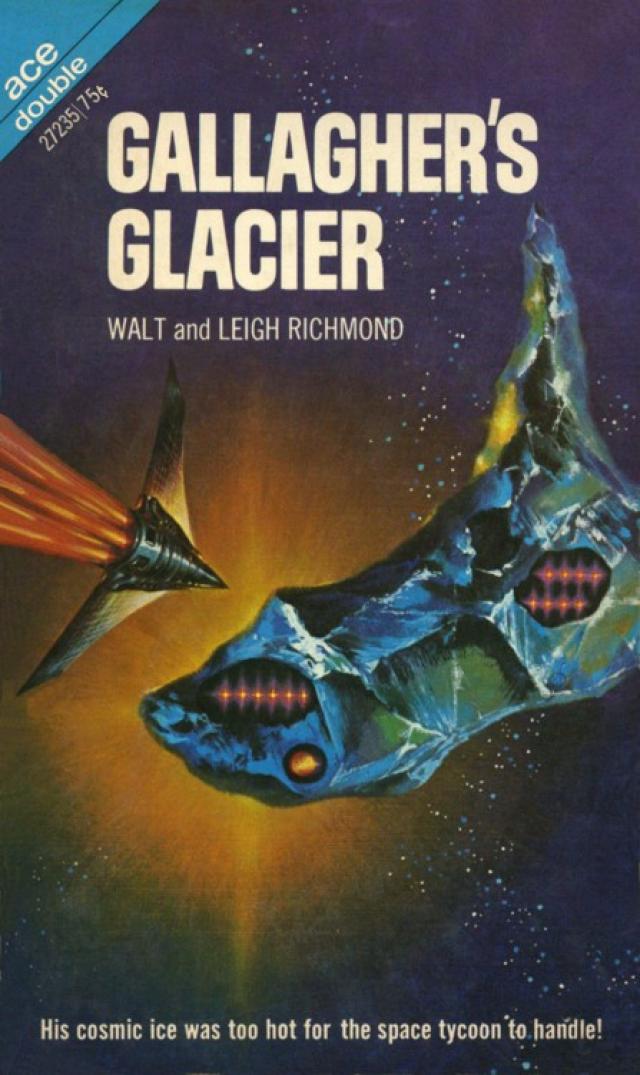
Gallagher's Glacier (UC),
p.1


Scanned by Highroller.
Proofed by .
Made prettier by use of EBook Design Group Stylesheet.
Gallagher's Glacier by Walt and Leight Richmond
I
It's hard to tell whether men make history or history makes men.
One example is Gallagher and his glacier. One might say that he changed history, or one might figure that history would have changed anyway and that he just happened to be in the right spot at the time. I wouldn't know. But he was a colorful character; history needs its Paul Bunyans.
When men first went into space, mortality was high, but the corporations survived. When men die as independents, that's that; but when they're representatives of a corporation, the corporation can replace them with more men, and the corporation stays alive.
People begin to think that only corporations belong in space and act accordingly. Soon space is tied up in blue corporate ribbons, and it's no longer a pioneering venture. Then a man doesn't stand so tall, and the colonies learn to obey corporate rules.
That was the way things were going. But the corporations had one drawback: they tended to employ bright young technicians, like me, with much education and very little know-how. In space, what one really needs, experience has taught me, is what some people call horse sense. One needs the ability to translate what is in a book into what makes sense in the concrete situation.
That kind of man, though, isn't the kind the corporations can hire, even when they want to. That kind of man is almost always an independent.
From this, frictions arose.
One might think that space is big enough so that the bright young men of the corporations, with their seeming-ly endless replacements, and the independents that managed to survive after all would not be at odds. But, though space is big, the meeting places are common to both groups, and the frictions are real.
The independents that survived had the horse sense, or know-how, which was a needed thing on the planets. The corporations could send in all the bright young men they liked to control their colonies, but it was the surviving independents that controlled the colonies that paid off.
The corporations controlled the ships, and they were push-button ships in those days. One didn't need horse sense. It took a great deal of cash to buy a ship and a great deal of equipment to build one. As far as anyone could see, it would be a cold year in hell before the independents could master their own fleets and break the hold of the corporations. So maybe it was Gallagher and his glacier that changed the times, and not the times that fitted Gallagher.
A pioneer goes out into the unknown and solves problems as he meets them. In that respect Gallagher was a pioneer. He had all the degrees of an engineer, but also an incurable wanderlust. His name was black in the company books, for he'd jump a ship or stow away out of a colony as soon as sign the papers.
Just before I met him, he sat, mostly in Joe's Bar, waiting for a ship to berth that was setting a course the way he wanted to go. How he was planning to sign on, with his record, he would not say.
But when my ship orbited, heading for Altura, there was a series of incidents that left my engineer in the hospital. At the same time I got the news of the "incidents," Gallagher presented himself with a piece of paper.
"Your next port is Altura, Captain Harald Dundee," he said. His name was N. N. Gallagher, and they called him Dublin; it was a pun and a reference to his origin. He was more than six feet tall, his red hair nearly brushing the roof of my cabin, and making me feel small and insignificant despite my fine uniform, for I clear the ceiling by a good four inches. "And," he said, "ifs toward Altura I'm headin'. Now, seeing as it's not rightly your fault you're minus an engineer for the course, I'll take on the job without much cost to you. There's a glacier," he said, "that's moving towards Altura. You can compute to intersect her within three hours of your port. I'll take on your engineer's post that far and charge you nothing, if you'll put me aboard the glacier with my equipment. Your assistant engineer can take the ship from there."
I was a young man then, and it was my first command. I went by the book, and I didn't like the proposition. I didn't even really believe it, though there wasn't anything about it to disbelieve. I had heard that, though Gallagher might be footloose and black in the books, he could engineer a ship like the angel of machines.
I turned him down with a coldness that would have been an insult, if he'd been looking for one. I told him curtly that I would have no part of horsetrading engineering for passage.
He turned on his heel and left with a half smile. Within two hours I knew what that half smile meant. There wouldn't be another engineer available in that port. I soon found I could knuckle under, or wait until the next ship through brought me an engineer and forget the tight company schedule on which I was operating. I swallowed my pride and started to send a messenger to get the man back. Then I thought twice and put on my best uniform, to make my way into the port town. If he refused the messenger, I would have to go to him or run late with the company; he knew a young man with his first commission could not afford to run late.
I also went unaccompanied, though the custom was for not less than three to go ashore together in any space port. I headed for Joe's Bar, and though I could spy his red hair from the entrance, I pretended not to see him and sat down three stools away.
I drank the first two drinks slowly and saw from the corner of my eye that Gallagher paced me drink for drink. Then I spoke aloud to the bartender, and I called him Joe, though it was not his name.
"Joe," I said, stumbling over the words just a bit to show I'd been consuming, "my ship's out there with the sweetest motors that all the technical brains of Earth could put into her. These guys they call engineers are just racketeers," I said loudly. "There's not a thing they can do to a motor to make it purr more sweetly than the designer intended. They just figure to go along for the ride; it don't take a man to push the buttons."
By the time I'd finished, red hair was standing on end and there was no pretense as to whether Gallagher was listening. He gulped a couple of times and bit his tongue. When he finally spoke, it was in a soft brogue, and he had his temper where he wanted it, pushing from beneath but not pulling ahead.
"Mister," said Gallagher, "or perhaps I should say Captain—though button pushers never seemed to me to rate that title—you show me the drive that I can't tune, and I'll pay you the privilege of shipping me as engineer for three times five ports and not jump your ship. There's not a drive operating in a company ship since the corporations took over the shipping lanes that couldn't stand the touch of Gallagher and fly so much sweeter because of that touch that even her imbecile master would be forced to admit it, though it cost him his pride, if he had honor to boot."
No man impugns my honor, and I was on my feet looking up into his grinning Irish face with my fists doubled.
"Sit down, Captain," he said quietly. "Let's talk this over, for it was a good ploy, and it's got me aboard the Starfire, me and my equipment."
When I found out what Gallagher meant by equipment, I nearly reneged. The holds would take it, but we'd be shipping heavy.
"You'll only be heavy as long as I'm aboard, and I'll have your drive talking so pretty she'll use less mass than if you were running light with anybody else to engineer her," Gallagher said. "Your assistant will only have to take in a light ship, and the motors already purring."
The equipment included one of the old Antolaric drives that used to power the ships they sent out when man first entered space, and it was as massive as the old ships had been. There were also supplies to last a man for months, but those weren't much, and equipment enough to stock a small machine shop.
I was stuck with it, but that didn't make me like it. I liked it even less when he demanded—he didn't ask he demanded, but I ignored the manner of his request— twenty-four hours to work on the drive before we lifted.
When we lifted I didn't begrudge a minute of that twenty-four hours. The Starfire acted like a thing alive, tuned to my every motion. I changed from worrying over what he'd been doing in those twenty-four hours to worrying whether the changes in the engineering setup could be justified to a port inspection engineer, even though the results were such as captains dream of. Port inspection engineers are the brightest of the bright young men, and I knew my breed and its shortcomings. The drive wasn't tuned by the book; it wouldn't pass.
I didn't understand Gallagher, but I knew him for a breed that caught at my heart, for we were both from the "old sod" and we were both out in the new space-ways, though he was an independent and I was a corporation man.
I understood the man even less when we matched courses with his glacier and I had him and his equipment drifted over to it. It couldn't have been more than a mile the long way and a quarter mile through, an ungainly hunk of ice idling through space. What the man could want with it was more than I could see. There were plenty of steel meteors that size, if Gallagher wanted to make himself a meteor ship, and I admit that seeing his old drive was the first inkling I'd gotten of such a use. Then I realized that a steel meteor wouldn't have given him reaction mass for his fusion chamber, but the ice contained ample hydrogen, and that would be his mass.
We blasted on for Altura. There I spent my best wiles and the finest whiskey I could buy on the port inspection engineer, but to little avail. That ship had to be retuned before we blasted again, and he wouldn't even test it with me so I could let him handle a ship when it was tu
ned the way the Starfire was. He had a few cutting things to say about what would be in my records for letting a man like Gallagher manhandle my drive.
I spent the first planet-bound days wandering the company town and sitting in the port bar. By the end of the first day I was so furious with Gallagher that I was making up conversations with him, telling him off. Also, I was curious. I couldn't figure how he was going to manage the job alone; I had to see.
By midnight I'd rationalized myself into good reasons: the man was daft, he was alone on an iceberg, drifting helplessly in space, and by now he'd have realized how helplessly. I told myself that the least I could do, now that his senses had had a chance to reorganize, was to offer him an oiler's job to get him out of the mess he'd talked himself into. I wouldn't leave a dog alone out there, I told myself. I owed him a chance to get off honorably.
I rented a small interplanet scout and headed for (Gallagher's glacier.
What I expected to find I'm not sure. What I found was the glacier, lonely and sparkling cold. I could make out Gallagher's vac-suited figure working on its surface as I matched orbit two kilometers off.
Since he was on the surface and in a vac suit, I hailed him over the ship's suit comm, but he failed to answer. I maneuvered the scout closer, seeking a place to tie up. That's when I got an answer.
"Sheer off, you lunkhead," came his voice. Til not have you upsetting my balances here."
I was readying a tart reply when he went on. "Anyhow, this is already claimed."
"Okay, Dublin," I said. "If you're too proud to let your former captain see the mess you've got into, I'll be heading back to port. I was just being sociable anyhow"
The figure stood and waved, and Gallagher's tones, hardly less gruff than before, came back over the suit comm. "Neighborly of you, Captain. Take her around on the far side and hitch up to a mooring line, but gently, mind you. I'll still not have you upsetting my balances."
I could not see what he had in mind about balances, but I eased the scout around to the far side. That's when I got my first good look at what Gallagher had been doing.
There was a bubble dome anchored firmly to one of the smoother parts of the big ice chunk and a half-dozen standard Bourdon mooring tubes, long, snaky pipes of plastic inflated with gas, that extended out from the surface and to which various "dumps" had been attached. The bubble dome was normal equipment for airless planetary living and the mooring tubes were normal, if they were attached securely to the iceberg.
I hesitated before mooring to a vacant tube. I decided to moor and keep an eye on the scout. If it pulled the line loose and started to drift, I could catch it in the first few minutes with the rockets on my suit.
I nudged up to the tube and was rewarded with the hollow clink of a magna lock. The line was a good kilometer long, but I could see a tiny shuttlebug start its whirring way up the mooring line, so I'd have fast travel going in. The response was fully automatic, keyed to the impulse of the magna lock. Gallagher, I decided, was doing better than might have been expected.
While I waited, I looked over the cargo dumps attached to the other tubes; there was nothing but the things we had left, of course. The Antolaric drive was not moored to a tube, but carefully stanchioned directly at the far end of the berg itself, lined up with the balance point of the berg, as though it were nudging the glacier from behind. I asked myself sarcastically, Is he planning to push the damned berg to the nearest planet? It won't work that way, I assured myself; a drive is internal to a ship. But I had a haunting feeling that maybe I was missing something; the memory of the Starjire's tuning was fresh upon me.
The shuttlebug arrived and I reached out to grasp the awkward thing. I gave the trigger a nudge and got the giddy sensation of being thrown forward at nearly half a gee as the tiny electric motor whined along the semi-geared tracks. The acceleration was brief, and I seemed more to be floating than actually riding a conveyance as I descended towards the glacier.
The glacier below me was a panorama, nearing rapid-ly. As I neared, I could make out curious black spots, huge black spots. They were probably radiator surfaces, but I wondered how Gallagher had spread radiators directly on an ice surface and how he had handled a standard radiator surface by himself at all.
I postponed my curiosity. I'd have at least an hour or so to inspect what had been done while Gallagher made his way around the glacier, and I did not intend to waste the time.
But as the shuttlebug threw me into deceleration for the landing, I saw a suited figure emerge from the bubble dome near the terminus and wave to me.
"Welcome aboard, Captain." The voice over the intercom was Gallagher's. Most voices one can't recognize over an intercom, but Gallagher's is different; no intercom can cover his particular tonal quality. How he'd gotten there so quickly I didn't know. One couldn't have walked that distance on the skin of a metal ship, much less on the surface of a glacier with whatever cramp-ons or ice locks he'd dreamed up to keep him from drifting off the berg.
"Hi," I said weakly. "About ready to give up this foolishness?" It was too late to change my rationale now, though it did sound silly, considering the efficiency with which he'd got his equipment secured and gotten ready to go to work.
"I rather thought you'd come because you were ready to give up your foolishness," he replied. "Have they got the Starfire back to its sluggish norm yet? Independent Spaceways, namely me, can use a good navigator. Glad you're volunteering."
I could feel myself getting red. I was glad I was in a vac suit and he couldn't see it. I kept my voice calm and merely said, "You seem to be handling the initial stages okay. But maybe you've had some second thoughts."
I dropped from the shuttlebug and, as my feet touched the ice, I was surprised to find that the electret shoes of my suit gripped it quite satisfactorily. I hadn't expected the electrostatic field to work on ice, even though I could see Gallagher had no gripping problem.
He laughed and led me to the bubble dome, and, as we unhelmeted in the air lock, I put my foot in my mouth again. "Who's working on the far side of your berg?" I asked. "I saw somebody in a vac suit there as I came in. I thought you were alone."
He didn't answer at once, but just opened the inner door. There, leading from the far side of the dome was a yawning shaft going straight down into the ice, with a shuttlebug hanging in its mouth as though it was just as logical to use one inside a ship as out.
"Just me and my bugs, Captain," he said grinning.
"Bugs?" I glanced sidewise at Gallagher and then back at the hole. "Shuttlebugs I understand, but tunnels like that? Why, it would take a man a month to dig a tunnel like that through a berg like this."
He nodded solemnly. "Aye, you're right, Captain. But I didn't mean just shuttlebugs. Most of the cargo you landed me here with was bugs of one kind and another." He pointed to an odd-looking, circular, metallic device lying against a wall of the dome. "There's one of the bigger ones there."
I walked over and looked at the thing. It had a rim which I judged would just fit inside the tunnel; in the center of the rim was a rotating nose with a screw thread on it. It made about one turn every two centimeters, I decided. I looked more closely at the rim and saw that there were ridges so that if it were passing through ice it could slide easily forward, but could not readily turn. The rim itself seemed to be of two different materials, with a leading edge of metal and a ten-centimeter trailing section of plastic that matched the shape, including the grooves.
"Quite a fancy gadget," I said, "but how can a thing like this drill through ice? That nose with the screw thread on it doesn't look very sharp, and certainly there aren't any teeth here." I pointed to the surface between the protruding screw nose and the rim.
"Careful, it's hot," Gallagher said. The idea of the machine clicked into my mind as an operating device. The surface was sensibly hot. The screw would be heated too; and, if you turned it nose-first against a piece of ice and gave it a shove, it could probably melt its way rapidly in and then get hold and keep going. A sievelike mesh that formed the metallic surface between the rim and the spinner screw would take in water, I realized.
"Clever," I said. "Is it self-programming?"


