

One way street and other.., p.1
One-Way Street and Other Writings,
p.1
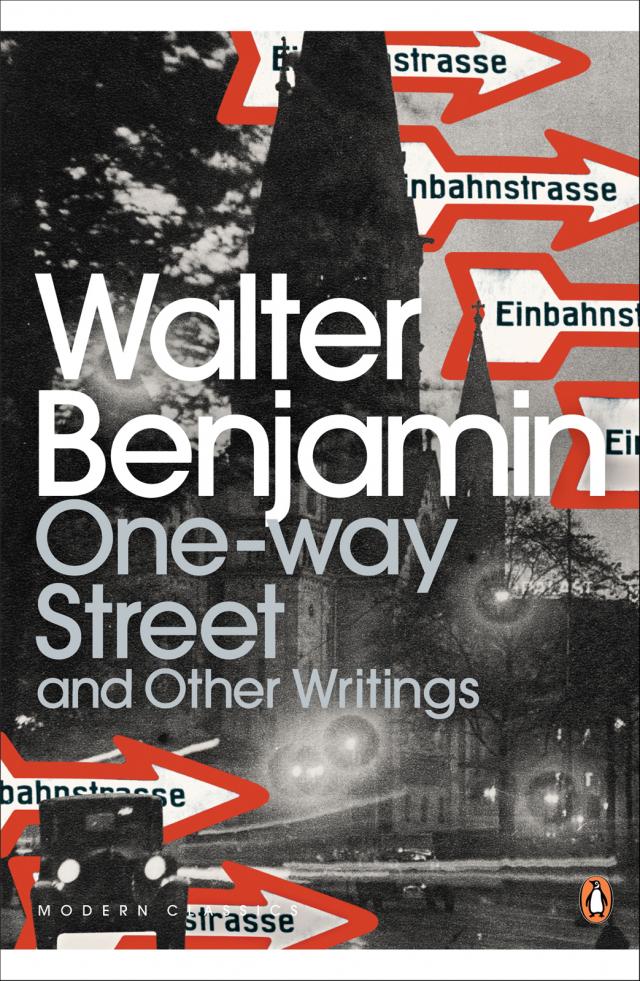


PENGUIN MODERN CLASSICS
One-way Street and Other Writings
Walter Benjamin was born on 15 July 1892 to a German-Jewish family in Berlin. He was educated at the Albert Ludwig University in Freiburg and the Friedrich Wilhelm University in Berlin. Benjamin considered himself a ‘man of letters’ and a literary critic; he shied away from the more formal title of philosopher. An essay on Goethe’s Elective Affinities published in 1924 earned him swift recognition but he struggled to find a position to support himself and build on its success. In the period between 1925 and 1933 Benjamin maintained a meagre living as a literary critic, translator and freelance writer for journals and magazines. During this time he met a number of left-wing intellectuals and befriended among others Bertholt Brecht and Theodor Adorno. When the Nazis came to power in 1933, Benjamin fled to Paris and became a prominent critic of Hitler’s regime. Paris served as an inspiration and it was during this period that he wrote some of his most influential essays and articles for literary journals, working on his immense study of nineteenth-century Parisian life known as The Arcades Project (which was posthumously published in unfinished form). Following the Nazi invasion of France Benjamin attempted to escape to the United States where a visa had been obtained for him. Trying to get through to neutral Portugal, Benjamin was prevented from crossing the Spanish border and committed suicide on 27 September 1940.
J. A. Underwood celebrates forty years as a freelance translator from German or French this year (2009), during which time he has been privileged to translate or retranslate books by a wide variety of authors including Elias Canetti, Jean-Paul Sartre, Franz Kafka, Alain Robbe-Grillet, Sigmund Freud, and now Walter Benjamin.
Amit Chaudhuri is a novelist, poet, critic and musician.
WALTER BENJAMIN
One-way Street and
Other Writings
Translated by J. A. Underwood
with an Introduction by Amit Chaudhuri
PENGUIN BOOKS
PENGUIN CLASSICS
Published by the Penguin Group
Penguin Books Ltd, 80 Strand, London WC2R 0RL, England
Penguin Group (USA) Inc., 375 Hudson Street, New York, New York 10014, USA
Penguin Group (Canada), 90 Eglinton Avenue East, Suite 700, Toronto, Ontario, Canada M4P 2Y3
(a division of Pearson Penguin Canada Inc.)
Penguin Ireland, 25 St Stephen’s Green, Dublin 2, Ireland (a division of Penguin Books Ltd)
Penguin Group (Australia), 250 Camberwell Road, Camberwell, Victoria 3124, Australia
(a division of Pearson Australia Group Pty Ltd)
Penguin Books India Pvt Ltd, 11 Community Centre, Panchsheel Park, New Delhi – 110 017, India
Penguin Group (NZ), 67 Apollo Drive, Rosedale, North Shore 0632, New Zealand
(a division of Pearson New Zealand Ltd)
Penguin Books (South Africa) (Pty) Ltd, 24 Sturdee Avenue, Rosebank, Johannesburg 2196, South Africa
Penguin Books Ltd, Registered Offices: 80 Strand, London WC2R 0RL, England
www.penguin.com
‘On the Critique of Violence’ first published 1921; ‘The Task of the Translator’ first published 1923; ‘One-way Street’ and ‘Hashish in Marseille’ first published 1928; ‘Picturing Proust’ and ‘Surrealism’ first published 1929; ‘Unpacking My Library’ first given as a radio talk 1931; ‘Brief History of Photography’ first published 1931; ‘Franz Kafka’ first published 1934; ‘The Work of Art in the Age of Mechanical Reproduction’, ‘Franz Kafka’ and ‘Picturing Proust’ first translated and published as The Work of Art in the Age of Mechanical Reproduction in Penguin Books 2008
This selection and translation first published in Penguin Modern Classics 2009
Translation copyright © J. A. Underwood, 2008, 2009
Introduction copyright © Amit Chaudhuri, 2009
All rights reserved
The moral right of the translator and introducer has been asserted
Except in the United States of America, this book is sold subject to the condition that it shall not, by way of trade or otherwise, be lent, re-sold, hired out, or otherwise circulated without the publisher’s prior consent in any form of binding or cover other than that in which it is published and without a similar condition including this condition being imposed on the subsequent purchaser
ISBN: 978-0-14-193227-9
Contents
Introduction by Amit Chaudhuri
On the Critique of Violence
The Task of the Translator
One-way Street
Hashish in Marseille
Picturing Proust
Surrealism
Unpacking My Library
Brief History of Photography
Franz Kafka
The Work of Art in the Age of Mechanical Reproduction
Notes
Introduction
One must begin, as Susan Sontag did in her great essay ‘Under the Sign of Saturn’, by looking at photographs of the man. This is because, despite our curiosity and ardent interest, we know relatively little about him, and the little we know is too familiar. So we go back to the man himself, to the likeness – as we sometimes study the faces of those whose lives were interrupted early, to see what they can tell us. Sontag notes that Benjamin, in 1927, at the age of thirty-five, is, with his ‘high forehead’ and ‘mustache above a full lower lip’, ‘youthful, almost handsome’. His head is lowered in this picture, and ‘the downward look through his glasses – the soft, daydreamer’s gaze of the myopic – seems to float’, believes Sontag, ‘off to the lower left of the photograph’. In a picture taken after about ten years, though, Sontag finds ‘no trace of youth or handsomeness… The look is opaque, or just more inward: he could be thinking… or listening… There are books behind his head.’
Two things strike a chord in Sontag’s summation, although it takes a long time to grasp what they are. The first is the portrait of the intellectual – in this case, Walter Benjamin – as contemporary, and contemporaneousness being a quality (bestowed on him by death) at once tragic and optimistic. Despite losing his ‘youth’ and ‘handsomeness’, Benjamin will never grow old, and we are always subliminally aware of this: Benjamin, thus, never forfeits his curious unworldliness – he never settles into success or hardens into conservatism, never disintegrates into infirmity or dependence. This contemporaneousness, achieved through both the texture of the work and the arc of the life, is the essence of the photographs, and gives Benjamin, despite – or because of – his strange life, his anomalous, friend-like status in our imaginations. It makes this, in many ways, difficult and complex writer seem oddly accessible.
This brings me to the second thing that Sontag notices almost inadvertently: the recognizability proffered by the photographs. Sontag does not approach the man in them as if he were a stranger; instead, she speaks of him with intimacy. This note of intimacy allows her to draw the portrait within the essay, which elaborates upon a single remark that Benjamin made about himself: ‘I came into the world under the sign of Saturn – the star of the slowest revolution, the planet of detours and delays…’ Benjamin’s ‘melancholic self-awareness’, ironically fortified by his fatalism, draws Sontag out, in this connection, on ‘his phantasmagorical, shrewd, subtle relation to cities’, on his famous flânerie, as a theory and a practice, and even on his ‘slowness’, his ‘blundering’, his ‘stubbornness’:
Slowness is one characteristic of the melancholic temperament. Blundering is another, from noticing too many possibilities, from not noticing one’s lack of practical sense. And stubbornness, from the longing to be superior – on one’s own terms.
In this way, Benjamin is turned, by Sontag, into a familial figure, an obscure relative whom one had largely studied from a distance, and, somewhat peremptorily, thought one knew. There might be a reason for this sense of curiosity and recognition; Benjamin might belong to a family that many of us have a relationship to.
*
When I look at Benjamin’s photographs, I realize now that I, too, experience that sense of recognizability – which Sontag builds her argument around, and uses to her advantage, but does not explain: so subtle and integrated into the personal, into memory, is that register of affinity. When I look at Benjamin’s face, for instance, I realize that I do not see, first and foremost, a ‘Western’ man; I see someone familiar, someone who could also have been a Bengali living at any time between the end of the nineteenth and the middle of the twentieth centuries. Certainly, the ‘high forehead’ and the ‘mustache above a full lower lip’, and especially the ‘soft, daydreamer’s gaze of the myopic’, the features characterized not by nationality or caste but by introspection, gentility, and the privileges of childhood, mark him out as a bhadralok – the Bengali word for the indigenous, frequently bespectacled bourgeoisie that emerged (mainly in Calcutta; but also in the small towns of Bengal) in the nineteenth century. The bhadralok boy was born to well-being and maternal affection, but well-being is not the only connotation of the word: it could denote anything from well-to-do to hand-to-mouth. Almost the only assured possession of the bhadralok was, in lieu of property (since the bhadralok often also comprised East Bengali migrants settled in Calcutta) what Pierre Bourdieu misleadingly called ‘cultural capital’, made material, commonly, in a collection of books (‘There are books behind his head’). I say ‘misleading’ of Bourdieu’s term
What is it that makes Benjamin, for me, so familiar? What is it that converges in the face of a certain kind of Bengali and Jewish bourgeois, a face that is now, to all purposes, a relic? It is a current of history that shaped the late nineteenth and the twentieth centuries everywhere, and brought a particular kind of individual – putatively, the ‘modern’ – into existence. The face of the ‘modern’ belongs to someone who is secular, probably deracinated, and whose face, in place of the old patrician certainties of class, caste, and standing, possesses a new expression of inwardness; the glasses add to the refractedness of the expression. It is a face that inhabits a world in which various cultures are suddenly in contact with one another, and it is a product of that contact; but its inwardness refutes any easy formula – internationalism, miscegenation, hybridity – for how that contact takes place. Both Benjamin’s and the bhadralok’s face, with their look of introspection and contemporaneity, conceal something: in Benjamin’s case, the shame of Jewishness; in the Bengali’s, the disgrace of colonial subjugation. This is what makes the secular Bengali, the secular Jew, political: his or her angularity in relationship to the mainstream. But, unlike today’s post-colonial or proponent of identity politics, the bhadralok is unsure of his own identity: confronting world history has displaced him from his lineage, and his politics extends to a critique of his forebears. Many of us know what it means to occupy such a position, or to emerge from a tradition of individualism, of modernity, inflected by minority; and of minority not being a political certitude, but an experience of ambivalence. This is what makes Benjamin’s face, and its pensiveness, recognizable to us; for a large number of twentieth-century moderns belong to, or are a progeny of, that peculiar, nomadic family. Even Sontag – a Jew, a lesbian – is shaped by world culture in such a way as to permanently complicate, for her, simple affiliations of race and sexuality, and to force her to constantly reinterpret minority; in the end, for the modern, ambivalence becomes identity, and modernity a very specific kind of problem.
What kind of problem is Benjamin pondering in these photographs? I think it is the problem of constructing tradition – his very special approach to which makes him unique in the annals of modernism, as well as integrally a part of it, and also makes him continually resonate for us. That war, capitalism, industrialization, and technology destroyed the unity, the presence, of the European past is a well-worn myth; so, too, is the consequent myth supporting the modernist aesthetic, of revisiting the past, or only being able to revisit it, through the fragment and the moment; to privilege that inheritance less, in a sense, than the talismanic bits and pieces through which it would henceforth be useful – thus, Eliot’s simultaneously resigned but assertive admission in The Waste Land about shoring fragments against ruins. Benjamin himself explored this nostalgia in ‘The Work of Art in the Age of Mechanical Reproduction’: ‘We can say: what shrinks in an age where the work of art can be reproduced by technological means is its aura.’
This account misses how much of what is inadequately called ‘European culture’ was being reinterpreted, in this unprecedented way – a way that destroyed, in effect, traditional historical narrative – by those who, for reasons of race or religion or gender, had no ‘natural’ proprietorial claim to it: that the mode of disjunctiveness, and the problem of constructing a tradition, was not to do with the onset of industrialization alone, but liminality and disenfranchisement: for, say, Jews, Bengalis, and women, both political disenfranchisement and cultural inadmissibility. And so, for example, in Virginia Woolf ’s A Room of One’s Own, the act of perusal, the right to access books (especially in Oxbridge), or, in the case of women, the dismemberment of that right, is directly connected, in an arc, to the act of writing, in a tale of humour and frustration that echoes Benjamin’s ‘Of all the ways of getting hold of books, the most laudable is deemed to be writing them yourself.’ Not only writing them, but, as in the case of Woolf and Benjamin and others, abandoning the safety of a certain mode of telling for disjunctiveness as an entry into a tradition one has no natural right to, but in relationship to which one harbours both a deep kinship and a concealed sense of alienation. ‘The world changed in 1910,’ said Woolf; this is taken to be a reference to many things, including the loosening of sexual mores in Woolf ’s own family; but it could also include a subterranean awareness that the emergence of the disenfranchised ‘other’ – the Jew, the female, the non-Western – was going to be increasingly coterminous with the career of the ‘modern’; and this is one of the principal reasons why, from the prism of modernity, tradition, in a way at once theatrical and exemplary, becomes so difficult to access or even recognize.
*
The Romantic stereotype of the artist and the radical – who, in his propensity for wandering and towards exclusion prefigures, in some ways, the flâneur – is, with his exacerbated individualism, visibly ‘different’: ‘flashing eyes… floating hair’. With the modern, a new and deceptive quality emerges worldwide – normalcy – where difference and even radicalism are formative but implied. The gentleman (literally, the bhadralok: ‘civilized person’), the most characteristic face of normalcy, is the product of a complex contemporary history – to do with secularism, but also to do with colonial history, on both sides of the divide – where all sorts of inadmissible intellectual transactions (between languages, between cultures) are taking place within the domain of normalcy and sameness. It is worth recalling that both capitalism and colonialism generated an administrative class that was crucial to governance but which was disallowed real political power; from this class emerge Kafka’s hapless protagonists as well as the doorkeepers who so bewilder and confound them. ‘Sameness’ and ‘normalcy’ become the mode, then, through which the governed and subjugated – let’s say, Jews and Indians – share in governance through this new class, but are also denied absolute power: the ‘world of chancelleries and registries, of stuffy, shabby, gloomy interiors, is Kafka’s world’, says Benjamin. This, too, is the world that Macaulay intended when, in 1835, he spoke of conjuring, in India, ‘a class of persons, Indian in blood and colour, but English in taste, in opinions, in morals, and in intellect’; an administrative class, predominant within India at first in Bengal, working away in rooms and creating refracted lives of the mind, and reshaping and relocating its difference under the illusion of the normal and the recognizable. The artists and radicals who are the products of this class and history also conceal their marks of departure and oddity, just as those administrative servants do; a safe and conventional (and secular) respectability is the defining air of the Jewish or bhadralok intellectual – indeed, of the modern – a respectability interrogated from within through both the workings of the imagination and, significantly, of radical difference. Baudelaire’s description of the dandy provides a clue as to how this marginal but recurrent type will proliferate everywhere from the late nineteenth century onwards: ‘the burning desire to create a personal form of originality, within the external limits of social conventions’ (my emphasis).





