Brig of war, p.45
Brig of War,
p.45
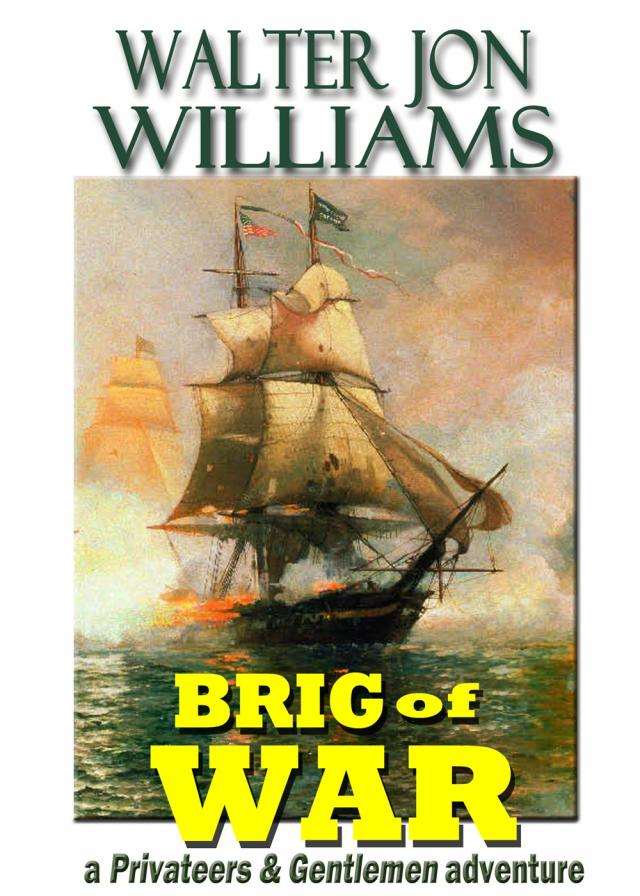


Hibbert’s hand came forward, and Favian clasped it. There was a wordless exchange in the red light, understanding in Hibbert’s eyes. “Detail your men, Mr. Hibbert Everyone else below decks.”
“And a half six!”
They were coming up onto the mud bank. Favian gave the elements one last chance to change their mind as Hibbert prepared the best bower and one of the sheet anchors. Perhaps, on this foul ground, one of the anchors would hold. It was more likely that abrasion with some submerged rock would wear away the cable entirely.
“By the mark five!”
“Stand by!” Favian bellowed. Axemen stood by the weather shrouds, ready to begin their cutting. Favian raised his arm. He could see word being passed aft.
“And a half four!”
“Cut!” Favian roared, and dropped his arm. Axes thudded against the taut backstays. One by one they sprang free. Another rocket shot up, and a false fire burned brightly from the stem. In the white-hot light of the false fire the mainmast went over, toppling into the water with a wooden moan, a torn ruin of hemp, pine, and canvas. Then the fore-topmast toppled, men leaping free. Experiment wallowed in the waves, rocking wildly without the pressure of the sails to keep her heeled over.
“Stand clear of the cable! Let go the best bower!” He had gotten rid of the masts first, before anchoring; otherwise they would have crashed down on deck instead of over the side, probably killing half the crew.
Even as it was, the deck was a litter of broken spars’ and scattered lines. No one seemed to be hurt. The sheet anchor followed the best bower; the cables were veered out. Experiment pitched madly, broken masts grinding alongside. As the strain came on the cables, a titanic sea came aboard, washing her fore and aft. Favian clung, blinded, to the fife rail, feeling the water threatening to tear him free; at last the wave poured aft, and he glanced about him. The two helmsmen were miraculously staying at their stations; Casterburgh had been knocked to his knees, but was struggling blindly to his feet.
“Head for the hatch, boys!” Favian shouted. “No point in staying on deck!”
They ran for it, managing to duck down the aft scuttle before the next sea came aboard. Hibbert was waiting for them; he gave his report in a subdued voice.
“I think we may have lost a few men overboard in that sea,” he said. “Mr. Sprague reports a broken arm.”
“Take a head count. That’ll keep everyone busy for a few minutes.”
“Aye aye, sir.”
“Can you tell if we’re dragging?”
“Not yet, sir.”
“Nor can I. I’ll be in my cabin.”
The cabin seemed as good a place as any to await the end. Experiment was pitching like a mad thing, and Favian knew she couldn’t stand it for long. The anchors would drag, or the cables part. This storm was unbelievable; it must be a West Indian hurricane that had climbed high into the Atlantic before thrashing itself to bits on the New England coast. That was always a danger this time of year. At least Favian could console himself with the thought that British Bermuda had probably been hit a lot worse.
Favian broke out some of his father’s wine he’d been saving for a special occasion, and poured a cup for himself and for the pilot.
“Here’s to the hereafter,” he found himself saying, knowing there was a diabolical grin on his face, a reckless acceptance.
“Amen,” Casterburgh said solemnly, and drank. Favian seated himself in his chair, hearing the little trickles as his wet clothes drained themselves onto the deck. He could feel the little shocks as the anchors dragged, and calculated what would happen when they struck. Stem-first onto the mud banks, then they’d broach-to and probably break in half. The safest places would be clinging to the masts in the lee of the wreck; they would be sheltered from much of the waves’ force there, and from much of the wind. Hibbert knocked, then entered.
“Two missing, sir. Sprague has splinted that broken arm.”
“Have some wine, Mr. Hibbert.”
“The anchors are dragging, sir,” Hibbert said.
“Just so. Have some wine.”
This would make a tidy little story, Favian thought as the wine warmed him: the officers drinking wine in the cabin while Experiment went on the ground. But what else was there to do? he wondered. Nothing at all, nothing but take the little pleasures that remained.
They sipped the wine gratefully, speaking little, until one of the cables parted. It would not be long before the other went as well, and then the end. Favian rose, shook hands with his companions, and said, “Mr. Hibbert, please go forrard and pass the word that the safest place will be clinging to the masts.”
“Aye aye, sir. It has been a privilege.”
“The privilege was mine.”
The other cable parted before Hibbert returned. Favian decided to head for the companionway. He drained his glass. “Will you join me, Mr. Casterburgh?”
“I shall join thee in a moment.” The pilot took off his oilskin hat and began to pray. Favian left him in peace and went forward to the companion.
The first shock tore the rudder from its gudgeons and flung the brig sideways. Favian braced himself in the corridor and went up the companion, ripping open the hatch. A sea poured down into his face; he lurched blindly upward, then ducked as he heard the new launch break free of its lashings and fling itself to leeward. Wreckage scraped against the coamings. There was another roll as the sea lifted the wreck, and Favian was bracing himself in the hatchway with all his strength as Experiment went over on her side, her hull scraping along the mud with a tortured, grating sound; then she swung upright violently, suddenly free of the ground. She’d been hurled clean over the first mud bank, but would soon be on a second.
Favian flung himself out of the scuttle, heading for a pinrail; he seized a length of line and tried to secure himself before the next sea came. Dark figures were scurrying over the deck, pouring up from the fore scuttle, some flinging themselves into the water as they struck out for the masts. The next wave lifted Experiment, boiling over the weather rail, then brought her crashing down onto the next bar. Favian heard timbers breaking. She wouldn’t last long.
More men were on deck, furiously lashing themselves down or peering off to leeward, trying to guess their chances of swimming to the masts. A small figure bolted from the aft scuttle and ran to the shelter of the stump of the mainmast, arms wrapping around the fife rail as the next sea came aboard. Experiment lurched; Favian saw one of the weather carronades break free and hurtle across the deck, a tumbling juggernaut, until it smashed its way through the lee bulwark.
A head popped out of the after hatch; apparently Casterburgh’s meditations had been disturbed. The head popped down as another sea burst over the wreck, then Casterburgh scrambled up with surprising agility and flung himself into the sea. Favian heard a clattering by his foot; a brass speaking trumpet was lolling in the scuppers, torn from its locker. He reached down to pick it up.
“Make for the masts, those who can swim!” he shouted. He saw heads turning on the foredeck. “This is the captain! Make for the masts if you can swim!” he roared. He saw nods.
Another sea tore at the wreck, lifted it, brought it crashing down. The figure at the mainmast fife rail lost his grip, spinning to leeward; Favian dropped the speaking trumpet, reached out, and seized oilskin. He felt his fingernails being torn out one by one— there was no pain yet, but it would come soon enough in the salt water— but he kept his hold, the water receded, and he found he’d saved Mr. Midshipman Stanhope. Favian seized a length of line and began lashing him down.
“Can you swim?” he roared into the boy’s ear. Stanhope, his eyes wide, overwhelmed by the suddenness and completeness of the disaster, stared wildly, then nodded.
“Wait till the next surge, then follow me!” There was slow comprehension, then another nod. The next sea brought grinding, breaking sounds from below; planks were starting everywhere, and the stores in the hold were shifting. Experiment had no life left in her; soon she’d be kindling washed up on the rocks. Favian cast off his safety line, seeing Stanhope doing the same; he timed the seconds between the waves, saw a moment of stillness below the rail, and leaped.
Foam, roaring madness, blackness, wet. His crippled hands struck out, bringing him up; somehow he got rid of his boots. Stanhope was nowhere to be seen. The next wave carried him toward the wreckage of the masts, drifting fifty feet from the wreck, still connected by the lee shrouds. It felt as if he were breathing in pure seawater; he could hear the thundering of his heart above the shriek of the wind and crash of waves.
He saw the fractured mainmast looming overhead like a great broken spear, and lunged for it; he felt a trailing shroud under his hands and seized it. He hauled himself in, then grasped the mast itself. A head swept by and he recognized Stanhope, hands flung up, despair on his face; and Favian reached out again, finding Stanhope’s hair, and gripped. A little of such purity goes a long way, he thought, and probably would have grinned if it hadn’t meant opening his mouth to the foam. The next sea almost parted them; but here in the lee of the wreck it was calmer than on whatever remained of Experiment’s, deck, and Favian held on. Stanhope’s hands clutched Favian’s arm, and then the mast; Favian passed a line around them both and lashed them firmly.
Favian gasped for breath until he felt the weariness begin to ebb from his limbs, until his trip-hammer heart began to slow. He looked up. Others were clinging to the mast; he saw one of the helmsmen lashed safely, the pilot Casterburgh with his hair streaming, other heads bobbing in Experiment’s lee.
“Is that you. Captain?” It was Gable, the acting bosun; he was straddling the lower mast just below the fighting top, which lay like a great upright shield in the water.
“Aye,” Favian said.
“There are a score of men here!” Gable roared. “We’re all snug! It’s easier t’other side of the top, sheltered like!”
“Good!”
“I can see men on the foremast! I think I can see Mr. Hibbert!”
Hibbert had survived; wonderful. Favian hauled himself up until he straddled the mainmast, then he lashed himself down again.
“Gable!”
“Aye, sir!”
“Is there room behind the top for more men?” There was a hesitation.
“If some really need it, sir!”
“Very well. I’ll remember that.”
The brutal storm raged on. The sea grew darker as night fell. Favian’s crippled hands began to throb. Experiment broke in half about midnight, having lasted far longer than Favian had expected; he never saw what happened to the men on the foremast. The stern half rolled over the mud bank, then stuck fast to another, still providing shelter for the men clinging to the mast. Favian tried to sleep, and may have succeeded in snatching a few minutes’ rest.
Toward dawn Favian saw Casterburgh was suffering, only half-conscious; the Quaker pilot was passed behind the shield of the fighting top and lashed down, but it was too late. Just before dawn Gable reported that the pilot had died.
The storm had been moderating for some hours. Dawn produced a sickly yellow sun, and cheers. Favian looked around him: Experiment’s stern half was near-buried in a mudbank, surrounded by foam. There was no sign of the fore part; presumably it had broken up entirely. The foremast was gone as well, along with Hibbert and whoever else had been clinging to it.
“Get a head count,” Favian said.
There were twenty-three survivors clinging to the mainmast, including the indestructible Tolbert; the total was more than Favian could reasonably have expected. The trick now was to keep them alive. Favian began making drowsy plans to wait for the sea to moderate and the tide to come rolling in, then to cut the mast free from the wreck and drift in as close to shore as possible before beginning the last swim.
The clouds had torn themselves to fragments and streaked the sky. The tide began coming in; the waves were smaller. No vessel would have had a hard time beating out against this weather, but it was still formidable enough for anyone trying to navigate a piece of jetsam.
Stanhope’s eyes opened wearily; he climbed up to straddle the mainmast next to Favian. “Good morning, sir,” he said politely, and yawned. It appeared that be had upheld the proud tradition of midshipmen, that they could sleep anywhere.
“Good morning,” Favian said. His hands ached like hell, and the night’s activity had finally caught up with him; he felt wretched. Sixty men dead, he thought— not bad for a day’s work. Not a great cost, considering they’d made a new chapter to the naval legend. And then, of course, there would be the automatic court-martial that came to any captain who lost his ship. He supposed he would be cleared; he was a hero, after all ... a hero who would have to write a letter to Hibbert’s father and to Casterburgh’s wife, to Brook’s parents, to the purser’s wife, and to so many others. Favian wondered if he would feel himself obligated to explain the perversity of the wind, that it really wasn’t his fault that sixty men died. Compared to the horror of composing those letters, the court-martial held no terrors for him.
“A sail! A sail!” Gable’s hearty voice roared over the waves. Favian craned his head; a little cat-rigged vessel was coming out of the bay, bucking each wave. Someone must have seen the rockets, he thought dully, or the crewmen of that ketch had watched the wreck.
The men set up a weary cheer. The catboat came closer, hesitated at the edge of the mud bank, then began sliding in. She drew only a few inches without her leeboard; she was safe enough.
Favian looked up, seeing the heads clustering at the gunwale, hands reaching out to drag the half-drowned men aboard. The wreck’s survivors were babbling their thanks, their joy. Favian felt the salt crusting on his forehead and thought of the letters.
He untied his lashings, then slipped off the mast. There were men with broken ribs, arms, and legs; he helped them free, handing them to the men on the catboat. He saw Stanhope go over the gunwale, then Gable, Tolbert, and the body of Casterburgh. He was alone in the sea, treading water near the mast. The last to leave the ship, he thought... what was left of it.
A man in a leather cap leaned over the gunwale to help him into the catboat.
“Here ye go. Captain. I was hoping we’d meet again. Take thee my hand.”
“Thank you,” Favian said.
Hadn’t the storm had the calling of destiny in it, a certain implacable inevitability? Why shouldn’t the symbol of his fate appear in the morning of the storm’s conclusion? For whatever reason, he was not surprised.
The man who helped him over the gunwale was, of course, Lazarus.
The End
Walter’s home page and blog
Read an essay Walter wrote about Brig of War
Join Walter’s mailing list and get a free Hugo- and Nebula-nominated ebook!
Please enjoy this special preview of the Tern Schooner, the next novel in the Privateers & Gentlemen series.
When he saw the enemy squadron drop from the wind, studding sails blossoming as they raced to get a clear look into the bay, Captain Gideon Markham, of Portsmouth, New Hampshire, knew that his privateer was doomed. The British squadron consisted of a seventy-four of the line, a frigate, and a sloop of war, with over a hundred guns altogether and perhaps a thousand men; while the General Sullivan was a New England schooner with thirteen guns and a crew of sixty, embayed by an offshore wind in a Cuban inlet, and moored alongside two captured British prizes.
Gideon would have abandoned his schooner and his prizes there and then, but it was low tide and the British would not be able to get their vessels over the bar until after dark; the two-decker wouldn’t be able to get over in any case. Gideon controlled the frustration and rage he’d felt when he’d first seen those studding sails sheeting home. He had time. Cutting himself a plug of tobacco, Gideon Markham chewed meditatively and studied the enemy through his glass. If he were that enemy captain, he thought, he’d give the lookout a guinea.
Unquestionably they were British. Never mind that they were in Spanish— and therefore neutral— waters; so was General Sullivan, and on an illegal mission to boot. If the British attacked in neutral waters, Gideon could scarcely appeal to any Spanish court. The Spaniards, though neutral in the fight between Britain and the American commonwealth, were nevertheless allied with Britain against the French armies that had invaded Spain; the Spanish would find it politically expedient to overlook the occasional British irregularity.
Anger flashed through Gideon, and he fought to control it. Helpless. He had been helpless too often in his lifetime. He hath enclosed my ways with hewn stone, he hath made my paths crooked... Gideon fought down his despair. All travail had its purpose. He spat his tobacco over the lee rail and turned to his first officer.
“Go ashore, Mr. Harris,” he said. “Find the fastest horse you may and ride to Rio Lagartos. You will carry to Don Esteban a letter. I will give you that letter in five minutes. Be ready.”
“Aye aye, Captain,” said Alexander Harris. He was in his shirt-sleeves and in no condition to pay a visit. He ran his fingers through his shock of wheat-blond hair and turned hastily to pick out a boat’s crew. Gideon returned to his glass and his observations of the enemy. Behind him he heard Harris run down the aft scuttle for a quick wash and change of clothes.
The British frigate was in the lead, a fine, fast-lined ship, her yellowed canvas taut as it bellied out with the following wind, stuns’l booms spread wide like the claws of a pouncing eagle. As fast as the frigate looked, Gideon knew his own General Sullivan could show the enemy a clean pair of heels in any wind— but he was anchored in a Cuban bay, trapped.