

The futures so bright, p.1
The Future's So Bright,
p.1
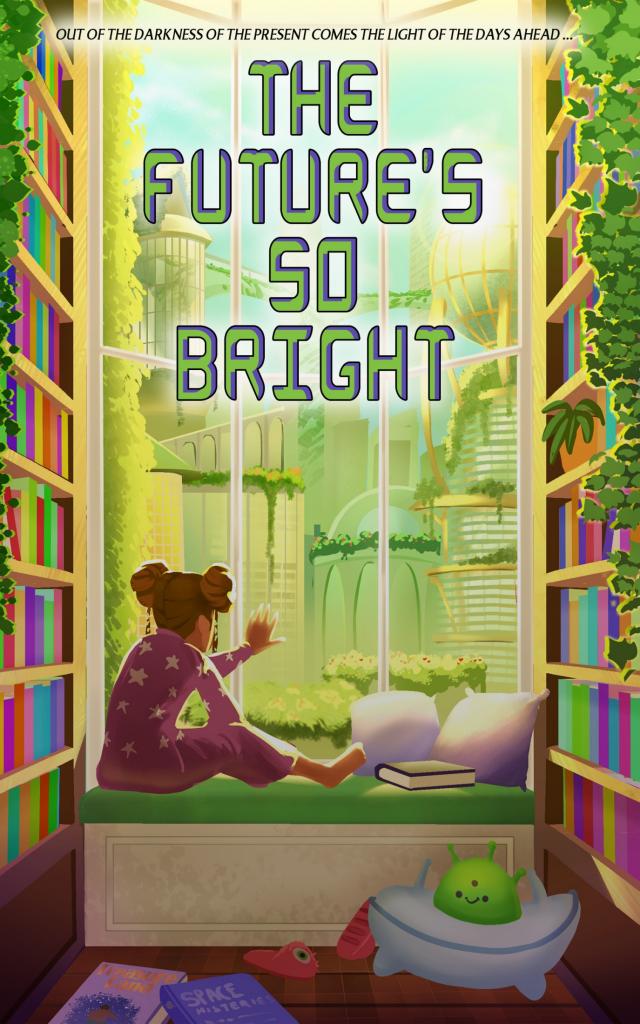


The
Future's
So
Bright
Published by Water Dragon Publishing
waterdragonpublishing.com
All rights reserved.
No part of this book may be reproduced or transmitted in any form or by any means, electronic or mechanical, except for the purpose of review and/or reference, without explicit permission in writing from the publishers.
Cover design artwork copyright © 2022 by Dany Rivera
danycomicsarts.com
Cover design copyright © 2022 by Niki Lenhart
nikilen-designs.com
ISBN 978-1-957146-66-9 (EPUB)
10 9 8 7 6 5 4 3 2 1
FIRST EDITION
Foreword
copyright © 2022 by Elyse Russell
“Born in the Black”
copyright © 2022 by Brandon Ketchum
“The Comforting”
copyright © 2022 by Kevin David Anderson
“The Ear is a Vital Organ “
copyright © 2022 by Nels Challinor
“Emergence”
copyright © 2022 by A.M. Weald
“The Emperor's Proposition”
copyright © 2022 by David Wright
“The Faceless Enemy”
copyright © 2022 by Stephen C. Curro
“Hopfull Future”
copyright © 2022 by Alfred Smith
“Hydropolis”
copyright © 2022 by Julia LaFond
“Imaginary Friends”
copyright © 2022 by Steven D. Brewer
“Lady Jade”
copyright © 2022 by Maureen Bowden
“The Last Gift”
copyright © 2022 by Nestor Delfino
“Legacy”
copyright © 2022 by Cynthia McDonald
“Machine Intelligences Don’t Care about the Fermi Paradox”
copyright © 2022 by Jetse de Vries
“Misty and the Windmills”
copyright © 2022 by Gail Ann Gibbs
“Night Circus”
copyright © 2022 by Regina Clarke
“The Repairwoman”
copyright © 2022 by Henry Herz
“Salvage at the Selvage”
copyright © 2022 by Christopher Muscato
“Scars of Satyagraha”
copyright © 2022 by R. Jean Mathieu
“Xenoveterinarian”
copyright © 2022 by Gwen C. Katz
All rights reserved.
Foreword
“And they lived happily ever after.”
How many times have we heard that phrase? The end of most every children’s story is butterflies and rainbows.
Good triumphs over evil. Love prevails. Happiness is found. Now you can pull your covers up to your chin and go to sleep, snug in your bed and in the knowledge that all is right with the world.
That is, until we grow up. Then we see that all is not always right with the world. In fact, it sometimes feels as though we are stuck in a pit of sand from which we cannot escape. All of our struggles only cause us to sink down further amongst the grains. War. Disease. Loss. Despair.
Where are the butterflies and rainbows now, when we need them most?
It’s sometimes so difficult to look to the future with any hope in the heart. What will this world look like for our great-grandchildren? What will become of humans? The questions spiral and the sand pulls us down.
Have you ever heard of the Baader-Meinhof Phenomenon? It explains how, after you learn of the existence of something, you start to see it everywhere. For instance, you are told about a certain celebrity and start seeing their face in every advertisement. It’s like a strange moment of waking up to the world being just a little bit bigger than it was moments before.
Well, here’s my hope: that this book sparks that phenomenon for you. Tuck into bed, pull the covers up snug, and read about how maybe the future could be bright after all. Then…maybe you’ll start seeing bits and pieces of it here and there, all around you, in real life. Soak up some of that positivity. Perhaps it’s a story in the news of a brilliant new breakthrough in medicine that saves lives. Or a video of an animal being rescued and adopted. People coming together and fighting back against injustices. Trees being planted. A parent playing with their children in the park.
Of course life isn’t all butterflies and rainbows, but … the story isn’t over yet, is it? We’re still here. There’s still a chance.
This collection of stories runs the gamut of positive emotions. Some are bittersweet, others are steady lights of hope, and a few will even make you laugh out loud. Some are expansive views of what the future could hold for all of mankind, and others are microcosms of hopeful futures for just a single person.
But what they all have in common is that, perhaps despite some sadness, happiness is ultimately found. These authors have crafted tales for you to escape into, yes, but also to carry with you long after you put the book down. The creation of this collection is a story in and of itself: a story about people wanting to push some positivity out into the world and provide a respite for others.
All is not lost. The future really can be bright.
Elyse Russell
curator of The Future’s So Bright
Nels Challinor is a writer, musician, and teacher from the Pacific Northwest of the United States. His work has appeared in The Wells Street Journal, Visual Verse, and Brain Mill Press's Ab Terra 2020 Collection. Nels is also the co-founder and editor of Great Ape, a literary magazine for absurdist humor.
I wrote “The Ear is a Vital Organ” after reading Robin Wall Kimmerer’s incomparable “Braiding Sweetgrass”. I was inspired to create a positive vision of the future that does not involve humans gaining something we lack, but learning to appreciate and respect what we already have. Thank you to Dain Weisner for fact-checking the ecology in this story.
The Ear is a Vital Organ
Nels Challinor
There are some sounds that cannot be heard. Trees speak to each other, sending messages through fungal networks belowground. Tadpoles wriggle through the murky waters of a still pond. The mountains crumble beneath the weight of themselves. Most of us are too busy listening to sound to sense these subtle changes in the world. But those of us who live with silence, like my Aunt Sadie, whisper along to the symphony of nature. And when she speaks, everyone stops talking so that they can listen.
Many years ago, when Sadie was a young woman who still had her hearing, and I wasn’t yet an idea in my mother’s head, no one cared to listen. Everyone spoke as loudly as they wanted, secure in the belief that it was only us, only people, who mattered. They told themselves that this made them healthy and happy, but really, nobody anywhere had ever been so miserable. When I ask Aunt Sadie why people lived like this, she explains that nearly the whole world forgot that the ear is a vital organ, even when it no longer works the way it’s supposed to.
On days when I feel self-pity clawing at my gut, I wish that my own ears stopped working, or started working in the way that Aunt Sadie’s and Rebecca’s do. I know that my hearing is an asset when it comes time to hunt or greet strangers. I know that not everyone can be blessed. But I still envy Aunt Sadie, because I wish I could add my quiet voice to the forest. Instead, my whispers sound alien and harsh, all wrong, as though I am singing in a different key from the rest of the chorus. I have decided to speak only when absolutely necessary.
• • •
My mother tries to convince me to speak more often as we pick blueberries on the Northern face of Big Slide. We do this every three days: waking early to make the 10-mile hike out to the trailhead from our cabin. We walk in silence the whole way there, barefoot because it’s summer and because that way we can hear if someone’s coming. But once we reach the summit and arrive at the great open rock face for which the mountain is named, my mother asks me why I have given up speaking.
“You have such a beautiful voice,” she says. “Why hide it from the world?”
“I don’t,” I sign back. “And I am training myself to hear. Like Aunt Sadie hears.”
She shakes her head. “Aunt Sadie doesn’t hear.”
“You know what I mean.”
“No,” she says, “you don’t know what I mean. Aunt Sadie herself will tell you that she doesn’t hear. Hasn’t heard since the bomb that took her husband.”
“But,” I argue, “she told me that the ear is a vital organ. I know hers don’t work anymore to alert her to sound, but she still hears the world. She still hears so much more than you or I ever will. She hears the garter snakes molting, the birch back peeling, the waterfalls crashing. She hears it all, somehow.”
My mother looks up at the dull gray sky, so close from this high up. Today it is cloudy, but the intensity of the sunlight, even with the clouds, feeds the hungry blueberries. They cluster in tight bunches spread across the rock face. We are not the only ones who graze here. These purplish pockets of sugar entice birds and squirrels, who will eventually deposit the seeds in digested form. And the blueberries will spread. The whole chain of communication from sunlight to blueberry to squirrel repeats itself year after year for no particular reason except that this is how the conversation has evolved.
My mother sighs. “I can’t speak for Sadie. Wouldn’t dare. But it seems to me that she might be implying that the ear is more than someone’s ability to hear.”
&n
bsp; “No shit,” I sign.
“Watch it,” she says.
We drop the subject, concentrating instead on filling our two large wicker baskets with berries. By the time we return to camp, our backs are cricked, and our calloused fingers bear new cuts and scrapes. We give both baskets to Rebecca, who pours them into a pot over the fire with a small ration of granulated sugar.
“Where’s Sadie?” I sign to Rebecca, but she just shrugs.
I’m too tired to go looking for her, so instead I head for my room with a small candle. I try to draw, to commit the view from the top of Big Slide to paper, but the horizon doesn’t come out the way I want it to, so I tear it in half. Then I look at the pieces on the floor of my bedroom.
When my father and mother were young, people split the Earth itself in half, looking for precious stones. They unzipped the clouds with puffy white chem-trails. They diverted rivers, burned forests, dumped thousands of tons of plastic into the ocean. Is it any wonder then that the elements themselves turned on people? That tsunamis, earthquakes, wildfires, and hurricanes rose up to stem the flood of human intervention? The Earth is old and much stronger than anyone realized; it was not the one who needed saving.
My parents speak of a time when other people were inescapable. Wherever you went, you found them. When they talk about this, my parents assume the far-off reminiscent look of golden days gone by, but to me, it sounds awful. We see people from time to time, crossing near our camp, or when we’re out scavenging, but sometimes a year or more will go by between these sightings, which is fine by me. After the “natural disasters” — a name which I find so idiotic as to be comical — took away people’s access to food and shelter, violence spread across the world. Those who couldn’t live quietly without supermarkets and televisions and SUVs were killed, either by themselves or someone else.
“The only people you can trust,” my parents once told me, “are us and Sadie and Luke and Rebecca.”
That was ten years ago though, and my parents have started trusting again. I will occasionally see my father laughing with other men in town as we are scavenging. Or my mother will invite a passing stranger to share our fire and our food for a night. The lesson, I suppose, is that you can’t trust everyone, but most people are harmless.
I fall asleep waiting to hear Aunt Sadie’s heavy footsteps outside my door.
• • •
The next morning, I wake at dawn, ready to help gather firewood or water, whatever we need. Outside, by the smoldering firepit, the adults are arranged into a circle, discussing something.
“She’s done this before,” my father signs.
“Something feels different this time,” my mother responds.
“Different how?” Luke asks.
“She’s my sister. I know her better than you all do. And this is different. Something has happened to her. Otherwise, she would be back here, at home, where she belongs.”
I feel my mother’s worry creep underneath my skin. They haven’t yet realized that I am eavesdropping.
My parents have told me that when they were young, they felt certain that they would live to see the end of the world, by which, they meant the end of human beings. Even before the violence and the death, they were told that the Earth would give up sustaining them. Nobody worries about this anymore. The abundance around us is so evident, you can sense it, or at least Aunt Sadie could. As I listen to the adults talk about where she could be, I feel a panic not unlike what they must have felt when they were young. I feel like I will live to see the end of the world.
“We can check in town,” my father says. “Maybe she went scavenging.”
My mother shakes her head, but says nothing.
“I’m coming with you,” I sign to my father and he only nods, knowing that it would be futile to argue.
I don’t go into town often, not because I’m not welcome, but because I have little interest. The shops and the cars and the consumer goods do not trigger the nostalgia my parents feel. I have never known a world with them. For this reason, I am terrible at scavenging. I prefer to spend time around camp and in the woods, where the knowledge that my mother and Sadie have poured into my head is readily accessible. But I would walk through the rubble of urban sprawl for years if it meant finding Aunt Sadie.
I lace up my boots. Barefoot is not an option in town, what with the broken glass and rusted metal. I fill my backpack with water, a bag of nuts and seeds, and a pocket knife.
My father and I set out, following a herd path for a mile or two, until it joins a two-lane highway. Walking on the concrete feels strange, as though my feet are being slapped with each footfall. I jog a bit to keep up with my father, whose stride is long, his eyes set straight ahead. We pass cars and trucks, abandoned along the road where they ran out of gas.
Eventually, we come to a metal bridge above a river. Turning my head downstream, I hear the roar of the river reduced to a swift burble. A young stand of alder sprouts from one of its banks. This is a new bank, created by gradual buildup of sediment brought by the rushing water. The skinny white trees will reinforce the ground, until another storm comes and redirects the river again. Tufts of elk fur still cling to the trunks and branches.
Sadie once told me how alder may as well be a feather bed to an elk. They love the feeling of the closely packed trees on their hides. While rubbing themselves, they graze on the shrubs and shoots sprouting in the underbrush and then they deposit manure, which fertilizes the soil. More nutrients, more trees. The river is the director of this pocket drama, determining who goes where and when. The beauty is that it’s always changing.
“Keep up,” my father says. He is a good twenty paces ahead of me, halfway across the bridge.
The air itself changes on the other side. It tastes like moldy upholstery and smoke. The moisture and fragrant spruce and pine have been masked by the stench of humans. As we draw closer to town, the houses get closer together, until one buts right up next to another. It never ceases to amaze me that people used to live so close to each other.
On Main Street, we come across a man carrying several bags. He looks exhausted, but still raises a hand in greeting to my father. “Howdy, Jim. This your boy?”
My father nods and places a hand on my shoulder. “We’re looking for Sadie. Have you seen her?”
The man shakes his head. “Sorry, can’t say I have. Been staying home most days though, what with the new baby.”
My father smiles. “How is she?”
“Beautiful,” the man says, beaming.
“And Portia?”
“Recovering well. I’ll tell her you asked after her. She’ll appreciate it.”
“You do that,” my father says.
As the two men continue talking about the man’s family and the early summer rain and what it will mean for our respective gardens, I drift away, seething. I hate my father for not feeling the same urgency and panic that I feel. I don’t understand how he can carry on about the weather at a time like this.
In the broken window of a ransacked pharmacy, I see an untouched greeting card display. The side closest to me has birthday cards. One of them sticks out to me. It features a cartoon bear with the words “Have a Grrrrrrr-eat Birthday!”. My father gave me this card two years ago. He must have found it on this very rack.
I remember that birthday, the gooey sweetness of the nut bars my mother made, dipping into our precious flour supply. I remember the fire and the laughter. I remember smiling so much that my cheeks were sore, and I had to keep massaging them. Sadie hadn’t spoken a word all day, to me or anyone. My father, drunk on sugar and protein, ribbed her for it, asking whether she’d forgotten that it was my birthday. Sadie ignored him, turning to me instead.
“Are you ready for your present?” she asked aloud. Sadie’s voice is a harmony of rough stone and smooth water. When she speaks, she directs, as powerful as a river. The adults quieted down so that they could listen.
“Your present is a story. A lesson. It’s the story of a birthday.
“Many, many years ago, all the world gathered for a birthday party. Everyone was so excited and nervous. Squirrel kept chittering from his treetop. River babbled incessantly to a silent moose. The pine trees shivered in anticipation, casting their prickly needles to the ground. They were all waiting for the guest of honor, a small hairless ape that they decided to call human.


