A time to die, p.13
A Time to Die,
p.13
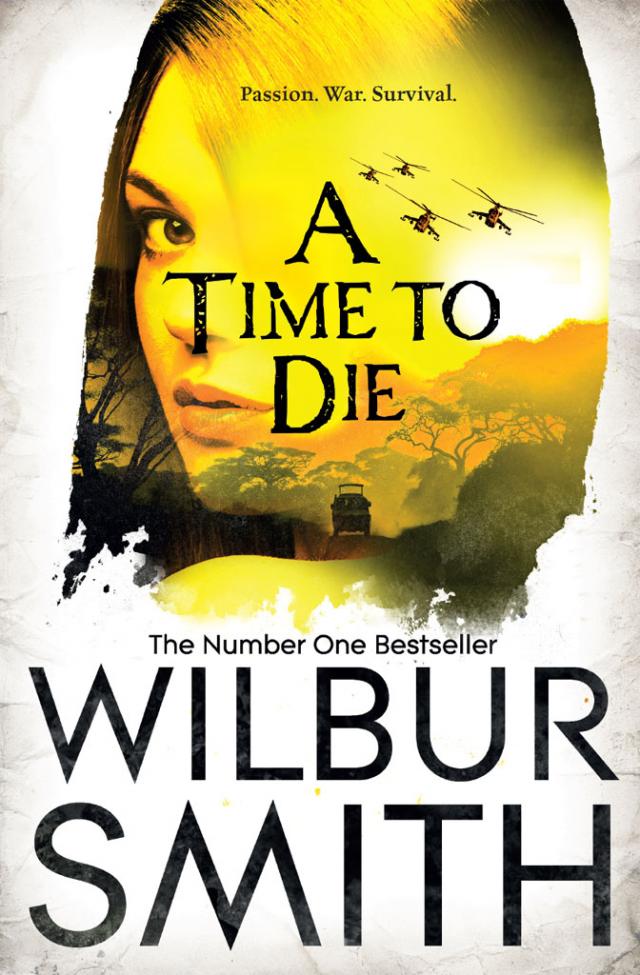


Racing at the head of his men, Sean was the first to reach the headquarters hut in the centre of the camp. He recognized it by the gaudy flag drooping on its flagpole in front of it.
The doorway was dangerous. He fired a burst through the grass wall and then dived in head first through the window. There was a tall black man in the front office. He was dressed in blue denims, and he was scooping armfuls of documents out of the paraffin boxes that served as filing cabinets and dumping them in the centre of the floor. Clearly he was going to attempt to burn them, but now he dropped his armful of paper and reached for the pistol in the holster on his belt.
Sean kicked his legs out from under him and as he dropped, he slammed the butt of his weapon into the side of his neck just below the ear. As Sean rolled to his feet, Matatu appeared beside him like a grinning gnome and stooped to slit the unconscious guerrilla’s throat with his skinning knife.
‘No.’ Sean stopped him. ‘We want that one.’ Job was seconds behind him, bursting into the room with the heavy RPD machine-gun held ready across his hip.
‘Okay, Captain,’ Sean ordered him. ‘Get a detail to recover all this bumf.’ He glanced at his watch. ‘The choppers will be here in twenty minutes.’
The Rhodesian air force was desperately short of helicopters. They were under sanction by every nation in the world except South Africa, and a British warship was blockading the Mozambique channel to deny those ports to them.
They could risk only two helicopters for this operation and one of those was loaded with captured documents, almost five tons of them: lists of the trainees, and their organization, target priorities and supply sheets, equipment dossiers, training manuals, field evaluations of Rhodesian counter measures, communist propaganda, maps of the attack routes and safe corridors, the entire order of battle of the guerrilla army. It was a treasure trove, its acquisition a greater blow to the enemy than the hundreds of bodies lying in the riverbed, but it filled one of the precious helicopters.
The second Alouette helicopter Sean used for ‘Casevac’ and for ferrying out the prisoners. However, the Scouts had taken more casualties than he had anticipated: three troopers had been injured in the parachute drop, torn cartilages and sprained ligaments, and five others had been wounded by the desultory and quickly suppressed counter-fire of the more plucky of the guerrillas. Then one of the guerrillas had feigned dead in the riverbed and thrown a grenade when the Scouts came forward, killing a black trooper and wounding two others. The Scouts always took their dead out for decent burial and the trooper’s corpse was already in its green plastic body bag.
In addition to his own casualties, Sean’s men had captured eight suspected officers and commissars. The guerrilla leaders wore no insignia of rank but could usually be identified by the superior quality of their clothing, by their sunglasses, wrist-watches and by the rows of ballpoint pens in their breast pockets.
They had too many passengers for the helicopters, and Sean was forced to keep five of his prisoners with him for the outward march. He picked those who looked fit enough to survive a forced march with the Scouts, and one of these was the man they had captured in the command hut.
Forty-five minutes after the attack had begun, the last helicopter took off and the Scouts were ready to move out. They could expect the Frelimo counter-attack to be dilatory and unenthusiastic, but Sean was taking no chances. He was on the riverbank surveying the carnage of the killing ground. They couldn’t afford the time to make a body count, but the air force would run another reconnaissance later this morning and they would get a fair estimate from the photographs.
‘Must be at least fifteen hundred,’ Sean decided. They were lying in heaps and windrows like newly cut wheat and already the flies were hanging over them in a grey mist.
Sean turned away from the scene. ‘All right,’ he called. ‘Move them out!’
The first section of fifty men set off at a trot. The troop trucks would race across the border and come in as far as they could to meet them, but the men would still have to run thirty miles or more before they could ride, a full marathon under arms, but most of the ammunition had been shot away and the packs were almost empty.
Job hurried across to where Sean stood on the bank. ‘The prisoner you took, Colonel. I have recognized him. It’s Comrade China himself.’
‘Are you sure?’ Sean did not wait for Job to reply. ‘Damn, if I had known I would have sent him out on the chopper.’
Comrade China was high on the wanted list of the Rhodesians. He was the area commander of the entire north-eastern sector, the equivalent of a major-general, and one of their most successful commanders, a man with a lot of interesting stories to tell to military intelligence.
‘Make sure he gets out safely. Captain,’ Sean ordered brusquely. ‘Treat him like your new wife.’
‘China refuses to march,’ Job said. ‘We can’t shoot him, and we can’t carry him. He knows that.’
Sean strode across to where the prisoner was held under guard. He squatted sullenly with his hands behind his head.
‘On your feet and march,’ Sean ordered, and Comrade China spat on Sean’s boots. Sean unbuckled his holster and drew the .357 Magnum revolver. He laid it against the side of the man’s head.
‘On your feet,’ he repeated. ‘Your last chance.’
‘You won’t shoot,’ the man sneered. ‘You daren’t shoot.’ And Sean fired. The muzzle was aimed over Comrade China’s shoulder, but the barrel was pressed hard against his ear.
Comrade China screamed and clutched at his ear with both hands. A thin trickle of blood from his ruptured eardrum ran out between his fingers. ‘On your feet!’ Sean said and, still holding his damaged ear, Comrade China spat at him again. Sean laid the revolver barrel against his other ear. ‘After your ears, we will take out your eyes, with a sharp stick.’ Comrade China stood up.
‘At the double, move out.’ Job took over. He placed his hand between China’s shoulder-blades, and sent him tottering down the riverbank.
Sean took one more look around the battlefield. It had been done swiftly and thoroughly, what the Scouts called ‘a good kill’.
‘All right, Matatu,’ Sean said softly. ‘Let’s go home.’ And the little Ndorobo ran ahead of him.
When Comrade China faltered and his knees went rubbery and he collapsed from the agony of his burst eardrum, Sean gave him a subcutaneous shot of morphine from a disposable syringe and a drink from his water-bottle.
‘For a soldier of the revolution who shoots babies and chops the feet off old women, this is a stroll in the park,’ Sean told him. ‘Brace up, China, or I’ll blow your other ear out.’ And he took one of his elbows and Job the other. Between them, they hoisted him to his feet and half carried him until the morphine had a chance to work, but they kept up the pace of the running column of Scouts through the forest and over the rolling rocky hills.
‘You may have killed some of our people today.’ After a mile or so the morphine was working and China became loquacious. ‘Today you have won a single little battle, Colonel Courtney, but tomorrow we will have won the war.’ China’s voice was harsh with bitter self-righteousness.
‘How do you know my name?’ Sean asked with amusement.
‘You are famous, Colonel, or should I say infamous. Under you, this pack of killer dogs is even more dangerous than when the murderous Ballantyne himself was leading it.’
‘Thank you for the pretty compliment, my old China, but aren’t you claiming victory a little prematurely?’
‘The side which controls the countryside by night wins the war.’
‘Mao Tse-tung,’ Sean smiled. ‘A most appropriate quotation for one of your name.’
‘We control the countryside at last, we have you bottled up in your villages and towns. Your white farmers are losing heart, their women are sick of war. The black peasants are openly sympathetic to our cause. Britain and the world are against you. Even South Africa, your only ally, is growing disenchanted with the struggle. Soon, very soon . . .’
They argued as they ran, and despite himself, Sean could not suppress a grudging admiration for his prisoner. He was quick-witted, his command of English impressive and his grasp of politics and military tactics even more so. He was physically strong and fit. Sean could feel the wiry muscle in his arm as he supported him, and few other men with a burst eardrum could have sustained the pace of the march.
‘He would make a superb Scout,’ Sean thought. ‘If we could turn him . . .’ Many of his most valuable men were former guerrillas, captured and skilfully turned by Rhodesian intelligence.
So as they ran on he studied Comrade China with renewed interest. He was probably a few years younger than Sean. He had refined Nilotic features, more Ethiopian than Shona, a narrow high-bridged nose and chiselled lips rather than the broadly negroid. Even the morphine could not dim the intelligence of his large dark eyes. He was a handsome man, and of course, he would be tough and utterly ruthless. He would not have reached his rank were he not.
‘I want him,’ Sean decided. ‘My God, he would be worth another full regiment to us.’ And he tightened his grip on the man’s arm, a proprietorial gesture. ‘This little darling is going to get the full treatment.’
The vanguard ran into a Frelimo patrol in the middle of the morning and brushed them aside, hardly slackening their pace to do so. The corpses in their blotched Frelimo camouflage lay beside the track as they trotted past.
They came up with the troop convoy a little after midday. The trucks were guarded by the Eland armoured cars, and they had cans of ice-cold Castle beer in the cool boxes. The Scouts had covered forty-two miles in just over seven hours, and the beer tasted like nectar.
Sean gave a can to Comrade China. ‘Sorry about your ear,’ he told him, and saluted him with the beer can.
‘I would have done the same to you,’ China smiled, but his eyes were inscrutable. ‘To our next meeting?’ he suggested the toast.
‘Until we meet again,’ Sean agreed, and handed him over to a guard detail under a white sergeant. Then he climbed into the command armoured car to lead the final stage of withdrawal.
Sean extricated his column and had them back across the border ten and a half hours after the attack began. Ian Smith, the prime minister, came on the radio net in person to congratulate him and inform him of his decoration, a bar to his silver cross.
Sean didn’t learn about Comrade China’s escape until the column went into laager that evening. Apparently, China had slit the canvas hood of the troop truck and slipped through it while his guard was dozing. Undeterred by his manacles, he had dropped off the speeding truck, screened by the dust boiling out from the back wheels, and rolled into the head-high elephant grass along the verge.
Two months later, Sean had seen an intelligence report that placed China in command of the successful attack that had wiped out a supply convoy on the Mount Darwin road.
‘Yes, Matatu, I remember it all very well,’ Sean answered his question, and made one more steep turn above the site of the old terrorist base before he returned the Beechcraft to straight and level flight on a southerly heading.
He did not, however, fly as far southwards as the railway line that linked the port of Beira to the land-locked Zimbabwe border. This was a focus for all the military and rebel activity in the area, and the countryside would be swarming with Frelimo and Zimbabwean troops, all armed with RPG rockets and eager to get a shot at an unmarked low-flying aircraft with no flight authorization.
‘At least’, Sean told Job, ‘it looks like a possibility.’
Job agreed. ‘The border opposite our camp seems undefended and deserted.’
‘Worth a try for half a million?’ Sean asked, and Job just grinned at him.
‘One more little chore before we go home,’ Sean told them.
It required precise navigation and an eye for the terrain, but Sean crossed back into the Zimbabwean side and flying low they were able to pick out the spot where the previous day they had first come across the poachers’ tracks; from that point, with Matatu craning his head to see down and calling directions, they found the tableland and valley where they had come up with the band of poachers and taken them under fire. From the air the distances seemed much shorter than they had on foot.
Matatu directed Sean along the trail the old bull had made towards the border. It seemed that his gift for direction and terrain was not impaired by height above the ground, and Sean was following their course on the map he held in his lap.
‘We are crossing back into Mozambique now.’ Sean was scribbling notes on the map.
‘That way.’ Matatu leaned over the back of the seat and pointed out a more northerly track. Sean knew better than to argue with him, and turned a few degrees left.
Minutes later Matatu demanded he turn slightly south again.
‘Little bugger is actually sensing the old bull’s trail, he is thinking like the elephant,’ Sean marvelled and at that moment, Matatu gave a squeak of triumph and pointed urgently out of the side window.
As they flashed across another dry riverbed, Sean glimpsed the tracks trodden in the soft sand. They were so deep that they were filled with shadow, a string of dark beads on the white background. Even Sean, who for twenty years had watched Matatu work, was amazed. On instinct alone, Matatu had followed the bull to this river-crossing. It was a supernatural feat.
Sean circled the tracks, his port wing-tip pointing directly at them, so steep was his turn.
‘Which way now?’ he called to the back seat, and Matatu tapped his shoulder and pointed downstream. Without demur, Sean followed the gnarled black finger.
‘There he is!’ Job shouted suddenly, and Matatu shrieked with laughter and clapped his hands, bouncing in his seat like a child at the pantomime.
A mile ahead the river ran into a wide vlei that still held water from the last rains. The elephant’s humped back showed above the tops of the tall reeds that surrounded the pool, like a grey whale in a sea of green.
As they raced low towards him, the elephant heard the Beechcraft’s engine. He lifted his head and spread his ears wide, turning to face them, and they saw his tusks, those legendary shafts of black ivory raised to the sky. The beauty of their curved symmetry struck Sean all over again.
There was just a glimpse of them as they flashed overhead, but the image was printed vividly on his mind’s eye. Half a million dollars and those tusks, he had risked his life a hundred times for much lesser prizes.
‘Going back for another look?’ Job asked, twisting his head to try and see back over the tail-plane.
‘No,’ Sean shook his head. ‘We don’t want to disturb him more than necessary. We know where to find him, let’s go home.’
‘It’s my half-million dollars that you are so gaily throwing around,’ Claudia told her father.
‘How do you work that out?’ Riccardo asked. He was lying on his camp-bed dressed in a pair of silk pyjama bottoms, his chest and his feet bare. Claudia noticed that most of his body hair was still crisp, curly and black, with only a patch of fuzzy grey in the centre of his chest.
‘My inheritance,’ she explained sweetly. ‘You are blowing my inheritance, Papa.’
Riccardo chuckled. She had the sass of a divorce lawyer, coming bursting into his tent to renew the argument which he thought he had finalized in the mess tent over breakfast.
‘If I’m not going to get it in your will, the very least you can do is let me enjoy it with you now.’
‘According to the last audit, young lady, you will have a little over thirty-six million coming to you after taxes, and after I have allowed myself this small extravagance. I hasten to add that every cent is tied up in a trust fund that not the most crafty lawyers will ever break. I don’t want you handing my hard-earned loot out to one of your bleeding-heart charities.’
‘Papa, you know the money has never interested me. What interests me is coming with you on this crazy jaunt after the elephant. I came to Africa with you on the understanding that I was to be included in everything. That was our bargain.’
‘I’ll say it one more time, tesoro, my treasure.’ He only called her by that baby name when he was feeling very affectionate or very exasperated. ‘You are not coming into Mozambique with us.’
‘You’d go back on your solemn promise?’ she accused.
‘Without a qualm,’ he assured her. ‘If your safety or happiness was involved.’
She jumped up from the canvas camp-chair and began to prowl around the tent. He watched her with secret pleasure. Her arms were folded over those pert little breasts, and she was frowning heavily, but the frown left no lines on her smooth plastic skin. In looks she reminded him of the young Sophia Loren, his favourite actress. Now she stopped beside the camp-bed and glared down at him.
‘You know I always get my way,’ she said. ‘Why don’t you make it easier for both of us, and just say I can come.’
‘I’m sorry, tesoro. You aren’t coming.’
‘All right.’ She drew a deep breath ‘I don’t want to do this, Papa, but you leave me no choice. I have begun to understand what this means to you, why you are prepared to pay such a vast sum for a chance to do it, but if I can’t go with you, as is my right and my duty, then I will prevent you from going.’
He chuckled again, easily and unconcernedly.
‘I am serious, deadly serious, Papa. Please don’t make me do it.’
‘How can you stop me, little girl?’ he asked.
‘I can tell Sean Courtney what Doctor Andrews told me.’
Riccardo Monterro came to his feet in one lithe swift movement and seized her arms.
‘What did Andrews tell you?’ he asked in a voice as thin and cutting as a razor blade.
‘He told me that last November you had a little black spot on your right arm,’ she said. Instinctively, he put his right arm behind his back, but she went on. ‘It had a pretty name, melanoma, like a girl’s name, but it wasn’t pretty at all, and you left it too late. He cut it out, but the pathologist graded it Clark 5. That’s six months to a year. Papa. That’s what he told me.’