House of two pharaohs, p.2
House of Two Pharaohs,
p.2


Taking the captain’s torch, Piay made his way to where the guards waited. He had ordered the vault’s construction as one of his first decrees as nomarch, and had arranged for the finest mason in Lower Egypt to oversee the work. And Ptah himself would have been proud of the new addition to his temple, Piay thought, as the shadows swooped away from the immaculate wall of pale limestone.
‘Tell me what happened here,’ Piay commanded.
One of the guards, a broad-shouldered man with a nose that had been broken more than once, wiped the back of his hand across his mouth and said: ‘As you ordered, Nomarch, we admitted the scribe Djau-Aa soon after the sun was at its highest. Once he was inside, we sealed the doors behind him.’
‘As has been done for the last five days?’
The guard nodded. ‘Every night he would hammer on the doors, and we would let him out, searching him before sending him on his way.’
‘And this night?’
‘There was no knock. We thought nothing of it. We thought he was working late to make up time.’
‘Show me the blood.’
The guard moved hesitantly towards the vault, raising his torch as Piay followed. In the small anteroom that had been constructed in front of the doors, the guard pointed down to the flagstones where a dark pool was slowly congealing.
‘The vault was empty – every man who entered during the day was accounted for. And no man went in after Djau-Aa,’ the guard croaked. ‘Only some sorcery could have caused this.’
Piay sensed the eyes of the Memphis Guard upon him. They were men who had proven themselves in battle, but they had been reduced to frightened children here – their deepest fears had been stirred.
‘Open the door.’
The guard reached out his trembling hand, then hesitated.
‘Open it!’
Muttering apologies, the guard stepped forward and, with the aid of one of his comrades, heaved away the three heavy drawbars that lay across the door. The keyholder pulled the wooden key from the pouch at his hip – the torchlight gleaming off the bronze pins protruding from the shaft – and twisted it in the lock, so it turned the tumbler, enabling the final bolt to be drawn.
The four men glanced at one another, then, together, they gripped the hide-rope handles and dragged the doors open, swinging them wide.
Piay stared into the darkness, then pushed his way forward, holding his torch high.
The body lay just beyond the threshold. Djau-Aa was sprawled on his belly in a sticky pool of his own blood, his neck twisted grotesquely so that his final vision would have been the doors, beyond which the four guards were waiting, had he only been able to reach them.
His throat had been slit from ear to ear, and his pristine white robe was soaked with gore. Piay imagined the scribe staggering towards the door with his life flowing from his wound. ‘Get your men to bring their torches,’ he shouted back to Ahmose, who had followed him into the anteroom. ‘Search the vault.’
Muttering a prayer, the soldier flexed his fingers to ward off evil.
‘All of them. Or is every man here afraid of shadows?’
The captain gave a heavy nod and barked to his command: ‘Search the vault. No man goes anywhere inside it alone.’
Suppressing their fear, the men moved into the vault, each one stepping carefully around the corpse as they crossed the threshold. As Ahmose organised his men into teams, Piay watched the thick black smoke billow up from the flames that flickered atop their torches, roiling around the heads of the columns that held up the heavy stone of the ceiling. If this had been Djau-Aa’s tomb, the roof would have been painted with stars, Piay thought to himself. Instead, it was as if the goddess of the sky had been immolated. There would be no protection for Djau-Aa’s soul on its journey to the afterlife.
Ahmose gave a final command and the soldiers scattered, darting in pairs around the edges of the chamber while a phalanx progressed down the central aisle. Piay listened to them calling to each other as they disappeared from view, but their bluff assertions that nothing was amiss did not reassure him, instead he felt his unease grow.
Finally, the soldiers marched back out and Ahmose stood in front of Piay. ‘We have scoured the vault. It’s empty. There is nowhere anyone could be hiding.’
Piay stared at the corpse of Djau-Aa, trying to gather his thoughts. ‘How could a man alone in a sealed chamber be murdered?’ he murmured to himself.
He looked around the faces of the Memphis Guard, pale and drawn in the torchlight. For them, clearly, there could only be a supernatural explanation.
Perhaps they were right.
Something appeared to catch the commander’s eye, and he frowned. Lowering his torch, he bent down over the body. ‘Look,’ he breathed.
Piay crouched beside the soldier, looking down at the symbol he was pointing at, thick lines against the white limestone. ‘Djau-Aa must have written it in his own blood. To do that with his last breath, it must be important.’
Piay leaned in, squinting at the smudged outline.
‘A message from beyond the grave . . .’
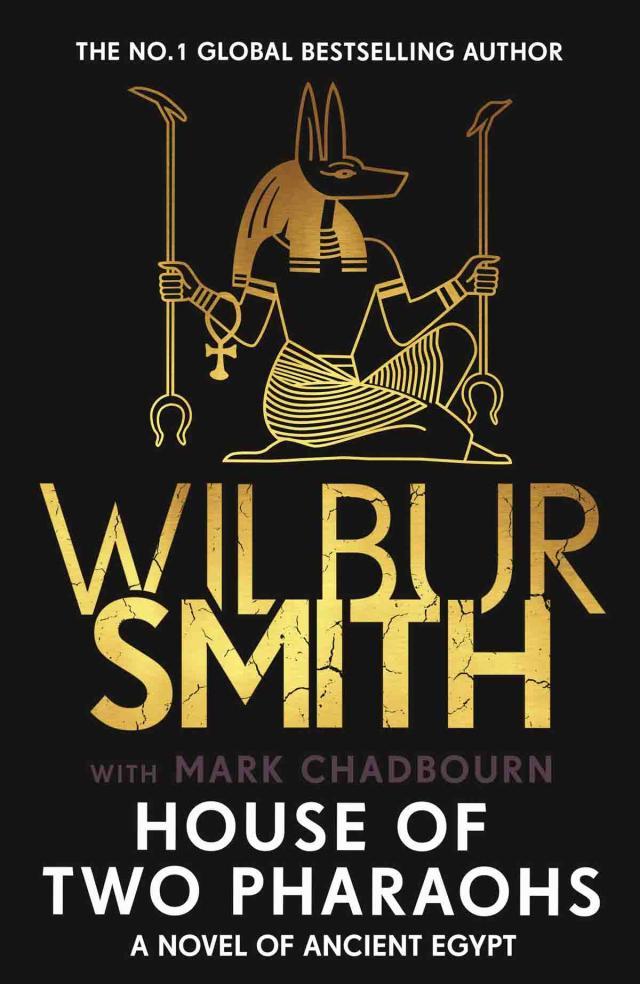
Ahmose was a simple man. He could not read. But Piay had learned to understand some of the medu neter, the gods’ words, during his time in the classroom of his esteemed master, Taita. He wanted to dismiss the captain’s eerie assessment, but as he traced his finger along the blood-black lines and in his mind made sense of the scrawl, he found that he could not: it was a jackal’s head, arms, a staff.
‘That is the mark of Anubis,’ he said quietly.
• • •
‘T
here is only one person who can unwind a riddle like this,’ Piay exclaimed, staring down at his hands, which gripped the back of Zahur’s gilded throne.
‘Taita,’ a gruff voice answered confidently.
At the sound of his master’s name, Piay inhaled deeply, but he did not turn to look at the man who had spoken.
‘You have finally sent word to him, then? After more than six new moons?’
‘I have.’
When at last Piay finally turned, his eyes settled on the short, muscular man leaning against the wall.
‘I’m glad to hear that you have finally come to your senses,’ Hannu said dryly.
Piya grunted. ‘I am the Nomarch of Memphis. In a few hours, rumours of the scribe’s death will be coursing through the streets like poison through a man’s veins. The city will be gripped by terror. Taita’s arrival will help to calm the people.’
‘You are right to realise that you could use your master’s help,’ Hannu asserted. ‘Perhaps he will also release you from your duties, finally allow you what you desire.’
As a young man, Hannu had been drafted into Pharaoh’s army. It wasn’t long before his skill with a sword had been recognised and he had become part of the elite Blue Crocodile Guard. For twenty years all he had known was war. He had fought the enemies of Egypt across the Upper Kingdom until a Hyksos axe had shattered his leg. Piay had found him begging on a dusty street and quickly discerned that Hannu still had much to give – he was courageous, knowledgeable and wise, three things that an even wiser man valued. Piay had offered him employment, and he liked to think that the two of them had become friends in their time serving Pharaoh.
‘You mock me, but have I not transformed this city since I was made nomarch?’ Piay swept his hand out across his imaginary kingdom.
‘You have.’ Hannu’s withering stare only served to fuel Piay’s irritation.
‘I re-established the trade routes, the people of Memphis are no longer starving, and the Memphis Guard have been trained by General Kamose and the Blue Crocodiles, on my order. The city wall is rebuilt, the many damaged homes repaired and the monuments and temples are being restored to their original glory. The treasure that the Hyksos looted is being discovered where it was hidden in the desert wastes and returned to the city, cartload by cartload . . .’
‘All true,’ Hannu conceded.
‘Memphis has been pulled back from the brink!’
‘And there has not been a single day in all that time when you have not been dark-minded with bitterness and resentment towards the city and people you have been ordered to serve. Despite your accomplishments, you are a pitiful excuse for a ruler. You long for nothing, but to leave this place and to destroy yourself. The only reason you remain in Memphis is because Pharaoh appointed you nomarch and you cannot disobey him.’
Piay clenched his jaw.
Hannu was right. It was an annoying habit of his – telling the bitter truth.
‘Is it any wonder that I wish to join her?’ Piay took a deep breath, his shoulders sagging forward with the weight of his immense loss.
‘I understand your grief. I, too, lost my beloved, but I did not let my sorrows overcome me.’
‘You were begging on the streets of Thebes when I found you. Tell me how you were not overcome.’
Hannu frowned at Piay. ‘I was begging because of the wound I suffered sending my wife’s killer to his own wretched afterlife. You know this . . .’
Piay threw up his hands in frustration. ‘I do not know how you found a way to recover from the loss of your beloved. I will never recover from the loss of mine.’
‘You choose not to,’ said Hannu. ‘Do you think Myssa would have wanted you to live this way?’
Piay flinched as if he had been burned with a hot coal. ‘Do not presume to know what she would have wanted.’
His thoughts drifted back to that first time he had seen Myssa standing on the slavers’ block in the port in Lacedaemon. She was a Kushite, possessed of an unearthly beauty; she carried herself like a queen and her skin shone like polished ebony. Soon, though, it was her sharp wits that he came to most admire, along with her courage and fortitude. He had freed her from slavery only to become enslaved in turn, his soul bound to hers for eternity.
But there were to be no happy endings in this life. Taita had charged Piay, Myssa and Hannu with uncovering the location of the tomb of the Great Architect, which contained enchantments that could break the veil between this world and the realm of the gods. In the final contest Myssa had lost her life, and Piay felt as if his own had been extinguished in the same instant.
‘Myssa –’
‘I said, do not presume to speak for her!’ Piay raised his voice in anger.
‘You have never been one to listen to sense,’ Hannu shot back.
Piay snorted. ‘Well, then leave.’
‘I will.’ Hannu allowed his words to hang in the air, to see if they would spark a response. When they didn’t, he continued: ‘There have been attacks on some of the caravans returning the looted gold and gems to the city. The military escorts have managed to repel most of them, but it is still troubling. I have been thinking it would be wise to scout the trade routes –’
‘Go, then,’ Piay said, waving his hand dismissively.
‘Very well.’
Piay could feel Hannu studying him, as if expecting him to say more. When he remained silent, the old soldier nodded, turned and walked towards the door.
‘At least you have finally sent word to Taita,’ Hannu said, over his shoulder. ‘I hope you are also ready to admit that Myssa’s death was no more his fault than it was yours.’
Piay glared fiercely. ‘Have you forgotten that it was Taita who sent us to Memphis in the first place?’
Hannu sighed. ‘Perhaps your master can knock some sense into your thick head. I have better things to do.’
And with that he was gone.
• • •
L
ike a lion prowling through the morning mist that shrouded the Nile, the galley drifted towards Memphis. The merchants on the quayside at the great port of Peru-nefer paid little attention to it, flapping their palm fronds at flies as they haggled over bolts of silk from the east and spices from the lands beyond the Great Green. It was just another vessel from the Upper Kingdom – there were many such galleys, now that the new nomarch had made the city a safe place to do business once again.
The vessel overshadowed the skiffs that flitted along the channel. It was constructed from cedar wood from the mountains beyond Byblos, with twenty men heaving on the oars on either side.
As the galley neared the port, drums began to pound. Their steady beat was accompanied by the blare of trumpets, heralding the arrival of a dignitary.
Turning towards the sound, those on the dock squinted into the brassy light until they saw the two trumpeters standing on the deck, one to port with an instrument made of silver, and one to starboard with its twin wrought in copper.
The great square sail of the galley was unfurled, and as it caught the breeze the Eye of Horus, emblazoned in cerulean blue on the creamy linen, appeared for all to see. The crowd that had started to gather along the water’s edge now had no doubt of the identity of the new arrival – the nomarch had sent criers into the streets to proclaim that the Lord High Chancellor and Chief Minister to the God-Pharaoh Rameses had been called upon to investigate the death of the scribe in the Temple of Ptah.
In confirmation, the heralds on the watchtower added their own welcome, their instruments echoing those of the trumpeters on board the vessel. A cheer went up amongst those who now thronged the quayside and was taken up by the men in the warehouses behind the docks.
Lord Taita had arrived.
• • •
T
he tall, elegant man who stood in the prow with his hands folded behind his back wore a white robe, tailored from the finest linen. Against his chest hung a pendant set with the finest dark green emeralds and fiery rubies that sparkled even in the dim morning light – Horus in his falcon form, with regal wings outstretched. His features could have been called beautiful, for his cheekbones were high, his jaw strong and his lips as full as plump grapes. But it was his eyes that caught the breath of anyone who beheld them. They danced like quicksilver, bright with fierce intelligence.
Taita smiled as he looked along the restored walls of Memphis. The last time he had seen the city, its defences had been shattered and blackened by fire; the vultures had clouded the sky and the air had been thick with the reek of decay.
Taita’s smile faded as he remembered the siege. It had been fifty years since the Hyksos had first thundered in from the east on their gleaming chariots, flooding across the Lower Kingdom with the speed and power of the annual inundation of the Nile. Though the false pharaoh of the Lower Kingdom, the Red Pretender, had fallen in the first battle, in the Upper Kingdom a robust defence had been mounted. The fortunes of war had ebbed and flowed during that half century. Finally, with new allies and a formidable army from beyond the Great Green, a decisive battle had been won and the long war in the Upper Kingdom was ended as quickly as it had begun.
When Memphis had been liberated, Taita had prayed to Horus that a new age would be ushered in by the victory, and so it now seemed. The ancient grandeur described by the scribes once again seemed to emanate from every part of the sprawling city and the docks teemed with activity.
Listening to the cheering of the crowd that had begun to gather on the quayside, Taita raised a hand and waved to them. The gods had seen fit to bless him above all other men. His life had been uncannily long, and while those around him saw their faces crease and their hair turn grey, the years had not visited any decline upon Taita. In that time, he had been able to amass deep knowledge to help steer Egypt through turbulent times as the advisor to successive pharaohs. There were days, though, when he felt as if he had never known peace. He had stewarded the land he loved through so much, and for so long, that although the fire within him still burned brightly, he sometimes felt a weariness deep in his bones. He yearned for a time of reflection and study.
Perhaps, finally, this was that moment. Egypt was rising from the blood of the battlefield. Pharaoh once again wore the double crown. An era of peace and prosperity beckoned. Taita nodded, pleased with what he saw as the steersman guided the galley towards the wharf. Piay had exceeded his expectations. He had discovered Imhotep’s tomb, hidden for a millennium, which contained the invocations that the Great Architect had left to protect Egypt from its enemies. He had reopened the trade routes with their allies, rebuilt Memphis and cleared the waterways to the Great Green of the last of the Hyksos.
As if summoned by his thoughts, Taita saw a knot of soldiers pushing through the crowd, making space for the palanquin that followed behind them – the Memphis Guard and their commander in chief, the nomarch. He watched as the litter was lowered by the eight naked Kushite slaves who carried it and two men stepped out and began to organise the soldiers on the wharf.
The nomarch barked orders to his men as Taita watched. For all that had been accomplished, Taita reflected, the task of reuniting the Upper Kingdom with the Lower – of reunifying Egypt after an age of division and occupation – still remained incomplete. Memphis had fallen and the Hyksos had abandoned their capital at Avaris, but the terrible divide that had begun with the Red Pretender, and the lies he had peddled, persisted. Perhaps Imhotep’s spells would provide the antidote? The time had come at last for Taita to look upon them.
At the captain’s command, the oarsmen heaved up their blades and locked them into place. Yet as he watched the crowds, the men and women of Memphis craning their necks to catch a glimpse of the most powerful man in Egypt, second only to the God-Pharaoh Rameses himself, Taita felt a strange melancholy creep into his mind.
The price paid for the liberation of this great city had been steep. The contest that had won Piay the allegiance of the Sons of Apis – an ancient order founded by Imhotep and named after the great bull that served as an intermediary between men and the gods – had also cost him his beloved Myssa. Taita, too, had mourned her loss. Like Myssa, his beloved had passed through the gate to the afterlife before her time, and in the many years since, there hadn’t been a day that passed without Taita thinking of his mistress, Lostris. He had christened his new galley the Breath of Horus in her memory.