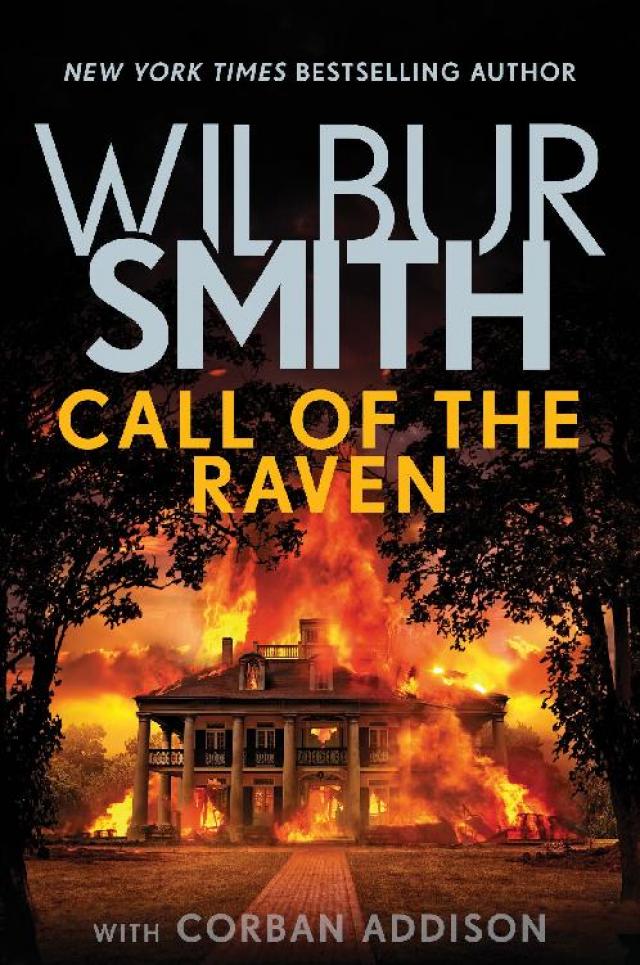
Call of the raven, p.30
Call of the Raven,
p.30


“What are you doing?” Mungo asked.
Pendleton paused. The iboga root had had its usual effect, putting a grotesque bulge in his trousers.
“Sampling the merchandise,” he said with a smirk.
Mungo leveled his rifle. “You don’t touch any of them.”
The chill command in Mungo’s voice cut through even the iboga daze. Pendleton took one step forward, saw Mungo’s finger tighten on the trigger, and stopped.
“I thought we were partners,” he complained.
“And that is why we will do nothing to spoil our cargo. Let her go.”
With a sour look, Pendleton released the girl. She ran back to the crowd and squeezed in among them.
Pendleton spat on the ground. He took up a coil of bark rope and thrust it into Mungo’s hands.
“Tie them up—by the neck, mind you, not the waist. That way they won’t pretend to fall. And you’d better make sure the knots are tight. If there is a shortfall, it will come out of your share.”
A dawn mist rose off the mouth of the Nyanga river, blotting out the sun and turning the world gray. Birds sang and monkeys screeched from the trees, but the sound was muted; the river surface was still and glassy. The only ripples that disturbed it came from the prow of a longboat cutting through the water, and the sixteen oars that drove it forward.
In the stern of the boat, Captain Edwin Fairchild of HMS Maeander peered through the mist for the dark shape of the ship he knew must be moored nearby. It had been a poor year for him. Either the war against the slave trade had had more success than he dared hope, or—more likely, he feared—the slavers were getting better at avoiding the Royal Navy. In the months the Maeander had been sailing these waters, they had barely caught anyone. Then there had been the storm—which the Maeander had barely survived—and more fruitless days patrolling the coast. It was late in the season, and pickings were slim, but Fairchild had driven his crew relentlessly. He was convinced there might still be ships in the area, and would not give up the chase.
“If there is any hope of saving even one poor African from bondage, we owe all our best endeavors to save him,” he had lectured the crew.
Even so, he could not keep the ship at sea forever. With provisions running low, Fairchild had been about to turn back to their base at Freetown. Then his prayers had been answered. All his weeks of searching and doubt had simply been the Lord’s way of testing him. Coasting north, looking to take on water, an eagle-eyed lookout had spotted a masthead in a river estuary. As soon as they were around the point, hidden by a thickly wooded peninsula, the Maeander had dropped anchor.
Fairchild’s officers had counseled caution. Better to wait until she sailed, when the evidence of her crime would be incontrovertible. But Fairchild was impatient. The shame of his last voyage aboard the Fantome still burned in his breast. He had stood on the slave ship’s deck and failed to save her captives. Worse, he had only escaped with his life thanks to Mungo St. John. True, the London papers had lionized him as a hero for standing alone against the slavers, and he had earned a promotion from the engagement. But that was hollow praise. What he needed was redemption.
“Besides,” he argued, “once the slaves are loaded aboard, we will not be able to use our cannon without risk of hurting them. Better to take the ship at anchor, when she has no chance of escape.”
And that was why, at first light, Fairchild found himself leading a boarding party of three boats up the river. His scouts had reported that the slave ship appeared lightly manned, but he was taking no chances.
“There.”
He saw a dark shadow ahead and altered course. The mist hid their approach until they were almost under her stern. Even when they were close enough to read the name picked out on her transom—Raven—no one saw them. The crew had not bothered to post a guard.
The longboat sidled against the Raven’s hull. The coxswain—a sturdy man whose preferred weapon was a boarding ax—made to climb her ladder, but Fairchild waved him back.
“I will go first,” he whispered. He would lead by example.
His heart raced as he climbed the ladder. He kept waiting for shouts or shots, any sign that he had been seen. But none came. He reached the top, paused a second to draw his pistol, then vaulted over the side.
“In the name of Her Majesty Queen Victoria, I am taking possession of this ship!” he announced.
No one heard him. The deck was empty. More of his men swarmed over the side, weapons ready.
“Search her!” Fairchild snapped the order.
His confidence had begun to waver. Perhaps she was a simple merchantman that had put in for water. Perhaps the ship had been abandoned. But her rigging was in good order, and though she had suffered damage recently it had been repaired.
Then all his doubts were laid to rest. The coxswain emerged from below decks shepherding four disheveled men who stank of rum. They must have been rousted from their hammocks. They looked around in shock, rubbing their bleary eyes in disbelief at the crew of Royal Navy men aboard their ship.
“Which of you is in command?” Fairchild asked.
After a pause, one shuffled forward. He did not look like an officer. He had a prominent forehead, sharp sideburns and a terrible sunburn. He looked around like a cornered animal, fixing his eyes anywhere but on Fairchild.
“Are you the captain?” Fairchild asked.
“Only a passenger.”
“And what is your purpose here?”
The man looked at the masthead, as if for inspiration from above.
“Fishing,” he tried.
“Where is the captain? Where are the rest of the crew?”
“Gone hunting.”
“Hunting for what?”
He did not answer, though it made no difference. The coxswain had finished his search and emerged from below carrying a set of iron shackles. He threw them down on the deck.
“There’s hundreds of those. They’ve even built the slave decks.”
“Then this ship is forfeit,” said Fairchild.
Whoever the captain might be, he was clearly an amateur. Most slavers took great care not to carry any of the tools of their evil trade until the slaves were ready to come aboard. Chains, shackles, copper kettles—even timbers and nails for building extra decks: possession of any of these things meant the Royal Navy could seize the ship. The Raven proclaimed her guilt on every count.
The only protection she had was the American flag fluttering defiantly at her masthead. It should have given her immunity from being searched by a British officer; Fairchild had overstepped his authority. But there were ways around that.
He crossed to the mast and severed the halyard with his saber. The flag fluttered to the deck. Fairchild threw it over the side and watched it disappear in the muddy river current.
“You will record the ship was not flying any colors when we boarded her,” he told his men.
They nodded happily. They all stood to gain a share of the money if the Raven was sold by a prize court.
But where were the rest of the crew?
Fairchild surveyed the shoreline.
“There are no barracoons here. They must have gone inland to capture the slaves themselves.”
He had never heard of such a thing—usually, white captains and crews touched African soil as little as possible—but it was the only explanation. The captain was not just a novice; he must have been desperate. Fairchild thanked the Lord again for the opportunity he had been given.
“Secure the ship,” he told his men. He pointed to the embankment beyond the mud flats that lined the river. The trees grew thickly around its edges; the only path led up an earthen gully toward the higher ground. That would be the way the slaves would come.
“When this ship’s captain returns, we will give him a warm welcome he does not expect.”
A thought struck him. He turned back to his prisoner.
“What is the name of the man who commands this unholy vessel?”
De Villiers considered not answering, but it would make no difference. They would surely find the name written in the logbook.
“Thomas Sinclair.”
Fairchild had heard the name before, though for a moment he could not think where. It was not a man he had captured before. Someone he had read about?
Then—with a rush of surprise so hard he almost had to sit down—it came to him. A warm night in Madeira, the Mariners’ Ball and the last man he had expected to see.
I would be grateful if you could forget the name Mungo St. John. Here, I am Thomas Sinclair.
He gripped the rigging, staring out at the mudflats and the land beyond. As the shock receded, he saw this for what it truly was. The Lord had answered his prayers. He had given Fairchild the opportunity to atone for what had happened aboard the Blackhawk.
When Mungo returned, Fairchild would be ready for him.
* * *
Mungo crested the brow of the hill and looked down into the river delta. There was the Raven riding safely at anchor. His spirits rose to see his ship again, and the promise of the open sea. The journey back had been long and difficult. The slave coffle—almost three hundred and fifty people—moved agonizingly slowly. Back at Wisi’s village, the Punu had yoked the captives together with forked branches tied fast around their throats. Even if one escaped, a six-foot branch hanging off his neck meant he could not run far. It was a wise precaution, but it did not help their speed—and Mungo could not drive them too hard, for he needed them in good enough condition to survive the passage to Cuba. Normally, they would have had weeks or months being fattened up in the barracoons, but Mungo did not have that luxury.
He was desperate to get aboard—to be free of Africa, the flies and the heat. Yet now he hesitated. Looking down on the Raven, he felt a prickle on the back of his neck that something was wrong.
There was no one on deck. That angered him, though it didn’t surprise him. De Villiers and the others were probably below decks, out of the sun, sleeping off their hangovers.
Then he saw it. The masthead was bare; there was no flag flying.
Mungo pulled out his spyglass and studied the scene more carefully. The edge of the riverbank had been churned to mud, as if a great herd of animals had come down to drink. But what animal would choose to drink so close to the ship? Beyond, he saw tracks in the soft earth. From a distance they could have been animal tracks, but magnified by the glass they looked decidedly more human. He followed them with his telescope, across the mud flats and up an embankment until . . .
There.
It was well camouflaged, but Mungo already had an idea what he was looking for. In a grove of trees, almost hidden by thorn bushes and long grass, he saw the black muzzle of a gun pointing out.
He ran back to the main column and gestured them to halt. The slaves collapsed to the ground, groaning. The branches tied around their necks had made sores that were beginning to suppurate in the heat. Flies clustered on the wounds, and with their hands bound the captives could do nothing to stop them.
All because of Mungo. He was the reason they had been torn from their homes, watched their families slaughtered. Sometimes when he looked at them, he felt a pang of something almost like sympathy. He knew—too well—what it was like to lose everything. Was it right to visit the same misery on them in pursuit of his revenge?
You are starting to sound like Fairchild, he scolded himself. God could judge him. Chester had given him no choice.
There is only one law, Mungo reminded himself. The power of the strong and wealthy over the weak and poor.
He could not let himself be weaker or poorer than Chester. He had to rescue Camilla.
And now he had more urgent things to worry about than the pangs of conscience. He summoned Tippoo, Pendleton and Wisi and explained what he had seen.
“How many men?” Tippoo asked.
“I did not see any. But the ships of the Preventative Squadron are mostly corvettes and sloops. There could be upward of a hundred men.”
Mungo tried to imagine what the British officers—they must surely be British—might have planned. Clearly they were expecting him to bring his slave coffle down the track and across the mudflats to the ship. They had prepared their ambush on the embankment so that when he came out on the mudflats, he would be directly under their fire.
But if he were the British officer in command, he would not have stopped there. The Royal Navy had obviously been aboard the Raven to strike her colors. Presumably they had captured her skeleton crew as well. Why leave the ship abandoned? Why not hide a detachment of men below decks, ready to burst out on Mungo’s men when they arrived? Out on the flats, Mungo would be caught between the sailors on the embankment and the sailors on his ship. He would be utterly at their mercy.
“What do we do?” said Tippoo.
They could not retrace their steps to Wisi’s village. It would take the best part of a week overland; slaves would start to die. Even if they reached it, what then? The Nganga had no more men to spare. And while they were gone, the British captain might get bored of waiting. If he sailed the Raven away, Mungo would be marooned.
But to march out onto the mudflats would be as good as surrendering. Even with Wisi’s men and the Raven’s crew combined, he barely had forty men. They would be outnumbered more than two to one.
Tippoo, Wisi and the rest of the men were looking at him, waiting for a decision.
“The only advantage we have is that the British do not know that we have seen them,” Mungo mused.
“So?” said Tippoo.
“So we will give them what they expect.”
Mungo explained his plan. It took some time to translate it for Wisi, and even longer to persuade him to accept it.
But there was no other choice.
* * *
Fairchild crouched at the top of the embankment and peered out through the brush that disguised their position. A fly crawled over his face, but he did not swat it away. He had waited three days in this infernal heat, being eaten alive by insects and scratched by the thorn bushes that surrounded them. Some of his men had started to mutter that they should give up. They had more than enough evidence to seize the ship. They could take her to the Mixed Commission Court and claim their prize money, and leave her crew to rot on the coast.
Fairchild had silenced all such talk. He would wait here until Judgment Day, if necessary, for Mungo St. John. The man was the Devil incarnate. Fairchild had to stop him. And yet, even now, he thought of the look in Mungo’s yellow eyes in that moment he had pointed the gun at his head aboard the Blackhawk. He was convinced he had seen a spark of goodness there, a moral qualm buried deep that had made him spare Fairchild’s life. If Fairchild could capture Mungo—confront him—he could surely redeem him.
There is more joy in Heaven over one sinner who repents, than ninety-nine just men, he told himself.
That was why he had endured three days in this horrible place, deaf to the pleas of his men, and of reason, rather than simply sail away with his prize. He would save Mungo St. John, and when they returned to England, Mungo would be able to testify with the full power of the convert about the abhorrent practices still rife on the coast of Africa. His testimony might even force the American government to withdraw the immunity their ships enjoyed, and allow the British squadron to intercept them. That would be a hammer blow against the slave trade.
On the hill away upriver, where the Nyanga disappeared around a bend, a movement caught his eye. Keeping his telescope carefully shaded, lest any flash of the glass betray him, Fairchild examined the ridge. A man had appeared. He paused, scanning the river basin ahead. Fairchild held his breath, but evidently the man saw nothing to alarm him. He lifted his arm in greeting to the Raven, lying at anchor, and began descending the hill. More men followed, armed with rifles. Fairchild counted a dozen of them, escorting a column of about twenty Africans who were bound together at the neck by forked sticks. It had not been a productive raid. Twenty slaves, even prime healthy young men such as these, would not even cover the cost of the voyage.
They would never see the inside of the ship’s hold, Fairchild promised himself. He wriggled back and found his second in command.
“Ready the men,” he ordered.
Of the Maeander’s total complement of one hundred and eighteen men, he had brought one hundred ashore.
“If the Raven escapes, that does not leave enough men to work the ship to pursue her,” his lieutenant had warned, but Fairchild dismissed that risk. Mungo would not get aboard the Raven—and if he did, he would find forty of the Maeander’s toughest men waiting for him. Sixty more were with Fairchild at the top of the embankment.
Everything was ready. Fairchild loosened his sword in his scabbard, checked the priming on his pistols, and prepared to give the command to attack.
* * *
Mungo led his men across the mudflats, forcing himself not to look at the guns hidden in the thicket to his right. He felt almost naked, walking into a trap he knew was waiting for him. What if he had misjudged? He doubted the British would open fire at that range for fear of hitting the slave coffle, but there was always the possibility that they had a marksman with a rifle trained on his head.
He held himself upright and showed no fear. He had made his choice, making the best of the hand he had been dealt. Now all that remained was to see how the cards fell.
The boom of a gun sounded from the embankment, echoing across the flats. Smoke puffed from the thicket, and a flock of red-breasted birds flew into the air. Mungo turned, as if he was surprised, to see a group of check-shirted British sailors charging out of the trees, armed with pikes and boarding axes. An officer led them, sword raised, blue coat unbuttoned and flapping around him. A mop of sandy hair blew back from his weathered face.