

The house on the borderl.., p.1
The House on the Borderland,
p.1


Series Volumes of
Haunted Library of Horror Classics:
The Phantom of the Opera by Gaston Leroux (2020)
The Beetle by Richard Marsh (2020)
Vathek by William Beckford (2020)
The House on the Borderland by William Hope Hodgson (2020)
The Parasite and Other Tales of Terror by Arthur Conan Doyle (2021)
The King in Yellow by Robert W. Chambers (2021)
…and more forthcoming
First published in 1908 by Chapman and Hall, Ltd., London
Introduction © 2020 by Ramsey Campbell
Additional supplemental material © 2020 by Eric J. Guignard and Leslie S. Klinger
Cover and internal design © 2020 by Sourcebooks
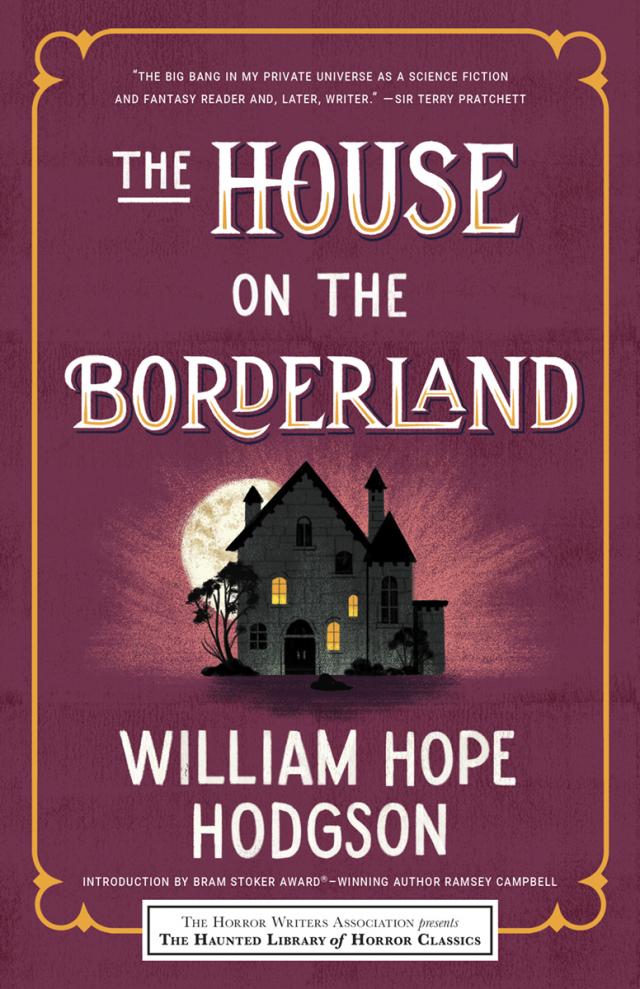
Cover design and illustration by Jeffrey Nguyen
Cover images © Vector/Shutterstock
Sourcebooks, Poisoned Pen Press, and the colophon are registered trademarks of Sourcebooks.
All rights reserved. No part of this book may be reproduced in any form or by any electronic or mechanical means including information storage and retrieval systems—except in the case of brief quotations embodied in critical articles or reviews—without permission in writing from its publisher, Sourcebooks.
The characters and events portrayed in this book are fictitious or are used fictitiously. Any similarity to real persons, living or dead, is purely coincidental and not intended by the author.
Published by Poisoned Pen Press, an imprint of Sourcebooks
P.O. Box 4410, Naperville, Illinois 60567-4410
(630) 961-3900
www.sourcebooks.com
Originally published as The House on the Borderland in 1908 in London, England, by Chapman and Hall, Ltd. This edition based on the edition published in 1908 in London, England, by Chapman and Hall, Ltd.
The original spelling, grammar, and punctuation have been retained.
Library of Congress Cataloging-in-Publication Data
Names: Hodgson, William Hope, author. | Campbell, Ramsey,
writer of introduction.
Title: The house on the borderland / William Hope Hodgson ; with an
introduction by Ramsey Campbell.
Description: Naperville, Illinois : Poisoned Pen Press, [2020] | Series:
Haunted library of horror classics | First published in 1908 by Chapman
and Hall, Ltd., London.
Identifiers: LCCN 2020023835 | (trade paperback)
Subjects: GSAFD: Horror fiction.
Classification: LCC PR6015.O253 H68 2020 | DDC 823/.912--dc23
LC record available at https://lccn.loc.gov/2020023835
Contents
Front Cover
Title Page
Copyright
Introduction to the Novel: A Cosmic Voyager
Author’s Introduction to the Manuscript
Chapter I
Chapter II
Chapter III
Chapter IV
Chapter V
Chapter VI
Chapter VII
Chapter VIII
Chapter IX
Chapter X
Chapter XI
Chapter XII
Chapter XIII
Chapter XIV
Chapter XV
Chapter XVI
Chapter XVII
Chapter XVIII
Chapter XIX
Chapter XX
Chapter XXI
Chapter XXII
Chapter XXIII
Chapter XXIV
Chapter XXV
Chapter XXVI
Chapter XXVII
Grief
About the Author
Suggested Discussion Questions for Classroom Use
Suggested Further Reading of Fiction
About the Series Editors
Back Cover
This edition of The House on the Borderland is presented by the Horror Writers Association, a nonprofit organization of writers and publishing professionals around the world, dedicated to promoting dark literature and the interests of those who write it.
For more information on HWA, visit: www.horror.org.
Introduction to the Novel:
A Cosmic Voyager
WILLIAM HOPE HODGSON (1877–1918) was a proponent of physical culture and for several years a sailor, none of which prepares the reader for the macabre and cosmic tales he left the world. His best work is as extraordinary as any produced during the visionary flowering of the fantastic that spanned the late Victorian era and the Edwardian, and can hold its own with the tales of Arthur Machen and Algernon Blackwood. Of his four completed novels, The House on the Borderland is the vastest in scope. At times it feels as if the various dimensions—spatial, temporal, spiritual—to which the building is a portal, may burst the narrative apart just as they apparently undermine the house.
The tale seems easily summarised—a fellow living with his equally elderly and unnamed sister in a remote Irish mansion is visited by visions while monsters swarm beneath the foundations—but this account can’t contain its ambiguities and contradictions. For instance, his first vision takes him to a transformed version of the house, located on a distant planet and surrounded by avatars of ancient gods. Which house, if either, is a projection of the other, and how is the solitary inhabitant of the other world, a swinish creature, related to the herd below the Irish residence? Does the vision conjure them into our world or simply help reveal their presence? The copious footnotes supplied by Hodgson (commenting on the journal he and a friend are said to have found, itself called “The House on the Borderland”) offer no interpretation, and perhaps I’m not alone in being put in mind of another challengingly constructed tale of terror, House of Leaves.
In our field, mystery and enigma can be more satisfying than any explanation, and Hodgson’s novel keeps its secrets as it extends its scope. The afterlife is glimpsed but remains ungraspable, not least because the account of it disintegrates. A journey to the end of time, reminiscent of The Time Machine but vividly reimagined, eventually returns us to the extraterrestrial house and thence to the earthly one. Perhaps these weird voyages destabilise the building, though the foundations may well have been weakened by an onslaught of water in a scene evoking the terrible power of that medium (a recurring motif in Hodgson’s work, drawing on his maritime experiences), but how do they affect the hermit’s mind? In the final sentences of his journal he turns into that strange denizen of uncanny fiction, the impossible narrator, but how unreliable has he already been? One borderland the tale may cross is that of sanity. As with Poe’s “The Fall of the House of Usher,” the habitation and the tenant’s mind seem inextricably linked, and perhaps collapse together. The unlucky sister appears to fall between the narratives (the hermit’s and the commentator’s), and is heard of no more. Perhaps Hodgson is observing, inadvertently or otherwise, how his structure can’t encompass his themes but instead functions as a metaphor for them.
I leave further interpretation to the Freudians and Jungians, though it occurs to me that the subterranean swine could represent the hermit’s hidden brutish nature, while the familial relationship might stand for his everyday humanity, and the cosmic and uncanny visions could denote spirituality and the aspirations of imagination. Again, how interdependent are they? Ultimately, the hermit is corrupted by a brute before suffering a nameless fate. Anyway, enough analysis! The House on the Borderland is an enduring classic of cosmic terror, decades older than comparable tales by Lovecraft, who read and enthused about it only near the end of his career. I’m delighted to be involved in its revival. May it haunt the reader’s mind and help to resurrect Hodgson’s considerable body of fantastic work.
Ramsey Campbell
October 16, 2019
Wallasey, Merseyside
From the Manuscript, discovered in 1877 by
Messrs. Tonnison and Berreggnog, in the
Ruins that lie to the South of the
Village of Kraighten, in the West
of Ireland. Set out here,
with Notes.
TO MY FATHER
(Whose feet tread the lost aeons)
Open the door,
And listen!
Only the wind’s muffled roar,
And the glisten
Of tears ’round the moon.
And, in fancy, the tread
Of vanishing shoon—
Out in the night with the Dead.
“Hush! And hark
To the sorrowful cry
Of the wind in the dark.
Hush and hark, without murmur or sigh,
To shoon that tread the lost aeons:
To the sound that bids you to die.
Hush and hark! Hush and Hark!”
Shoon of the Dead
Author’s Introduction
to the Manuscript
MANY ARE THE HOURS IN WHICH I HAVE pondered upon the story that is set forth in the following pages. I trust that my instincts are not awry when they prompt me to leave the account, in simplicity, as it was handed to me.
And the MS. itself—You must picture me, when first it was given into my care, turning it over, curiously, and making a swift, jerky examination. A small book it is; but thic
k, and all, save the last few pages, filled with a quaint but legible hand-writing, and writ very close. I have the queer, faint, pit-water smell of it in my nostrils now as I write, and my fingers have subconscious memories of the soft, “cloggy” feel of the long-damp pages.
I read, and, in reading, lifted the Curtains of the Impossible, that blind the mind, and looked out into the unknown. Amid stiff, abrupt sentences I wandered; and, presently, I had no fault to charge against their abrupt tellings; for, better far than my own ambitious phrasing, is this mutilated story capable of bringing home all that the old Recluse, of the vanished house, had striven to tell.
Of the simple, stiffly given account of weird and extraordinary matters, I will say little. It lies before you. The inner story must be uncovered, personally, by each reader, according to ability and desire. And even should any fail to see, as now I see, the shadowed picture and conception of that, to which one may well give the accepted titles of Heaven and Hell; yet can I promise certain thrills, merely taking the story as a story.
WILLIAM HOPE HODGSON
DECEMBER 17, 1907
I
THE FINDING OF THE MANUSCRIPT
RIGHT AWAY IN THE WEST OF IRELAND lies a tiny hamlet called Kraighten. It is situated, alone, at the base of a low hill. Far around there spreads a waste of bleak and totally inhospitable country; where, here and there at great intervals, one may come upon the ruins of some long desolate cottage—unthatched and stark. The whole land is bare and unpeopled, the very earth scarcely covering the rock that lies beneath it, and with which the country abounds, in places rising out of the soil in wave-shaped ridges.
Yet, in spite of its desolation, my friend Tonnison and I had elected to spend our vacation there. He had stumbled on the place, by mere chance, the year previously, during the course of a long walking tour, and discovered the possibilities for the angler, in a small and unnamed river that runs past the outskirts of the little village.
I have said that the river is without name; I may add that no map that I have hitherto consulted has shown either village or stream. They seem to have entirely escaped observation: indeed, they might never exist for all that the average guide tells one. Possibly, this can be partly accounted for by the fact that the nearest railway-station (Ardrahan) is some forty miles distant.1
It was early one warm evening when my friend and I arrived in Kraighten. We had reached Ardrahan the previous night, sleeping there in rooms hired at the village post-office, and leaving in good time on the following morning, clinging insecurely to one of the typical jaunting cars.2
It had taken us all day to accomplish our journey over some of the roughest tracks imaginable, with the result that we were thoroughly tired and somewhat bad tempered. However, the tent had to be erected, and our goods stowed away, before we could think of food or rest. And so we set to work, with the aid of our driver, and soon had the tent up, upon a small patch of ground just outside the little village, and quite near to the river.
Then, having stored all our belongings, we dismissed the driver, as he had to make his way back as speedily as possible, and told him to come across to us at the end of a fortnight. We had brought sufficient provisions to last us for that space of time, and water we could get from the stream. Fuel we did not need, as we had included a small oil-stove among our outfit, and the weather was fine and warm.
It was Tonnison’s idea to camp out instead of getting lodgings in one of the cottages. As he put it, there was no joke in sleeping in a room with a numerous family of healthy Irish in one corner, and the pig-sty in the other, while over-head a ragged colony of roosting fowls distributed their blessings impartially, and the whole place so full of peat smoke that it made a fellow sneeze his head off just to put it inside the doorway.
Tonnison had got the stove lit now, and was busy cutting slices of bacon into the frying-pan; so I took the kettle and walked down to the river for water. On the way, I had to pass close to a little group of the village people, who eyed me curiously, but not in any unfriendly manner, though none of them ventured a word.
As I returned with my kettle filled, I went up to them and, after a friendly nod, to which they replied in like manner, I asked them casually about the fishing; but, instead of answering, they just shook their heads silently, and stared at me. I repeated the question, addressing more particularly a great, gaunt fellow at my elbow; yet again I received no answer. Then the man turned to a comrade and said something rapidly in a language that I did not understand; and, at once, the whole crowd of them fell to jabbering in what, after a few moments, I guessed to be pure Irish. At the same time they cast many glances in my direction. For a minute, perhaps, they spoke among themselves thus; then the man I had addressed, faced round at me, and said something. By the expression of his face I guessed that he, in turn, was questioning me; but now I had to shake my head, and indicate that I did not comprehend what it was they wanted to know; and so we stood looking at one another, until I heard Tonnison calling to me to hurry up with the kettle. Then, with a smile and a nod, I left them, and all in the little crowd smiled and nodded in return, though their faces still betrayed their puzzlement.
It was evident, I reflected as I went towards the tent, that the inhabitants of these few huts in the wilderness did not know a word of English; and when I told Tonnison, he remarked that he was aware of the fact, and, more, that it was not at all uncommon in that part of the country, where the people often lived and died in their isolated hamlets without ever coming in contact with the outside world.
“I wish we had got the driver to interpret for us before he left,” I remarked, as we sat down to our meal. “It seems so strange for the people of this place not even to know what we’ve come for.”
Tonnison grunted an assent, and thereafter was silent for awhile.
Later, having satisfied our appetites somewhat, we began to talk, laying our plans for the morrow; then, after a smoke, we closed the flap of the tent, and prepared to turn in.
“I suppose there’s no chance of those fellows outside taking anything?” I asked, as we rolled ourselves in our blankets.
Tonnison said that he did not think so, at least while we were about; and, as he went on to explain, we could lock up everything, except the tent, in the big chest that we had brought to hold our provisions. I agreed to this, and soon we were both asleep.
Next morning, early, we rose and went for a swim in the river; after which we dressed, and had breakfast. Then we roused out our fishing tackle, and overhauled it, by which time, our breakfasts having settled somewhat, we made all secure within the tent, and strode off in the direction my friend had explored on his previous visit.
During the day we fished happily, working steadily up-stream, and by evening we had one of the prettiest creels of fish that I had seen for a long while. Returning to the village, we made a good feed off our day’s spoil, after which, having selected a few of the finer fish for our breakfast, we presented the remainder to the group of villagers who had assembled at a respectful distance to watch our doings. They seemed wonderfully grateful, and heaped mountains of, what I presumed to be, Irish blessings upon our heads.
Thus we spent several days, having splendid sport, and first-rate appetites to do justice upon our prey. We were pleased to find how friendly the villagers were inclined to be, and that there was no evidence of their having ventured to meddle with our belongings during our absences.
It was on a Tuesday that we arrived in Kraighten, and it would be on the Sunday following that we made a great discovery. Hitherto we had always gone up-stream; on that day, however, we laid aside our rods, and, taking some provisions, set off for a long ramble in the opposite direction. The day was warm, and we trudged along leisurely enough, stopping about midday to eat our lunch upon a great flat rock near the river bank. Afterwards, we sat and smoked awhile, resuming our walk only when we were tired of inaction.
For, perhaps, another hour we wandered onwards, chatting quietly and comfortably on this and that matter, and on several occasions stopping while my companion—who is something of an artist—made rough sketches of striking bits of the wild scenery.
And then, without any warning whatsoever, the river we had followed so confidently, came to an abrupt end—vanishing into the earth.


