Felonious monk, p.1
Felonious Monk,
p.1
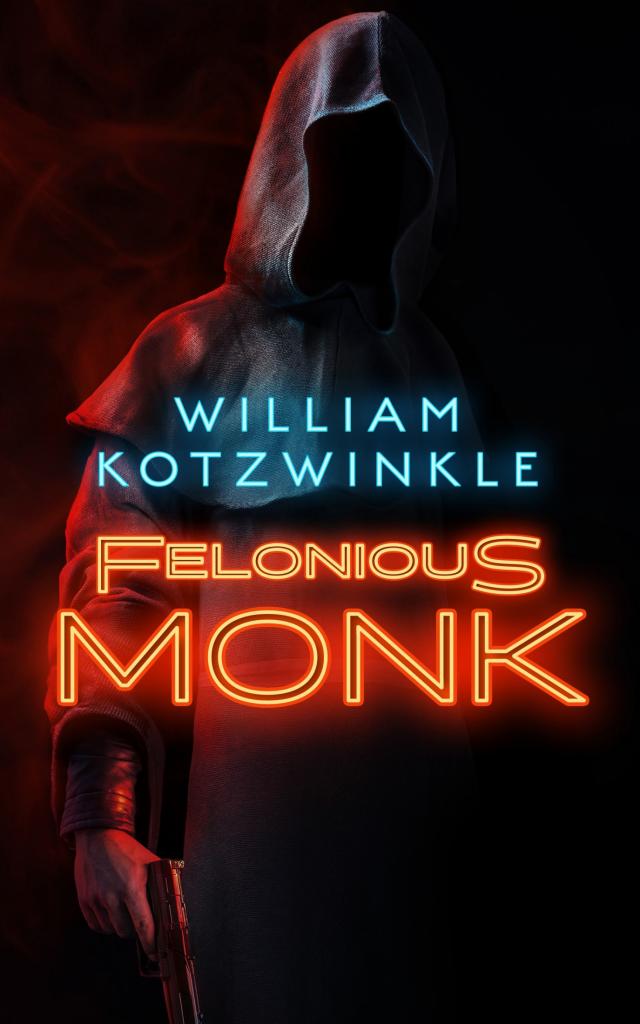


PRAISE FOR FELONIOUS MONK
“Robert Parker and James Crumley come to mind—then quickly get left behind in the rearview mirror. You want Tommy Martini in your corner, not on the other side, and thanks to Kotzwinkle’s unique verve and talents, every reader can be the ex-monk’s best friend—if they dare!”
—PAUL DI FILIPPO,
author of The Big Get-Even and others
“A great legend of the written word has returned with a mighty shotgun blast that proves yet again why we call him a legend…Refreshingly original, ever-inventive, and deeply moving in the most unexpected moments…A virtuoso symphony from one of fiction’s master maestros.”
—Stephen Romano,
author of Resurrection Express and The Riot Act
“Sharp as a razor, wryly humorous, and bursting
with breathless action, Felonious Monk is William
Kotzwinkle at the top of his game. If you’ve never
read him before, this is a great place to start!”
—Nicholas Kaufmann,
Thriller Award–nominated author of
Chasing the Dragon and The Hungry Earth
“A savage, white-hot noir overflowing with humor darker than Vantablack. Uncompromising, page-turning, genre-bending—James Cain on nitrous and LSD. Kotzwinkle firing on all cylinders = the best thriller of the year.”
—John Altman,
author of The Korean Woman and others
“A wild ride of double-crossing crimes…This hard-
boiled mystery benefits from its frequent injections
of humor and its appealing characters…Tommy’s
interior dialogue is entertaining; his struggles
to reintegrate with normal life are thought
provoking…A character-driven thriller.”
—Foreword Reviews
“[A] nimble comic thriller…Fans of Donald
Westlake’s action-packed, screwball crime fiction
will hope Martini will be back for an encore.”
—Publishers Weekly
Other Books by William Kotzwinkle
Elephant Bangs Train (short stories)
Hermes 3000
The Fan Man
Nightbook
Swimmer in the Secret Sea
Doctor Rat
Fata Morgana
Herr Nightingale and the Satin Woman
Jack in the Box
Christmas at Fontaine’s
Queen of Swords
Jewel of the Moon (short stories)
The Exile
The Midnight Examiner
The Hot Jazz Trio (short stories)
The Game of Thirty
The Bear Went over the Mountain
The Amphora Project
Copyright © 2021 by William Kotzwinkle
E-book published in 2021 by Blackstone Publishing
Cover design by Kathryn Galloway English
All rights reserved. This book or any portion
thereof may not be reproduced or used in any manner
whatsoever without the express written permission
of the publisher except for the use of brief quotations
in a book review.
The characters and events in this book are fictitious.
Any similarity to real persons, living or dead, is coincidental
and not intended by the author.
Trade e-book ISBN 978-1-0940-1771-6
Library e-book ISBN 978-1-0940-1770-9
Fiction / Crime
CIP data for this book is available from the Library of Congress
Blackstone Publishing
31 Mistletoe Rd.
Ashland, OR 97520
www.BlackstonePublishing.com
1
Midnight kidnappings, street warfare, and murder in broad daylight are typical for Modelo. It’s in the Sovereign State of Chihuahua, Mexico. I was supposed to be in the sovereign state of grace, as a monk in the monastery of San Juan Diego. I fell from grace one afternoon.
I went to Modelo to buy hay and oats for our horses. The monastery had been my home for the past five years, during which a drug lord known as the Camel came to power in Modelo.
“Hey, Brother Martini, how you doing!” called the regulars loafing about as I parked the monastery truck at the feed store.
I answered them in the passable Spanish I’d learned during my five years. Strictly speaking, I shouldn’t have talked to them, but the monastery relaxes that rule in the interest of getting along in town. On the day I fell from grace, I was approached by a woman I’d never met before, but it was clear she had been waiting for me.
“Father, can you help me?”
I was only twenty-six years old and hardly worthy of being called “Father.” She was about thirty, and her clothes looked homemade. She was poor and there was pain in her face.
“I’m at your service, senora.”
“The layabouts are watching us,” she said. “Can you walk with me away from such eyes?”
We walked toward the plaza fountain. She said quietly, as if fearing that the plaza could hear us, “The Camel is recruiting my son. This is a knife in my heart. He’s only thirteen.”
“What does he say about this?”
“His friends have gone over to the Camel.”
When your friends go, you go. In the Sovereign State of Chihuahua, thirteen-year-old assassins are common.
“The Camel wants to give him a gun and show him how to use it.” She was gazing into the water of the fountain, as at something holy. “But my boy has been going to the School for Social Improvement. He wants to become something better.”
I’d spent my years in the monastery making up for a single bad moment of my own. Like her son, I wanted to become better. So I was sympathetic to her problem.
She dipped her hand in the water, her small fingers playing in the ripples. “My husband is dead. He was shot one night.”
People were often shot at night around Modelo, for reasons that usually had to do with the Camel. She said, “I’m alone in this matter.”
“Perhaps not,” I said.
She lifted her face toward mine. I saw the struggle of thirteen years in her eyes, to raise a son in poverty yet hope that he escapes the corruption that breeds everywhere in the Sovereign State of Chihuahua. I followed her from the plaza.
She said, “The cartel devils know that if a boy is older, he may think about what will happen to him. At thirteen, he doesn’t think. He grabs a gun and shoots someone.”
She led me to the place where her son was to meet the recruiter. It was a bus stop, and across the street was a restaurant. Parked in front of it was an SUV with the window rolled down. The man at the wheel was a Camel assassin named Bustamante. He swaggered around Modelo each day in aviator sunglasses, gold chains gleaming on his neck.
The bus from the School for Social Improvement pulled to the curb, and the woman pointed out her son to me as he stepped down. Then she withdrew so that he wouldn’t see her. He was walking toward the SUV when I intercepted him.
“Do you like horses?”
He looked at me, startled.
I continued, “Horses can tell a predator by its eyes.”
I was breaking the momentum of his thought, the one he’d been turning over all day—a thought of glory and power.
“The son of a bitch waiting for you is a predator. Do you know what a horse does when he sees a predator?”
“No.” He was staring at a six-foot-tall monk who had come out of nowhere, like something from a dream.
I said, “A horse is made for running. It’s not lack of courage. Running is a power, do you understand?”
I heard the door of the SUV opening. I had expected that. Saving this boy would require a demonstration.
I said to him, “If, for some reason, the horse can’t run, he kicks. His kick can crush the skull of a mountain lion.”
From the moment I spoke to the woman, I had joined myself to folly. Now I was deep in it, about to throw five years into the flames.
The boy was staring past me, toward Bustamante. His eyes told me how close the man was. At the correct moment, I turned with the full force of my two hundred pounds, grabbing him by the throat. His aviator sunglasses flew off his face.
I heard the other door of the SUV open quickly. I had expected this too.
Using Bustamante as a shield against his partner, I looked at the boy and said, “Run like the horse. Run to the world of the spirit. This man is the turd of a coyote.”
Spanish has a natural formality and eloquence built into it. I often think it was meant for moments like this. The boy stared at me, and I saw he was at that place we rarely get to, when a wild chance appears.
He ran, not with fear but with the spirit.
Bustamante’s partner was swaggering confidently toward us, in preparation for solving the problem. He was a cartel specialist who built impenetrable security systems for his employer’s many residences. I heard him rack a round into the chamber of his automatic. But he was not about to shoot Bustamante in the back to get at me.
Bustamante’s eyes bulged as I held his throat. He couldn’t breathe, and his feeble punches merely caught in my robe. I shifted him slightly so that he continued to shield me.
When the partner reached us, I drove Bustamante into him, plowin
g them both backward and smashing the security specialist against their SUV. He crumpled to the street, unconscious and out of the fight. I held Bustamante in the air. His face had now turned blue.
Each day after morning prayer, I opened a medicine bottle and tapped out a little pill to control my anger. You might think it wasn’t working, but it was, because instead of following the urge to drive Bustamante’s head through the window of his SUV, I dropped him onto his partner. As he clutched at his throat, trying to get more air, I removed the pistol from his belt. I got his partner’s gun too. I was now a monk with a pistol in each hand.
I returned to the feed store and bought the hay and oats I’d come for.
2
Our abbot was a man who had worked half his life on the mountain slopes of northern Chihuahua, harvesting candelilla plants and then processing them over poisonous fumes of sulfuric acid to turn them into wax. With the same strong purpose, he processed a group of unruly men into a unity of spirit. When we chanted, his rich bass voice seemed to come out of the earth, and in those deep tones we heard his faith and his sacrifice. The wild life he loved, on the mountain slopes, was inside him now. We felt his longing for that life—a match to our own longing and our own sacrifice.
When I received the order to go to his office, I prepared myself for a lecture and heavy penance. A few bare bulbs lit the way to him. The stone floor was worn from the tread of generations of silent men. The stone walls breathed cold, moist air, the air of renunciation.
When I entered the abbot’s office, he said, “The boy’s mother got word to me about your intervention.”
His big hands were covered with burn scars, and there was a scar across his forehead where a vat of sulfuric wax had once exploded in his face. “Her message was accompanied by a dozen tortillas, which will be on our table tonight.”
“I regret subjecting the monastery to reprisals.”
“I baptized the Camel’s son. There will be no reprisals. But dealing with such a man is complicated. He hires children to kill for him, but he also gives tractors to farmers, and soccer equipment to schools. But Bustamante never gave anyone anything but a bullet in the back of the head. So I don’t reproach you for what you did. I would have enjoyed doing it myself. But Bustamante is your enemy now. However, we won’t worry about that until you come back.”
“Am I going somewhere?”
“Your uncle has sent for you. He’s dying.”
My uncle had brought me here five years ago, during my bad moment.
“You should go to him,” the abbot continued. “He’s been your protector.”
“I’ll make my travel arrangements now.”
“I’ve made them for you. You fly to Phoenix tomorrow morning.”
3
In the air, with a bright layer of clouds below me, I prayed for my uncle and for the young man I had killed in a barroom five years before.
At Sky Harbor International in Phoenix, I rented a Chevy Impala. I could have had a Chevy Spark for ten bucks less, but guys my size don’t fit well in small cars. The Impala moved me along easily through the high desert country of Arizona, but when I pushed down hard for more power, I felt a lazy transmission. And on fast turns, the suspension didn’t accommodate the g-forces very well. I’d grown up in a car mechanic’s family. I knew all about cars, had worked on them, raced them, and put them behind me, but I couldn’t resist testing the Impala. Conclusion: same old General Motors, two steps behind. But the speaker system, while not up to the acoustics of an old Mexican monastery, did the job. I was listening to a CD the abbot had given me on my departure: the Benedictine monks of Fontgombault in France. “These are the best,” he’d said. “You’ll need them out in the world.”
He was right. The world was calling me with a strength that seemed supernatural. I’d gotten used to narrow stone corridors, frankincense and solemn bells, and the support of men who had chosen renunciation. Their support had been largely silent, but the strength of their commitment somehow found me, and I felt what might be called grace.
Now a barren desert called me with its distances, with its tumbleweed crossing the road in front of me and telling me to just keep rolling. The mountain peaks said I could lose myself in them just as easily as in a monastery.
Landscapes without human habitations appeal to the spirit. They, too, instruct in silence, but they don’t demand abstinence.
I was vulnerable outside the monastery. What faith I had was built on ritual. When you wake each day to solemn morning bells and walk with other monks in silence to a chapel laden with the smell of frankincense, even the statues seem to speak. Tiers of red votive candles offered to the dead are a form of eloquence.
A coyote crossed the road in front of me. Every particle of its being was in readiness. A coyote doesn’t require ceremony to stay focused on what matters.
Benedictine monks chanted from the four speakers surrounding me. “The man of God, Benedict, was full of the spirit; may he intercede for all those of the monastic profession . . .”
I’d escaped having to go to Catholic high school, because the football team wasn’t good enough and I wanted to bang heads with the best. A wrestling scholarship took me to the state university, and during the summers, to keep in fighting form, I worked as a bouncer. And then I killed someone and wound up in a monastery. I didn’t rediscover my religion. I found peace of mind. And now, after just twenty-four hours, I felt it slipping away from me.
I got off the interstate, onto an old two-lane highway. It had once been important; now it was almost abandoned. I followed it north for two hours, and only a few cars appeared from the other direction. Occasionally, I saw a ranch house reached by a dirt road that wound through low hills. I saw a solitude that rivaled or surpassed the monastery’s. Whoever lived out here was going it alone. Maybe there were ranch hands. Maybe there was family. I saw no one.
Finally, the old highway connected with a more traveled road. The low hills gave way to dramatic outcroppings of rock. The rocks turned red and massive, and suddenly I was seeing formations that were surreal—huge red shapes reminiscent of Eastern temples and Egyptian tombs, spires of red rock shaped by wind and rain over millions of years. I was approaching Paloma. And Paloma knew that it was blessed by these ancient red shapes. Shops, restaurants, and motels began to line the road. Solitude was no longer the theme of the landscape.
I felt uneasy. Now I was going to have to cope with the real temptations of the world, but I told myself I was being unnecessarily cautious. I wasn’t entering Sodom and Gomorrah, only a tourist town in the desert.
Dominating the skyline was a mountain that looked like an enormous red eagle’s head. This majestic image was diminished by a nearby five-star hotel whose illuminated sign indicated it was hosting the 25th Annual National UFO Convention.
This was the town my uncle had chosen for his retirement. I assumed that it was not for things like the UFO conference. His address was in my GPS, and I followed directions into the center of town, then turned onto Thunderbird Road. Modest bungalows lined both sides. I kept preparing to stop, expecting one of them to be his.
But the GPS took me higher, and the houses got bigger. They were no longer bungalows. They were expensive dwellings of smoothly rounded adobe in the pueblo style, with beautiful red-tiled roofs. Round, polished beams protruded from the adobe walls. Other wooden beams framed elaborate entranceways. These had to be the homes of well-to-do retirees or working professionals with plenty of extra money for celebrating stylish desert living. They weren’t priests, which is what my uncle had been. How had he gotten the money to live here?
Thunderbird Road took me to the base of Storm Mountain. It was another red rock temple, and my uncle’s house, as upscale as any I’d seen, was directly across from it. The old priest had done very well for himself.
My cousins had gotten to Uncle Vittorio’s house ahead of me, all of them watching each other to make sure nobody swiped anything, for the blood of the Mafia was in all our veins.
4
My cousin Angelina, who cheated at cards in our childhood, put her arms around me, giving me the feeling I always had with her—that she was picking my pocket.