

Complete science fiction.., p.31
Complete Science Fiction 01 Immodest Proposals,
p.31
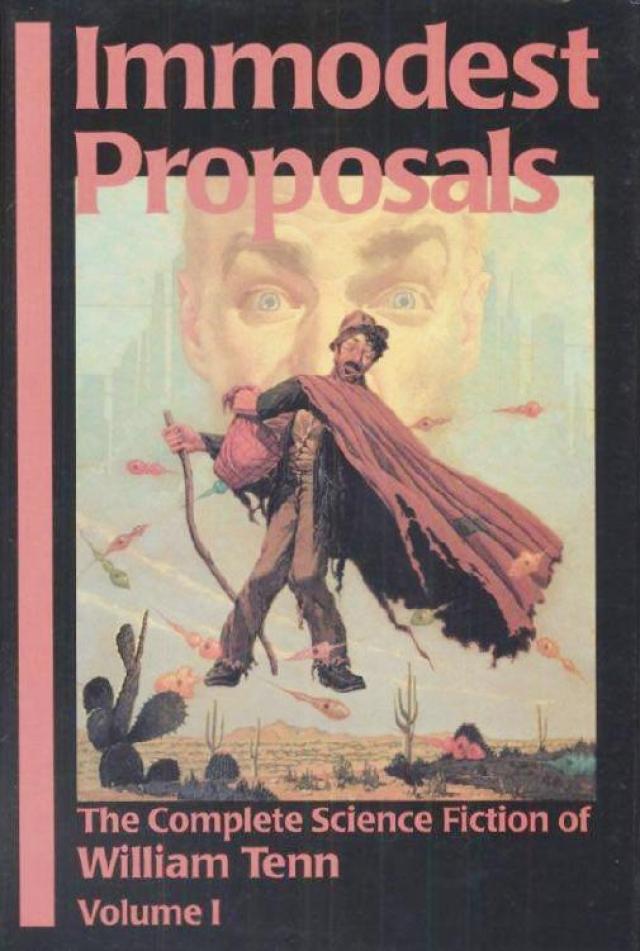


His head hanging, his body exhausted, Jerry muttered in misery, “Yes. All the Indian nations on our borders have hostages. As earnests of our good will and peaceful intentions.”
Bright Book Jacket snapped his fingers. “That girl. Sarah Cameron—Canton—what’s-her-name.”
Jerry looked up. “Calvin?” he asked. “Could it be Calvin? Sarah Calvin? The Daughter of the Chief Justice of the United States Supreme Court?”
“Sarah Calvin. That’s the one. Been with us for five, six years. You remember, chief? The girl your son’s been playing around with?”
Three Hydrogen Bombs looked amazed. “Is she the hostage? I thought she was some paleface female he had imported from his plantations in southern Ohio. Well, well, well. Makes Much Radiation is just a chip off the old block, no doubt about it.” He became suddenly serious. “But that girl will never go back. She rather goes for Indian loving. Goes for it all the way. And she has the idea that my son will eventually marry her. Or some such.”
He looked Jerry Franklin over. “Tell you what, my boy. Why don’t you wait outside while we talk this over? And take the saber. Take it back with you. My son doesn’t seem to want it.”
Jerry wearily picked up the saber and trudged out of the wigwam.
Dully, uninterestedly, he noticed the band of Sioux warriors around Sam Rutherford and his horses. Then the group parted for a moment, and he saw Sam with a bottle in his hand. Tequila! The damned fool had let the Indians give him tequila—he was drunk as a pig.
Didn’t he know that white men couldn’t drink, didn’t dare drink? With every inch of their unthreatened arable land under cultivation for foodstuffs, they were all still on the edge of starvation. There was absolutely no room in their economy for such luxuries as intoxicating beverages—and no white man in the usual course of a lifetime got close to so much as a glassful of the stuff. Give him a whole bottle of tequila and he was a stinking mess.
As Sam was now. He staggered back and forth in dipping semicircles, holding the bottle by its neck and waving it idiotically. The Sioux chuckled, dug each other in the ribs and pointed. Sam vomited loosely down the rags upon his chest and belly, tried to take one more drink, and fell over backwards. The bottle continued to pour over his face until it was empty. He was snoring loudly. The Sioux shook their heads, made grimaces of distaste, and walked away.
Jerry looked on and nursed the pain in his heart. Where could they go? What could they do? And what difference did it make? Might as well be as drunk as Sammy there. At least you wouldn’t be able to feel.
He looked at the saber in one hand, the bright new pistol in the other. Logically, he should throw them away. Wasn’t it ridiculous when you came right down to it, wasn’t it pathetic—a white man carrying weapons?
Sylvester Thomas came out of the tent. “Get your horses ready, my dear sir,” he whispered. “Be prepared to ride as soon as I come back. Hurry!”
The young man slouched over to the horses and followed instructions—might as well do that as anything else. Ride where? Do what?
He lifted Sam Rutherford up and tied him upon his horse. Go back home? Back to the great, the powerful, the respected capital of what had once been the United States of America?
Thomas came back with a bound and gagged girl in his grasp. She wriggled madly. Her eyes crackled with anger and rebellion. She kept trying to kick the Confederate Ambassador.
She wore the rich robes of an Indian princess. Her hair was braided in the style currently fashionable among Sioux women. And her face had been stained carefully with some darkish dye.
Sarah Calvin. The daughter of the Chief Justice. They tied her to the pack horse.
“Chief Three Hydrogen Bombs,” the Negro explained. “He feels his son plays around too much with paleface females. He wants this one out of the way. The boy has to settle down, prepare for the responsibilities of chieftainship. This may help. And listen, the old man likes you. He told me to tell you something.”
“I’m grateful. I’m grateful for every favor, no matter how small, how humiliating.”
Sylvester Thomas shook his head decisively. “Don’t be bitter, young sir. If you want to go on living you have to be alert. And you can’t be alert and bitter at the same time. The Chief wants you to know there’s no point in your going home. He couldn’t say it openly in council, but the reason the Sioux moved in on Trenton has nothing to do with the Seminole on the other side. It has to do with the Ojibway-Cree-Montaignais situation in the North. They’ve decided to take over the Eastern Seaboard—that includes what’s left of your country. By this time, they’re probably in Yonkers or the Bronx, somewhere inside New York City. In a matter of hours, your government will no longer be in existence. The Chief had advance word of this and felt it necessary for the Sioux to establish some sort of bridgehead on the coast before matters were permanently stabilized. By occupying New Jersey, he is preventing an Ojibway-Seminole junction. But he likes you, as I said, and wants you warned against going home.”
“Fine, but where do I go? Up a rain cloud? Down a well?”
“No,” Thomas admitted without smiling. He hoisted Jerry up on his horse. “You might come back with me to the Confederacy—” He paused, and when Jerry’s sullen expression did not change, he went on, “Well, then, may I suggest—and mind you, this is my advice, not the Chief’s—head straight out to Asbury Park. It’s not far away—you can make it in reasonable time if you ride hard. According to reports I’ve overheard, there should be units of the United States Navy there, the Tenth Fleet, to be exact.”
“Tell me,” Jerry asked, bending down. “Have you heard any other news? Anything about the rest of the world? How has it been with those people—the Russkies, the Sovietskis, whatever they were called—the ones the United States had so much to do with years and years ago?”
“According to several of the Chief’s councilors, the Soviet Russians were having a good deal of difficulty with people called Tatars. I think they were called Tatars. But, my good sir, you should be on your way.”
Jerry leaned down further and grasped his hand. “Thanks,” he said. “You’ve gone to a lot of trouble for me. I’m grateful.”
“That’s quite all right,” said Mr. Thomas earnestly. “After all, by the rocket’s red glare, and all that. We were a single nation once.”
Jerry moved off, leading the other two horses. He set a fast pace, exercising the minimum of caution made necessary by the condition of the road. By the time they reached Route 33, Sam Rutherford, though not altogether sober or well, was able to sit in his saddle. They could then untie Sarah Calvin and ride with her between them.
She cursed and wept. “Filthy paleface! Foul, ugly, stinking whiteskins! I’m an Indian, can’t you see I’m an Indian? My skin isn’t white—it’s brown, brown!”
They kept riding.
Asbury Park was a dismal clatter of rags and confusion and refugees. There were refugees from the north, from Perth Amboy, from as far as Newark. There were refugees from Princeton in the west, flying before the Sioux invasion. And from the south, from Atlantic City—even, unbelievably, from distant Camden—were still other refugees, with stories of a sudden Seminole attack, an attempt to flank the armies of Three Hydrogen Bombs.
The three horses were stared at enviously, even in their lathered, exhausted condition. They represented food to the hungry, the fastest transportation possible to the fearful. Jerry found the saber very useful. And the pistol was even better—it had only to be exhibited. Few of these people had ever seen a pistol in action; they had a mighty, superstitious fear of firearms.
With this fact discovered, Jerry kept the pistol out nakedly in his right hand when he walked into the United States Naval Depot on the beach at Asbury Park. Sam Rutherford was at his side; Sarah Calvin walked sobbing behind.
He announced their family backgrounds to Admiral Milton Chester. The son of the Undersecretary of State. The daughter of the Chief Justice of the Supreme Court. The oldest son of the Senator from Idaho. “And now. Do you recognize the authority of this document?”
Admiral Chester read the wrinkled commission slowly, spelling out the harder words to himself. He twisted his head respectfully when he had finished, looking first at the seal of the United States on the paper before him, and then at the glittering pistol in Jerry’s hand.
“Yes,” he said at last. “I recognize its authority. Is that a real pistol?”
Jerry nodded. “A Crazy Horse forty-five. The latest. How do you recognize its authority?”
The admiral spread his hands. “Everything is confused out here. The latest word I’ve received is that there are Ojibway warriors in Manhattan—that there is no longer any United States Government. And yet this”—he bent over the document once more—“this is a commission by the President himself, appointing you full plenipotentiary. To the Seminole, of course. But full plenipotentiary. The last official appointment, to the best of my knowledge, of the President of the United States of America.”
He reached forward and touched the pistol in Jerry Franklin’s hand curiously and inquiringly. He nodded to himself, as if he’d come to a decision. He stood up, and saluted with a flourish.
“I hereby recognize you as the last legal authority of the United States Government. And I place my fleet at your disposal.”
“Good.” Jerry stuck the pistol in his belt. He pointed with the saber. “Do you have enough food and water for a long voyage?”
“No, sir,” Admiral Chester said. “But that can be arranged in a few hours at most. May I escort you aboard, sir?”
He gestured proudly down the beach and past the surf to where the three forty-five-foot gaff-rigged schooners rode at anchor. “The United States Tenth Fleet, sir. Awaiting your orders.”
Hours later when the three vessels were standing out to sea, the admiral came to the cramped main cabin where Jerry Franklin was resting. Sam Rutherford and Sarah Calvin were asleep in the bunks above.
“And the orders, sir…?”
Jerry Franklin walked out on the narrow deck, looked up at the taut, patched sails. “Sail east.”
“East, sir? Due east?”
“Due east all the way. To the fabled lands of Europe. To a place where a white man can stand at last on his own two legs. Where he need not fear persecution. Where he need not fear slavery. Sail east, Admiral, until we discover a new and hopeful world—a world of freedom!”
Afterword
IN 1957, ANTHONY Boucher retired from the wonderful magazine he had helped found, The Magazine of Fantasy & Science Fiction. Bob Mills, the managing editor, needed someone with a substantial background in science fiction to temporarily take Tony’s place, so Cyril Kornbluth was hired as Consulting Editor. There was a heavy snowfall in New York about that time, and Cyril, who suffered from very high blood pressure, made the mistake of hurriedly shoveling his driveway clear so he could get his car out and keep an appointment with Mills. He dropped dead, I believe, in the driveway.
Mills called me and asked me to take a short-time appointment, now filling Cyril’s place. I told him I was honored.
I worked there for about four months, trying to empty one large file drawer where Tony had stashed stories that were just not quite good enough to be published, but still too good to have been rejected. Each story had a special problem: one, for example, by Robert Bloch, “That Hell-Bound Train,” was an absolutely fine piece of work that just didn’t have a usable ending. It was my job, among other things, to come up with such an ending and persuade the writer to write it. I developed a great respect for the editors—chief among them John W. Campbell and Horace L. Gold—I had known and quarreled with a lot, an awful lot.
One of the things Bob Mills asked me to do right off was give him a story by me for the tenth anniversary issue of the magazine. I agreed, and promptly forgot about it as I wrestled with the thick inventory of science fiction written by people I much admired but which always lacked some essential quality or passage.
And then Mills came to my desk at 4:45 p.m. on a Wednesday as I was getting ready to leave, and asked me where it was.
I got into my coat and stared at him. Where what was?
“The story for the anniversary issue. It goes to bed tomorrow. Thursday morning. Dead deadline, Phil!”
In an emergency, my mother had taught me, always lie. “Oh, it’s home,” I said. “I’ll bring it in with me tomorrow morning. I’m pretty sure you’ll like it.”
“How long is it?” Mills wanted to know. “I hope it’ll fit the book. We can’t use much more than about six thousand words.”
“That’s just about what I have,” I told him. “Six or six five. I haven’t counted it yet.”
And I got out of the place.
All the subway ride home, I plotted feverishly, to absolutely no avail. I couldn’t think of a single good idea, certainly none I wanted to write. But as I got out at my station, a large poster advertisement on the platform caught my eye. It was the latest in a group that advertised a Jewish rye bread, each showing a color photograph of someone of a different, non-Jewish ethnic group proclaiming that he or she simply adored Jewish rye. This one was of an American Indian in full feathered headdress.
I ran up to the ad and, to the astonishment I suspect of everyone on the platform hurrying home that night, blew a couple of kisses at it. That was my story, I knew immediately.
And by the time I reached my house in Sea Gate at the Coney Island tip of Brooklyn, I had worked it out almost completely.
Ever since my boyhood, I had been fascinated by the Indian story—or the many Indian stories, perhaps I should say. When I was a kid and my gang played Cowboys and Indians, I always insisted on being one of the Indians. I did it partly out of a partiality for the exotic, but mostly out of a kind of an apology.
What was I apologizing for? I’m not sure. Possibly for what my people had done to them. (My people? My people came from ghettos in Poland and Lithuania! Oh, well, maybe my people, the Cowboys.)
I swallowed the supper Fruma had prepared for me and rushed to my typewriter. I began typing almost immediately.
I stopped only to go to the bathroom. By the time dawn broke over the end of the boardwalk, the story was done.
It needed very little rewriting, and once I did that, the piece came to sixty-four hundred words almost exactly. For a title, I went back to a book by a writer whose work I had loved since the age of twelve, Charles Kingsley, the vicar of Eversley. And I had a story that was science fiction and also what I liked to write those days—a moral tale. I decided that I too adored Jewish rye.
Bob Mills liked it too, the story, not the bread. And I’ve always been quite fond of what I call my science-fiction western.
Written 1957 / Published 1958
Null-P
SEVERAL MONTHS AFTER the Second Atomic War, when radioactivity still held one-third of the planet in desolation, Dr. Daniel Glurt of Fillmore Township, Wisc., stumbled upon a discovery which was to generate humanity’s ultimate sociological advance.
Like Columbus, smug over his voyage to India; like Nobel, proud of the synthesis of dynamite which made combat between nations impossible, the doctor misinterpreted his discovery. Years later, he cackled to a visiting historian:
“Had no idea it would lead to this, no idea at all. You remember, the war had just ended: we were feeling mighty subdued what with the eastern and western coasts of the United States practically sizzled away. Well, word came down from the new capital at Topeka in Kansas for us doctors to give all our patients a complete physical check. Sort of be on the lookout, you know, for radioactive burns and them fancy new diseases the armies had been tossing back and forth. Well, sir, that’s absolutely all I set out to do. I’d known George Abnego for over thirty years—treated him for chicken-pox and pneumonia and ptomaine poisoning. I’d never suspected!”
Having reported to Dr. Glurt’s office immediately after work in accordance with the proclamation shouted through the streets by the county clerk, and having waited patiently in line for an hour and a half, George Abnego was at last received into the small consulting room. Here he was thoroughly chest-thumped, X-rayed, blood-sampled, and urinanalyzed. His skin was examined carefully, and he was made to answer the five hundred questions prepared by the Department of Health in a pathetic attempt to cover the symptoms of the new ailments.
George Abnego then dressed and went home to the cereal supper permitted for that day by the ration board. Dr. Glurt placed his folder in a drawer and called for the next patient. He had noticed nothing up to this point; yet already he had unwittingly begun the Abnegite Revolution.
Four days later, the health survey of Fillmore, Wisc., being complete, the doctor forwarded the examination reports to Topeka. Just before signing George Abnego’s sheet, he glanced at it cursorily, raised his eyebrows and entered the following note: “Despite the tendency to dental cavities and athlete’s foot, I would consider this man to be of average health. Physically, he is the Fillmore Township norm.”
It was this last sentence which caused the government medical official to chuckle and glance at the sheet once more. His smile was puzzled after this; it was even more puzzled after he had checked the figures and statements on the form against standard medical references.
He wrote a phrase in red ink in the right-hand corner and sent it along to Research.
His name is lost to history.
Research wondered why the report on George Abnego had been sent up—he had no unusual symptoms portending exotic innovations like cerebral measles or arterial trichinosis. Then it observed the phrase in red ink and Dr. Glurt’s remark. Research shrugged its anonymous shoulders and assigned a crew of statisticians to go further into the matter.


