Kill or die, p.23
Kill or Die,
p.23
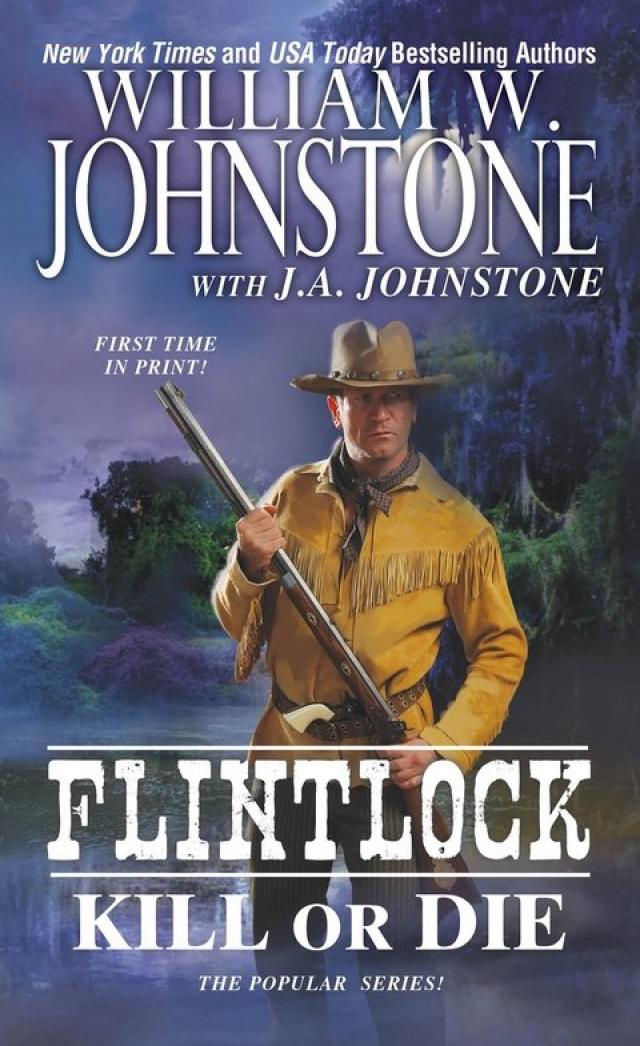


Rising groggily to his feet, Flintlock pulled his Colt from his waistband. He staggered toward O’Hara in time to see the man’s left arm in the alligator’s jaws. Basilisk, his reptilian eyes emotionless, dragged O’Hara toward the swamp. At a range of just a few feet, Flintlock emptied his Colt into the alligator’s side. Basilisk bellowed and thrashed and released O’Hara. But then the alligator swung toward Flintlock, its jaws gaping. Flintlock stumbled back, fell and immediately with incredibly savage violence Basilisk clamped onto his booted right ankle. The crushing pain made Flintlock cry out and he felt himself being dragged toward the swamp. He reached out for his fallen Winchester but both his hand and the rifle were wet and muddy and it slipped through his fingers.
Then he was in the water and the alligator went into its death roll. Flintlock turned with Basilisk, but even so it felt as though his leg was about to be wrenched from his body. He steeled himself for some moments of tearing, searing agony and hoped that his death would be quick.
But then . . . nothing.
Basilisk, as huge around as a cypress trunk, lay on his back, his white belly turned to the rain and black sky. Blood stained the water around him. Flintlock heard a splash and then strong hands grabbed him and pulled him back to shore. O’Hara looked down on him, his face close. “How bad are you hurt?” he said.
“Bad,” Flintlock said.
“Me too,” O’Hara said. “Can you walk?”
“I don’t know.”
“Then try.”
“I killed him, O’Hara,” Flintlock said. “I got five shots into him.”
“Next time bring a bigger gun,” O’Hara said. “He could have torn you apart before he died. Now, let’s see if I can help you get to your feet.”
“He got your arm,” Flintlock said.
O’Hara looked down at his shredded and bloody left arm. “Seems like,” he said.
“Does it hurt?”
“Of course it damn well hurts. Are you crazy?”
“Sorry,” Flintlock said. He checked to make sure that Evangeline’s scarf was still in place and then climbed to his feet. He couldn’t put any weight on his mangled ankle. “I don’t think I can make it to my horse.”
“You’d better. I’m sure as hell not carrying you and I’m not bringing the horses over here. I’d make it once, maybe, but not twice.”
Flintlock turned his face to the pounding rain. Then he sighed deeply and said, “All right, let’s try.”
“I got a bottle of Old Crow in my saddlebags,” O’Hara said. “It’s yours when you get there. A prize for being brave.”
“Where the hell did you get that?”
“I stole it from the hotel kitchen before we left.”
“Damn it, O’Hara, sometimes you act the white man and make me real proud of you,” Flintlock said. “Shall we proceed?”
“We’d better,” O’Hara said. “When them little alligators get through eating the big alligator they might look at us as dessert.”
Flintlock groaned as he took a step, then said, “You like that word, don’t you, O’Hara?”
“Sure do. It’s the kind of word can take a man far, help him make a name for himself and be somebody.” Flintlock cursed his pain and O’Hara said, “But he won’t get real far with that word, Sammy.”
“Well, I only want that word to get me as far as my horse,” Flintlock said. He grimaced. “Now you’re gonna hear some more of them words. Air out your lungs, O’Hara, we’ll have at it together.”
The two bloody, battered men turned the air around them blue with string after string of curses . . . it took them awhile, but they made it to their horses.
The storm hadn’t yet played out its string. In crashing thunder and pounding rain, Flintlock and O’Hara found shelter of sorts in a hole created by the roots of a toppled pine. They passed the whiskey bottle back and forth and gradually began to feel better, but O’Hara’s tattered arm streamed blood and rain and Flintlock’s ankle swelled inside his tooth-scarred boot, causing him considerable suffering.
“That’s got to come off, Sammy,” O’Hara said.
“I tried to pull it off but it’s impossible. Hurts like hell.”
“I’ll cut it off,” O’Hara said.
“It’s the only boot I own.”
“You got a second one.”
“Damn it, O’Hara, it’s on my other foot.”
“It’s got to come off, let your ankle swell,” O’Hara said. “Besides, you may have wounds that need cleaned.”
“You’ll need to cut it. Damn, I’ve had that there boot for years.”
“Seems like,” O’Hara said, his face straight.
It took a lot of pain, a lot of cursing and a lot of wild accusations from Flintlock that O’Hara was an Apache in disguise and a lot of desperate swigs from the Old Crow bottle, but the boot finally came off. “Broke, I think,” O’Hara said.
“Broke, I know,” Flintlock said. “And you made it worse. Look at the size of the swelling. Hell, how’s your arm, O’Hara? Your blood is all over me.”
Thunder crashed and O’Hara waited until the sound rolled away and then said, “We both need a doctor, Sammy. Once the storm passes we’ll mount up.”
“That’s going to be a sight to see,” Flintlock said.
CHAPTER SIXTY
“Well, that’s a sight to see,” Dr. Oliver D. Toler said. “Mr. O’Hara, you’re lucky you still have your arm.”
“Will you look at my ankle, Doc?” Flintlock said.
“I can stitch it up, but there is some tissue loss and you may never have your full strength in this arm again,” Dr. Toler said. “And I’m afraid there will be scarring. It’s a large wound.”
“It was a large alligator,” O’Hara said.
“What about my ankle, Doc?” Flintlock said.
“Nurse Meadows, clean up Mr. O’Hara’s arm, please. I want to get started on it right away.”
“Anybody going to look at my ankle, Doc?” Flintlock said.
“Mr. Flintlock, it’s a bad sprain,” the doctor said. “I’ll bind it up for you later. Now tell me, in the name of God, how can someone escape the jaws of an alligator and suffer only a sprain?”
“I’d already shot it, Doc,” Flintlock said. “Maybe it wasn’t feeling too good.”
“I don’t agree with killing animals,” Nurse Millie Meadows said. She was a tall thin woman, with a little steel purse of a mouth that snapped open and shut and slightly protruding blue eyes. She carried a brown bottle and a swab.
“You would have agreed with killing Basilisk,” Flintlock said. “He’d been a man-eater for two hundred years and maybe longer.”
“We’re all God’s creatures, Mr. Flintlock.” Then to O’Hara, “This stuff stings like crazy, so you must be a brave little soldier.”
Flintlock watched the nurse start to clean up O’Hara’s arm. “Does it sting?” he said.
“Like crazy,” O’Hara said, his mouth tight.
“You’re next, Mr. Flintlock,” Nurse Meadows said. “Let’s hope you’re as brave a little soldier as your friend.”
“Tough to be brave when the nurse from Hell is bandaging up a broken ankle,” Flintlock said.
“It’s only sprained,” O’Hara said.
“It felt like it was broke.”
“Yeah, well my arm felt as though he was sawing it off at the elbow,” O’Hara said. “Ah, here’s the restaurant, Ma’s Kitchen. And Doc Toler was right. They are looking for a dishwasher.”
Flintlock glanced at the sign in the window and said, “I say we ride on out of here. Look at this town, there’s hardly enough people left to dirty dishes.”
“Sam, you heard what the doc said—we need to stay in town for a few weeks to make sure my arm doesn’t get infected,” O’Hara said. “Besides, we’re broke. How are we going to reach the Arizona Territory without a grubstake?”
Flintlock had a borrowed crutch under his arm, a fat bandage on his foot, and O’Hara’s arm was in a sling.
“And you need boots,” O’Hara said.
“I can’t stand on a bad ankle and wash dishes,” Flintlock said.
“I reckon they’ll give you a chair, Sammy. And Doc says Ma is paying fifty cents a day. That’s good money around these parts.”
“O’Hara, maybe I could gun an outlaw along the trail and claim the reward,” Flintlock said. “It’s time I went back to practicing my old profession anyhow. I’d say it’s a plan that beats dishwashing.”
“Too thin, Sam. We need fifty cents a day to survive while my wounds heal. You heard what Dr. Toler said about gangrene. I could lose my arm.”
Flintlock’s shoulders slumped. “All right,” he said, “I got no other choice but to put my head in the noose.”
A couple of men were eating a late lunch when Flintlock stepped into the restaurant. “Take a seat,” a large woman said. “God knows there’s enough of them.” Then, after looking Flintlock up and down from the tattoo on his throat to his bandaged ankle, she said, “What the hell are you?”
“I’m a dishwasher,” Flintlock said.
“No, he ain’t, Ma.” One of the diners stood. “He’s the ranny that robbed the bank.”
“I gave the money back,” Flintlock said.
“It was Mathias Cobb who was the real robber, Elmer,” Ma said. “He’s the one who destroyed this town.”
“You can’t trust that outlaw, Ma,” the man called Elmer said. “He’ll rob you blind.”
“Hell, I got nothing much left to rob,” Ma said. “And I need a dishwasher. Kitchen’s that way, mister, and the wage is fifty cents a day and grub. You can bed down in the kitchen if you got nowhere else to live and by the look of you, you don’t.”
Flintlock touched his hat. “I’m much obliged, ma’am. Name’s—”
“I don’t care what your name is. You can call me Ma. I’ll get you a chair so you can sit at the sink. Well? Get started.”
When Flintlock stepped into the kitchen he was appalled. His predecessor must have quit a while back because there were teetering pillars of dirty plates, mountains of pots and pans and tangled masses of silverware.
Flintlock found an apron and started in to earn his fifty cents.
Six weeks later Ma closed her kitchen for lack of customers. She said she was moving to Philadelphia to live with her widowed sister. By then O’Hara’s arm was healing nicely and Sam Flintlock’s ankle was back to normal. Ma, impressed by Flintlock’s efforts, told him he was a credit to the dishwashing profession and she filled a couple of sacks with leftover grub for the trail. “I hope you find your ma, Sam,” she said as she closed the restaurant door for the last time.
Three days later Dr. Toler took down his shingle and moved on with Nurse Meadows, who was now his bride, and the saloon closed the very same day. Flintlock and O’Hara had kept their horses at the abandoned livery and the animals had gone through all the hay and oats that had been left behind and were in fine shape for the trail.
Matthew Garry, the general store owner, sold his entire stock “at below cost,” and Flintlock and O’Hara were able to outfit themselves for the coming winter cheaply.
As they rode out of Budville under a clear fall sky, O’Hara said, “I’m looking forward to a peaceful trail, Sammy, shooting my own grub along the way and sleeping on dry land under the stars.”
“That makes two of us,” Flintlock said. “You know, I’ve been thinking. I believe I could prosper in the restaurant business.”
“Why not? Ma gave you some good dishwashing experience and that’s all it takes, experience.”
“Well, I’ll find my ma and then decide,” Flintlock said. “Just plain home cooking, mind, steaks and eggs and pork chops. Nothing fancy.”
“Why, the more I think on it, the more I feel it’s a crackerjack idea, Sammy,” O’Hara said. “I’d like to throw in with you.”
“Sure,” Flintlock said. He extended his hand. “It’s a deal.”
“What are we going to call our place?”
“The Evangeline,” Flintlock said.
And O’Hara said, “Crackerjack!”
CHAPTER SIXTY-ONE:
Afterward
Sam Flintlock and his half-breed sidekick O’Hara found the town of Bearsden by accident. It was an ill-starred discovery that they very soon would have cause to regret.
They were twenty miles south of the New Mexico Territory and a few miles east of the southernmost ridges of the Guadalupe Mountains in the rugged Delaware Basin country when Flintlock said he smelled a pig on a spit.
“Wind’s blowing from the north, so it’s got to be just ahead of us,” he said. “Man, I could eat some of that.”
“I smell it too, but I never heard tell of any settlement around this part of the country,” O’Hara said.
“Well, maybe it’s a ranch cookout or even a hunting party,” Flintlock said. “I sure aim to find out.”
The vast bulk of the Guadalupe looked like a great monolithic wall through the desert erected by a giant race of men in times past. But that was deceptive. Within the wall lay dramatic canyons, hanging valleys and shady glades surrounded by desert scrub and a profusion of wildlife.
Flintlock said, “Why not build a town around here? It’s as good a place as any.”
O’Hara nodded. “There’s something not setting right with me, Sam. I have the feeling we’re riding into—”
“Danger?”
“I don’t know. Something . . . bad.”
“That’s the Injun in you talking, O’Hara. Injuns reckon there’s evil spirits and such just around every bend of the trail.”
O’Hara shook his head, his long black hair moving across his shoulders. “I can’t shake it, Sam. I say we ride on.”
“Look!” Flintlock said, pointing. “See how wrong you are? It’s a town all right and I bet they’re roasting a pig.”
Ahead of them lay a one-street town like thousands of others in the West, dusty, dry and barely clinging to life. But for two hungry and thirsty men it was an oasis in the desert, as bright and beckoning as any big city back east.
“Grin, O’Hara. Look, stretch your mouth wide like me.”
“Why?” O’Hara was always inclined to surliness when something troubled him.
“Because we’re flat broke and we’re depending on the generosity of others. Now grin, like we’re visiting kinfolk.”
O’Hara tried, but his grin came off as a grimace. It didn’t really matter because when they rode into the street Flintlock’s own grin vanished like frost in sunlight. A gallows, hung with red, white and blue bunting, had been erected at the entrance to the town and a booted man hung from a hemp noose. His neck was twisted to one side, his tongue lolled out of his mouth and his eyes, bulging out of his head, were wide open. But he’d ceased to see anything hours before when his neck broke.
A sign on the gallows said, WELCOME TO BEARSDEN.
But there was no one around to form a welcoming committee. The street was deserted.
Tables laden with food, fried chicken, great haunches of beef, cakes, pies and even a melting tub of ice cream lined the boardwalk. The pig Flintlock had smelled was spiked on a spit but since there was no one to turn the handle the huge hog had begun to char and dripped fat into the flames of the fire. All the stores were bright with bunting, their doors wide open, and inside the empty saloon a player piano tinkled the tune, “’Tis the Last Rose of Summer.”
Flintlock drew rein and said to O’Hara, “Where the hell is everybody? Hell, I don’t even see a horse around or a even a dog.”
“Sammy, I don’t like this,” O’Hara said. “Let’s get out of here.”
“With all this grub around and a wide-open saloon? Are you nuts?”
The crash of a rifle shot shattered the quiet, followed by a scream. “It came from the livery stable,” Flintlock said. He kicked his horse into motion, O’Hara, his Winchester in his hands, close behind him.
Flintlock reined in his horse, pulled his Colt from his waistband and warily stepped from bright sun into the gloom of the stable. Gun smoke hung in the air . . . but the place was deserted.
O’Hara stepped beside Flintlock and said, “Sam, this is a bad luck town and there’s evil around. We got to get out of here now.”
“I think we’re already way too late,” Sam Flintlock said.
TURN THE PAGE FOR AN EXCITING PREVIEW
They survived the perilous thousand-mile journey to the
far edges of the Texas frontier. Now the family that tamed
the Wild West must fight to defend their home from a
ruthless band hell-bent on stealing it away.
A KERRIGAN NEVER BACKS DOWN
Kate Kerrigan has seen the blood-soaked face of
war. But nothing has prepared her for the assault
on her land that begins with an eviction order
hammered onto the door of her family’s cabin.
Beautiful, cold-blooded Savannah Saint James
has her sights set on the Kerrigan property—
and twelve of the deadliest hired guns in Texas
are ready to back her play. Kate has her sons by
her side, a ragtag group of ranchers who don’t like
outsiders messing with their cattle, and a fighting
spirit passed down from her Irish ancestors.
One thing’s for sure: the Kerrigans aren’t giving up
what’s theirs without a scrap. When the battle
is joined, only one side will prevail—
and the end will be written in gun smoke.
USA Today and New York Times Bestselling Authors
WILLIAM W. JOHNSTONE
with J. A. Johnstone
The Kerrigans, a Texas Dynasty
THE LAWLESS
On sale now, wherever Pinnacle Books are sold
CHAPTER ONE
“You had to do it, Miz Kerrigan,” Sheriff Miles Martin said, hat in hand. “He came looking for trouble.”