The matriarch, p.1
The Matriarch,
p.1
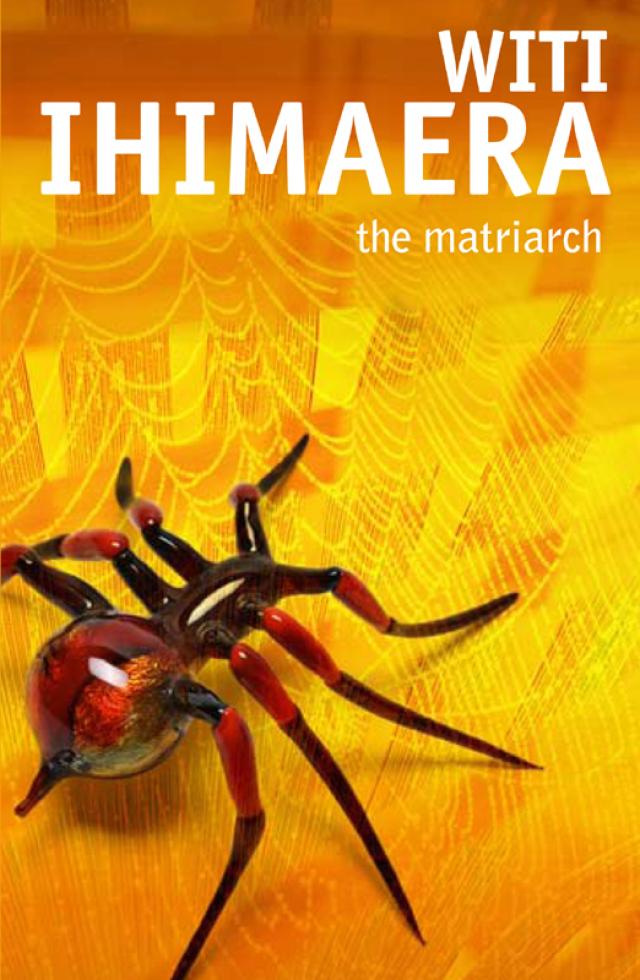


Witi Ihimaera
THE MATRIARCH
Contents
prologue
act one
WAITUHI
act two
THE SONG OF TE KOOTI
act three
THE TIME OF THE SPIDER
act four
AVE, AVE, WI PERE
act five
SUCCESSION
epilogue
VENICE, 1973
author’s note
Follow Penguin
the matriarch
Witi Ihimaera was born in Gisborne, New Zealand, in 1944. He was a pioneer of Maori writing in English: the collection of short stories Pounamu Pounamu (1972) was followed by Tangi (1973), the first novel by a Maori. A hard-working writer and editor, his works include novels, short-story collections, children’s books, plays and numerous anthologies. His book The Whale Rider has been made into a successful international film, which won the Toronto Film Festival People’s Choice Award in 2002. Ihimaera is professor of English at the University of Auckland, teaching creative writing and indigenous literature.
OTHER FICTION BY WITI IHIMAERA
Short Stories
Pounamu Pounamu (1972)
The New Net Goes Fishing (1976)
Dear Miss Mansfield (1989)
Kingfisher Come Home (1995)
Ihimaera: His Best Stories (2003)
Ask the Posts of the House (2007)
Novels
Tangi (1973)
Whanau (1974)
The Whale Rider (1987)
Bulibasha, King of the Gypsies (1995)
Nights in the Gardens of Spain (1995)
The Dream Swimmer (1997)
The Uncle’s Story (2000)
Sky Dancer (2001)
Whanau II (2003)
The Rope of Man (2005)
Children’s Books
The Whale Rider—children’s edition (2004)
The Amazing Adventures of Razza the Rat (2006)
Prologue
It was Uncle Alexis who started it all—this imaginative reconstruction of the woman who wore pearls in her hair, Riripeti, the matriarch who ruled the Mahana family for three generations. Poor Uncle Alex. The Italians would have called him un superbo uomo, a superb man, and so he was. But it was he who without knowing it started this journey into the past and into the dynamics of an astonishing family.
Father Blain said that all families are somewhat like jungles. So it is with mine, but I have made it even more of a jungle by mingling fiction with fact, like saprophytic vines twining the trunks of already dead trees. I think the matriarch herself would have approved of this. After all, she was the one who turned my own life into fiction.
The matriarch. She was sitting with the child on the highest terrace of Ramaroa pa, the ancient hill fort above the village of Waituhi. The hill was a gigantic crescent staircase of eleven terraces, like the poutama pattern, the wondrous Stairway to Heaven. Down below was the village itself and, beyond Waituhi, river flats widespread and country towns afar.
The child was listening to her telling him of his ancestry, his whakapapa. Her face, covered by a veil, was mysterious. Her beauty shone out with a gleaming light that he could almost touch and feel; it vibrated and electrified the air. Beneath the veil, shimmering like tears, were the pearls in her hair. Then the pearls gleamed with brilliance as she turned to him, and her voice thrilled with excitement. The clouds, swirling through the sky, cast strange patterns like fleeting kowhaiwhai designs across the earth, swirling, ever swirling.
‘E mokopuna, but your life began even before you were born in Waituhi. You may have taken your first breath here but, ara, you have eternity in you also. Your life started even before the Stairway to Heaven was built. It began beyond the uppermost terrace of Ramaroa. Listen, and I will tell you of your creation and your beginning. Listen. Listen.
‘At the beginning was Te Kore, the Void. Within the Void, the Nothingness, there came Te Po, the Night. After a timeless time, Te Po began to change. It changed twelve times—from the Great Night to the Extensive Night, from the Extensive Night to the Enveloping Night, from the Enveloping Night to the Intensive Night, from the Intensive Night to the Night Streaked with Light, from the Night Streaked with Light to the Night Streaked with Broad Light, from the Night Streaked with Broad Light to the Night of Unseeing, from the Night of Unseeing to the Night of Hesitant Exploration, from the Night of Hesitant Exploration to the Night of Groping, from the Night of Groping to the Night Inclined towards Day, from the Night Inclined towards Day to the Night that Borders Day. At this, the eleventh changing, the Night that Borders Day was divided by Twilight and Dawnlight, and beyond the Daylight arose the twelfth changing—Te Ao Marama, the Broad Daylight. All our rituals, mokopuna, acclaim the coming of Te Ao Marama, the World of Light.
‘Look at the Heavens, mokopuna. At the same time as the coming of the World of Light the foundations of the Universe were evolving—of the earth and sky and waters, of the depths and heights, of the expanse of the skies and borders of the seas—and our own Maori home of the gods, the legendary Hawaiki, our Maori Olympus, was formed. Hawaiki nui, Hawaiki roa, Hawaiki pamamao, is how we describe this place, mokopuna, the place of greatness, of expanse, the place far away. All our Maori dead are still farewelled to Hawaiki in the ceremony we call the tangihanga.
‘Then from Te Kore arose the first gods, Rangi awatea and Papatuanuku, the Sky Father Above and the Earth Mother Below. The Sky Father began to create the Heavens but, during his labours, he thought to make love to Papatuanuku because she was so beautiful. They pressed together in a close embrace, so close that they shut out the light. So it was that when they had children, who were gods themselves, the children were born into the darkness—Tane mahuta, God of Forests; Tangaroa, God of Oceans; Rongo ma tane, God of the Kumara Plant; Tu matauenga, God of Man and War; Haumia tiketike, God of the Fern Root; Ruaumoko, God of Earthquakes; and Tawhiri matea, God of Storms. At first the god children thought to kill their parents so they could live in the light, but it was Tawhiri matea who pitied his parents and argued that they should only be separated. One by one the god children tried to break Rangi’s embrace from Papa, and one by one they failed. Then Tane conceived of the idea of standing on his hands on Papa and thrusting against Rangi with his feet. His manoeuvre was successful and, with great grieving, Rangi and Papa were separated until one was far above and the other was far below. Now, at last, the light came flooding across the land and there could be seen the great numbers of men who had been hidden between the bodies of the primal parents. Oh, it was so good to walk upright, and that is why our people, the Maori, still give salutations to Earth and Sky and the Separation which continues to allow us to live in the light. We say, “Ko Ranginui kei runga, ko Papatuanuku kei raro.” Earth and Sky are our primal parents, mokopuna. Sky is high, sacred and male while Earth is low but fruitful, profane and female. Thus, so the old texts say, was the first setting apart of the roles of male and female. But I have always disputed this interpretation.
‘With the coming of the Light, creation was able to be resumed. The children of Rangi and Papa completed the building of the Heavens, of earth and the water, of all things in them, animate and inanimate. Then because the children of Earth and Sky were male, Woman was created. It was Tane, instructed by his sky mother, who fashioned the first female from the red earth. Her name was Hineahuone, and she began to live when Tane breathed into her. Tane mated with her and, when his daughter was born, he mated with her also. His daughter’s name was Hinetitama, Maid of the Flashing Dawn. But when she discovered that her husband was also her father, she fled in shame to the underworld, there to become Hine Nui Te Po, The Great Lady of the Night. She did this because of her shame that her husband was also her father.
‘Now, mokopuna, up to this time none of your ancestors, the offspring of the gods, knew death. Thus they increased and multiplied upon the earth. Among them was Maui Tikitiki a Taranga, who was aborted by his mother and cast into the sea. Maui was half man and half god and it was he who tamed the sun so that it would go slower across the sky, who stole fire from his ancestress Mahuika and who, in his last adventure, brought death into the world. This occurred when he tried to destroy Hine Nui Te Po, she with the human body but whose eyes were greenstone, her hair sea-kelp, and her mouth that of a barracuda. He set off toward the red flashing light in the western sky where she lived. He took the smallest birds of the forest with him as companions. His plan was to enter her body at her vagina, make his way through it, and reappear at her mouth. “If I can pass right through her body I shall live,” he told his bird companions. “But if Hine Nui Te Po is awakened, aue, I shall die.” Thus, Maui began his journey. The watching birds kept as silent as possible—but then the fantail trilled into waiata. Hine Nui Te Po awoke, opened her eyes of greenstone and closed her thighs. Maui’s body was crushed and he suffered the agonies of death. Because he failed in this adventure, all men became mortal.
‘But before Maui died, e mokopuna, he had achieved a most important task. He went out fishing with his brothers and took with him an enchanted hook. He had no bait but what he did was strike his nose and smear the blood over the magic hook. With this hook Maui pulled up his fish, Te Ika a Maui, which we now stand on. It is known as the North Island of New Zealand and, as it rose out of the waves, Maui’s canoe came to rest on the peak of Mount Hikurangi. The fish-hook became the cape which now forms the southernmost tip of Hawke’s Bay.
‘The fish of Maui became the land of the Maori, an
d we call it Aotearoa, e mokopuna. We are the tangata whenua, the people of the land. We have always been here—Ancients descended from the Time of Gods. Later, Maori voyagers also journeyed here from Hawaiki. Kupe was the first, around 700 AD, and Toi and Whatonga a few centuries later. Then, in tribal histories we are told of the arrival of legendary canoes from that same Hawaiki—the Tainui, Te Arawa, Aotea, Tokomaru, Takitimu, Kurahaupo and Mataatua. The Tainui, captained by Hoturoa, landed near Cape Runaway, coasted northward and rested finally at Maketu, spreading its people inland from Tamaki in the north to Mokau and Taumarunui in the south. The people of Te Arawa, led by Tamatekapua and Ngatoroirangi, landed near Cape Runaway also and travelled widely in the Bay of Plenty and inland to Tongariro, naming and claiming the land as they went. The people of the Aotea, sailed by Turi, finally settled in Patea. The Tokomaru began its voyage to Aotearoa in turmoil, made its landfall in the South Island and then in its voyage northward, settled the north Taranaki coast from Mokau to New Plymouth. The Kurahaupo scattered its settlers mainly along the western coast of the North Island. The Horouta landed at Ohiwa and peopled the Ngati Porou area from Cape Runaway to Whangara. The Mataatua, commanded by Toroa, is the canoe from which the Ngapuhi, the Rarawa, the Ngati Awa, the Whakatohea and the Ngati Tuhoe people are descended. The new Maori arrivals were fruitful and after a time about forty tribes developed and spread across the land. Within tribal groupings, rose sub-tribal and then kinship groups like ours of Te Whanau a Kai.
‘Now, mokopuna. Listen and watch, because I must tell you of your lineage, and point out the land which is yours through me by birthright. Listen and remember.
‘You are descended of the Ancients of Aotearoa. You are also descended of the canoe voyagers and, particularly, of the Takitimu. This was a very sacred canoe. It carried chiefs and priests, the repositories of the ancient lore, and it was they who brought much of the knowledge of Hawaiki to the new land. The captain was Tamatea Arikinui and you are named after him. Because of the precious freight of gods only raw food was eaten and cooked food was not taken on board. Many sacred ceremonies were performed to protect Takitimu on its voyage, and rituals were conducted to ensure that the winds and waves were favourable for its journey south. The canoe was escorted by a school of fish, with a taniwha named Ruamano heading it and another taniwha named Arai te uru behind. The god, Kahukura, in the form of a rainbow, guided the Takitimu by day. A lunar halo lit the way by night. When Takitimu struck rough weather, the sacred axes with which the waka had been made, Te Awhiorangi was used to chop a way through the waves.
‘The Takitimu sailed the coast of Aotearoa for several years, settling different areas with its cargo of gods. One of these areas was the place called Turanganui, south of Hikurangi where Maui’s canoe had rested, and north of his fish-hook at Hawke’s Bay. Inland from this place is where we arose, mokopuna, you and me of Te Whanau a Kai, and all the people of Te Aitanga a Mahaki, Rongowhakaata and Tai Manuhiri.
‘This is our land, mokopuna. Here. Now look: there, is the boundary between us and the Ngati Porou to the east. There, we have the Whanau a Apanui to the north. There, to the south, are the Ngati Kahungunu people with whom we have close affiliations. The Tuhoe, the Children of the Mist, are to our west. Now, within Turanganui, we have the Rongowhakaata confederation, Tai Manuhiri and Te Aitanga a Mahaki. The boundary of the Rongowhakaata confederation begins at the sea north of Muriwai and runs along the Oneroa Beach as far as Waikanae. There lies the boundary between Rongowhakaata and Te Aitanga a Mahaki, running to Makaraka, south-west across the Waipaoa River to, and up, the Waikakariki Stream, past Patutahi, then east to join the Tai Manuhiri tribal boundary. Watch even closer, mokopuna, for now I must point out to you your lands of Te Whanau a Kai as they exist between the tribal lands of the people of Turanganui. Commit this to memory: we are on the western side of the Waipaoa River and opposite the Waimarie settlement near Ormond. We are washed by the Waipaoa River on our east and our north. We are divided from Repongaere by Tore o Haua. We are separated from Pukepapa by the Pouarua Creek on the west. We are five miles from Patutahi. Ramaroa Pa is our ancient hill fort. Taumata o Tumokonui is our highest peak. Our family marae is Rongopai, in the Waituhi Valley. Our closest kin in the valley are Nga Potiki.
‘E mokopuna, we ruled here for over a thousand years and this was our land. This was our life. It is your life and land now. It was yours even before you took your first breath. It came to you beyond the time of men and gods to the very beginning of Night and the Void. A thousand years and further back, mokopuna, we had eternity in us.
‘Then came the Pakeha.’
Act One
WAITUHI
Chapter 1
It was July, 1974. Wellington. I had arrived late to see my Uncle Alexis who was going blind and after two hours I realised that I was committed to stay longer. It might have been better had I not gone to see him at all. But Regan, my wife, said I ought to go, and my father, Te Ariki, was expecting me to see his younger brother. Dad was cross that I hadn’t made the effort before this. ‘You’ve been back from London for a year now,’ he had said the previous weekend when he’d telephoned from Gisborne. ‘Surely you can get in your car and drive down the hill to Oriental Bay. Take your daughters with you. Your uncle’s expecting you. He’s wondering why you haven’t been to see him. I told him last week that you must be busy. Well, Tamatea, try to un-busy yourself for a couple of hours. Go and see your uncle. It’s not easy for him, being blind.’ My father always called me Tamatea when he wanted to remind me of my family obligations.
It wasn’t that Uncle Alex and I didn’t get along together; just that the gap between the last time I had seen him and now was as wide as the ocean and as treacherous to navigate. Almost three years had gone by. How can you cross three years of sea in a few hours? On top of this we’d never really known each other very well and I was inclined to suspect that he didn’t approve of my successes—the diplomatic career and public achievements had established a reputation which, for him, was all too good to be true. But I like to think that he admired me and, perhaps, was fond of me. I do know that he had always been amazed that I, among all his nephews and nieces, had never asked him for money—Uncle was wealthy, you see, though he never flaunted it. That hadn’t stopped him from continuing to try to bribe me, and it was the same on that evening I went to see him. Alone.
Uncle’s house was on a narrow street which wound down like a bandage into Oriental Bay. I had friends further down the street, James and Ilse, and I was almost tempted to drive past Uncle’s and talk Russian literature with the wondrous Ilse. But I stopped the car and stepped out. The house was olive-green and there were no lights shining in the diamond windows. Then I saw my Aunt Roha, looking through the curtains at me. I ran through the rain, past the tall slapping shrubs, to the front entrance. The glass panels shimmered with a woman’s shadow.
‘Well look what the wind blew in,’ my aunt said when she opened the door. Roha was an attractive woman, very slim and elegant. Tonight she looked sallow and waspish.
‘I’ve come to see Uncle,’ I said.
She kissed me. As her cheek brushed mine I felt the velvet of her skin. ‘It took you long enough,’ she answered.
She ushered me in and shut the door against the wind and the rain. The house was warm. Some of my cousins were home watching television. I saw one of them drifting past in a dream, a renaissance beauty with a bee sting for a mouth.
‘Say hello to your cousin,’ Roha said.
She turned to look at me. ‘Oh, hello, cousin,’ she whispered vaguely. She was like a somnambulist, a fairy princess sleepwalking her way down the dark corridor.
Roha took me to the main bedroom. It was dark. After all, what did a blind man need with the light? Uncle was sitting up in bed looking at nothing and listening to the wind and the patterning of rain against the window. ‘Alex,’ my aunt said to him. ‘Your nephew’s here to see you. Te Ariki’s son.’