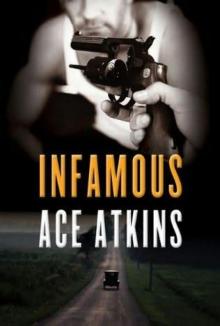
Infamous, p.30
Infamous,
p.30


You got a dime?
Yes, sir, the deputy said, reaching into his hip pocket.
I dont want your whole gosh-dang wallet. Just a dime.
Harvey made two stops.
One to kick the deputy out of his car.
The second to make a phone call.
Harvey drove down the narrow dirt road, passing slow-moving cars in the opposite direction, spraying up potholes of muddy water, windshield wipers flapping, headlights cutting through the storm. The road had turned to shit, and he just wanted to keep the wheels moving, as he was leaning in, looking for road markers to Irving, that old church where he was to turn off to Manions house. He overshot it by a mile and had to turn back, the wind almost ripping the top from the vehicle.
The lights were on in a white two-story house with a gabled entrance and crooked black shutters. Harvey killed the motor and sat for a moment in the rain, seeing only a Ford sedan parked outside. The light inside was orange and glowing, coming from kerosene lanterns.
An electric wire had broken free from a pole and skittered up and around, throwing sparks up into the wind.
Harvey lit a cigarette and smoked, the wind rocking the car, until he decided to pull it around back to an old shed and kill the motor. He entered the house by the back entrance to the kitchen.
Tom Manion was eating a piece of buttermilk pie and reading a crisply folded newspaper when Harvey entered, wringing wet and holding the .44 in his waistband.
Real shit storm, aint it? Manion said, training his eyes on the newspaper and reaching for a cup of coffee.
I couldve been killed, Harvey said. I shoulda been.
Good day for an escape. You like some coffee?
Id like to get going, if its all the same.
Have some coffee, Manion said. Got your change of clothes right there. Vehicles gassed up.
Harvey glanced down at a worn-out pair of denims and a blue work shirt. Brogans with broken soles. He took off his Panama hat.
What about the rifle?
What about my money?
Im good for it.
Manion nodded and walked to an old farm sink, pouring out the dregs from his cup. He leaned into the window, seeming to watch the old trees bend and break, limbs littered his yard. When he turned, he held a shiny new .38 in his hands.
Harvey had pulled the old, rusted .44.
Arms up, Harvey.
I told you Id get it.
Im bringing you in.
You got to be pulling my pecker.
You gonna shoot? Then shoot.
Naw, Harvey said, letting the cylinder fall from the gun. Figured I might throw it at you.
I did me some thinking the other night, and I figured the man who brings in Harvey Bailey could write his own ticket. Dont you agree? When Im sheriff, I can do as I please. Ten thousand aint worth that.
Harvey shook his head. The coffee was still over the flame and smelled acrid and burnt. He lifted his hands, Manion marching him to the back door, reaching onto the table for a napkin to wipe the pie crumbs from his mustache.
You dont think Ill tell em about the file and the razor blade?
Whos gonna believe you, Bailey? Didnt you flush em down the commode like I said? Wheres your evidence?
Lighting cracked close to the house. There was thunder, the rain falling even harder, while Manion pushed open the back door with his pistol. You first.
The wind shot around the house, blowing a small lace curtain from a door window.
Harvey smiled and picked up his new Panama hat. If its all the same, Id rather square it right here, Tom.
Whatever you say, Mr. Bailey. I just hate to have to mop my gosh-dang kitchen floor.
Harvey looked down at the linoleum and then up at fat Tom Manion and his shit-eating smile. He almost felt sorry for the sorry bastard as the gun cracked three times, blood spreading on Manions boiled shirt like spilt gravy, the son of a bitch toppling down to his knees. You lying cocksucker, Manion said, blood on his chin, flailing a bit before he died.
How long you been here? Harvey asked.
A dark figure in a black hat and black rain slicker stepped inside and pocketed the hot .44. His eyes cold and blue, jaw clenching.
I left the hotel when you called, Verne Miller said. Lets burn this house down and then go find George Kelly.
Good to see you, Verne, Harvey said. Youre a swell pal.
KATHRYN DIDNT GET WORRIED ABOUT LUTHER ARNOLD COMING back until about eleven oclock that night, but a half hour later the grizzled man showed up, wet as a drowned rat, wringing out his hat on the cottage stoop like it was a washrag. Kathryn shooed him on inside, where she handed him a towel, with him saying he sure didnt want to mess her things, as he dried his old head himself, and she told Flossie Mae to fetch up her husband some clean drawers. The rain fell hard and strong, raining all damn day, pinging so hard on the shingled roof that it was hard to talk.
The little girl, Geraline, was asleep, but all the movement and whispering woke her up, and she sat up in her bed and looked over at her father, shaking her head, saying, Luther, why dont you at least take your shoes off?
Hush up, child.
The child reached for a pack of cigarettes, lighting one up and blowing smoke from the corner of her mouth.
What did he say? Kathryn asked, reaching for his clean clothes from Flossie Mae. Kathryn wore a black silk robe with gold orchids. Her red wig left to dry on the nightstand.
Can we speak in private, maam? Luther asked.
We cant go outside.
They walked into the small bathroom, and Kathryn ran the water, not that it made much difference with the commotion outside. Luther sat down on the commode, with a fist propping up his head. Well, the counselor said hed need some more money.
You ask him about the trade?
He said he couldnt put that matter on the table less you both come to him in person.
How are we supposed to both come to him when the whole world is looking for us?
You dont look much like your picture, Luther said, taking off his water-logged shoes and rolling off his socks. I seen it in the bus station. That woman in the photographs looks like a hardened character. You aint no hardened character, Miz Kelly.
Kathryn ignored him, listening to the rain against the windows. Luther rolled up his pant legs and leaned forward, with both elbows on his skinny knees. He sniffed a bit and rubbed his nose with a forearm.
Your husband, Mr. Machine Gun, know about this here deal?
She kept thinking.
Cause thats a mighty white thing for a man to do for his mother-in-law. I know some men wouldnt give a squirt of piss if their mother-in-laws on fire.
Kathryn shot him a look.
Sorry, maam. Didnt mean to curse.
Just shut up about the deal, Kathryn said. Thats between us and our counsel. What else did Sayres say?
Not much, Luther said, rubbing his unshaven jaw. He had the nose of a drinker, bulbous and veined. Wouldnt let me in his office, though. Told me to go round to this alley like Is some kind of beggar, where he didnt come back for a half hour.
You know any good lawyers? Kathryn asked. In Oklahoma? Sam Sayres wouldnt know how to shit outside Texas.
I knowd a real good counselor over in Enid. You want me to call him up?
Kathryn reached into her cosmetic kit for a jar of cold cream and began to rub down her face. Luther sat the opposite way, shaking his head and grunting with her complaints. I dont know where that SOB is, but when I find him hes gonna surrender to the G and get my momma sprung.
Mighty white.
So you trust this fella? she asked, slathering the cream up on her cheeks. Really trust him?
Who?
The lawyer in Enid.
With my own life, Luther said. Hes gotten me out of a scrape or two. Misunderstandings with the law. You understand.
But of course.
Mrs. Machine Gun?
Call me Kit.
Kit, you want me to call im? Id appreciate a ride back to town to use the telephone. The weathers mighty nasty to walk the road again. I kept slipping outta my brogans.
Kathryn shook her head and reached for a rag to wipe the cream from her face, staring into her own eyes, thinking about her next move to get out of this goddamn mess. The rain kicked up a little outside, pinging the windows, and Luther turned from the commode and said, Whoo-whee.
Scoot over, Kathryn said.
Maam?
I need to do some thinking.
He exchanged places with her on the commode and stood, looking awkward and loose, arms folded across his chest and trying to look smart, as she talked out a plan, more to herself than to Luther.
I want you to take the bus back to Fort Worth tomorrow, she said, holding up a hand, the silk material on her robe draping down her forearm like a butterfly wing. Hold on . . . Hold on . . . Ill pay. But I want you to go back and see that sorry fat bastard Sam Sayres and tell him that he no longer works for the Shannon family. Tell him were trading up, and that Kit Kelly wants her Chevrolet back.
He has your machine?
Used it as collateral, for him sitting on his ass while my dear ole momma is sent to the gallows.
You want me to drive the car back here?
I want you to go to Enid and hire that lawyer you told me about. Ill take Gerry and Flossie Mae with me.
Where to?
San Antonio, Kathryn said. You can contact me there care of General Delivery. Ill make sure theyre clothed and fed till you get back. Dont you worry about a thing.
Luther nodded.
He better be good, she said.
Hes the cheese on apple pie.
Kathryn nodded, long legs spread in a solid stance on the commode, listening to herself and making the plan definite in her mind. Tomorrow morning Ill give you five hundred dollars to advance him.
Five hunnard, Luther Arnold said, Kathryn noticing the shriveled flesh on his toes and long, curled nails turned yellow. Thatll keep him busy for a while.
And tell him I want him to put the deal for George on the table, she said. If the G wants George R. Kelly, they can have im. All I want is my momma.
Someone knocked on the door. Daddy?
Yes, muffin.
I got to pee-pee. Whatre yall doin in there?
What if you cant find Mr. Kelly? Luther asked in a whisper.
That rotten son of a bitch disappears when you need him most, but hell show up like a bad penny. I know my George.
31
When Kathryn heard the story, she couldnt tell which parts were true, which parts George invented, and how much of the small stuff he just threw in there to keep it sounding gospel, the details of it coming out of Georges mouth like a sinner come to witness about his road of trials. George started with when hed jumped into a jalopy Chevrolet and headed off Ma Colemans land, heading right for Biloxi, knowing that Kathryn would understand his note and follow him to his favorite hotel, where they could lay low a bit, put their feet in the sand and drink some cold beer, out of the forsaken state of Texas, down to the Gulf, to vacation from being outlaws for a while. Hed made it as far as New Orleans, George knowing some people in that part of the country from when hed run booze up to Memphis, and hed taken a room in the Lafayette Hotel and only left once to get a pint of gin and an Italian sandwich. He said he sat in the room all night, not being able to sleep, reading five different newspapers, all of em carrying the same story about her mommas family being taken by airplane to await a fair and speedy trial. And he said it made him so damn sad that he didnt want more company than a bottle of gin, remembering that hed left the hotel one more time, walking down Canal Street to find a liquor store and a Catholic church, where he wandered in and lit a candle for the Shannon family. That part of the story diverging a bit from the truth of that piney gin, but Kathryn took the lie as a solid gesture, and let him continue on about driving out of the city the next morning, figuring the one-eyed bellhop sure noticed he could be none other than Machine Gun Kelly, and him driving along Highway 90 into Mississippi, following that road through Waveland and into Bay Saint Louis, where he went to the Star movie house and watched a Barbara Stanwyck picture in the colored balcony. Again getting sad, because Barbara sure had a lot of Kit Kelly in her, wandering out of the black night like a crazy dream and staring out at the Bay under oaks older than time, moss in the cool breeze, getting good and buzzed till his heart stopped hurting. He drove on through Gulfport to Biloxi, a town that he knew just as well as he knew Memphis. He headed to the first pharmacy he saw to buy a bottle of peroxide and a shower cap, a toothbrush and some talcum powder, and five True Detective magazines, before checking into the Avon, that fine old hotel right off the Gulf.
For three days, he rubbed his body with baby oil and poured the peroxide into his hair, wearing purple-tinted sunglasses and drinking gin mixed with pitchers of lemonade that the negros sold to the tourists. No one talked to him, and everything seemed fine as moonshine, as hed sit in a deck chair, dozing to the sound of the surf, letting his cramped car legs unknot, and waking only as the shadows ran long across the combed beach and the sun got ready to disappear to wherever it went at night. In the evenings, hed order up steaks and hamburgers to his room, some more gin, and would drink all his sorrows away while reading How the Sensational Boettcher Kidnapping Was Solved, the Baffling Mystery of the Dead Dancer, the Ministerthe Love Lyricsand the Murdered Woman, and then coming across an advertisement in the back pages that promised to help you Read Law at Home and Earn up to $15,000 Annually, and George said that sure let the snakes loose in his head, thinking, hell, he was earning fifty thousand a year just for knocking over a few banks, and they had to get good and greedy and start in the kidnapping racket, letting the hounds loose on their trail. (This was usually when George would go into that long speech about how he had a different path in Memphis with his first wifesweet Genevaand what a good man his father-in-law had been, much better than his own father, that worthless, mean son of a bitch, and that if Mr. Ramsey hadnt been snuffed out like that, a high beam falling from his own construction site and splitting open his head like a watermelon, old George Barnesthat being Georges real namewould be an upstanding member of Memphis society to this day.)
And thats how you came to Memphis, George?
George shook his head, and said, Gosh dang it. My own fault, we couldnt find each other at the Avon.
He had to pack and move over to the Hotel Avelez, on account of the bellhop studying his profile when hed stumble down to the front desk to get some fresh towels. He said hed burned through his Urschel stash in New Orleans and had to dip into those American Express checks hed boosted in Tupelo.
You didnt, George.
Sure did.
And you didnt think anyone would notice?
Didnt have a choice.
Did you find that woman, that blond lifeguard?
Kit, hush up and pay attention to the tale at hand.
Coppers found you?
The Hotel Avelez swimming pool shimmered like a glass gridiron the morning hed decided to eat some break fast under the oaks and charge it to Mr. J. L. Baker, that being the name he decided sounded best with his tanned skin and yellowing hair. He said hed grown a little thickheaded, and cocky with his new looks, and decided to drive into the downtown and pick up some shirts and pants hed left to be laundered. George said hed also been contemplating wearing a straw boater but sure wished Kit couldve been with him because he wasnt sure a dandy little hat like that looked good on a big fella. He said hed just stepped foot out of his car, looking at some straw hats displayed in a department-store window, when he heard the voice of a corner newsboy yelling with all his might, MACHINE GUN KELLY IN TOWN!
George said he nearly shit his drawers.
What did you do?
Left it all.
Your luggage?
Even my .45 and my True Detective magazines. Wore the same pair of underwear for three days.
And that was Memphis?
That was Memphis.
George walked to the bus station and bought a ticket. He said his heart didnt stop racing until he crossed the Tennessee state line, and then he worried about coppers waiting for him when he stepped foot off that bus. But he said the sight of the old river sure did his heart some good, as did getting out on Union and walking into the Peabody Hotel, where he used to deliver hip flasks and bottles of bootleg bourbon in a raincoat with a dozen pockets. He felt like no time at all had passed and then realized that it had been nearly ten years since he lighted out for Oklahoma, finding more opportunity in Tulsa, and knowing Geneva and his two sons could get on with their lives without the shame of a daddy who sold whiskey.
You never told me you had sons, George.
You never asked for a résumé. Genevas remarried. They have a new daddy.
George broke his last dollar into dimes and called on the one fella who he knew he could trust in Memphis, ole Lang. His brother-in-law, Langford Ramsey. He hadnt seen Lang since Lang was just a skinny teenager starting out at Central. But George still telephoned him every anniversary of his daddys death, George usually drunk and telling Lang for the hundredth time how much he respected his father, even taking Ramsey as his middle name out of respect.
George R. Kelly.
Thats right.
Lang had two listings in the phone book, one his residence on Mignon and the other his law office. George found out that Lang had been the youngest man ever to pass the Tennessee bar, and had just married and had a son, with another child on the way. George had hugged him out of pride at the Memphis train station, and they shook hands over and over, Lang walking with him back over to the Peabody to have a big enough break fast for an army. George had two plates, since he hadnt eaten since Biloxi, and washed it down with a pot of coffee.