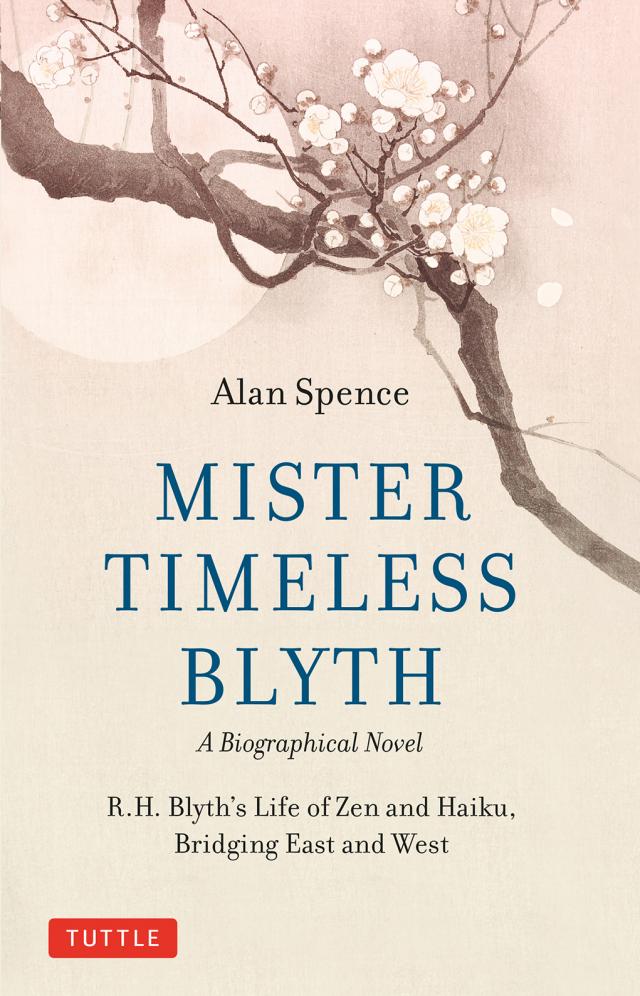
Mister timeless blyth, p.30
Mister Timeless Blyth,
p.30


She looked at me eagerly, as if expecting me to comment. I breathed deep. She turned the dog-eared page, found another underlined passage.
‘Regarding R. H. Blyth: Blyth is sometimes perilous, naturally, since he’s a high-handed old poem himself, but he’s also sublime – and who goes to poetry for safety anyway?’
Did you know about these passages? she asked.
They have been drawn to my attention, I said.
A high-handed old poem!
She had clearly familiarised herself with my own work, and at one point she ventured to take me to task, albeit gently and with a smile, for what she called a discriminatory attitude towards women.
I said perhaps she had read too much into one or two throwaway remarks about women haiku poets.
What then is your position? she asked.
Let me put it this way, I said. Zen distinguishes between what it calls dai-ich-gi and dai-ni-gi, the absolute and the relative.
Are you going to bamboozle me with philosophy? she asked.
Not at all, I said.
The absolute and the relative?
And we may speak from either. For example, absolutely speaking, men and women are the same and their enlightenment is the same. But relatively speaking they are different and their enlightenment is different.
And what does Zen say?
Zen means speaking from both at the same time. And we must speak from both at the same time. All the time.
Bamboozling! she said, showing an admirable grasp of Zen.
I might have said to her that the object of life is to understand one another, in particular, for men to understand women (which some think should be easy but is not) and for women to understand men (who seem mysterious but are not).
The process is as difficult as it is for one nation – if such an illusion has any real existence – to understand another.
A very old friend of mine, Cycill Tomrley, had recently written to me from home, not quite taking me to task, but challenging me, teasing me about the selfsame matter, and I managed to find the letter, show it to the young American.
(I have the letter here as I write this. It is written on the same kind of blue airmail paper my dear mother always used).
No one ever writes about Zen for women, she wrote, except you, and that with a tinge of dubiety. A western woman like myself, doing for many hours each week the sort of work men do, feels neither fish, flesh nor fowl. I am not one who believes men and women are built to the same plan. But if psychologists such as Jungians take especial pains over women, why not the Zen teachers? Could you write a book for British women? Obviously you could, but you can’t. (Answering my own questions is still a speciality!)
Occasionally women, usually old hags, appear in Zen anecdotes, but the enlightenment of women is conspicuous by its absence (and sex problems are conveniently ignored).
Buddha accepted women into his order with the utmost reluctance and prophesied they would be the ruin of it. A reaction to this has been to say he should not be judged by the standards of the 20th Century. I agree, but say he should be judged by the standards of the 30th Century. If a man’s view of half the world is wrong, then so must his view of the other half be wrong.
Woman is man’s joy and all his bliss. That was Chaucer.
But then Byron wrote, There is a tide in the affairs of woman / Which, taken at the flood, leads God knows where.
I would add that God does indeed know where, and that where includes randomness, spontaneity, unpredictability, all absolutely essential to our very existence.
Woman represents nature, and in criticising women, men criticise the universe itself.
‘All women…’
He declares, looking
Over his shoulder.
I myself like women. If I were the only man in the world, as the sentimental song does not say, then I would be perfectly happy!
Do I contradict myself? Very well, then I contradict myself.
I’ve quoted that before, often. Many a time and oft.
Do I repeat myself? Very well, then I repeat myself.
(Very well, then I repeat myself!)
Dickens called critics and reviewers the lice of literature, rotten creatures with men’s forms and devils’ hearts. But even Dickens was stung by them, by their pigmy arrows, and had to steel himself against them, overcome his rage and gain victory over them by being indifferent and bidding them whistle on.
There was one critic, however, who got to me and shattered my hard-won equanimity. My volumes of haiku translations and commentaries, published by Hokuseido, had gained me some small reputation, and for the most part they had been well received. But one day I received in the post a long angry letter from some old man who clearly regarded himself as (God help us!) an authority. He took me to task, mercilessly and at great length, saying that I did not understand haiku at all, neither in the particular nor in general, neither the individual poem nor the underlying spirit of the form.
I read the letter a second time to make sure I had not misunderstood. I folded it up again and put it back in its envelope, and I realised my hands were actually shaking I was so angry. I continued to be angry for three days, making life miserable for poor Tomiko and the children. Eventually Tomiko suggested, tentatively, that I go to Kamakura to visit Dr Suzuki at Engakuji. I thanked her and set out forthwith.
As usual the good Doctor and I sat with the tea-bowls, the little rice-cakes, on a low table between us. His secretary had brought in the tray, set it down and left us to it.
The pent-up rage came out of me all-in-a-rush. I ranted about the unfairness of the criticism, the unthinking dismissiveness of it.
Whatever I know or don’t know of haiku, I said, at least I can say I know nothing of Zen!
Nothing, he said, and nodded.
I waited for him to say more, to remonstrate with me. I braced myself for a reproof, hoped for teaching, advice.
Tea, he said, indicating the bowl in front of me.
I raised the bowl to my lips, sipped, breathed in the fragrance, the greenness. Vegetation after spring rain.
We sat in silence. The creak creak of cicadas came through the open shoji screen. I took in the deeper background smells, redolence of old timber, pine incense.
Finally he spoke.
People with poetic mind, he said, are more sensitive to things than others, and sometimes they take longer to forget.
To praise instead of blaming.
I was overwhelmed and burst into tears.
I look back at my younger self (and even my older self). Why that anger? Why the stupid tears? What was wrong with me? Who did I think I was? Puffed up and foolish, full of myself. And still Suzuki treated me with kindness.
O wad some power the giftie gie us, tae see oursels as ithers see us.
To see ourselves. That would be blessing and curse, in equal measure.
Critics aside, it seems my reputation has grown and I have been credited with the creation of an entirely new form of poetry, English language haiku. Existentialists, imagists, zennists, japanologists, all-sorts-of-other-ists have sung my praises and found in my little translations (or reworkings) something fresh and liberating. Apart from Mr Salinger, and that passage where he called me a high-handed old poem, I have been acknowledged by Alan Watts, himself a successful populariser of Zen. I am grateful to him, though his Beat Zen, Square Zen and Zen left me cold. And as for that Beat Zen (or beat zen) a whole host of those younger poets have quoted me and thanked me – Messrs Ginsberg and Kerouac and Snyder (who is by far the most interesting of them all). Beat, they say, is drumbeat or heartbeat, it is beaten, it is upbeat or beat up, it is blessed as in beatitude. (Beatitudinous?) I cannot say I particularly enjoy their excesses, but I admire their chutzpah. At their best they echo Whitman and Blake.
I sing the body electric.
Energy is eternal delight.
I am amazed that they have read my work and responded to it so positively and wholeheartedly.
At the other extreme, one outraged critic wrote, Blyth talks too much. He should have been strangled at birth. There’s just no pleasing some folks.
I have a cutting from The Times in which Aldous Huxley reviewed Zen in English Literature.
The book deals with the relation between moment-by-moment experience of things-as-they-are and poetry. It is a bit perverse sometimes, but very illuminating at others.
I would settle for that as an acknowledgement and a fair description (perhaps even an epitaph?) A bit perverse sometimes, very illuminating at others.
We does our best.
As for those self-styled Beat Poets, Mr Ginsberg’s angel-headed hipsters, Suzuki has his own view. The subject came up recently and he delivered his opinion in a controlled monotone, his words measured, his gaze steely. More than ever these days, with his eyebrows and nose-hairs overgrown and uncut, he resembles some ancient fierce-eyed sage, a Zen patriarch in a painting by Hakuin.
The aim of Zen, he said, is to open the eye of vision and knowledge, the aryajnana. It is to see directly into the true reality, to confront a world which is entirely new, and yet at the same time not new at all.
This is where there is gross misunderstanding, he said, a complete misinterpretation by those who have never actually had the Zen experience.
Those who know do not speak, I said, mindful of the fact that I myself was prone to speaking at great length on the matter in hand, and in fact on anything under the sun.
I refer, he said, to the modern-day addicts of the so-called psychedelic drugs.
Mr Huxley, I said, is a great advocate of mescalin as an aid to opening the doors of perception.
Indeed, said Suzuki. And I believe there are other drugs in use – psilocybin and LSD. It seems they conjure up ‘mystic’ visions which the users claim have some connection with Zen.
Instant samadhi, I said. Satori in a pill.
It is preposterous, said Suzuki. They will do anything for realisation except work for it. And these visions have nothing whatever to do with Zen, either psychologically or spiritually. The Mumonkan makes it perfectly clear. Zen is not concerned with visions but with the person. The drug-users can never have the true inner experience of identity. They stay forever on the surface of reality and never look into the secrets of the here-and-now which transcends the relative.
When he’d finished his rant, his little discourse for this audience of one, I bowed and smiled, like Maha Kashapa after the Flower Sermon.
Suzuki sensei, I said, you are the only man who can speak about Zen, or write about it, without making me loathe it.
Good, he said, laughing. Good!
Later I wrote down what he had said while it was still fresh. Lest I forget.
Among the unlikeliest of my admirers is Henry Miller who wrote to me to say how much he appreciated my work. I tracked down his Tropic of Cancer after he had contacted me and I could see why there has been such an outcry about his novels. He has stirred things up as much as Lawrence ever did, and for the same reasons.
I replied to his gracious letter, thanking him and saying in spite of all the outrage he has provoked, I had the impression he was a man of great modesty (and obvious frankness).
I said that perhaps my years of living in the East had inculcated the idea that what is hidden is best, a philosophy seemingly at odds with his own approach.
He said he hoped to come to Japan some day, and I said if he did it would be a shocking pleasure to meet him. (And I chose that adjective carefully, another example of the hidden!)
I might have told him that any criticism of the universe, its wasteful cruelty, its perverse purposelessness, its glaring inconsistencies, is improper.
Sadly I never experienced that shocking pleasure – we never met and now we never will. We exchanged a few more letters and I sent him in return for his novel, two of my small pamphlets on Zen. It would be hard to imagine work more different from his own, but they delighted him and he thanked me with great effusiveness.
I seem to recall him expressing a fondness for Japanese women, for their charm and reserve. I mentioned this to my American colleague Bill Moore who said Mr Miller probably wanted to marry one to add to his collection. His attitude to Japanese men was rather different. With a nod to Hobbes he dismissed the ones he had met as nasty, brutish and short. While disagreeing with the generalisation (as with all generalisations) I found that made me laugh out loud. I think Mr Miller would appreciate senryu.
Politically, nationally and cosmically we have to cheer on both sides, all sides, rejoicing with the brutes and weeping with the brutalised. This is no easy matter. For my part I find it difficult to share in superficiality, to wade in sentimentality and to wallow in vulgarity. But on all these fronts perhaps I have made some little progress.
(Do I contradict myself? Not only that, I have full-blown arguments with myself, both of me equally vehement).
There was another contemporary writer who acknowledged a debt to me, the black American novelist Richard Wright. I received a handwritten letter from him, addressed to me at Gakushuin, in an envelope with a Paris postmark. I hadn’t read his work, but I knew he had made an impact with his novel Native Son, and a memoir, Black Boy, drawing on his experience of growing up in the Southern States.
His letter moved me deeply. His suffering as a child had been unimaginable, and one lasting effect, he admitted, was that the countryside, and by extension the natural world, only reminded him of the misery and poverty, the sheer unremitting bleakness of his early years.
But then latterly, as if by some kind of miracle (his word!) he discovered my four-volume Haiku and (again, his words) the veil was lifted and he saw things clear. The brevity of the form was a revelation, as was the simple mathematics of it, the elegant 5-7-5 structure. (I write them all the time, he wrote. I’m always counting syllables on my fingers!)
He had been in poor health, and work on a full length book, Island of Hallucinations, was exhausting. Discovering haiku, he said, had been a liberation, and he just wanted to thank me, from the bottom of his heart, for opening up new worlds, or rather for showing him this world with new eyes.
He said he had written hundreds of poems. But don’t worry, he added, I don’t intend to bombard you! Instead he enclosed with his letter a sheet of thin paper with a single poem typed out. (Not strict form, he said, unusually for me. But I think it works!)
The poem described a light fall of rain, raising a smell of silk from umbrellas.
There was a return address, and I wrote back telling him how touched I was that he had taken the trouble to write to me, and that, like me, he had found the way of haiku a solace, a consolation and a joy. I told him the silk umbrella poem was very fine, made real by that sensory detail, the faint smell of silk, linking it to the thinness of the rain, the suggestion perhaps that the season might be spring. I also said I was glad to see he was not straitjacketed by the strict 5-7-5 form. Catching the moment, in just the right words was more important than the arithmetic of the thing.
Finally I said if he wanted to send me a few more of his poems I would be delighted to read them.
I fully expected a response but nothing came. I was hard at work with the teaching, and the work on my own books, so I thought no more about it. Then a month or two later I was in the library at Gakushuin, reading a week-old copy of the London Times, and I read a notice that he had died in Paris, ‘after a long illness.’
I sat for a time then folded up the newspaper. Yamanashi happened to pass by and he bowed, asked if something was troubling me. I told him about Mr Wright and his passing, said I was unexpectedly affected by it, considering I had never met the man.
Yamanashi was silent, then said simply, Life is tears.
I said I only wished I had written more in my letter to Mr Wright.
Things are as they are, said Yamanashi. I am sure what you wrote was perfect.
The writing of haiku worldwide, in other languages, was something I did not foresee. (Though I myself have been told I must accept some of the blame!)
It would be a good thing the Japanese to see that writers in America and elsewhere might equal or even surpass them in their own field, beat them at their own game.
I looked forward to reading haiku from Russia – all the vast energy, the intense bleakness of the Russian soul, contained, or constrained, in a three-line poem. War and Peace reduced! I cannot, however, imagine (nor could I countenance) a communistic haiku, any more than a capitalistic haiku, or a nationalistic haiku. Such things are a glorious impossibility. Haiku are universal, international. What an Earthly Paradise it will be when the Eskimo blow on their fingers as they write haiku about the sun that never rises, the sun that never sets. Or when African tribesmen compose jungle haiku about the gorilla or the python. Or nomads of the Gobi or the Sahara pause, wipe the grit from their eyes to see a world in a grain of sand.
I have always been rather resistant to most contemporary haiku about the realities of modern life. I stubbornly held to my view – of course I did! – even though a poet as great as Shiki had written passable verses on baseball. But poems on the mechanised city life of commerce and work held little appeal. However (a most useful word) I recently came across this in a newspaper:
The pattering of the hail,
The sound of the telegraph machine,
The night-scene outside the window.
This is good in that it finds meaningless meaning in the present day world, the urbanised industrialised world with its noise and harshness and clatter.