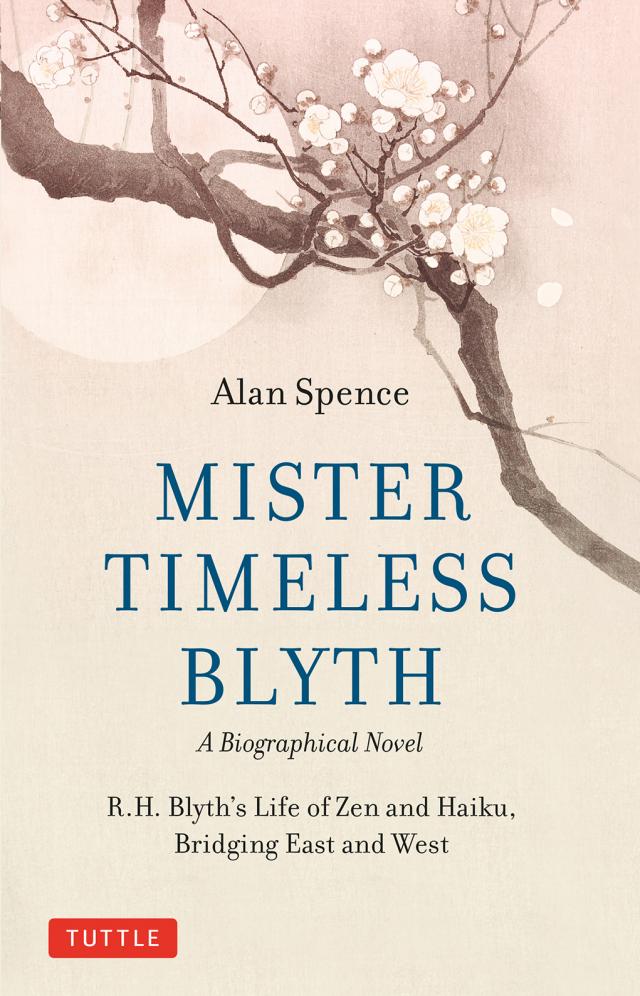
Mister timeless blyth, p.39
Mister Timeless Blyth,
p.39


Buraisu Kodo Shoshin Koji.
The late not-come person. Shining mind. Zen spirit way.
Or some such.
He who followed, with illumined mind, the old path of Zen.
Better? Perhaps not.
I met a man who wasn’t there.
My mother’s voice.
Again! Again!
And what next? What else can it become?
Ashes. Darkness. Dust.
I also had my hour.
One far fierce hour and sweet.
Not leaving my heart to the sasanqua flower, the day of this journey.
Not-coming, not-going, not-born, not-dying.
A man who wasn’t there.
Mister Timeless Blyth.
Thanks
The writing and publishing of this book would simply not have been possible without the help of a number of people, and I owe them all a huge debt of gratitude:
Ikuyo Yoshimura for her kindness and hospitality in welcoming me to Gifu and sharing her love of Blyth as well as the research material that had gone into her thesis, in Japanese, on Blyth’s life and work, published as The Life of R.H. Blyth (Dohosha).
Norman Waddell in Kyoto for his encyclopaedic and personal knowledge of Blyth and for patiently answering my endless questions. His own lifelong involvement with Blyth has resulted in his recently-published Poetry and Zen: Letters and Uncollected Writings of RH Blyth. (Shambala).
Saeko Yazaki at Glasgow University for her enthusiastic response to early chapters of my book and for putting me in touch with the Blyth archive at Gakushuin University in Tokyo where Blyth himself taught for decades.
Motoko Ohkawa and Yuri Tomita, archivists at Gakushuin, for their extraordinary helpfulness and support in allowing me access to the Blyth papers and artifacts in their care. Their work is a labour of love.
Yuji Takeda for his encouragement and for kindly and courteously sharing family memories and his own unique insight into Blyth.
Chieko Iwamura for her priceless stories of the years spent in ‘home study’ in the Blyth household where she became part of the family.
Kuniyoshi Munakata, one of Blyth’s last surviving former students, for his warmth and generosity, for introducing me to Noˉ theatre and for his memoir in Japanese, Thank you, Professor Blyth (Shohan).
Daisuke Matsunaga for tireless help with the research, translating material from Japanese, meticulously checking my work for linguistic and historical accuracy (keeping me straight!) and for his continuing friendship.
Alan Bett and Creative Scotland for financial support enabling me to make an invaluable research trip to Japan, thankfully completed just before pandemic restrictions would have rendered the visit impossible.
Elizabeth Sheinkman my indefatigable agent at PFD, first port of call for the completed manuscript, a positive voice, a reassurance in difficult times.
Eric Oey, owner of Tuttle Publishing, for committing to something new to their lists, a bio-fiction, the imagined autobiography of a real life character.
Terri Jadick at Tuttle, a sensitive and perceptive editor who really understood the book and its subject matter.
My wife Janani, as always, for spiritual and emotional support through the whole process of writing the book, for living through it with me, with love.
Also by Alan Spence
FICTION
Its Colours They Are Fine
The Magic Flute
Stone Garden
Wat to Go
The Pure Land
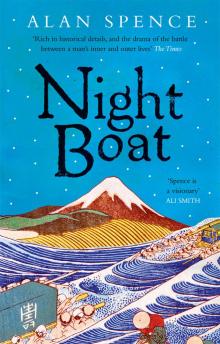
Night Boat
POETRY
Seasons of the Heart
Glasgow Zen
Still (with Alison Watt)
Clear Light
Morning Glory (with Elizabeth Blackadder)
zenscotlit
thirteen ways of looking at tulips (with Elizabeth Blackadder)
Edinburgh Come All Ye
PLAYS
Sailmaker
Space Invaders
Changed Days
On the Line
The 3 Estaites
No Nothing
Alan Spence, Mister Timeless Blyth