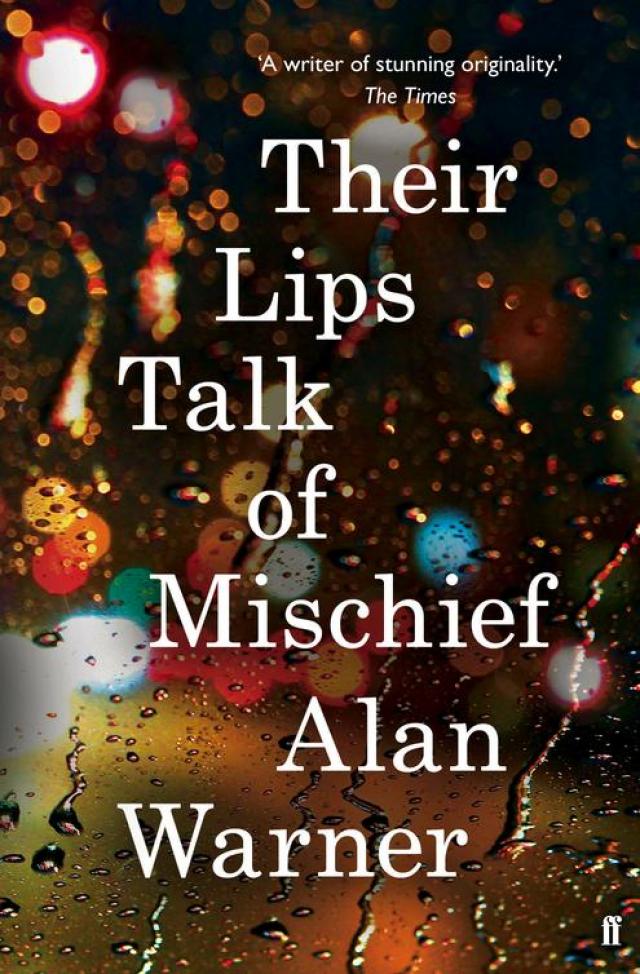
Their lips talk of misch.., p.16
Their Lips Talk of Mischief,
p.16


‘I’m not going to Mum and Dad alone. Surely you can do without drink for two or three days?’
I sensed an argument very soon. ‘I have to go to the parcel office. Can I get a borrow of your coat please, Lou?’
He snapped, ‘Is the other one there or in the wash?’
Asking about the other coat’s whereabouts meant he anticipated an argument and his auto-pilgrimage to The Bells. It was as good as arranging to meet me there.
‘It’s here,’ I called from the coat hooks.
In an understandably grudging voice Aoife said, ‘I washed it last week.’ She changed her tone to a more accommodating one. ‘Your shirts are here as well, Douglas, but I haven’t ironed them.’
‘I’ve told you not to bother ironing my shirts.’
‘I’m doing Lou’s ironing anyway. And you only have two shirts, Douglas.’
‘Oh. Okay then. Thanks. See yous in a half hour.’
I was wearing the older mac with the brown blood smear on the lining of the inside pocket. My breath showed on the landing lobbies. Halfway up Bollo Lane I was hit by a sleery front of hailstones which stung my face and scampered down the coat’s front, then the hail rapidly turned to sleet. The pavements shone with a glossy wetness. I could feel water in my sock, so I sheltered in Acton Town underground station for ten minutes but the sorting office closed at eleven thirty so I had to press on regardless.
When I entered the fluorescent light of the sorting office, I was shivering. There were two service points and a short queue built up behind me. It was an open counter, so surrendered parcels could be easily passed across.
The woman took one look at me, along with my postcard, and asked for identification. I showed her my UB40 card. After she came back with my parcel, I noted how she kept an eye on me as I settled over by the corner. My mum’s handwriting marked the parcel. I felt the clot of guilt and I quickly tore open the paper. People turned to look at me: perhaps alerted by my impatience, perhaps nosey as to what was in the parcel. Inside was a pair of size eleven leather brogues. I rooted around further. A note, From Mum & Dad xxx. Nothing else; no cheque, no currency.
Not only the counter attendants but the people in the queue watched me as I took off my old shoes, pulled on the new ones over my wet socks then tied up the laces. I stood and tested the feel of the shoes as one does in a shoe shop, then I lifted my old shoes and carried them to the bin. Heads followed me. I dropped the old shoes straight into the rubbish, along with the wrapping, and I stepped outside, making my way briskly toward The Bells.
15
On the morning of the twenty-third of December I helped Aoife down the stairs of Almayer House, carrying the front end of Lily’s buggy. I returned upstairs to assist Lou with the two suitcases. He was already swigging from the hip flask in the middle of the living room because Aoife wasn’t there.
I’d witnessed Lou pack his case the night before – mainly disposable nappies and some shirts. Both his hip flasks filled to the brim with brandy. He’d also packed the sloshing amount which remained in the big brandy bottle which he had decanted from. There was another small bottle of Martell and three cans of Guinness; single packs of cigarettes in their cellophane were uncovered and they slid into appearance each time he touched any garment. ‘I should be able to get at least six cans of Stella drunk on the train,’ he confided, nodding as if he was stating the time it would take him to walk a specific distance.
I carried Aoife’s case to Acton Town underground station, where they would begin their journey to St Pancras. Lou wanted to take the bus north and pocket the difference but Aoife wasn’t travelling with Lily on a bus. I kissed first Lily then Aoife at the ticket barrier. I shook Lou’s hand. ‘Merry Christmas when it comes.’
He nodded, glum and condemned. ‘You too, boyo.’
‘I hope you won’t have a sad Christmas, all alone. I feel very guilty. You should have gone home,’ Aoife said.
‘I’ll have a sadder one,’ murmured Lou.
‘Make yourself at home,’ Aoife smiled at me.
Back home, a newspaper gave the television and its trusty staples for Christmas Day: Ben Hur, The Wizard of Oz, a Morecambe and Wise repeat and the Queen at three, who I never miss – to shout obscenities at. Superb. I surprised myself to find it a luxury, contemplating Christmas up there alone in the sky above West London. A council spire for the curmudgeon. Peace at last from the constant and wearying temptation Aoife presented. However, gradually I was drawn down the carpet to their bedroom. Having the nude photo of Aoife there was like being left alone by some gallery director with a Canaletto, a Carpaccio or a Picasso etching. You were going to put your nose right up to the surface of the image and examine it, scrying for the brush strokes of the immortal presence. I did so with the photo. I noted the dust along the top of the clipped-on glass, but I also discerned the mist of an erect nipple concealed within Aoife’s vertical cascade of hair. I wondered if there were piles of negative out-takes somewhere, and looked haplessly around. I got on all fours and peered in under the bed. Only more of Abby’s clothes seemed to be compressed there. I was a little afraid to lift the photo down, study it even closer and hold it in my arms – I was wary of making tell-tale fingerprints in the dust. It was a sure giveaway. I studied her legs in the colour photo and scowled at the male model pretending to drive the vintage sports car. To look so great on just two days of your life, and to have photographic evidence, meant your heyday was both established and over with, I thought.
*
There was nothing in the flat to eat except half a dry loaf, fit only for toasting, and a jar of Marmite, which I was counting on to get me through all of Christmas Eve and Christmas Day. There was a whole pint of milk! I boiled up spaghetti, the black kitchen windows host to innumerable jewels of condensation; the lights and flashing blue sparked far outside, as if I were within a fly’s giant eye. There was no sauce for pasta – we were so broke we didn’t even have tinned tomatoes – so when I’d drained it, I melted a tablespoonful of old Marmite in and ate the browned spaghetti from the saucepan.
I peeled and sucked the juice from an orange while staring into space. Then I carried the typewriter through to the big table in the front room. Until two in the morning I slowly typed a long story. We could not afford Tippex so when I made a mistake, I used two coats of Lou’s Milk of Magnesia – for his whisky drinking – and this did just as well.
The story was this: A young man in London cannot get his novel published or taken seriously, so he resorts to using the last of his money at a seedy vanity publisher on Commercial Road. He has exactly twenty copies of his novel printed up and bound in a richly embossed leather. He then distributes these twenty books by his own hands, smuggling them in under his jacket and placing one copy each in the Fiction sections of twenty bookshops around Charing Cross Road – including Foyle’s. Although he is thrown out of his bedsit and made homeless, he finds himself happy each day of that summer, wandering these twenty bookshops in central London, letting his eye fall upon his book lodged upon those shelves. He feels fulfilled. The books can never be purchased as they are not listed stock, so they should remain there, making him happy.
Then, one afternoon in August, inside one of the bookshops, he witnesses a beautiful girl (I saw Aoife in my imagination, dressed as in the vintage-car photo) actually standing and, with great absorption, reading a copy of his book beside the shelves. To his amazement he witnesses this girl conceal the copy of his novel in her clothing and steal it from the bookshop. He follows her through the streets of Soho but he loses her. Then – one by one – copies of his book also begin to disappear from the shelves of all the other bookshops, as he patrols frantically between them. Sometimes he witnesses the beautiful girl’s figure turning street corners in the distance, but he can never catch her. The day comes when there is only a single book left. He takes to sleeping outside the bookshop door at nights, trying to guard the book during the day. Just another homeless figure. It isn’t the books that concern him any more. He considers them expendable bait. It is the young woman. He must meet her and talk to her. Eventually the bookshop owners call the police, who move him away, and when he forces his way back into the shop for a final time, the last copy of his novel has vanished. He never sees the beautiful girl again and the tale ends with him sleeping on the streets, shivering as winter arrives.
I slept upon their bed that night. On Aoife’s side. I could smell nothing in her pillow, though. Sleeping in the bed seemed a sacrilege too far, so I slept on top of it, between the crocheted cover and the candlewick bedspread with extra blankets from my camp bed.
On the morning of Christmas Eve I lay in late, then I reread the previous day’s writing and I was satisfied – making some small emendations in pen.
I brewed repeated mugs of coffee, ate Marmite and toast, listened to ‘Summer (The First Time)’, walked from room to room and paid homage to the photographs of Aoife again. And again.
I can remember clearly the feel of me, reading those pages but excited by them, in the cold alert air of that room high above Bollo Lane, taking frequent pulls on the latest mug of coffee. Then the daylight stuttering and drearily dying in a slow, almost thoughtful and testing progression as night came on. Ultimately, I was content. The day escaped under a metal sky and the night grew late. I wiped the condensation clear and could see lights in the distance, like the atmospheric colours seen spangling upon stars – but these weak globules of light, pleading in the dark, were in fact scores of Christmas trees receding in the windows of the south, down through Brentford to the Thames.
Close to midnight I jumped at a knock on the door. Abby? But she too had gone north and had talked of meeting with Lou and Aoife there. The North Will Rise Again. Well, Derbyshire. It might have been a neighbour with a last-minute Christmas card for Lou and Aoife: the Langhams with a remorseful gift, or to complain about the noise I’d been making, clomping about?
‘Got some rancid tart from the telephone boxes in there with you?’ Lou pushed through with his suitcase. ‘I saw a light high in the sky and was drawn here. Hey. All the bloody pubs were closed at St Pancras and I was propositioned by a whore outside King’s Cross. A wee Scotty, of course. Perhaps a relative?’
‘No doubt.’
I recall a split second of being despondent: despite occupying his home and coveting his wife, I felt the mildest twinge of resentment at Lou just for returning to his own flat and terminating my lonesome Christmas.
He stood in the front room. ‘What an unmitigated nightmare. I got the last train out of Derby, thank Christ. The last train out. And I tell you I wasn’t the only one fleeing. It was like the fucking American embassy in Saigon. It was like the pier at Smyrna – no, was it Austerlitz? Russians or Prussians trying to escape Bonaparte across the iced lakes and falling through. Anything was better than ending up in Derby for Christmas. It was like VE day on the happy train south. People embracing, crying with joy. I made sure I got next to the buffet car too, for some grog.’ He tapped his flat stomach.
‘Aoife’s staying on, then?’
He was drunk and went on for some time: ‘Course. I’m in the shit but I couldn’t take another minute of it. From the moment we left here. Bloody train up from St Pancras was packed. Lily crying all the way with snot pouring down her face. Every bastard had a cold, coughing up their lungs like they all smoke more than I do and we couldn’t get a seat nowhere but in bloody no-smoking with this coughing clan. I’d to stand in the aisle. So solid I couldn’t get up to the buffet for those beers. And I nearly got in a fight with fucking knuckle-headed Sheffield squaddies who were chatting Eeef up. I told them: “Stop trying to shag the wife and get a mission going lads. Your co-ordinates are the buffet car. Cup of tea for her, six beers for me.” They disobeyed those direct orders from a superior officer, boyo, I can tell you.’
I kept listening as I walked through to the fridge, retrieved the single can of Guinness from the back and returned, handing it to him. He took it and cracked the top without pause.
‘Fucking king’s shilling fascists, restless since the Falklands I should guess. Itching to poke their Armalites into another country’s business. The English are never happy unless they are. Arrived at the in-laws’ bunker stone cold sober, which is never the way to approach it. They started planning out how many Masses they could cram me into over the following days. You have to say grace before you have a cuppa there. Then Old Minky, their priest, was coming round for a glass of sherry to talk theology with me. Test my Spanish. I speak it better than him but for a shortage of vocab. I’ll discuss theology with him okay. Personally, I take the bishop’s position. I’m a stickler for it: with a fourteen-year-old blond boy underneath me. Anyway, I lasted one night, I think it was?’
‘Yes. You left here yesterday.’
‘Oh yeah. Then I had a stand-up row with Aoife’s dad, the self-righteous dandiprat. Never trust a Catholic who doesn’t drink, Cunningham. They’re either converted, poxed or pure psychotic. Like him. Doesn’t allow a drop in the house, covers it up with a daily matinee of pious fakery. Only a family like that could produce a woman with Aoife’s looks and indolence – it’s a cruel joke. Right?’ He looked around, as if he were unfamiliar with his surroundings already. ‘Is this all the booze?’
I felt a little possessive over my only bottle of wine. ‘There’s a bottle of Co-op wine left over from something. I was going to have it tomorrow.’
‘The hell with that, you lunatic. Reach for the corkscrew.’
‘But then we’ll have nothing to drink tomorrow. It’s Christmas Day, Lou.’
‘Nonsense. Course we will.’
‘How? We’re profoundly broke.’
‘Don’t you worry about the details.’
When Lou took a sip from the wine bottle, he smacked his lips and said, ‘Old Man McCrissican can’t moan, I’m partaking of the communion after all.’
I showed him my typed story and he became ominously quiet, reaching out and touching the pages suspiciously as if they were a court summons. ‘Christ sake, you’re inspired.’
‘It’s not much good.’
He nodded, ‘I’ll read it tomorrow, if you don’t mind so very, very much.’
That was that. The wine didn’t last long so we both turned in.
On Christmas morning Lou and I drank coffee, standing side by side, looking way south: the sky a ceiling of great sagging clouds like droops in wet ceiling plaster, carols playing in the background on television. The Heathrow planes must have been up above the cloud – if they flew on the Day of the Saviour. After a few moments you noticed the underground station’s uneasy stillness below.
‘The grub’s all out. There’s nothing.’
‘The hell with food, what about grog?’
‘Nothing left.’
‘Jesus. Why hast thou forsaken me?’ But he nodded decisively. ‘Pastures new. Capitalism always provides.’
I wore one of Lou’s cardigans and a scarf under the other raincoat and we sauntered through Christmas Day Acton in our identical macintoshes. No pedestrians moved but us. Roads were quiet, family cars crammed and shuttling from house to house, but no buses or lorries. Up past Woolies we paused by the windows of that rival to Harrods: Fine Fare. We gazed in at the yellow-label budget range so favoured by us. When Lou couldn’t afford Embassy Regal, he often made do with Fine Fare’s own: a yellow pack with Cigarettes proudly emblazoned upon the front.
Some of the Asian corner shops were open for business, which was frustrating as we glimpsed their rows of licensed liquor bottles, the curved glass glowing in fluorescent light. We moved north, toward the mainline railway, which was stilled.
Lou and I arrived at a low, flat-roofed red brick structure with a high wire fence round it, but the gate was open. The sign read: North Acton Railway Club. There was a Guinness sign up above the door and it was warmly illuminated.
‘This is licensed, but they’ll be picking over my cheque.’
‘Cheque?’
Inside was completely empty of customers; cheap, bright, reflective Christmas decorations were hung around the bar area. A gambling machine quietly signalled its lights with the same morose presence as the village idiot. I walked with Lou up to the bar. For a few moments nobody appeared, then a middle-aged guy stuck his head out from round back.
‘Merry Christmas,’ said Lou.
‘Oh. Hello.’
‘Our womenfolk have us running very late on that bloody turkey.’
‘Oh. Like that is it?’ the barman nodded.
‘Knew I shouldn’t have bought such a whopper. It’s going to take hours in that oven so we thought we’d nip round to you, slake our thirsts and spend a bit of our old hard-earned on a few quick ones,’ Lou continued without pause but turned to me for effect. ‘My old man used to take me here when I was younger. Right. Two pints of your Guinness, please, but I don’t have much cash on Christmas Day. Can I write a swift cheque for fifty pounds? We’re just going to spend the lot here anyway so, got a pen?’
‘Strictly speaking this is a members’ club, lads, but— You know?’
‘It’s Christmas?’
‘Yeah. It’s Christmas, isn’t it, and if your old man was once a member—’ He shrugged, passed the pen and he began to pour the first pint.
Lou had produced a chequebook of Midland Bank from inside his coat. I raised my eyebrow because I’d never seen such a totem before. He opened it and began writing a cheque for fifty quid.
‘Make it out to North Acton Railway Club?’
‘Yeah, please.’
‘Did you know Dad? Over at Old Oak Common depot? Jim McCrissican.’ He repeated, ‘McCrissican?’
I frowned at the lie.