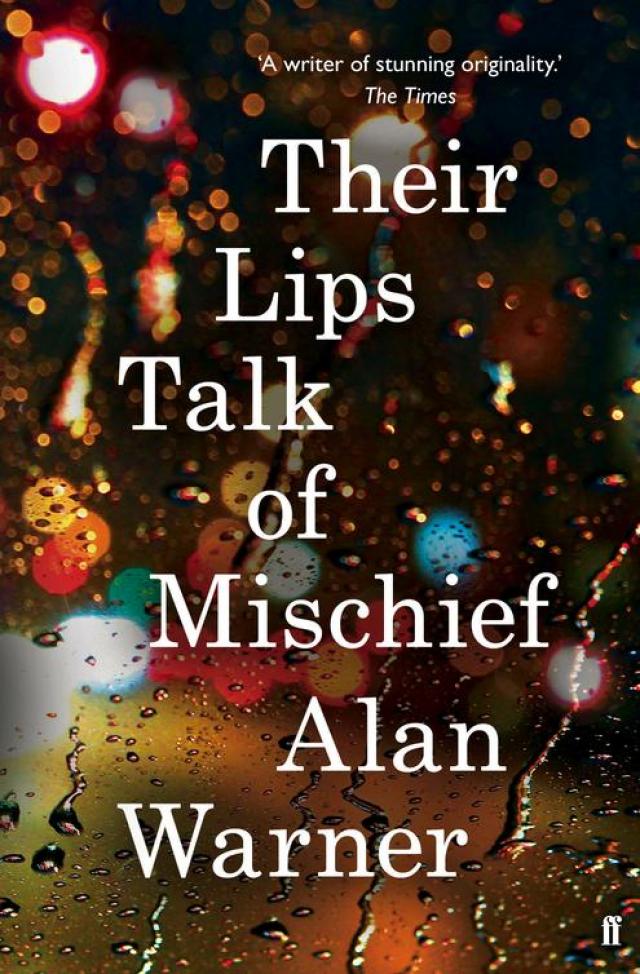
Their lips talk of misch.., p.7
Their Lips Talk of Mischief,
p.7


‘You’re very young to be an orphan.’
‘Mum died when I was just tiny. I don’t remember her – or only vague shiftings on the edge. The old man was Welsh. Ex RAF. Ground crew. Violent. Wandered back up the Valleys and drank himself to death in the early seventies. I hardly remember the guy, though Rhys does. And what I do remember was scary. All probably explains the way I’ve turned out.’
Mrs Smith lived in the exact image of the London house I would have imagined Lou to have grown up in. Red brick, two up two down, no bow windows, the North London British Rail line down the embankment at the back. It seemed generously proportioned inside after our flat. Filling the kettle in the kitchen, Lou nodded to the hump of the Anderson shelter and the disused toilets at the bottom of the small back garden. He claimed there was an original Victorian Crapper upstairs as well.
Old Mrs Smith had come slowly to the kitchen door to keep a close eye on us. ‘Been at The Bells, then? Well, boys, least you come before my mid-afternoons.’
You could hear the Welsh mixed with the cockney in her accent.
I soon found out that time spent with Mrs Smith was a fairly benign form of goalkeeping. There were quiet patches, then the action came rushing toward you and you had to deal with what was fired. Initially, she didn’t really pay my appearance there much attention, but when I sat down in the small front parlour she seemed to register my presence more profoundly and put a suspicious parrot’s eye upon me. She glanced once up at the ticking old carriage clock on the mantel. ‘Time for my mid-afternoons shortly.’
‘Douglas is lodging with us. Helps out, he does.’
‘Does he?’ she said, her voice heavy with perceptive doubt.
‘I try to.’
‘Are you one of Aoife’s fashion friends?’
This was an accusation.
‘I met Llewellyn at the hospital.’
‘Are you poorly too? You don’t look well. Too skinny.’
‘No.’ I thought I’d better make up a reason for me being in such a place. ‘I was bitten by a dog.’
‘Postman, are you?’
‘No, Mrs Smith. More like I wait for the postman.’
She made a small movement. ‘You’ll have to excuse it, my greens are repeating on me. Have you had your elevenses? Lou, make a cup of tea for the poor man.’
‘I have, Gran. He’s drinking it there.’
‘I hope you didn’t go give him the good china.’
‘Gran! No I didn’t.’
She chumped her mouth so her grey moustache shot up and down. ‘Sorry we don’t have any afternoon dainties. We used to like an afternoon dainty, didn’t we, Lou?’
‘Not good for your old ticker, Gran.’
‘Flo’s been round.’
‘Good.’ Lou turned to me as if excluding his grandmother. ‘That’s the neighbour. Brilliant neighbour. Good neighbours round here, mostly.’
‘Not these new ones coming in. How’s little Lady Lily?’
‘Touch of the cold, Gran.’
‘Oh dear.’
‘Gran. Lil’ll be staying with you and Flo on the wedding day, in the evening. All right? Then we’ll be back to pick her up.’
‘That’s nice. Wish you’d do it in the church though, Lou. I so wish you’d do it in the church. Your father would have too. You think he wasn’t for the church but you didn’t see him pray every night. It’s not too late.’
‘Leave it out, Gran.’
‘Is Aoife McCrissican still so thin as well?’ She glared at me as if I were responsible.
‘Bloody hell. You only saw her last week. Give her a chance.’
She turned slowly and looked up at the clock. ‘Time for my mid-afternoons shortly. That’s what that young girl’s lacking. A good dose of the mid-afternoons.’
Lou and I gave each other an eyeful of legerdemain.
‘Yes,’ he replied and coughed. He watched his gran and me, rather like a father watching his child’s first wobbles upon a bicycle, curious how it will negotiate the challenges.
Eventually she turned to me. ‘I don’t like the Scotch.’
‘Gran! Douglas is a scholar. He loves books, like me. He’s a very clever fellow. And a good man.’
‘Are you Catholic?’
‘I’m afraid not.’
She nodded slowly, taking in the full calamity of this. But then she changed direction. ‘Always had his face in a book, did Lou. His father only read the sports news. Till the telly came.’
I sneaked an eye at Lou. ‘You know you’re quite right, Mrs Smith.’ I was holding my china tea cup in my saucer since there was nowhere to place it. ‘We’re an awful lot, the Scots. We’re up there in our caves – most of them licensed – sheltering from the rain and you’re all down here in the sun of Merrie England, the spirit of endless sunken lanes, rolling fields, Shakespeare and Dickens, you beat Napoleon and Hitler—’
She turned to Lou. ‘What’s he on about, Lou?’
Lou laughed.
She said, ‘You sound like little Harold Wilson, though you look more like Ted Heath.’
I said out loud, ‘You might have got me in one there, Mrs Smith.’
Lou laughed again and even the old bird herself let her straight front dentures slide into view.
‘I’ll say this. You’re very polite for a Protestant.’
Lou laughed even louder.
She turned back on him quick in case he thought he was getting off easy. ‘I’ll talk to Father Petrie again about getting married in chapel. You’ll soon be changing your mind about all this, when you want Lily in the RC School. The father said so himself. Oh yes. The RC School.’
‘Did he now?’
On the way out, Mrs Smith suddenly turned her head. ‘Call me Myrtle and be done with it, son.’ Then she said, ‘Time for my mid-afternoons,’ and the front door was closed upon us both.
Lou and I faced up to domestic requirements and we visited the supermarket on the journey home. Toilet paper and nappies. The butcher called out to us from behind his glass counter about a special offer on lean mince.
Lou replied, ‘No thank you. Concerning our cuisine, we have long ago concluded that porridge and pasta are the staple dishes best suited to our economic and social aspirations.’
There was no denying it. Just before Lou’s giro was cashed the week before, for three long days, we’d already been reduced to the Scottish Emergency Plan. A little diced pasta and sauce for Lily but for we adults: watery porridge with honey for breakfast, plain watery porridge for luncheon and then – something to live for – an evening dinner of porridge with a dash of milk, seasoned with dried herbs. The primordial soup, as Lou called it. A sucked orange each for dessert. Then we ran out of milk on the last day and though we fished for coinage deep among the cushions of the bloodied sofa, we couldn’t even afford the smallest carton or manage to nick any of the small containers of UHT from McDonald’s or KFC. It was black instant coffee from then. The night before the giro came, Aoife had lifted two spoonfuls of the evening porridge, laid down her spoon for good and said, ‘Maybe time to cut down on the pub a bit, boys,’ before she abruptly left the table.
When we got back to Conrad Flats, Lily was crying. Maybe it was because Lily rarely cried, but baby wails always unreasonably irritated Lou. There was something chaotic about a child’s primal appeal – its lack of language – which affronted him. Generally you could feel Lou tensing up after three minutes of Lily crying. In any room where Lily was not crying, he would step back and forth smoking, looking distracted.
Aoife would often sit with Lily in the living room, lifting her from her buggy where she liked to settle, or letting her fall asleep in her arms. Meanwhile I would try to keep Lou distracted and amused, sitting down the corridor in my room with him – the camp bed stacked up on end and leaned against the wall as was daytime custom.
In my room, Lou had some good old singles, long-playing records and his big brother’s rejected hi-fi with its one functioning speaker. We played our favourites. We had an abiding passion for Bobby Goldsboro’s song ‘Summer (The First Time)’ and we would play the seven-inch 45 rpm again and again. We spoke along with the dialogue at the top of Iggy Pop’s ‘Dum Dum Boys’. We liked Atomic Rooster’s ‘Nobody Else’, grinning, nodding our heads violently to the middle section. Or our favourite of Britten’s Nocturnes. We mockingly held our palms to our sternums and sang along: What is more gentle than a wind in summer, until those astonishing, sublime chords of the string orchestra sliced in.
Between songs, when he had overheard Lily’s cries through the broken space in the pane of glass up above my door, Lou kept suddenly shooting his fist to his mouth and nibbling at a knuckle, then turning the hand over and going for a fingernail.
Again I asked him – as if I needed his permission – if we really should wait for replies from the fifteen or twenty publishers we’d already written to, touting our so far non-existent wares. Perhaps we really should finally begin our respective novels?
‘All right. Let’s build some desks.’ Lou nodded and blew smoke. It had begun raining outside, compressing drops in an oily way against the glass of the window, sudden mad rushes of it pushing up from the south, bouts of grey squalls passing across the distant gasometers.
We started organising two dining chairs in my room, carrying them from the living room down the corridor.
‘What are you doing?’ Aoife asked Lou, but he didn’t reply.
‘Going to do a bit of typing in my room,’ I told her.
She nodded temperately as I cradled off a dining chair before me.
Back in my room he said, ‘We’ll put you in pride of place at the window where you can be inspired as if you were at the forge of Vulcan. By views of the M4 and Brentford.’ He went through to their bedroom. I heard various strong oaths and low thudding, the heavy, multi-repeated impacts as many of Aoife and Abby’s knee-high boots tumbled out from the bottom of the bedroom wardrobe.
‘Lou. What you doing?’ Aoife’s voice, muffled and weary, was straining quietly from the living room. I knew Lily must be asleep.
That voice was ignored. Lou returned, invisible behind a very large colour television’s cardboard box. I could see a bright woollen scarf emerging, casually swung out over the edge from the inside. The box was forced against both sides of the door frame but wouldn’t fit through.
‘Jesus. Should you be lifting that with your stitches? Give it here. It won’t fit through, Lou. Put it down.’
‘I’m all right.’ His voice came from behind. ‘This is your desk. Won’t it fit?’
‘Nah. Need to sort of squeeze sideways. I’ll do it.’
Lou insisted, ‘It’s light. It’s not heavy, Douglas. It’s full of fucking knitwear belonging to a certain pussy-flashing, mutton hawker friend of Aoife’s.’ I was taken by surprise at the volume and vehemence this was snarled with, and a violent shove which buckled in one side of the cardboard and made me step back.
The box was in, though; then he lumbered towards the window and inverted the container. Unfortunately he didn’t turn the box over and down quick enough to trap the contents, so with a slump of gravity the knitwear slid out, forming a colourful heap, elevating the box at an awkward angle above the floor.
Lou stood back a moment, looking at the box canted askew with the guts of jumpers spilling through the bottom. He took another step backwards, then he raised his leg and kicked out aggressively at the box with his heel. His foot skated over the surface and slid along the top of the box – he hopped back upon his other leg, but not before the toe of his shoe had just touched the window. There was an immediate crunch and one single chunk of glass fell inward, flopping onto the top of the box accompanied by a theatrical gust of cold air and a splurt of rain which pattered darkened blots upon the cardboard. Some smaller glass shards tinkled, falling delicately down between the box and the outer wall.
‘I don’t fucking believe it.’ Lou looked out into the pure sky. His fringe snapped aggressively and he blinked. It was cold already. He turned his back on me and walked out.
‘What was that, Lou?’
‘Broke a fucking window, didn’t I.’
‘You what?’
‘I broke a fucking window!’ he screamed.
‘Where this time?’
‘In his room.’
‘Oh, Lou.’
‘Don’t start. How am I meant to work in this fucking place and her screaming there and you sat judging me all day?’
‘I’m not judging. Why say I’m judging you? If you want to go round smashing up the place that’s not going to help. Hush. You’ll wake her. Get the Hoover out. Oh. I forgot. It’s broke.’
‘It was a fucking accident,’ his voice yelled. ‘You judge just by your silence, Eeef. Just when you sit there all quiet, I know what you’re thinking. That I can’t write a great book. You’re like a fucking priest sometimes.’
‘I was just looking at the telly a bit. I wasn’t even thinking about you.’
Suddenly I heard Lily crying.
‘Now you’ve woke her. All over nothing, as usual.’
‘There you go. Judging. I’m warning you.’
‘Well don’t start chucking whole doors and books about again, like the corridor window and this now. Poor Douglas will freeze tonight. He’ll need to sleep in here on the sofa.’
So that explained the broken glass pane above my door. And the missing door. I tiptoed along the corridor to the living-room entrance. It was too windy in my room already. This was the third argument Lou and Aoife had had right in front of me.
I knew I should keep out of the way but at the same time I felt, as a house guest, I had an obligation to function as arbiter.
Lou dropped his voice into a whine. ‘Please, Eeef. Shut her up, can’t you, eh?’
‘I can’t stop her. She’s a cold. And now the window’s got broke. How would you say it? That’s not a positive development of the situation. Is it?’
He turned aside and moved past me as if I didn’t exist, so I had to shrink in against the passage wall. But then he turned and went back again into the front room and now he started shouting even louder at her. ‘And Gran was at me to get married in the church again. Fuck sake. I just wish you’d make some decisions yourself and take some of the flak off me. You’re just sat there. Judging. The passive approach. Everything’s so bloody passive with you, Aoife. Always has been. If I hadn’t got to you first you’d be a right slut by now.’
Her voice just continued, so you could hear above Lily’s crying a winded and less confident complaint: ‘I’m not judging. You broke the window. It’s not a judgement, Llewellyn.’ I could hear she was well misted up now.
‘Oh shut up, Lily, for fuck sake, darling, please. Aoife, you’re sat there day in day out. It’s me has to do all the worrying.’
‘I worry too.’
‘I’m going out.’
‘Where?’
‘Where do you think?’
‘The Bells.’
‘There you go. Judging. I’m going to get Jim Faring who I was at school with.’
‘Who’s that?’
‘He’s a fucking glazier, isn’t he? He’ll do me a price. Get him round sharpish so Lily doesn’t get the fucking pneumonia next.’
‘Why don’t you telephone?’
‘Aoife. When you need to pee, I’m surprised you don’t phone down the corridor to see if the fucking bathroom’s free.’
He stepped out again and tore his raincoat off the hooks by the front door, but then I saw him look both ways, stride past me once more and up into their bedroom. He returned holding a Penguin Modern Classic and a sealed pack of Regals, and slipped them in the overcoat pocket. I couldn’t help twisting my head to try to see the book title. So he was dropping off in The Bells. He looked directly at me and winked, then he stuck his face toward mine and whispered, ‘Put something on the window. I’ll be back with a glazier. Mind Lily on the glass.’ And he went out the front door and slammed it very hard. His other mac fell off the coat hooks. I rehung it and went through to the front room.
Lily and Aoife were on the sofa, crying together. The baby was laying in Aoife’s lap. I smiled. ‘Happy families.’
‘What happened?’ The tight skin of her smooth jaw wrinkled up a moment.
‘We were trying to build a desk with a big box and he accidentally broke the window. Looks like book writing might be off the agenda again. Here.’ I leaned and lifted Lily from her. I held the baby vertically, her face looking backwards over my shoulder, rocking her a little with my hand supporting the back of her head, my left fingers splayed out on the creamy skull and hair. My right hand was against the crunch and bulk of her nappy.
The volume level of the crying by my ear remained just about the same. No worse, no better, and I’d seen Lily’s cheeks puffed red. But then with the novelty of the view behind me and someone new holding her, abruptly, the babe’s crying ceased – seemingly to concentrate and reassess the situation. Her head was beautifully warm in my palm, like something just removed from an oven.
‘You’re so good with the baby.’ Aoife was using the back of her fingers to wipe at her eyes and then she looked carefully at each finger. It was because she had once been used to crying only in make-up and though she didn’t wear make-up any more, the habit had stuck.
‘Nah. She’s going to start again in a minute when she susses I’m not you. Freud or the psychologists wrote something about it. How when the baby realises it is other, and not part of its mum, it has its first big crisis.’
‘First of many,’ she said.
‘Yes. A whole menu to come. Especially for girls.’
‘Ah. But you’d make a good father, Douglas.’
I looked down at her. She was wiping her eye and looked off to the side. She’d stopped crying. I continued to stand there. I waited for her to say more but she wiped again at her eyes and whispered, ‘What was The Apple saying, then? That’s what I call her.’
‘Yes.’ She seemed to think it was tremendously witty.
‘It pisses bloody Llewellyn off to say The Apple. Doesn’t it, Lily? Bad Daddy.’
‘Wants you to get married in the church. Get Lily christened.’