In a time of distance, p.1
In a Time of Distance,
p.1


PUBLISHED BY ALFRED A. KNOPF CANADA
Copyright © 2020, 2021 by Alexander McCall Smith
Illustrations copyright © 2020 by Iain McIntosh
All rights reserved under International and Pan-American Copyright Conventions. No part of this book may be reproduced in any form or by any electronic or mechanical means, including information storage and retrieval systems, without permission in writing from the publisher, except by a reviewer, who may quote brief passages in a review. Published in 2022 by Alfred A. Knopf Canada, a division of Penguin Random House Canada Limited, Toronto, and simultaneously in the United States by Pantheon Books, a division of Penguin Random House LLC, New York. Originally published in hardcover in Great Britain by Polygon Books, an imprint of Birlinn Limited, Edinburgh, in 2020. Distributed in Canada by Penguin Random House Canada Limited, Toronto.
www.penguinrandomhouse.ca
Knopf Canada and colophon are registered trademarks.
This is a work of fiction. Names, characters, places, and incidents either are the product of the author’s imagination or are used fictitiously. Any resemblance to actual persons, living or dead, events, or locales is entirely coincidental.
Library and Archives Canada Cataloguing in Publication
Title: In a time of distance : and other poems / Alexander
McCall Smith ; illustrated by Iain McIntosh.
Names: McCall Smith, Alexander, 1948- author. | McIntosh, Iain, illustrator.
Identifiers: Canadiana (print) 20210156198 | Canadiana (ebook) 20210156236
| ISBN 9781039000186 (hardcover) | ISBN 9781039000193 (EPUB)
Classification: LCC PR6063.C326 I5 2022 | DDC 821/.914—dc23
Cover design: Abigail Salvesen
Cover images: Iain McIntosh
ep_prh_6.0_139716198_c0_r0
Contents
In a Time of Distance
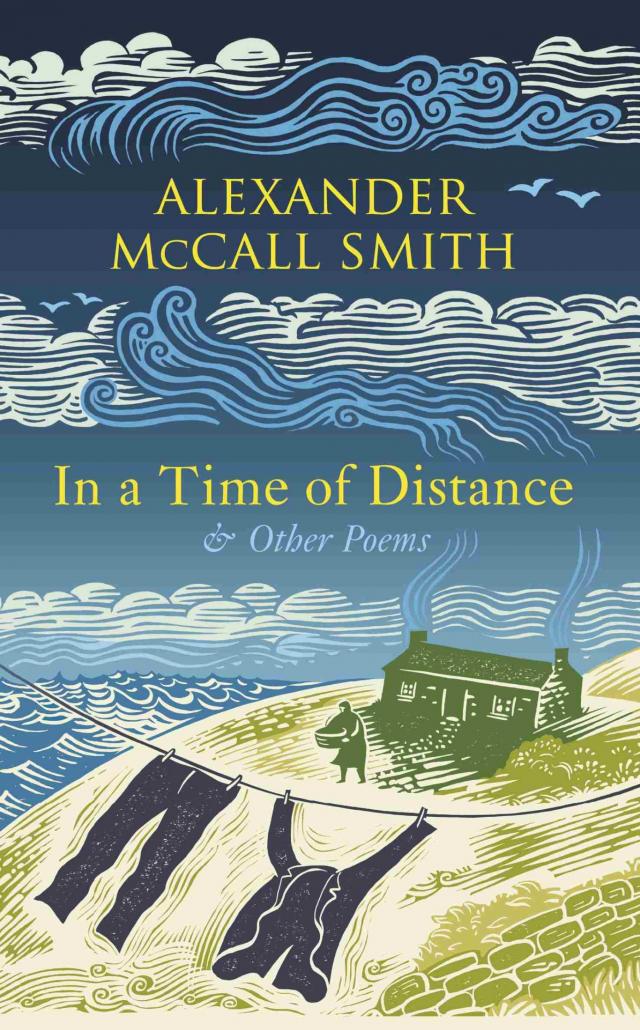
A Washing Line Outside a Croft House
Taste and Memory
In a Time of Distance
Journeys
Our Journeys
The Train Arriving at Platform Two
Adelstrop Revisited
The Language of Pilots
College of Hypnotherapy, Next Right
Quality Provisions for Ever
Not Rus in Urbe but Suburbia in Rure
A Typology of Angels
Household Gods
Holy River
Mustard Field, Rajasthan
Feel Glorious
Do Not Lean Again
Ne Pas
A Scottish Four Seasons
Spring
Summer
Autumn
Winter
Interlude: Seven Sonnets
I. Sixty Talks to Eighteen
II. Eighteen Replies to Sixty
III. Forty Intervenes, Remembers Horace
IV. Adventure and Uncertainty
V. It Takes a Village to Raise a Child
VI. King James VI of Scotland Reflects on the Loss of His Only Friend When Young
VII. Love Unforgotten
Of the Animals
Primate Cousins
The Gentleness of Whales
Elephants
Kangaroos
The Dung Beetle
Tortoise
Cheetah
Polar Bear
Crocodile
Lion
Small, Insignificant Antelope
Giraffe, Zebra
Our World, Their World
Of Love & Longing
Love over Scotland
On Clouds over Mull: A Love Song
Nocturnal Blessing
Love Lost
On Looking at a Child
Of Books & Reading
The Goodness of Books
I. The Book Becomes
II. Moveable Type
III. What the Book Is
IV. On the Bedside Table
Remembering Muriel Spark
Graham Greene
A Maker of Beautiful Books
Library of Congress
Places
Greece
The Oracle at Delphi
Goodbye to the Ionian
Scotland
St. Kilda
Dear One
Scotland’s Claim
Edinburgh
A Fragile Beauty
The Seven Hills of Edinburgh
The Castle Rock
Craiglockhart Hill, a Century Ago
Arthur’s Seat and Geology
Imagined Conversation on Blackford Hill
Corstorphine Hill
On Calton Hill
Braid Hills
Unrelated Poems
Northland
Wolves
The Canadian Museum for Human Rights in Winnipeg
From a Mumbai Hotel
Fish, and the Thoughts of Fish
Saving an Oak Tree
Friendship
A number of these poems were, on their creation, dedicated to particular people. Sometimes the dedicatees happened to be there at the time of writing; on other occasions the poem seemed just right for them.
These poems are:
“A Typology of Angels,” for Iain McIntosh
“Holy River,” for Prince Richard Holkar
“Feel Glorious,” for Hugh Raven
“Do Not Lean Again,” for Neil and Judy Swan
“Giraffe, Zebra,” for Richard Neville-Towle and Caroline Hahn
“On Looking at a Child,” for Ivy Rose Mant
“The Goodness of Books,” for Laura Bush
“Graham Greene,” for Joseph Kanon
“A Maker of Beautiful Books,” for Stephanie Wolfe Murray
“Goodbye to the Ionian,” for Nicky Wood
“St. Kilda,” for Fergus Hall
“Fish, and the Thoughts of Fish,” for Douglas Mant
“Saving an Oak Tree,” for Malcolm Wood
In a Time of Distance
A poem, in the mind of its creator, is often closely associated with the memory of a place, or of a time, or of something momentarily glimpsed and then seared into memory. Here is a poem that comes from a scene I saw many years ago in the Western Highlands of Scotland. I was travelling on a remote road and suddenly noticed that hung out on the washing line outside a white-painted croft house, alongside the ordinary items one sees on a washing line—shirts and so on—was a man’s suit. The nearest dry cleaner must have been hours away, and so I should not have been surprised to see a suit being washed. But I was, and the image has remained with me over the intervening decades. It was a bright day, and the sun was upon the green of the fields and the blue of the sea. A stiff wind blew against the washing pegged out to dry, animating it in a strange choreography. I realised at the time that this was something I would remember for a long time—and that is what I have done. If I close my eyes, I see it. And I smell the breeze from the sea, which is pristine in those parts, and I feel regret for what has gone, as we all must do when we think back to times when the world was fresh to us.
a washing line outside a croft house
Here on a line outside a croft
A suit has been hung,
A dark suit, old-fashioned,
The wear of some older man
For the regulated Sunday
Of a Highland kirk; its arms,
Filled with wind, beat time,
Remind us of half-remembered rhythms;
Remind us of the line of green between the sea
And the land behind the sea, that strip of flowers
And of whitened shells they call machair;
Remind us of that beat of the heart
That is this land, the unexpected vision,
The simple facts of being.
A memory rarely stands by itself. There is the memory, and then there are the associations that it triggers. In this poem, an olfactory memory reminds me of a particular part of Scotland and of a time, a matter of a couple of weeks, I spent there—again a long time ago. But any discussion of memory may itself remind us of Proust, whose theories of memory are, remarkably, being proven by contemporary neuroscience. In this poem, the image of machair appears again. It haunts me in its beauty. It is the landscape that I would expect to find in heaven, if heaven were ever to exist. Forget the fountains and clouds of other notions of heaven—make it Scottish machair, with the sound of the waves breaking on the shore and the cry of seabirds on the wind.
taste and memory
For Proust it was the m
adeleine cake
Dipped into tea; an unexpected key
To a flood of memories; for any of us
A taste, a smell, may evoke moments
We had not dwelt on very much
But that were always there, half hidden
In the lumber room of our minds,
Reproachful of our forgetfulness
But generous in their rewards,
Restoring place and emotion,
Love, friendship, the small exchanges
That go with being who we are
And where, and in what ways,
We have lived our ordinary lives,
Reassuring us that we have not
Lost what we thought we had.
For me it is the smell of gorse,
The flowers of which briefly in summer
Are redolent of coconut; small patches
Of yellow in the dark green foliage,
They scent the air, cling to the breeze,
Surprise the walkers or the lovers,
Make them stop, interrogate
The evening air, then put away
That unexpected memory of coconut
Amidst memories of islands
And quiet glens, the secret places
Of this country on the edge of
A continent, an afterthought of land.
On a Hebridean island in my twentieth year
I passed a place where gorse had colonised
A fold of land near a stretch of machair—
The lovely name by which some shores
Are known—grass and broken shells
And tiny flowers, close to the green sea;
But it is the gorse that I remember,
And its floral smell, touched with notes
Of seaweed, of sea salt, of iodine,
Those things that one can smell—and taste—
On the breath of the Scottish islands.
I was happy then and wished
Those around me, and one friend in particular,
The happiness I felt; now it is gorse
That reminds me of that time,
Not noisily, or with insistence,
But quietly, discreetly, as the wind
May whisper gently in our ear.
One friend in particular: anybody may do for that. All that we need is somebody on whom we can focus our feelings of gratitude. The real test of love, or friendship, is whether we are grateful that the other exists. Auden captured that in his lines about how love requires an object, but almost anything will do—even, in his case, when he was a boy, a pumping engine that was “every bit as beautiful as you.”
Here is another poem that will, I feel, always be closely associated in my mind with a very particular moment when people were required to live in conditions of isolation. This poem refers to that experience.
in a time of distance
The unexpected always happens in the way
The unexpected has always occurred:
While we are doing something else,
While we are thinking of altogether
Different things—matters that events
Then show to be every bit as unimportant
As our human concerns so often are;
And then, with the unexpected upon us,
We look at one another with a sort of surprise;
How could things possibly turn out this way
When we are so competent, so pleased
With the elaborate systems we’ve created—
Networks and satellites, intelligent machines,
Pills for every eventuality—except this one?
And so we turn again to face one another
And discover those things
We had almost forgotten,
But that, mercifully, are still there:
Love and friendship, not just for those
To whom we are closest, but also for those
Whom we do not know and of whom
Perhaps we have in the past been frightened;
The words brother and sister, powerful still,
Are brought out, dusted down,
Found to be still capable of expressing
What we feel for others, that precise concern;
Joined together in adversity
We discover things we had put aside:
Old board games with obscure rules,
Books we had been meaning to read,
Letters we had intended to write,
Things we had thought we might say
But for which we never found the time;
And from these discoveries of self, of time,
There comes a new realisation
That we have been in too much of a hurry,
That we have misused our fragile world,
That we have forgotten the claims of others
Who have been left behind;
We find that out in our seclusion,
In our silence; we commit ourselves afresh,
We look for a few bars of a song
That we used to sing together,
A long time ago; we give what we can,
We wait, knowing that when this is over
A lot of us—not all perhaps—but most,
Will be slightly different people,
And our world, though diminished,
Will be much bigger, its beauty revealed afresh.
Journeys
Script-writers like to talk about the journey that each character has. We must see that, they say. We must witness the development of character over time. People should not be the same at the beginning of a play or film as they are at the end; stability of character does not make for good entertainment.
So, a journey may be real or metaphorical. The real journey—one that involves ordinary transport across identifiable terrain—may be as rich in association, may give food for thought, just as much as any metaphorical journey.
Here is a journey into the land that lies to the south of Edinburgh—through the Scottish Borders.
our journeys
Driving one day into the Borders,
That quiet landscape where so much
Has long ago been the subject
Of such lively dispute, where the inhabitants
Are the same people at heart,
As they always were, but who
Equally believe they are not;
Into a land between two worlds,
Our road hugs ripening fields,
Of calculated barley,
Past neat farms cherished
In all their corners;
Undisturbed by the wind
Of our passage, those we glimpse,
The farmer on his tractor,
The boy walking a dog
Beside a meandering burn
Seem indifferent, and understandably so,
To our noisy concern
To be somewhere else.
Any journey, if reflected upon,