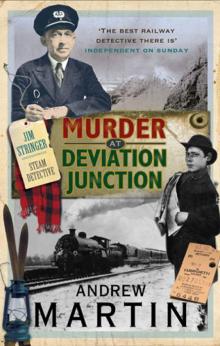
Murder at deviation junc.., p.13
Murder At Deviation Junction js-4,
p.13


'Tonight?' he said.
But even as I spoke, I was thinking: I'll arrive in the early hours, too late for the Underground ... I didn't fancy the cost of a cab across London.
'Well, I've got to look into the timings - that might not be on. But I'll run up to London tonight, put up somewhere near King's Cross and meet you first thing in the morning.'
'Then come to the office. But it can't be first thing - it's press day, and there's a lot of copy to get off. We'll meet at midday underneath the big clock at the Royal Courts of Justice on Fleet Street. Do you know it?'
I did - from my Waterloo days.
'I could spare an hour before I'd have to be back here,' Bowman continued, 'but we can sink a few pints and I'll put you in the picture.'
'Scrub out the beer if it's your press day,' I said.
'No fear.'
'But now you're going to have to go through another night of being watched. You might contact the Wimbledon police.'
'I've thought of it, but that would mean alerting Violet, which I'd rather not - and then again, what do I have to complain of? There's a man standing in the street. Well, it's not my street.'
Wright stepped back and marvelled at me as I put down the receiver.
'What now, then?'
'He's being followed.'
'It's to do with your photograph, is it?'
'You're beginning to believe there's something in it, aren't you?'
'I didn't say that.'
Wright was holding the door of the police office open for me. We stepped out and he locked up behind us.
The cold wind of Platform Four was cutting like no other.
'You can't go to London,' said Wright, as he followed me into the booking hall where the timetables were pasted up.
The last London train was nine thirteen. I knew the one. The night stationmaster turned out to see it off, then everything went quiet until six in the morning. I had no need of a ticket; my warrant card would see me to London.
'You'll be for it, you know,' said Wright, as we walked back to Platform Four. He had evidently decided to wait and see me off, being in no great hurry to get back to the Co-op ladies.
I was looking in my pocket book: two fivers might be in there, or one and a quid. I couldn't bear to look. I had a bit of silver besides, but that was all I had until payday - if there would ever be another payday. And there was still Harry's aeroplane to be bought, amongst many other Christmas items.
'You know my missus, don't you?' I said. 'Will you go back to the Ebor Hall and tell her I've gone to London in connection with a case - with the case, for she'll know what you mean - and that I'll most likely be back tomorrow?'
'Most likely!' exclaimed Wright. 'You've belted your superior officer, and now you're making off without permission.'
There was nothing to say to that. Above our heads, the great minute-hand of the station clock shuddered to the mark of half past ten.
It was a shame I had to go to London with my suit in such a state, for they were all dapper dogs down there. Further along the platform, a lass in a cape stood singing 'God Rest Ye Merry Gentlemen'. I'd seen her on the station before; she sang with a toy dog on a decorated box at her feet with an upturned straw hat placed alongside. By rights she was loitering and liable to a forty- shilling fine. Wright looked on as I walked up to her and put a shilling in the hat.
'Why d'you do that?' he said, as I returned to where he stood at the platform edge.
'For luck,' I said
'I'd say you'll need it,' said Wright, as the London train came into view behind him.
PART THREE
The Railway Rover
Chapter Nineteen
As I took my seat in an empty Third, I realised that I had boarded the London train partly in order to get properly warm. Even with my topcoat on, it took a good half-hour for the steam heat turned to maximum to thaw me out. Wherever there were lights beyond the window, they showed snow scenes, but the track was clear - at least the main line along which I travelled was. I saw gangers just before Doncaster, burning rags in the points of the branch lines, fighting the ice. On the platform at Doncaster, a tea wagon pulled up alongside my compartment. I opened the window and bought a cheese roll, a long bottle of water and a basket of chocolate biscuits off the boy, and these together killed the last of the Chief's rum punch. Then I cleared the stuff under the seat, kicked off my boots and stretched out. I watched the telegraph wires rise and fall against the dark blue of the night sky.
What were the chances that I would be returning the following day with the whole thing knocked and the case closed? Nil. For a start, I was most likely heading in the wrong direction. This was a northern matter, somehow tangled up with the iron-mining industry of the Cleveland Hills; it was in the slice of moon over Stone Farm; the lonely pit tops; beacon fires burning on the cliffs; the mineral train going between the legs of the Kilton Viaduct like a mouse between table legs. I watched the telegraph wires rising and crashing into the telegraph poles at an ever greater rate as we sped towards Peterborough, and somewhere on that stretch I fell asleep, waking on arrival at London King's Cross.
I walked along Platform One, going by a long line of trolleys piled with mailbags. A barrier had been erected around the parcels office so as to make extra space for working through the Christmas rush. Everybody who worked in that station looked in need of a good night's sleep, and the ones not moving about were shaking with cold. I stepped across the road from the station. The constant flow of traffic had turned the snow into black slush, but some remained on the pavements. I bought an orange from a bloke with a white beard who sold oranges and chestnuts - he looked very Christmassy, but wouldn't have thanked you for pointing it out. I looked along the Euston Road: it roared with life. I glanced upwards, at the giant white face of the clock on the Midland Grand Hotel, and it looked wrong for a moment. One hand had fallen off. But no - midnight.
I would not be spending fifteen bob on a night in the Midland Grand. Instead, I walked north to the small house-sized hotels that served King's Cross. The first was called the Yorkshire Hotel. Well, London was anybody's, and this place got custom by reminding folk of the places the nearby railways went to. A notice on the door of the Yorkshire Hotel read 'Respectable Persons Only', and I wondered whether that included me. For instance, I was probably out of a job at that very moment, but I'd brushed most of the loose mud off my suit, and it passed muster with the not very respectable customer who ran the place. He showed me to a sooty room at the top that had no fire, but two beds, and he advised me to take the bedclothes from one and pile them on top of the other. That was the Yorkshireness of the place, I thought: the bitter cold. But after putting my boots to air on the windowsill, I got my head down and slept through until ten o'clock, when I pulled back the curtains to see a bright, bitter day.
I was too late for the serving of breakfast in the Yorkshire Hotel, so walked to a stall near the station and drank a cup of Oxo and ate a bacon sandwich. I then rode the Inner Circle line to Charing Cross. There were faster ways of getting to Fleet Street, but I had time to kill until my midday meeting, and I liked the Inner Circle. They'd put on electric trains since I'd seen it last, but it was still a railway in a coal cellar; you were still looking up from below the streets at the towering, blank backs of the buildings, many of them covered with giant posters for Lipton's tea.
I stepped out of Charing Cross Underground into muddy snow, and the black shadow of the Hungerford railway bridge. Having taken my bearings, I put up my collar and walked north up Villiers Street, turning right on the Strand. I was under the clock a quarter of an hour before time and I felt a proper ass for standing still in that weather. Nobody else in Fleet Street stood still. They pushed on fast in their good suits, clicking canes and highly polished boots - all the dapper dogs, with many straw hats worn even in the extreme cold. Everyone walking was really working; there were no loafers in Fleet Street.
And the ones in the shiniest boots and hats were the lawyers - the thoroughbred black horses among the London nags. They were an exquisite lot, which made you suspicious of them. As I watched, they came and went from the ancient alleyways opposite in capes or fur-collared coats, and I thought of Marriott, the barrister of the Travelling Club who was known to the Chief. Every brief in the country came from that ancient place opposite - from it or other, similar places near by. They came to York for the Assizes, and I pictured them riding into the city like a pageant.
At twelve o'clock, about a dozen clocks struck, driving the people on to faster walking, and the vibration of the air seemed to bring on snow, for it started again now - just the odd, accidental snowflake, escaping from the dark, moving clouds above. Where was Bowman? I tried to recall his looks: the red, ridiculous face, the nose at once too big and too small. His head put me in mind of a teapot, somehow. He was strange-looking - and as a clever man, he knew it. He didn't like to be stared at and would seldom meet your eye. It would be wrong to take against him on that account.
I watched the road. I had the feeling that Bowman would cross it to get to me. Fleet Street contained as many cabs as the pavement did people, and they could only fit on to the road as long as they all kept moving - if one of them stopped, they all would. None did stop, though. Anybody in a cab in this weather would be inclined to stay in it, while the omnibuses, being open to the snow, ran empty.
A hand touched my shoulder and I whirled around.
He'd already had one or two, I could tell. The cold had made his face extra-red. Same green topcoat, same flat sporting cap, which was like a saddle on a donkey, for he was not at all the sporting type.
'Good to see you,' he said, and his eyes settled on mine for longer than at any moment during our time at Stone Farm, but even so, not for very long.
'This way, Jim,' he said.
'Where are we off to?'
'Licensed premises,' he said without looking back. 'He was there again last night. Looking at the living-room window when I sat in the dining room, then at the bedroom when I went upstairs ...'
There were pageboys everywhere, dashing about with great piles of newspapers - fresh batches, newly made.
'Snowing up north, is it?' Bowman asked me, looking ahead.
'It was bitter when I left,' I said.
We were passing newspaper offices: the Yorkshire Observer, the Irish Independent, the Aberdeen Free Press. The grander ones hung out a clock, just as a rich man will show off his watch.
'"Truro as a Railway Centre",' Bowman was saying. 'That's the masterpiece I've been slaving over this morning. Truro, you know, is one of the largest towns in Cornwall . . . which is saying absolutely nothing. The station is quite modern; there is still some tin traffic.'
He was talking more than he had at Stone Farm - still sounding worried, but in a different way. A newspaper placard read 'African Doctor Cooked and Eaten By Natives', and the hundreds of people and the hundreds of cabs just flowed on by. It took more than that to cause a sensation in Fleet Street.
'In the end I decided on leading off with the fact that every train on the main line stops there, but then Fawcett walked up - he is the leading railwayac of the office - and he told me of two that don't, including one that stops everywhere but Truro.'
He had stopped walking, and was standing before two pubs, weighing them in the balance.
'It's champagne or beer,' he said.
Both pubs had black windows with white writing on them: 'Saloon Bar and Buffet', 'Luncheons and Teas', 'Dining Rooms First Floor'.
'Will you take a glass of champagne?' Bowman asked, pushing at the door of one of the pubs. 'No thanks,' I said, as we entered, 'I had a skinful last night, and I'm a little -'
But Bowman had already moved off towards the bar. It was a good-sized, jolly wooden hall in full swing with a decorated tree just inside the door and giant beer barrels end-on over the bar, like locomotive wheels. The customers stood at tall tables - or just anywhere. Bowman was giving good morning to a man at the bar; he held two glasses of champagne in his hand. As he turned away from the man and approached me, I said, 'I didn't want a drink, thanks', at which he just frowned.
'It's on expenses, for heaven's sake,' he said. 'You'd better force it down because I'm getting you another in half a minute.'
He emptied his glass and folded his arms.
'I don't want to over-dramatise, but do you carry a gun?'
'No,' I said, downing the champagne.
'What do you do if someone fires at you?'
I shrugged.
'I get shot, I suppose.'
'Well, that's heartening,' he said. 'This fellow who stands outside our house always has his right hand in his coat pocket. I'm sure he has a pistol there. I'm sorry, but I can't talk about this without a drink . . .'
He was about to move off to the bar again, but I checked him by asking, 'The man who keeps watch - he was definitely there again last night, was he?'
Bowman nodded. 'From eight to nine-thirty.'
'Did Violet not notice?'
He shook his head. 'We spend most of our time in the drawing room - at any rate, the room that she calls the drawing room - and that's at the back of the house. Fortunately, she's gone off to her mother's for two nights.'
'Where's that?'
'Environs of Hampstead Heath.' 'Eh?'
'Strictly speaking, it's Tufnell Park.'
And he went back to the bar again.
He returned with two more glasses and a bottle of red wine. The cork had been taken out and put back loosely. It was 'finest Algerian wine' according to the label.
'This fellow outside my house obviously thinks I know something about the death of Peters,' he said, filling the glasses, 'and of course he's right. I'm sure the only reason he hasn't acted is that the street's been busier than usual, what with all the Christmas coming and going ... You said there'd been developments in the case.'
I produced the photograph and explained how I'd come by it; told him as much as I knew about it.
'Is the man outside your door one of these?'
Bowman looked, shook his head and saw off another great gulp of the Algerian red, and looked again.
He said, 'You think Peters was killed for that picture?'
I nodded. 'I'm sure it's the one his killer was after - only it didn't come from the Stone Farm camera, but the one stolen at Middlesbrough.'
He handed back the photograph, pulling a face, and saying, 'It looks just like something that might appear in our magazine: an interesting new sidelight on First Class travel.'
'Well, that's what it was meant for, wasn't it?' I said.
'Of course,' said Bowman. 'I'm not thinking straight.'
I was not surprised over that. Bowman's glass was at his lips, and the bottle was half-empty. I myself had not yet tried the Algerian wine.
'How can you write, shipping all that stuff?' I said, pointing to the bottle.
'You might ask that of any man in here,' he said. 'I mean, it's all scribes in this place. Every paper in London's carried into print on a wave of booze, you know - it accounts for a lot of the rubbish you read and a lot of the best stuff too.'
Silence for a space.
'Well, I'll come back to Wimbledon this evening with you and have a look,' I said.
'What will you do?'
'Well, I'll quiz him as to what he's about.'
'Do you have authority here in London?' he asked.
'It's a matter that began on North Eastern Railway lands,' I said. 'It would be a poor lookout if all any villain had to do was flee the territory.'
He sighed.
'One more ought to do it,' he said, looking at the empty bottle. 'Will you not join me in -' He was squinting at the label on the bottle,'- in Algeria, then?'
But he was already at the bar.
'Do you not take wine at luncheon?' he said, returning. He never so much as grinned, but sometimes it was there in his voice; and I could tell that the wine was now working in him.
'I don't take luncheon for a start-off,' I said.
'I will generally have a wine,' he said, pouring out two more glasses. 'One wine, that is,' he added.
'One gallon is that?' I said.
'One wine means half a bottle in Fleet Street,' he said.
'That's handy,' I replied.
'I drink because my nerves are strung,' Bowman continued. 'I mean to say, is that unreasonable? Whoever is behind it all has killed Peters, a young lad, so obviously they'll stop at nothing.'
'We must identify the man following you,' I said. 'It will all come clear then. You've not seen him about round here as well, have you?'
Bowman frowned and looked about the pub.
'Not so far,' he said. 'Of course, most of the blokes in here would kill for this story - "Curious Affair of the Body in the Snow", "Travelling Club Men Disappear". It's a detective yarn, ready made.'
'You could write it up,' I said.
He shook his head.
'It's a sight too interesting for The Railway Rover. It lacks the necessary boredom.''
'Do it for someone else. The Times?'
He nodded once quickly.
'I've had articles in The Times, you know. I did some comical railway pieces for them - byline "Whiffs". A layman's guide to the railways. That was their idea. The series was stopped in '06 to make way for the General Election, and never put back.'
'I'm a Yorkshire Evening Press man myself,' I said. 'I don't want The Times. I want, you know, the lighting-up times.'
I'd had four glasses by the time we pushed out into the snow again, with the consequence that my own barometer had swung a bit further towards 'fine'. The programme was that we would go back to the office of The Railway Rover, where Bowman would do another hour's work while I drank coffee, filled out my notebook and telegrammed to the wife to say that I would be returning by the last train of the day, or the first of the morning. Then we would go to Wimbledon and challenge the mysterious man. There had to be something in it all, and if the fellow cut up rough, that would only prove me right. It was all quite above board - an almost routine bit of police work. I told myself that I was not some child playing truant from school; I'd had no choice but to come to Bowman's aid - anything else would have been a breach of duty. I had the solving of one murder to my credit; if I solved another, I would be invincible. They could not then stand me down, or refuse me promotion. What could Shillito show to match the solving of a murder? He spent all his time chasing folk who'd pulled the communication chains without good reason, or defaced notice-boards, or failed to shut gates set up alongside railway lines.