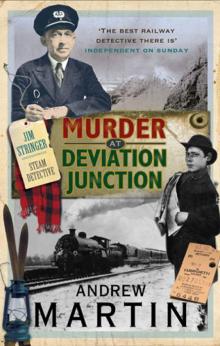
Murder at deviation junc.., p.16
Murder At Deviation Junction js-4,
p.16


We were approaching Inverness, and I woke again to see sleet flowing through the greyness beyond the window. It was nearly nine. For all the freezing weather, there had been no schedule slacks. In a goods yard to the left of the ticket gate stood a row of wooden letter As: snow ploughs to be fitted to the engine fronts. I stepped into the corridor. Our man was waiting at the head of the short queue for the door at the end of the carriage. I counted the queue - nine people - and I thought of all the effort the Midland company had gone to for this.
The night on the train had not put a crimp in the man in the least: breeches and socks were perfect as before, coat swinging open, cap pulled low over the great boulder of a head. He climbed down, advanced along the platform and stood still for a second, breathing the cold air of Inverness, taking the sleet. I thought: he likes this - this must be his home. He had a barrel chest, legs a little too thin and bandy. He might have been a boxer once - a boxing farmer. His white moustache was like the handle of a pail.
We walked the length of the short train, and we were right behind the man at the ticket gate. I thought: there is nothing out of the way in this - the three of us were all on the same train, and now we're heading for the same ticket gate. We had no option but to follow him; the only thing that marked us out was our lack of luggage. The man crossed the booking hall. He was standing before a wall panel showing the timings of Highland Railway trains.
'He's going on,' I said.
Chapter Twenty-three
But then we watched from the ticket gate as the man crossed the booking hall and left the station.
'He's not going on,' said Bowman. 'He's done with trains.'
He cut diagonally across the square that lay beyond the station, and walked into the Station Hotel. A five-second battering from the icy wind, and we were in the hotel ourselves - soft carpets, soft fires, beautiful warmth. There was a bar or lounge directly opposite the reception desk. The man who looked like Sanderson was carefully folding his coat, and draping it over the arm of a chair. As we looked on, a waiter approached and asked to take his coat. The man refused with a quick headshake. He then said one very short word to the waiter, which, as I worked out a moment later - when the waiter returned with a silver tray - must have been 'tea'. When the waiter placed the tea before him, the man did not seem at first to notice it, but then he took the silver tweezers, and moved four sugar cubes from the sugar bowl to the cup. He drank one cup, stockinged legs akimbo. There was more in the pot, but he left it. He did not smoke.
He then repeatedly shot his cuffs while sitting in the seat: left, right, left again. There must be just the right amount of shirt linen extending beyond his country coat sleeve. His clothes were not quite of the best quality, I thought. He was not, by his looks, a rich man, and there was something tired about his clothes, as if he tyrannised over them.
He now fell to stroking his moustache, coaching it forward, as though conjuring for himself an ever-longer top lip. Suddenly he stood up, put some silver on the table and walked smartly out of the hotel. Another blow in the square - where stood the snow-topped statue of some kilty fellow from times past - and we followed the man once again through the booking hall of the station, and on to a bay platform. Here another short train waited - but there was a powerful engine at its head. I sent Bowman to buy biscuits and water bottles and climbed up. As I did so, the man looked for the first time directly at me. He sat right by the door. His head was tilted back, and he inhaled slowly through his white 'tache as he saw me, as if to say, 'Now you're a bit over-familiar. What's your game?'
I took a seat two along. It was a Highland Railway carriage, flimsy as a cricket pavilion, and with no compartments but open seating - and with no beating either. Bowman came up by the same door, and gave not a glance at the man but coloured up even more deeply as he brushed past him. He carried a paper bag in which were bottles of mineral water, bread and cheese.
'You might've picked up a couple of footwarmers,' I said with a grin, to which Bowman made no reply. He had barely spoken since Edinburgh. Only two other passengers joined the carriage - two men. They were discussing church matters but were not vicars. Their accents made them sound mechanical, as though driven by clockwork: the words 'rector' and 'kirk' came round again and again. I could only see the backs of their heads, and it bothered me that they did not move more.
We came out of Inverness by a great grey stretch of water. A single ship sat miserably in the middle of it. The line was single, and there were many pauses for other trains to pass, and many stations. We heard them before we saw them, for we approached to the sound of a bell rung by hand by the stationmaster. I recall the strangest of the names: Beauly, Muir of Ord, Foulis, Nigg. It was odd to see ordinary-looking - by which I mean English-looking - working people standing about near such station nameplates. Not that there were many outdoors in the sideways-flying sleet. All the stations were church-like, made of heavy stone. They had what looked like low fonts projecting from the station houses, and I fancied these must be for the dogs to drink from. The stations were not meant to look beautiful; they were meant not to be blown away.
One of them would come up, and it was as if the town supposed to go along with it had been mislaid. Or there might be a few buildings - more of a camp than a town. There was a sawmill by one station; a blacksmith's by another; sidings here and there, with horses being loaded; some wagons with a word written in a giant letters - 'HERRING'; great tanks of lamp oil. Well, the people went to where the fuel was. Every platform showed a simple sign with one arrow pointing in a direction marked 'Inverness', and another marked 'Wick and Thurso'; no 'up' or 'down' here. We were way beyond all that.
At most stations, one or two climbed up into our carriage, and one or two got off. Our man remained; the two ministers remained. I wanted as many up as possible, for every person aboard was a guarantee against the man loosing off a bullet from his pistol.
We were now somewhere beyond a spot called Dingwall. When would the bloody man get off, and what would I do when he did? I had no notion. We'd been on the go for more than an hour. I looked at Bowman, and he seemed to be asleep. Had he even noticed the great mountains to our left? You could mistake them at first for great banks of clouds, until you worked out that they were not moving. I peered forwards: our quarry sat still as before. I could see the top of his wide cap.
One of the ministers was saying, 'It's all to the guid, it's all to the guid . . .' and I cursed his ignorance. It was not all to the good.
I turned again to the window. The sound came of another bell floating through the sleet, another station rolling into view. A curiosity on the platform: a smoking stove attached to the base of a water tower - against ice, as I supposed.
There came a clattering of a door in the next carriage as I read a poster on the station wall: 'Further North! Further North! Fortnightly Passes for Visiting the Northern Highlands', and then, underneath, in smaller print: 'Summer Only'.
I looked at the seat opposite; Bowman was eyeing me from the depths of his coat. The turned-up collar had skewed his glasses.
'Who comes up here in winter?' I asked him.
'Juggins like us,' he muttered.
Huddled in his coat, he did not meet my eye; he had hardly the will to speak. He hadn't taken on alcoholic fuel for a long while, and he had now reached the point of being made tired by the cold - which was a dangerous point. He belonged in an office, not a Highland train; an office or a pub, of course.
I looked out at two winter diehards in the fields, following a hay wagon as we moved on.
I was almost asleep myself when a jolt of the train brought me up sharply. Bowman was eyeing me again.
'The wild sea disclosed,' he murmured, and he nodded to the right. Great grey waves were rising and coming at us. The line was practically on the beach.
'When will he bloody get off?' I said, nodding along towards our friend; but Bowman had gone back into his own world.
I had hoped the man might step down at Helmsdale. This was a seaport with a slightly larger station. For once, grey houses blocked the view of fields and sea. But while everyone bar the two ministers got off there, our bastard sat tight.
After Helmsdale we were rocking along in a valley by a fast black river - one-sided trees and tumbledown cottages, all snow- covered. It seemed a great impertinence for the engine, which was green, and its carriages, which were greener still, to intrude upon this white world, which was a kind of fairyland, not real, not Britain. I could not believe they had the Royal Mail here; or even newspapers. There were telegraph poles and wires, but they were all askew and snow-loaded.
We stopped at a place called Kildonan, and hastened down on to the platform. I needed a piss, and there was no WC on the train.
A man in railway uniform stood before the station house.
'Good day,' I said.
(That was a laugh, with the wet snow flying at us.)
'Could I use the jakes in the station house?' I continued.
'The whit?' he said, making the sound of a cane going swish through the air.
'The station lavatory,' I said.
'Aye, aye,' he said, and jerked his thumb at the open door behind him. It was half booking hall, half living room with a good fire going and three pot dogs on the mantelpiece. The lavatory was in a door leading off. I pissed and came out, lingering by the fire. I then turned, nodded at the man and climbed up into the train as he blew his whistle. The ministers had gone, and Bowman was standing up at his seat.
He was talking in low tones to the man we had been pursuing.
The stationmaster slammed the door behind me, and the train jerked into motion as the man we had been pursuing turned towards me, gun in hand. With perhaps the beginnings of a smile, he motioned me towards him, motioned me into my seat. He sat down opposite me, and Bowman sat down beside him.
Bowman would not meet my eye.
He was in on it.
Chapter Twenty-four
'In five minutes, ye'll alight the train,' said the man.
'Will I now?'
'Aye, ye wull,' he said, with a glance down at the revolver in his hand.
Juggins like us, Bowman had said. Juggins like me. The business of the photograph was never meant to come to any good, and I should never have taken it up. Shillito had been right. I knew hardly anything, but it was too much for this Scotsman. Was he Sanderson? Had Sanderson been Scottish? I asked him outright:
'Are you Gilbert Sanderson?'
'Sanderson's deed,' he said. Again, the half-smile came. He had the smooth kind of Scottish accent, making the most of the Rs.
Down below us to the left, the black water seemed to be in a panic as it rushed towards two mighty boulders. We and it were the only things moving in the valley. Looking up at the mountains, I thought for some reason of hymn-singing in church, the search for the Beyond. This was an almost heavenly, life-after-death place where everything was different. I would not see my wife and child again, and all that was left was curiosity.
'Where is this place?' I said, and it was Bowman who answered, looking down and away. It took me a while to make out what he'd said, which was: 'Strath of Kildonan'.
Well, it sounded like a place in a book.
I looked back at Bowman, but he could not meet my eye.
The train began to slow, and a station rolled into view, but there had been no bell, and there were no people.
'Oot,' said the Scotsman, and I stood up. We climbed down,
Bowman slamming the door behind us, and then immediately huddling up into his coat again. The train went on. This was not a station, but a halt. The place was not named. The platform was of wood, like a theatre stage, and there was no station building, but only the two pointing arrows for 'Inverness' or 'Thurso and Wick'. The Scotsman must have requested the stop miles since.
I could not keep my eyes open in the floating snow, but I knew that the clattering river was near by, that mountains rose all around; and that a high-wheeled dog cart stood waiting at twenty yards' distance.
'Tae yer left', said the Scotsman, and I could not make out the words.
I turned in the snow towards Bowman. The lenses of his spectacles might have been painted white. He looked like a red-faced blind man.
'He means you to go to your left,' Bowman said.
The snow-covered heather leant across the path so that, as I came up to the cart, my trouser legs were soaking. It wasn't weather for a forty-shilling lounge suit.
Two men waited in the cart. Their collars were up, and their hats pulled low, but I knew them. They had stepped from the photograph in my pocket and up into the vehicle. They were the barrister known to the Chief and called Marriott, and the youngest man of the five, the one who'd been missed in Filey over the summer. Had I run them to earth, or they me? The young man was speaking to the Scotsman in what seemed like a friendly way, but the barrister, who was in the driving seat, stared straight ahead at the miserable horse. I was placed on one bench; the young man, the Scotsman and Bowman sat facing me. The revolver lay in the Scotsman's hand. He did not wear gloves; the gun would freeze before that hand of his did. He was made for this weather, born to it.
'Ye've the photograph about ye?' he said, and I gave it over.
Marriott the lawyer cracked the whip, and we started to roll as the Scotsman said to the young man, 'Would you no say I was better to look on than yon Gilbert Sanderson, Richie?'
The young man said something I didn't catch.
'Aye, he's the same high foreheed as me,' said the Scotsman, 'I'll grant ye that.'
Again a remark from the young man that I did not hear, to which the Scotsman said, 'Nay, nay, he was bald - I'm towsy-haired compared to the leet Sanderson.'
He pulled off his cap to show his smooth brown skull; there was not a hair on it. He didn't crack a smile, but he was jesting with the younger man, who smiled a little uneasily. The Scot seemed to have a liking for that young man, who looked maybe a couple of years shy of my own age.
Of course, the Scotsman's identity of appearance with Sanderson had been the key to the whole scheme. He had stolen Sanderson's horse and lamed the beast in the garden; he had then entered the house to do the murder, made sure he was seen by a servant and made off on foot. Was the Whitby-Middlesbrough Travelling Club a band of robbers then? I could not believe it.
The young man, evidently called Richard, stood in need of a shave, and there was a deep red cut on his forehead. He had come a long way from garden parties at Filey. The road was rising up above the railway line now. We were passing a broken-down stone house, and a sign reading 'DANGER', warning travellers off the land at certain times when shooting would take place. I glanced up again at the mountains, but could not make out the tops. On the hills were four-pointed shelters, like crossed swords.
I looked across at Bowman. He had found the horse's blanket and wore it over his shoulders, so that he looked like an old woman. Had he made the plan to net me? Who was the true governor here? The Scotsman? Or the man in the driving seat - the silent lawyer?
A thought came: I had been the one to suggest giving chase when the Scotsman had walked away up Bouverie Street. How could Bowman have known I would do that? But it was not really a mystery. Bowman had been on the point of making the suggestion himself. He had played with the window of the magazine offices. There had been no reason to open it on such a day of cold; instead, it had been the signal to the Scotsman to set off.
I looked up at this fellow who had led me such a dance.
'What are you called?' I asked him.
'Haud yer tongue,' he said, head tilted back. He was still staring as Bowman muttered, 'He's called "Small David".'
'Why are you called Small David?' I asked the man.
'Dae ye have any objection to the name?'
'It is not accurate.'
We were coming to a fork in the road.
'You're about the largest man in this cart,' I said, and again the half-smile seemed to develop underneath that moustache.
A white cottage marked the junction; deer antlers hung on the end wall. The Scotsman did not give a glance, but continued staring at me.
'He's called "Small" because he's big,' Bowman said.
'It's humour,' said someone; and I realised that the lawyer in the driving seat had at last spoken up. Having done so, he evidently thought he might as well continue.
'County Sutherland,' he said, half-turning around towards me. 'A country very different from the levels of the North Riding, Detective Stringer.'
He was as handsome as he had looked in the photograph, but strangely rigged out: half poor farmer in looks, half gentleman. Beneath his ulster he wore a good black suit, but with a dirty black guernsey under that. At his throat, he wore a black comforter and a green silk necker. And he had the wrong boots on for this place: town boots of thin leather. His face put me in mind of somebody. I looked quickly between him and the young man, Richie.
The lawyer was the father of Richie.
Beyond the white cottage, we turned on to a higher road. A white cloud was rising slowly behind the mountains ahead as the snow came down fast. The railway was out of sight below, but I knew it must be blocked by now.
A few seconds beyond the house, we had to pull into the hedgerow to let another cart by that contained another lot of muffled-up men. They looked respectable enough, but none of us raised our hat. The way was now becoming rougher; the stones rolled under our wheels, and underneath the snow.
After another few minutes of being shaken to bits in the cart I realised that the Scotsman, Small David, was staring at me again. I said, 'Why are you looking at me like that?' In reply he spat out something that sounded like: 'Why are ye?' 'What's the programme?' I asked the company after another long interval.
No reply from anyone.