Lakelore, p.1
Lakelore,
p.1
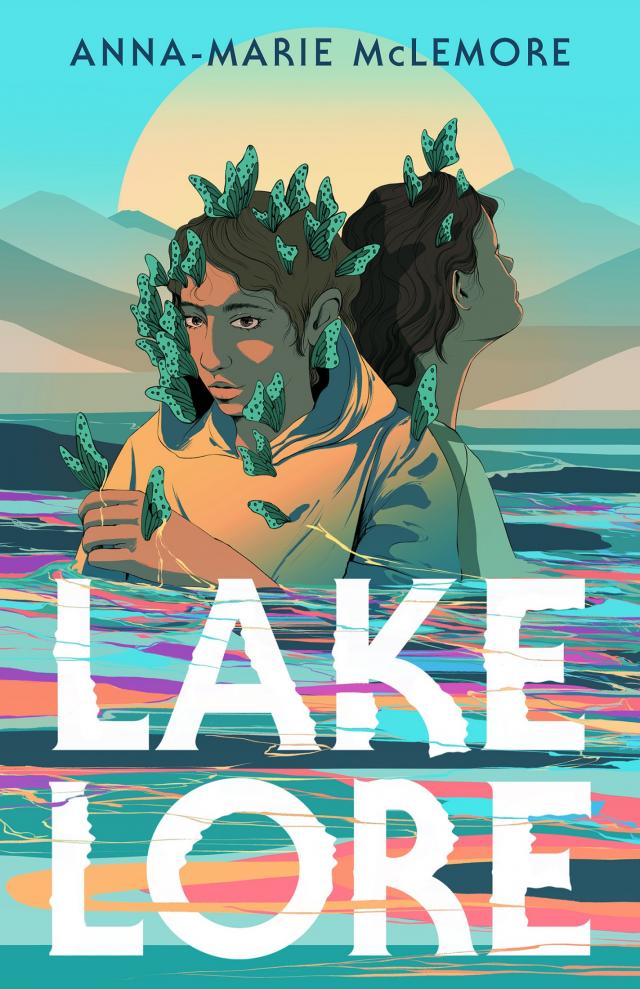


Begin Reading
Table of Contents
About the Author
Copyright Page
Thank you for buying this
Feiwel and Friends ebook.
To receive special offers, bonus content,
and info on new releases and other great reads,
sign up for our newsletters.
Or visit us online at
us.macmillan.com/newslettersignup
For email updates on the author, click here.
The author and publisher have provided this e-book to you for your personal use only. You may not make this e-book publicly available in any way. Copyright infringement is against the law. If you believe the copy of this e-book you are reading infringes on the author’s copyright, please notify the publisher at: us.macmillanusa.com/piracy.
To my mother, who taught me that the way our brains work holds enough brilliance to light up worlds
BASTIÁN
No one believed it when I said I’d seen the world under the lake. But that could have been for a lot of reasons. The first time I found it I was seven, and what adults called daydreamy, lost in thought, and other words that suggested my imagination might create a whole world out of the lakelore I’d heard growing up.
If I had to guess why no one believed it—other than how I never could find it when I tried to show anyone—it was probably because no one believed it existed anymore. People around here used to. It was once a given that there was a whole world under the lake, that it was half water, half air, that it was as strange and luminous as being inside a sea-foam bubble.
All that was just part of the shared understanding of the lake here, the lakelore. Like fishermen telling how far out storms were by the tint to the sky, or how las viejas measured the seiches so carefully they could predict them like tides.
But as far as I could tell, anyone who took the world under the lake as fact was long gone. The old men gauging the clouds, the old women reading the rise and fall of the water, they were probably the grandchildren and great-grandchildren of anyone who’d believed in the world under the lake.
That part of the lakelore had fallen away, yielding to talk of where opposing winds were likely to make whirlpools or sightings of perch as big as horses. The world under the lake sounded so impossible that no one even made up stories or bragged about it the way they would about seeing ghosts along the western shoreline, or spotting giant prehistoric fish that looked like a cross between dolphins and lizards.
There was no one else here who’d seen the world under the lake, or who even pretended they had.
Then I met Lore.
Not that I knew their name yet.
Not that they did either.
LORE
The worst mistake I’ve ever made is bad all on its own, but I never think of it on its own. Some mistakes come in sets, and my worst mistake had a part one that came seven years earlier.
It was on a field trip to a nearby lake, where we were supposed to learn about aquatic and terrestrial biomes. Some of the guys were climbing rocks to see if they could spot high school girls in bikinis on the nearby beach. The rest of us were either studying the craggy shore, looking out for loons (everyone wanted to see their red eyes), or trying to figure out how far we could wander during lunch without the teachers and parent chaperones noticing.
Then there were the few of us clustered close to the volunteer guide, a whipped-cream-haired woman wearing hiking boots and carrying a pocket guide to the local plants and animals. “If the answer’s not in here”—she tapped her forehead—“we’ll find it in here.” She thudded the corner of the book against her palm.
One girl wanted to know if there was really a vanishing lake in Ireland. (“Yes, Loughareema!” the woman said like the words were a song. “One day it’s there, the next it’s nothing but mud.”) A boy asked if lakes had tides like oceans. (“Yes and no,” the woman said. “We have seiches, which can look a little like tides, but the moon doesn’t set the schedule.”)
I asked how much water was in the lake, ready for the thrill of an unfathomably big number.
Then I heard Merritt Harnish’s familiar laugh, and my body did what it always did at the sound of Merritt Harnish’s laugh. It drew in, like a lake snail curling into its spiraled shell.
I shrank away from the group clustered around the guide.
Later, during lunch, Merritt and his friends were still laughing. “What, so you’re smart now?” he asked.
It was, I guess, hilarious to them that someone who could barely read out loud wanted to know things.
He made sure all the adults’ backs were turned, and then started mimicking the halting, stuttering noises I made whenever I got to a word I didn’t recognize. The heat in my face flared, matches striking against the insides of my cheeks. That fire flew down to my hands so fast I didn’t realize I was punching Merritt Harnish in the face until he stumbled back.
The look he got, once he registered what had happened, wasn’t the rage I expected. It was almost respect, like he was impressed. He even nodded back at his friends, like maybe he’d just take the hit and we’d all laugh about it.
Then a different laugh, a high, tinkling laugh, sprinkled over us.
Jilly Uhlenbruck, the girl with strawberry-blond hair in strawberry-pink ribbons, wearing strawberry lip gloss, with her perfectly symmetrical dusting of freckles, was watching us. She and her friends, in their rainbow of hair ribbons, perched on the smoothest rocks, lunch bags in their laps.
Jilly’s hand was to her mouth. Her glitter nail polish twinkled in the sun, like she was trying to stifle that laugh but couldn’t.
Merritt’s whole face changed. His next look to me was a glare, as though I’d invited Jilly to watch.
That’s when I ran.
That’s when Merritt and his friends followed me.
That’s when they would have gotten me and probably shoved my face into the dirt if it wasn’t for the fever dream that saved me, a boy I’d never seen before, and a world I’m not sure ever really existed.
BASTIÁN
The first time I saw Lore was near the inlet. At first, I thought the motion rippling the brush was a mule deer, but then I saw someone running. Not running in the laughing way you would with friends—they were alone—or even how you run to get somewhere. They were running in the frantic way of trying to get away from someone, stumbling out of the brush and onto the rocky ground, checking back over their shoulder every few seconds.
I guessed they were about my age. And maybe this is because I’m trans, and always looking out for it, but I got the flicker of recognition that comes with finding someone else like you. A feeling that whatever words this person got assigned at birth maybe didn’t fit them either.
It wasn’t really any one thing about them. The dark brown of their hair was in two braids, heavy enough that I could hear them hitting their shoulders as they ran. Their jeans had a rip in the knee that looked recent, not yet frayed. Blood and gravel dusted the edges of the rip, like they’d just fallen.
Their T-shirt was the orange yellow of Mamá’s favorite cempaxochitl, the kind of marigold that looks like firewood crumbling into embers. Which wasn’t doing this person any favors if they didn’t want to be spotted.
None of that told me anything for sure. Gender identity never reduces down that easily anyway. Recognizing someone like you is never as simple as picking things apart to see what they add up to.
They tripped, hard, hands hitting the ground in a way that made me wince.
I went halfway up the path from the inlet, close enough to yell, “You okay?”
They startled so hard that I knew I was right. They were running from someone.
“Do you need help?” I asked.
They looked around for where my voice came from, and found me.
Maybe it was seeing someone else like me, brown and maybe trans, that made me call out, “Come on.”
I planned to help them hide out behind the rocks. Then I saw the first flicker of iridescent blue lift off the water. It fluttered through the air, a slice of lake-silver wafting like a leaf. Then another followed it. Then a few more, then a dozen. Then a hundred, each of them like a butterfly with its wings made of water. Then a whole flock of blue-green and silver-blue wings, their backs shining like the surface of the lake.
They spooled away like they always did, showing me the dark underneath the water.
The person I’d just met stared into the shimmering dark. And it took that for me to realize they’d seen it.
The world under the lake had opened for someone besides me.
Maybe it was the wonder in their face. Maybe it was the raw fear. But I led them into the world under the lake, a place I’d never shown anyone because I’d never been able to show anyone.
They looked around and wondered at the coyotes and sharks with eyes that glowed like embers, and the water star grass growing taller than either of us.
They didn’t stay long. Just long enough to make sure they’d lost whoever was following them.
I didn’t find out their name, or their pronouns for sure, not then. As soon as the world under the lake opened back up to the inlet, they took off, yelling “Thank you” over their shoulder.
Sometimes I do things without thinking, and back then I did that a lot. Talking faster than I was supposed to. Interjecting a random fact about limestone or dragonflies without giving any context. Leaving to do something Mom asked me to do while she was still talking, because I was pretty sure I knew what she wanted from the
car, and I was never any good at standing still and listening to directions.
But the other side of that is that sometimes I freeze. When I should do something, I stay still. So many corners of my brain buzz at the same time, a hundred threads of lightning crackling through dry air, that no one thread comes forward. No path or direction makes any more sense than dozens of others, and I do nothing.
So I realized, about a minute too late, that I should have asked where to find them. Or at least called after them to ask their name.
But by the time I thought of that, they were gone.
LORE
I never told anyone what happened, what I saw.
And Merritt never told anyone about that hit I got in. He’d never admit that a girl had gotten him. Not that I was a girl, but that’s how he saw me. That’s how everyone saw me back then.
But Merritt shutting up didn’t stop Jilly and her friends. So he got a good couple of weeks of When’s your next fight? I want to make sure I get a good seat, and You want my little sister to kick your ass next? And he never forgot it.
He pretended he did. But I saw it in his face, years later.
I wish that had been the last time I fought back, the only time, but it wasn’t.
BASTIÁN
My parents have different memories of what made them take me to Dr. Robins. Mom says it was my changes in speed, the pacing around, climbing things, and then staring out windows, not hearing her when she talked to me. Mamá says she started worrying when I was inconsolable over forgetting a stuffed bear at a park, not because I didn’t have the bear anymore, but because I thought the bear would think I didn’t love him.
My brother thinks it was the thing with the cat.
I kept ringing the neighbors’ doorbell every time their cat was sitting outside like she might want to come in, and then started sobbing about whether the cat was okay when Mamá told me you have to stop doing this.
All the restlessness inside me was spilling out, like I was too small to hold it all. If I had to sit still, I bit my nails or pulled at a loose thread on my shirt. Adults kept calling me daydreamy and lost in thought like they always had, but now they also called me fidgety, a nervous kid, or they used euphemisms. And I knew what every one of them meant.
Trouble staying on task referred to me filling in half a coloring page and then deciding I absolutely had to check on the class fish, right then. Difficulty listening meant I might have been listening, but the directions didn’t soak into my brain enough for me to do what I was supposed to. Overly reactive meant that when I accidentally knocked over a jar of paint or broke a pencil, I treated it as a disaster I had caused, like all the other paint jars and pencils might follow suit and just tip over or snap on their own.
Somewhere between that first appointment and when Dr. Robins explained to me what ADHD was, Antonio sat down with me at the kitchen table on a Sunday. “You having a rough time, little brother?” he asked.
I didn’t answer. I kept coloring a drawing, trying not to grip the pencils so hard they’d crack in my hands.
“We’re gonna do something together, okay?” Antonio said. “You and me.”
That was the afternoon he taught me to make alebrijes, to bend wire into frames, to mold papier-mâché, to let them dry and then paint their bodies.
“Our bisabuelo,” Antonio told me as he set out the supplies, ran the water, covered the table, “the family stories say he learned to make alebrijes from Pedro Linares himself, did you know that?”
Everything I knew about alebrijes I knew from Antonio. He crafted whales with magnificent wings. Birds with fins for tails. Snakes that looked like they were trailing ribbons of flame.
“When I don’t know what to do with something,” Antonio said as he adjusted the curve of a wire, “I do this.” He said it as casually as if he were talking to himself.
“If I have a bad day, or a fight with my girlfriend, or I’m frustrated with something at work”—he went on later, the milk of papier-mâché on his fingers—“I just think about it when I’m making alebrijes. For just this little bit, I think about it as much as my brain wants to.”
My inexperienced fingers made lumpy, nondescript monsters that looked like rocks with wings, or lopsided fruit with equally lopsided antlers. Not the perfect animals Antonio made, like the one he was working on now, a lizard with fish fins and a flamelike tongue, so it looked like a dragon.
But I watched him, and I listened. My hands bent the wire, held the cold papier-mâché, glided the paintbrush over.
Everything rushed into my head at once. The neighbors’ cat. The stuffed bear. How hard it was for me not to interrupt people, not because I didn’t care what they were saying, but because I could guess where they were going and was excited about it. How when people got too close to me I wanted to physically shove them away, and it took so much energy not to.
“One thing, okay?” Antonio said.
I looked up at him.
“Just pick one thing that bothers you,” he said, “and give it as much space in your brain as it wants, just for now.”
I shut my eyes. I tried to let one thing float up from the chaos in my brain.
What I thought of, though, wasn’t the cat, or the stuffed bear.
It was Lore. It was how I didn’t even know how to look for them. I’d lost them, so now I’d keep being the only person around here who knew the lakelore was true.
“And then,” Antonio said a while later, when he was painting the lizard that looked like a dragon, “when I’m done, it’s like I can let it go. I got to make it into something, and now it’s something outside of me, and it doesn’t bother me so much, you know?”
I was painting marigold orange onto the back of an alebrije that looked a little like a mule deer. My hands were so restless that my brush left wispy patterns.
But by the time I was done, my hands were a little calmer, my brushstrokes a little more even. The beams of light in my brain, the ones always going in different directions, converged on this one small thing, on this brush, on these colors.
I turned the deer in my hands.
Like Antonio, I had made what bothered me into an alebrije.
It was now something outside of me.
So I kept making them. When something I did wrong got stuck in my brain—when I was frustrated, or impatient, or restless—I made an alebrije.
The yellow marmota with sherbet-orange wings was me losing a take-home test.
The teal cat with the grass-green peacock’s tail was the panic of realizing I’d messed up a course of antibiotics, because I hadn’t learned to keep track of when I ate or when I took pills or even just time itself.
The brown horse with the copper wire tail was my whole body tensing with the effort it took not to kick the guy at school who called me a name I knew the meaning of, but that I also knew I couldn’t repeat to any adult.
A butterfly-spider painted as colorful as a soap bubble reminded me of how painfully slowly I had to learn to transition topics in conversations. I had to learn to say things that connected with what everyone else was saying instead of following my brain as it skipped forward, otherwise I’d get looks of How did you get there? or What does that have to do with anything?
When Dr. Robins asked what I did when I got frustrated or overwhelmed, and I told him about Antonio and the alebrijes, he said, “You have a good brother.” He told me the painting and sculpting I was doing helped with emotional regulation, that it helped interrupt cycles of rumination, terms I was just starting to understand.
There was just one problem.
Within months, the alebrijes crowded every surface in my room. Everywhere I looked, there was a reminder of how many things I worried about, or got fixated on. There was a bat made when Abril frowned and I was convinced she was mad at me and I had done something horrible but couldn’t figure out what. There was a squirrel that held my guilt over yelling I hate this family to my parents because I was hurt about my abuela’s reaction to me changing my name. There was the rounded, porpoiselike body of a vaquita, containing my frustration about the day I mistimed taking my medication, accidentally took it twice, and fell asleep during class.