Infinity lens singularit.., p.19
Infinity Lens (Singularities Book 2),
p.19
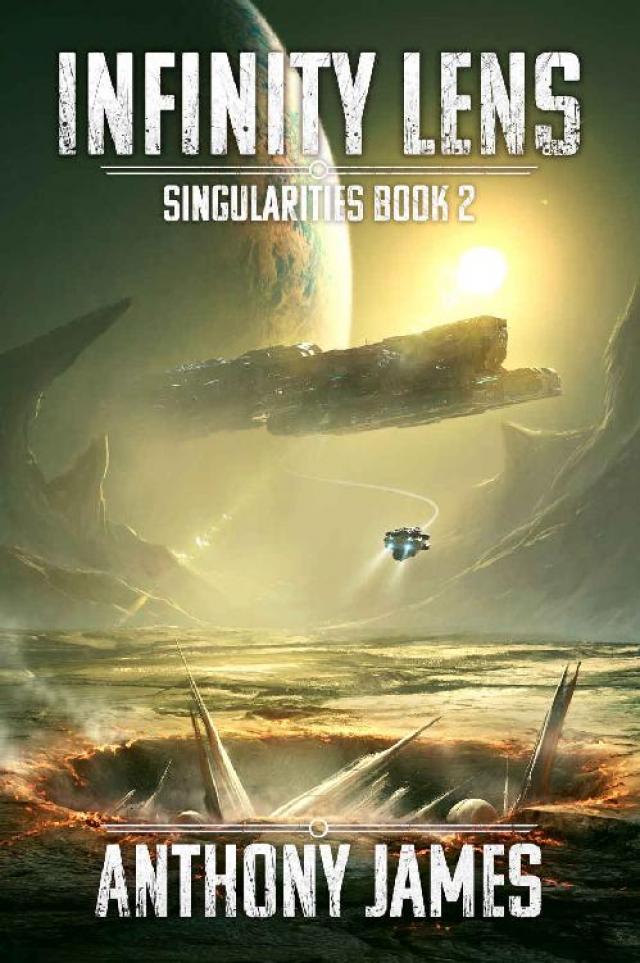


Unfortunately, it wasn’t possible to block line of sight from all the openings, so Lanson could only hope the attacking aliens weren’t yet positioned in the passages the transport was exposed to.
All the while, his thoughts kept returning to the torment the enemy death weapon had inflicted upon him. Despite Sergeant Gabriel’s reassurance that the effects of a second application would be reduced, his mind was fearful of the pain.
The seconds went by, and Commander Matlock held the shuttle’s nose repeater in a state of continuous fire. Gradually, the weapon’s motor heated up and eventually it would cut out, though there was a real possibility the gun would run dry of ammunition first.
“Come on! Break, damnit!” she yelled in an uncustomary display of anger.
The window didn’t break, though by now its surface was heavily pitted from the countless impacts. When Lanson glanced at the repeater’s ammunition readout, he saw that it had fallen below twenty percent.
“We’re not going to make it,” he said. An idea came and he decided to act upon it at once. “Commander Matlock, hold fire,” he ordered.
As he spoke, Lanson requested maximum output from the transport’s engines, and the vessel accelerated directly towards the window.
“Rocket incoming!” shouted Turner in sudden warning.
Lanson spotted the tell-tale streak of orange-white propulsion as a missile raced from one of the lower tunnels. He made no effort to avoid the rocket and held the shuttle on course.
When the transport was no more than fifty metres from the window, the approaching missile struck, detonating on the shuttle’s rear underside plating. Several of the sensor feeds turned a brief, vivid white, before they went offline.
In the cockpit, Lanson felt the transport shudder with the force of the blast, and a dozen red lights appeared on his console. He felt a surge of relief that the life support system didn’t fail.
Although the life support continued to function, the propulsion output fell drastically and the engines sounded like they were on the brink of cutting out. Luckily, the transport held together and Lanson crashed the shuttle’s nose straight into the control room window.
With a shriek of crumpling metal, the vessel was brought to a sudden halt. Cushioned by the life support system, Lanson felt little of the impact, though he saw the result on his console. The forward sensors went out and another four red lights appeared, including one for the nose gun.
“Did we break the window?” asked Lieutenant Abrams.
“We’re screwed if we didn’t,” said Lanson.
“Captain, Sergeant Gabriel confirms we have access into the control room!” said Lieutenant Turner.
It was the news Lanson had been hoping to hear. “Everyone head to the starboard flank door and be ready to jump!” he ordered.
“What about you, Captain?” asked Matlock.
“I’ll follow once I’ve repositioned the shuttle. Now go!”
As his crew scrambled for the cockpit exit, Lanson tried to make sense of the outside world using the few operational feeds. One of the starboard arrays was still online, and through its feed he could see the bay stretching away into the distance. The enemy weren’t visible, but Lanson knew they hadn’t gone anywhere, and he hoped they wouldn’t be able to obtain a new firing angle until he was finished here on the shuttle.
He instructed the vessel to rotate, intending to jam its hull tight up against the control room window. With clear reluctance, the shuttle followed his commands. A glance at his console informed Lanson that the propulsion output was still falling and he didn’t know how long the transport would remain airborne.
In the moment before impact, the life support system failed, and the connection with the bay wall produced a noticeable thud. Lanson held tight to the twin joysticks, willing the vessel to hold together for just a little longer. Through the starboard sensor feed, he could see into the control room, though the soldiers of Sergeant Gabriel’s squad were keeping themselves out of sight.
“Time to go, folks,” said Lanson on the comms. “Please confirm the flank door is operational.”
“Yes, sir, the flank door has opened,” said Matlock.
It was the confirmation Lanson needed. He activated the shuttle’s autopilot and sprang from his seat. Exiting the cockpit, he rapidly descended the steps leading to the bay below. Commander Matlock had evidently overridden the airlock controls, and the movement of air from the shuttle’s depressurization tugged at Lanson.
Once he was in the bay, he sprinted for the airlock. Ahead, he could see the last two members of his crew - Lieutenant Perry and Commander Matlock - jumping side-by-side from the opening. As they grabbed hold of the window ledge, willing hands hauled them into the control room.
“You have to move, Captain!” said Matlock. “The shuttle is dropping!”
Lanson cursed and ran harder. By the time he entered the airlock, the shuttle had drifted almost two metres from the side wall, and the opening itself was no longer in sight through the door.
With no choice other than to commit, Lanson hurled himself upwards and outwards. He glimpsed the space below, hungering for him to plummet into its depths, while the ledge above seemed an impossible distance away. Faces looked at him from the control room, their mouths urging him onwards.
For a moment, Lanson thought he’d failed, and that he would tumble into the abyss. Flailing in desperation, he managed to hook the first two joints of his right-hand fingers over the ledge. His grip wasn’t strong enough to hold on and he immediately felt himself slipping.
Quick as a flash, two hands wrapped around his wrist, giving Lanson a chance to swing his left hand over the ledge. Other hands took hold and he was dragged into the control room, across the top of an alien console, and then onto the floor amongst the many pieces of shattered window.
Rising with the assistance of Private Damico, Lanson stepped once more towards the window aperture and looked outwards. The shuttle was falling rapidly now and was already fifty metres below the window.
From out of the gloom a third missile streaked, hitting the transport on its underside. Lanson and everyone else ducked down, but the explosion didn’t reach as far as the window aperture.
Standing again, he looked around at the soldiers and at the other members of his crew. They’d made it this far, but the mission wasn’t nearly over.
TWENTY-SIX
Lanson took in his surroundings. The control room was a mess of broken window polymers, and pieces of the material were scattered everywhere. Only part of the window had broken – a testament to its toughness – and the hole was less than five metres across. Already, the soldiers were sweeping the main console clear, so that Lanson and his crew could make use of the hardware.
“I don’t know if we broke or activated anything when we were climbing across this top panel, Captain,” said Sergeant Gabriel.
“It shouldn’t be a problem, Sergeant,” said Lanson, staring at the console as he tried to make sense of how it had been set up. “Hardware like this will normally recognize when too many functions are being accessed at once, and create a software prompt for confirmation.”
“There’s one of those prompts on this screen here, Captain,” said Matlock nearby. “I’ll cancel the confirmation request.”
“You’ll need to authenticate first, ma’am,” said Sergeant Gabriel, pointing to a panel on the console. He smiled thinly. “And I hope you can authenticate, because I’m damned if I’m ready to operate as the middleman between you and the hardware.”
“Let’s give it a go,” said Matlock, placing her hand on the panel. “Biological scan initiated…access granted! Now, I should be able to cancel the confirmation request.” She tapped a finger on one of the console’s touch controls. “Done.”
“We need to familiarise ourselves with the hardware,” said Lanson, placing his own hand on the authentication panel.
To his relief the console granted him access within a couple of seconds. When that was done, he decided to take a more hands-on approach to learning how the console operated. Already, he thought he understood the principles of how the hardware was set up, and they didn’t seem too far removed from how both the Human Confederation and the Sagh’eld configured their control systems.
“Captain, if we’re lucky, the enemy might think everyone on that shuttle died,” said Sergeant Gabriel, who was standing nearby. “That should give us a better shot at making it to the Ragnar-3.”
“I’ll admit I was hoping to use the shuttle,” said Lanson. “But these are the circumstances, so we’ll have to deal with them.”
“Do you think we’ll be able to steal the warship, sir?”
“That’s the plan,” said Lanson. “But you’ve seen what we’re up against, Sergeant. The Ragnar-3 might have a hundred-billion-ton mass, while our opponent is closer to a trillion tons.”
“So we’re looking to escape?”
“That’s the best we can achieve, Sergeant.”
Gabriel was a fighter and his face betrayed his disappointment. “Like you say, Captain. It’s a hundred billion tons versus a trillion.”
“Sir, I’ve figured out how to access the facility sensors!” said Lieutenant Turner. “There’s a network of surface-installed arrays, as well as some deep space satellites which haven’t been knocked out.”
“Is the enemy warship still over the base?”
“Yes, Captain, and it’s recognized by the facility databanks as a vessel named Tyrantor.”
“Tyrantor,” said Lanson. The word was unpleasant on his tongue. “Are there any more details about the warship, such as known weaknesses?”
“I don’t know yet, sir,” said Turner. “I’ll keep searching.”
“I’ve discovered how to access the internal security monitors, Captain!” said Lieutenant Perry a moment later. “There are currently more than six hundred hostiles within the facility.”
“Show Sergeant Gabriel,” said Lanson. “He’ll be able to make sense of the enemy movements.”
“I’ll take a look, Captain,” said Gabriel. “However, I can see from here that the enemy are back on the main bridge leading to the Ragnar-3, so we’d best keep our heads low in case they decide to launch a rocket into this control room.”
“Shit, they’d better not,” said Lieutenant Turner.
“We need to finish what we’re doing and quickly,” said Lanson.
“Or maybe the Tyrantor will just fire another—” Corporal Hennessey began.
At that exact moment, the enemy vessel did indeed fire its death weapon. Lanson dropped to his knees with the pain and bowed his head, and it took every ounce of will to keep from crying out.
The agony of it passed and Lanson rose unsteadily. “Damn,” he said. “Corporal Hennessey, you need to keep your mouth shut.”
“You’ll hardly feel the next one, Captain,” said Hennessey unrepentantly. “And look on the bright side – the enemy will now be doubly sure that we’re all dead.”
“At some point, they’re going to start asking themselves why there always seems to be a bunch of us left alive after they’ve discharged that weapon,” said Corporal Ziegler.
“Since they keep firing it, they still believe it’s effective,” said Gabriel. “I bet they’ve wiped out billions with the same technology, and they won’t be ready to accept that it isn’t working on us.”
Lanson was already back at the console, and was only paying a small amount of attention to what the soldiers were saying, but he guessed there might be something in Gabriel’s suggestion. He didn’t offer a comment of his own, and continued delving through the menus on the alien control system.
“I’ve discovered how to access the Ragnar-3’s onboard security systems, Captain!” said Matlock in sudden excitement. “I should be able to give us all command authority.”
“Do it!” said Lanson, feeling the same excitement. “That’ll allow us to take control of the Ragnar-3!”
“Command authority granted!” said Matlock. “The warship’s weapons systems are online!”
“We have to make it through this facility and across that bridge, Captain,” said Gabriel. “That’s a lot of aliens to kill.”
“I’m not so much worried about the bridge, Sergeant,” said Lanson. “With command authority over the Ragnar-3, we should be able to remote-operate its hull repeaters. I wouldn’t want to be in the way when they start firing.”
“We still have to make it as far as the bridge,” said Corporal Ziegler, who, like Sergeant Gabriel, was studying the feeds from the internal monitors. “And I’m not sure how much chance we have of that, given how many of the enemy we’re facing.”
“And another four hundred hostiles have just appeared on the internal monitors,” said Lieutenant Perry. “They’re on the uppermost levels of the facility.”
“The Ragnar-3 must be carrying shuttles,” said Lanson. “Lieutenant Perry, find out how many.”
“Yes, sir.”
“Captain, I’ve discovered how to access the Ragnar-3’s propulsion systems,” said Lieutenant Abrams.
“Something in your voice makes me think it’s not all good news,” said Lanson.
“It’s not, Captain. The warship’s engines will require twenty minutes to come fully online, and after that, they’ll need additional time to ready for a lightspeed jump.”
Lanson checked his HUD. “We have fifty-two minutes on the singularity timer.” He grimaced. “But damn, we don’t even know if its creation is significant or not.”
“If the local star is collapsing, it wouldn’t normally be a cause for concern, sir,” said Abrams. “The resultant black hole would have the same mass and therefore the same gravitational pull as the star which created it. However, we saw what happened when the Galos went critical. I dread to think what might happen if all those other cubes from the Scalos storage facility were to alter the normal behaviour of the star.”
In his mind, Lanson pictured millions of cubes, each with a far greater volume than the Galos, detonating within the centre of a star. From a purely scientific viewpoint, he was sure the final outcome would be fascinating. From the viewpoint of a man who wanted to wake up tomorrow, it seemed wisest to miss this once-in-a-lifetime opportunity.
“If we cleared those linking bridges using the Ragnar-3’s hull armaments, and then remotely ordered one of the warship’s shuttles to pick us up from this window, we’d save plenty of time,” said Lanson. He focused his gaze on Lieutenant Perry. “This is where you confirm the Ragnar-3 is carrying shuttles.”
“Yes, sir, it is,” said Perry. “There are two docking bay entrances on the warship’s facing flank, and there’s a single shuttle in each.”
“Once we’re onboard the Ragnar-3, we’d need to make it from the shuttle docking bay to the bridge, and then figure out how to make the spaceship work,” said Matlock. “Though I reckon if the bridge consoles are anything like this one here, we’ll already have a head start.”
“Let’s face it, Captain. It’s going to be tough to get out of here in less than fifty-two – now fifty-one - minutes,” said Abrams.
There was a mountain to climb, and Lanson knew it. “What makes it even worse is that if we send a remote command to the Ragnar-3’s propulsion to warm up, or activate its hull weapons, the Tyrantor will soon learn about it. If the enemy believe they’ll be unable to capture the Ragnar-3, they’re certain to destroy the vessel to prevent it falling into our hands.”
“In which case, I can’t see a way for us to achieve our goals, Captain,” said Matlock.
“There’s always a way, Commander,” said Lanson, as if saying the words would make them true. “It’s just a matter of finding it.”
At that moment, he had an idea. Unfortunately, this idea was so risky, he hardly dared consider whether it might be forced into a semblance of viability.
“Lieutenant Turner, show Lieutenant Abrams how to remote link to the New Beginning,” said Lanson.
“What am I checking for once the link is formed, sir?” asked Abrams.
“I’d like you to gauge the instability of the warship’s propulsion.”
“I don’t need a remote link for that, Captain. Sooner or later, the engines are going to be afflicted by a runaway reaction, and then something bad will happen.”
“Do you have any way to control the timing of that something bad?”
“I—” Abrams narrowed his eyes. “What’s the underlying question, sir? I might be able to answer better if you stop beating around the bush.”
“I’m asking myself if we can remotely command the New Beginning into lightspeed, so that it arrives here at Ilvaron with its engines in a state of criticality.”
“Possibly,” said Abrams. “However, the explosion would kill us at the same time as it takes out the Tyrantor. It could destroy this entire planet.”
“Who said I want it to explode?” said Lanson. “What if the New Beginning exited lightspeed with its engines critical, and right off the Tyrantor’s flank?”
Abrams furrowed his brow and a hint of a smile appeared. “Either the enemy crew would blow the New Beginning into pieces – possibly setting off a detonation – or they’d take one look at the destroyer’s hull readings and decide to make an immediate exit into lightspeed. Assuming they have that capability.”
“You’ve seen that warship, Lieutenant. You know it can perform an instant lightspeed entry if it needs to.”
“I don’t know it, but I’m willing to bet you’re right, sir,” Abrams conceded.
“So, how long would it take to send the New Beginning’s propulsion into a state of criticality?”
“One instant lightspeed transition will almost certainly create a runaway reaction.”
“And would that reaction be identifiable to the Tyrantor’s sensors, or would it need time to spread throughout the propulsion modules before the hull readings become unmissable?”
“The enemy crew would know about it straightaway, Captain, unless they’re asleep at their stations.”