Infinity lens singularit.., p.6
Infinity Lens (Singularities Book 2),
p.6


His eyes were now on the sensor feed locked onto the Tagha’an, and the mental countdown he was running for its Thak cannon reload time was almost at zero. Almost imperceptibly, the heavy cruiser’s forward turret adjusted its aim.
The moment he saw it happen, Lanson threw the New Beginning onto a new heading. Less than two seconds later, the Tagha’an’s rear turret also fired, and again Lanson was ready for it. He felt the tightness in his arms and shoulders as he pushed the warship to the limits of its manoeuvrability.
“No impacts on our hull, Captain,” said Turner.
“Fifty seconds until the enemy’s Gorlan missiles reach us,” added Perry. “They max out at 750 kilometres per second, so we should be able to outrun them with a change of course.”
Lanson wasn’t planning to turn tail. “Lieutenant Abrams, I’d like you to program our navigation system with a new ILT vector,” he said.
“Captain, we can’t take the—” Abrams swore. “What’s our destination?”
“The cusp of Scalos – a place where we’ll have visibility on the shuttle hiding behind the Tagha’an.”
“Captain, is there an alternative to this?” asked Matlock.
“If we run now, we’ve lost, Commander,” said Lanson. “Even if we return later, we’ll have given the Sagh’eld time to escape with whatever they’ve found.”
“We’ll still have the New Beginning, Captain.”
“I think the Sagh’eld have discovered something far more valuable on Scalos than this destroyer, Commander. Besides – once we eliminate the target shuttle, we’ll have an opportunity to wreck the others which took off at the same time, and I intend to firebomb the ground excavations at the same time.” Lanson nodded to himself. “Maybe once we’re done with all that, it’ll be time to run.”
Matlock was conflicted, that much was clear, but she didn’t argue. “Yes, sir. If that’s the plan, then let’s get it done.”
As Matlock was speaking, the Tagha’an discharged its forward Thak cannons again. For a third time, the high velocity and agility of the New Beginning was sufficient to evade the projectiles across such a large distance. The second enemy discharge also missed.
“Lieutenant Abrams, how long until you’ve finished creating the ILT vector?” asked Lanson.
“It’s almost ready, sir.”
“Commander Matlock, the Tagha’an crew is going to wait until we’re distracted by those incoming Gorlans before they fire their Thak guns again,” said Lanson.
“Yes, sir. The enemy missiles will soon be in Kraal targeting range. I’m watching out for them.”
This was one of the few times Lanson could remember the Sagh’eld being forced into a stalemate and, like on those other occasions, the enemy didn’t lose their discipline, or act rashly. The Tagha’an would play the part of an alloy shield for as long as it took for reinforcements to arrive.
“Captain, I have the vector ready to activate,” said Abrams. “It’s going to be difficult to compensate for the New Beginning’s motion, so you’ll need to reduce velocity to near-zero before I add the data into the navigation system.”
“Let’s do that right now,” said Lanson.
He drew back on the controls and the velocity gauge fell rapidly. The straining engines produced a wall of sound and Lanson felt the deceleration pulling him forward.
“The activation is now assigned to button five on your left-hand control bar, sir,” said Abrams. “Same as last time.”
Lanson took one last glance at the sensor feeds. The warship’s destination was more than a hundred thousand kilometres away, and when the New Beginning exited lightspeed, it should have a clear particle beam shot at the enemy transport.
Once the target shuttle was down, there would also be an opportunity to knock out the other transports with Kraal and missile fire, and afterwards, maybe to deal some real damage to the excavation works, which might potentially set the enemy back months, assuming they didn’t have replacement excavation vehicles in the hold of the lifter.
Lanson hoped his daring plan would bring some pain to the Sagh’eld. Smiling grimly, he waited until the velocity gauge was at zero, and then pressed the switch to active the instant transit.
EIGHT
The in-out transition lasted such a fleeting time that Lanson’s brain was not able to comprehend a duration so short. All he knew of it was the expulsive boom of the engines and the fact that the sensors were all offline.
“Waiting on the feeds,” said Turner.
“Ready on the particle beam, Commander.”
As Lanson spoke, he became aware that the New Beginning’s propulsion volume hadn’t lessened after the lightspeed transition. Instead, the deep boom of moments ago had transformed into an irregular thunder that he could feel through the control bars and through his seat.
“Yes, Captain,” said Matlock. By her expression, she wasn’t any happier about the change in the engines. “Point the New Beginning in the right direction and I’ll take out the target.”
“Sensors coming up!”
The feeds sprang simultaneously into life and Lanson took in the details. Beneath the warship, the planet Scalos was visible, approximately ten thousand kilometres below. The other feeds were not yet focused on anything, though Turner and Perry were fighting to correct that.
“Where’s that sensor lock?” Lanson demanded. “We can’t aim the particle beam if we can’t see the target.”
“Working on it, Captain,” said Turner. “Done!”
The feed on Lanson’s central screen updated, showing him the Tagha’an heavy cruiser, along with the oversized shuttle taking shelter barely two hundred metres from its hull. His tactical updated with the positions of several other spaceships – the rest of the fleeing shuttles. Those were next on the list for destruction.
Lanson’s hands acted almost without assistance from his brain, and they brought the New Beginning’s nose around towards the target vessel. “Ready,” he muttered.
The sudden disappearance of the New Beginning had understandably surprised the crew of the Tagha’an. However, the Sagh’eld heavy cruiser was already rotating, while the shuttle accelerated to maintain its position at the larger vessel’s flank.
“Captain, we need to talk about our engines,” said Abrams.
“Later,” said Lanson. “When this is done.”
The rotation of the Tagha’an was too little too late. “Particle beam on target!” said Matlock. “Discharged!”
Out stabbed the beam of red energy, and it struck the target shuttle dead on its flank.
The outcome was vastly, incredibly different to the one which Lanson had imagined. He saw how, in a split-second, the transport’s armour turned from grey to incandescent white. Then, both the shuttle and the heavy cruiser simply vanished.
“What the hell?” said Lanson in stunned disbelief. “Lieutenant Turner, what happened to those spaceships?”
“Captain, I don’t know,” said Turner. “The other shuttles vanished as well.”
“Sir, our engines!” said Abrams, more forcefully than before. “We have another reaction, this time on two of the main modules.”
Lanson cursed. He didn’t know what had happened to the enemy warships, but he damn well wanted answers. However, a glance at the engine monitoring tools suggested the New Beginning was in real trouble.
“Lieutenant Abrams, do what you can with the engines. We’ll talk about it in a moment.”
“Yes, sir.”
“Captain, something has happened to the superheavy lifter!” said Lieutenant Perry. “And to Scalos as well. There’s something down there.”
“Show me the lifter,” snarled Lanson. He took a steadying breath – this was a situation that called for level heads. “Show me,” he repeated calmly.
“It’s on your screen, Captain,” said Perry. “The lifter has lost part of its hull.”
Lanson stared intently at the feed. The enemy vessel was about sixty thousand kilometres from the New Beginning, at a higher altitude, and on a course around Scalos that would eventually see it disappear from the sensor feeds. However, the greys of the enormous vessel’s hull were now patchy, though the details weren’t clear enough for Lanson to determine why.
One fact was clear - the rear 2500 metres of the lifter were gone, as if a knife had slashed diagonally down from its stern and out through its undersides.
“What happened to that spaceship?” asked Lanson? “Where’s the debris?”
“I can’t find any debris, Captain, and I don’t know what happened,” said Perry.
“Enhance the feed.”
“Yes, sir. I’m working on it.”
“While you do that, let me see what happened to the planet.”
“On your screen, sir.”
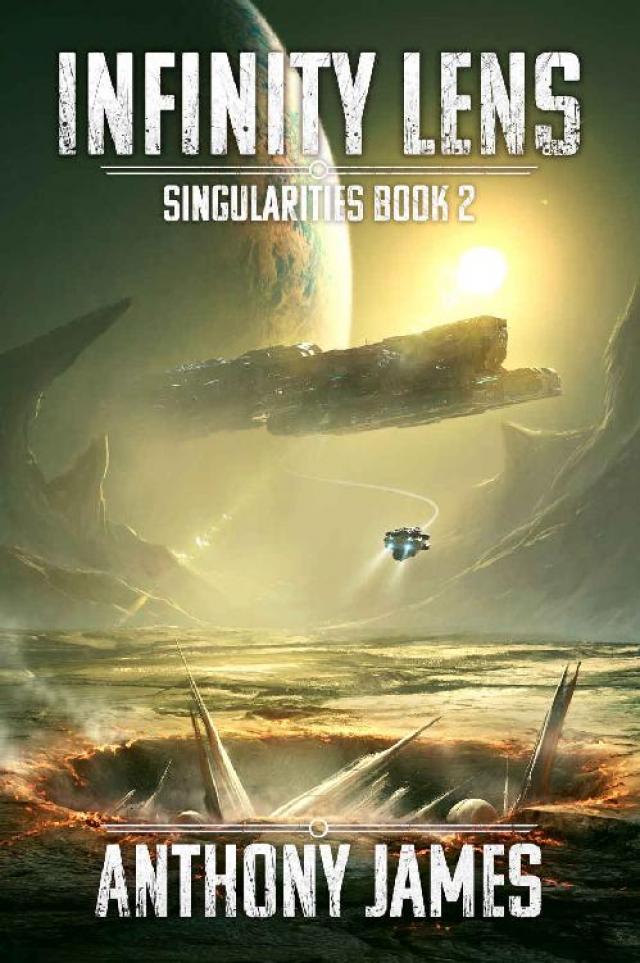
The sensor feed of Scalos was focused on the position of the Sagh’eld excavations. Now, those excavations were gone, and replaced by a huge bowl with a diameter of almost fifty kilometres. The bowl itself wasn’t particularly deep – just deep enough to wipe out all signs of the Sagh’eld, and reveal something metallic which had been hidden beneath the rocky surface.
Staring at the curved centre shape and the adjacent square edged, flat-topped protrusions for a moment, Lanson couldn’t decide what he was looking at.
The outcome of the attack on the shuttle was far stranger than anything Lanson had anticipated and he was left with many questions. He put those questions on the back burner – other issues were pressing.
“Tell me about the engines, Lieutenant Abrams,” said Lanson without turning. The propulsion spikes showing on his console were crazily high and the engines sounded like they were ready to either shut down, explode, or do something else entirely unwanted.
“The propulsion modules are not going to settle, Captain. We weren’t ready for another ILT so soon after the last one.”
“What will be the outcome and in how long?” asked Lanson.
“They’re both how long is a piece of string questions, Captain,” said Abrams. He continued quickly. “My guess is that the engines will detonate, and it’ll happen in the next ten or fifteen minutes.”
“There must be something you can do other than watch the gauges, Lieutenant?”
“I haven’t begun to grasp what changes the Galos device made to our engines, sir,” said Abrams. “That means I can’t—” He swore. “Maybe that’s it. Maybe I can—”
“Can what?” asked Lanson.
“One moment, sir, I need to check something out.”
Lanson clenched his teeth in frustration. He hated the lack of control, but he trusted his engine man enough that he didn’t interrupt.
“Lieutenant Turner, Lieutenant Perry, tell me more about what happened after the enemy shuttle was struck by the particle beam,” said Lanson.
“I think I’ve found something, Captain,” said Turner. “Watch what happens when I replay this part of the recorded feed. I’ve slowed it right down.”
The recording, showing both the target shuttle and the Tagha’an heavy cruiser, appeared on Lanson’s screen. He watched it carefully and, for a time, nothing seemed to happen. Then, the particle beam came into view from the lower edge of his screen. The beam elongated in steps because the sensors didn’t capture data fast enough to obtain a perfectly smooth recording of its progress.
When the particle beam connected with the shuttle, heat expanded from the impact area, again, slowed down to far less than a crawl.
“I’ll need to forward the next part frame by frame, Captain,” said Turner. “Watch.”
Lanson did watch. The first half-dozen frames showed the hull of the shuttle starting to crumple as it melted in the intense heat. On the next frame, a sphere of blackness with blurred edges and a diameter of five hundred kilometres appeared, and both the shuttle and the heavy cruiser were gone within it. The frame after that showed no sphere, no shuttle, and no cruiser.
“Something within the target shuttle’s storage bay detonated,” said Lanson. “And it happened so quickly that our sensors almost didn’t capture it happening.”
“That’s about the long and short of it, Captain,” said Turner. “I reckon we got lucky to see anything whatsoever of the blast.”
“Our sensor recordings take twenty-five thousand image snapshots every second,” said Lanson in disbelief.
“Yes, sir. The explosion – if that’s the right term for it – came and went in a fraction of a second.”
“And the superheavy lifter must have been caught at the extreme edges of the blast,” said Lanson. “What was the diameter of the explosive sphere?”
“Almost one hundred thousand kilometres, according to my initial calculations, sir,” said Turner. “You’ve seen that the planet was caught in the detonation and—” she took a breath, “—the New Beginning was within two thousand kilometres of being wiped out.”
“This time we were on the right side of a fine margin,” said Lanson, glancing down at his console. The propulsion showed no sign that it was about to settle. “But not that superheavy lifter. Is the feed enhancement complete, Lieutenant Perry?”
“Yes, sir. It’s on your screen – the superheavy’s hull looks as if it’s been stripped away.”
Lanson narrowed his eyes at the feed. The extra detail provided by the enhancement was enough to reveal the additional damage suffered by the vessel that hadn’t been apparent before. As Perry had said, the lifter’s armoured hull had become heavily pitted, like it had spent weeks travelling at high velocity through a grit-laden atmosphere.
“What the hell happened there?” asked Lanson. “Another effect of the detonation?”
“I can’t think of another explanation, Captain.”
“Is the lifter still operational?”
“The enemy vessel hasn’t deviated from its heading since I first obtained a sensor lock after that last ILT, sir,” said Perry.
“Its engines must have failed,” said Lanson. “And from here it doesn’t look as if any of its hull emplacements are operational.”
“Thinking of taking another shot at the lifter, Captain?” asked Matlock.
“I’m not ready to make that decision yet, Commander.” He twisted in his seat. “What’s going to happen to that spaceship in the coming minutes and hours, Lieutenant Perry?”
“It looks as if the enemy vessel began decelerating just after our ILT, sir,” said Perry. “The predictive software I’m running indicates the lifter has been caught in the gravitational pull of Scalos, and it’s on a medium-term decaying orbit.”
“How medium term?”
“It’ll be weeks before it crashes down, sir - assuming the Sagh’eld crew don’t manage to bring the vessel’s engines online again.”
Lanson grimaced in thought. “Evidence suggests the lifter doesn’t present an immediate threat.”
“Maybe we should set off in pursuit anyway, sir,” said Matlock. “Just to make sure.”
“I don’t think we should strain the engines, Commander,” said Massey. “Even if we positioned the New Beginning somewhere along the superheavy’s predicted course around Scalos, the Captain would still need to utilise the engines in case the enemy vessel started firing back.”
“The lifter will have to remain a problem for later,” said Lanson. “Lieutenant Abrams, can you tell me of your plan to fix our engines? There’s no reduction in the output spikes.”
“Captain, I need to focus.”
Lanson didn’t push and he spent a few moments taking stock. He’d been right to think that the Sagh’eld were transporting something important away from Scalos, and the particle beam shot into the shuttle had caused the cargo in the vessel’s bay to detonate. The size of the blast - at nearly a hundred thousand kilometres in diameter – was colossal, and both its magnitude and the way it had appeared and then vanished so rapidly was unlike any explosive possessed by the human military.
The blast could have destroyed the entire planet, Lanson thought.
It wasn’t just the thought of a planet being obliterated by a single detonation – as terrifying as it was – that had him so worried. Lanson’s biggest fear was that the device within the Sagh’eld shuttle had not even been a dedicated explosive – perhaps it had been a power source, or something else, which, if the enemy had brought it into their possession, would tip the scales so utterly in their favour, that the war would be lost in months or even weeks.
And now it’s gone. But what if there are others like it on Scalos?
“Lieutenant Abrams, you told me earlier that the engines would detonate in ten or fifteen minutes,” said Lanson.
“I told you they might detonate, Captain. For all I know, they might do something completely different.”
“Do we need to abandon ship?”
“Give me two minutes, and I’ll tell you, sir. I’m sure you’ve already realised that we’re not going to outrun a detonation if it happens.”
“I know it.” Lanson turned. “Lieutenant Perry – contact Sergeant Gabriel and tell him to take his squad to the New Beginning’s portside shuttle. He might need to deploy at short notice.”
“Yes, sir, I’ll let him know, and I’ll instruct him to confirm when he’s ready to go.”
With the order given, Lanson took hold of the control bars. “We’re heading closer to the surface – I want to find out what that explosion revealed,” he said. “Lieutenant Turner, add an overlay to the tactical that shows me the predicted course of the superheavy on its next ten circuits of Scalos.”
“Yes, sir, I’ll have that added in a moment.”
Cautiously, Lanson increased the New Beginning’s velocity, while he listened carefully for any audible change in the propulsion and watched the monitoring tools for signs of increased activity.
“The fact that we’re still alive makes me think there was nothing on the surface capable of being triggered by that shuttle detonation,” said Matlock. “We got lucky.”
“It happens sometimes,” said Lanson.
“Whatever that is poking up from the bottom of the crater, it isn’t Sagh’eld, Captain,” said Turner.