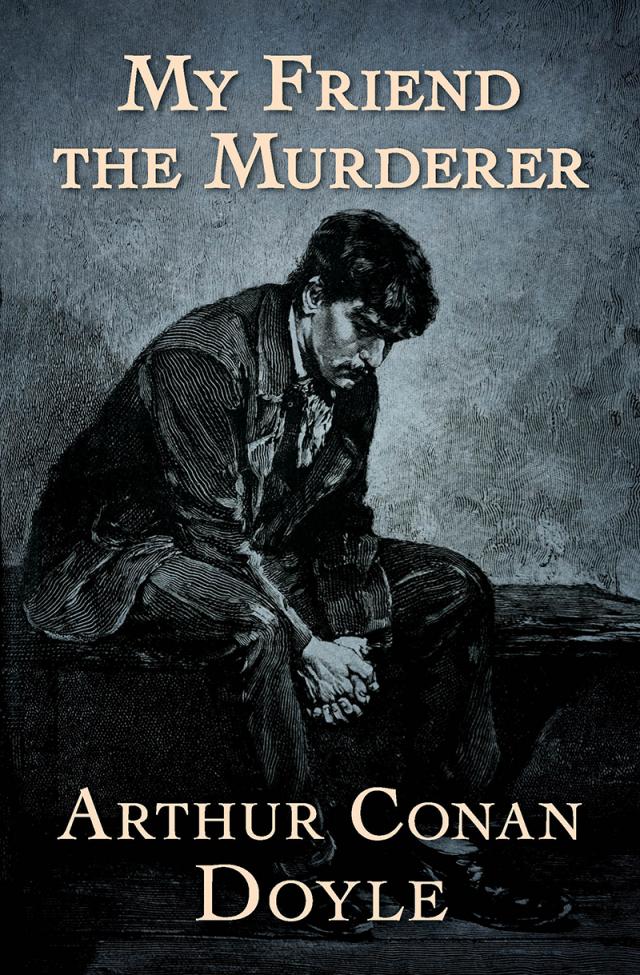
My friend the murderer, p.14
My Friend the Murderer,
p.14


“Gregory,” I said, as I strutted into the office, “I’m off on a mission—a secret mission, my boy; an affair of thousands of pounds. Lend me your little portmanteau—mine’s too imposing—and tell Ivan to pack it. A Russian millionaire expects me at the end of my journey. Don’t breathe a word of it to any of Simpkins’s people, or the whole game will be up. Keep it dark!”
I was so charmed at being, as it were, behind the scenes, that I crept about the office all day in a sort of cloak-and-bloody-dagger style, with responsibility and brooding care marked upon every feature; and when at night I stepped out and stole down to the station, the unprejudiced observer would certainly have guessed, from my general behavior, that I had emptied the contents of the strong-box, before starting, into that little valise of Gregory’s. It was imprudent of him, by the way, to leave English labels pasted all over it. However, I could only hope that the “Londons” and “Birminghams” would attract no attention, or at least that no rival corn-merchant might deduce from them who I was and what my errand might be.
Having paid the necessary roubles and got my ticket, I ensconced myself in the corner of a snug Russian car, and pondered over my extraordinary good fortune. Dickson was growing old now, and if I could make my mark in this matter it might be a great thing for me. Dreams arose of a partnership in the firm. The noisy wheels seemed to clank out “Bailey, Robinson & Co.,” “Bailey, Robinson & Co.,” in a monotonous refrain, which gradually sank into a hum, and finally ceased as I dropped into a deep sleep. Had I known the experience which awaited me at the end of my journey it would hardly have been so peaceable.
I awoke with an uneasy feeling that some one was watching me closely; nor was I mistaken. A tall dark man had taken up his position on the seat opposite, and his black sinister eyes seemed to look through me and beyond me, as if he wished to read my very soul. Then I saw him glance down at my little trunk.
“Good heavens!” thought I, “here’s Simpkins’s agent, I suppose. It was careless of Gregory to leave those confounded labels on the valise.”
I closed my eyes for a time, but on reopening them I again caught the stranger’s earnest gaze.
“From England, I see,” he said in Russian, showing a row of white teeth in what was meant to be an amiable smile.
“Yes,” I replied, trying to look unconcerned, but painfully aware of my failure.
“Travelling for pleasure, perhaps?” said he.
“Yes,” I answered eagerly. “Certainly for pleasure; nothing else.”
“Of course not,” said he, with a shade of irony in his voice. “Englishmen always travel for pleasure, don’t they? Oh, no; nothing else.”
His conduct was mysterious, to say the least of it. It was only explainable upon two hypotheses—he was either a madman, or he was the agent of some firm bound upon the same errand as myself, and determined to show me that he guessed my little game. They were about equally unpleasant, and, on the whole, I was relieved when the train pulled up in the tumble-down shed which does duty for a station in the rising town of Solteff—Solteff, whose resources I was about to open out, and whose commerce I was to direct into the great world channels. I almost expected to see a triumphal arch as I stepped on to the platform.
I was to be expected at the end of my journey, so Mr. Dickson had informed me. I looked about among the motley crowd, but saw no Mr. Dimidoff. Suddenly a slovenly, unshaved man passed me rapidly, and glanced first at me and then at my trunk—that wretched trunk, the cause of all my woes. He disappeared in the crowd; but in a little time came strolling past me again, and contrived to whisper as he did so, “Follow me, but at some distance,” immediately setting off out of the station and down the street at a rapid pace. Here was mystery with a vengeance! I trotted along in his rear with my valise, and on turning the corner found a rough droschky waiting for me. My unshaven friend opened the door, and I stepped in.
“Is Mr. Dim—” I was beginning.
“Hush!” he cried. “No names, no names; the very walls have ears. You will hear all to-night;” and with that assurance he closed the door, and, seizing the reins, we drove off at a rapid pace—so rapid that I saw my black-eyed acquaintance of the railway carriage gazing after us in surprise until we were out of sight.
I thought over the whole matter as we jogged along in that abominable springless conveyance.
“They say the nobles are tyrants in Russia,” I mused; “but it seems to me to be the other way about, for here’s this poor Mr. Dimidoff, who evidently thinks his ex-serfs will rise and murder him if he raises the price of grain in the district by exporting some out of it. Fancy being obliged to have recourse to all this mystery and deception in order to sell one’s own property! Why, it’s worse than an Irish landlord. It is monstrous! Well, he doesn’t seem to live in a very aristocratic quarter either,” I soliloquized, as I gazed out at the narrow crooked streets and the unkempt dirty Muscovites whom we passed. “I wish Gregory or some one was with me, for it’s a cut-throat-looking shop! By Jove, he’s pulling up; we must be there!”
We were there, to all appearance; for the droschky stopped, and my driver’s shaggy head appeared through the aperture.
“It is here, most honored master,” he said, as he helped me to alight.
“Is Mr. Dimi—” I commenced; but he inter rupted me again.
“Anything but names,” he whispered; “anything but that. You are too used to a land that is free. Caution, oh sacred one!” and he ushered me down a stone-flagged passage, and up a stair at the end of it. “Sit for a few minutes in this room,” he said, opening a door, “and a repast will be served for you;” and with that he left me to my own reflections.
“Well,” thought I, “whatever Mr. Dimidoffs house may be like, his servants are undoubtedly well trained. ‘Oh sacred one!’ and ‘revered master!’ I wonder what he’d call old Dickson himself, if he is so polite to the clerk! I suppose it wouldn’t be the thing to smoke in this little crib; but I could do a pipe nicely. By the way, how confoundedly like a cell it looks!”
It certainly did look like a cell. The door was an iron one, and enormously strong, while the single window was closely barred. The floor was of wood, and sounded hollow and insecure as I strode across it. Both floor and walls were thickly splashed with coffee or some other dark liquid. On the whole, it was far from being a place where one would be likely to become unreasonably festive.
I had hardly concluded my survey when I heard steps approaching down the corridor, and the door was opened by my old friend of the droschky. He announced that my dinner was ready, and, with many bows and apologies for leaving me in what he called the “dismissal room,” he led me down the passage, and into a large and beautifully furnished apartment. A table was spread for two in the centre of it, and by the fire was standing a man very little older than myself. He turned as I came in, and stepped forward to meet me with every symptom of profound respect.
“So young and yet so honored!” he exclaimed; and then seeming to recollect himself, he continued, “Pray sit at the head of the table. You must be fatigued by your long and arduous journey. We dine tête-à-tête; but the others assemble afterward.”
“Mr. Dimidoff, I presume?’’ said I.
“No, sir,” said he, turning his keen gray eyes upon me. “My name is Petrokine; you mistake me perhaps for one of the others. But now, not a word of business until the council meets. Try your chef’s soup; you will find it excellent, I think.”
Who Mr. Petrokine or the others might be I could not conceive. Land stewards of Dimidoff’s, perhaps; though the name did not seem familiar to my companion. However, as he appeared to shun any business questions at present, I gave in to his humor, and we conversed on social life in England—a subject in which he displayed considerable knowledge and acuteness. His remarks, too, on Malthus and the laws of population were wonderfully good, though savoring somewhat of Radicalism.
“By the way,” he remarked, as we smoked a cigar over our wine, “we should never have known you but for the English labels on your luggage; it was the luckiest thing in the world that Alexander noticed them. We had had no personal description of you; indeed we were prepared to expect a somewhat older man. You are young indeed, sir, to be intrusted with such a mission.”
“My employer trusts me,” I replied; “and we have learned in our trade that youth and shrewdness are not incompatible.”
“Your remark is true, sir,” returned my newly made friend; “but I am surprised to hear you call our glorious association a trade! Such a term is gross indeed to apply to a body of men banded toll gether to supply the world with that which it is yearning for, but which, without our exertions, it can never hope to attain. A spiritual brotherhood would be a more fitting term.”
“By Jove!” thought I, “how pleased the boss would be to hear him! He must have been in the business himself, whoever he is.”
“Now, sir,” said Mr. Petrokine, “the clock points to eight, and the council must be already sitting. Let us go up together, and I will introduce you. I need hardly say that the greatest secrecy is observed, and that your appearance is anxiously awaited.”
I turned over in my mind as I followed him how I might best fulfil my mission and secure the most advantageous terms. They seemed as anxious as I was in the matter, and there appeared to be no opposition, so perhaps the best thing would be to wait and see what they would propose.
I had hardly come to this conclusion when my guide swung open a large door at the end of a passage, and I found myself in a room larger and even more gorgeously fitted up than the one in which I had dined. A long table, covered with green baize and strewn with papers, ran down the middle, and round it were sitting fourteen or fifteen men conversing earnestly. The whole scene reminded me forcibly of a gambling hell I had visited some time before.
Upon our entrance the company rose and bowed. I could not but remark that my companion attracted no attention, while every eye was turned upon me with a strange mixture of surprise and almost servile respect. A man at the head of the table, who was remarkable for the extreme pallor of his face as contrasted with his blue-black hair and mustache, waved his hand to a seat beside him, and I sat down.
“I need hardly say,” said Mr. Petrokine, “that Gustave Berger, the English agent, is now honoring us with his presence. He is young, indeed, Alexis,” he continued to my pale-faced neighbor, “and yet he is of European reputation.”
“Come, draw it mild!” thought I, adding aloud, “If you refer to me, sir, though I am indeed acting as English agent, my name is not Berger, but Robinson—Mr. Tom Robinson, at your service.”
A laugh ran round the table.
“So be it, so be it,” said the man they called Alexis. “I commend your discretion, most honored sir. One cannot be too careful. Preserve your English sobriquet by all means. I regret that any painful duty should be performed upon this auspicious evening; but the rules of our association must be preserved at any cost to our feelings, and a dismissal is inevitable to-night.”
“What the deuce is the fellow driving at?” thought I. “What is it to me if he does give his servant the sack? This Dimidoff, wherever he is, seems to keep a private lunatic asylum.”
“Take out the gag!” The words fairly shot through me, and I started in my chair. It was Petrokine who spoke. For the first time I noticed that a burly stout man, sitting at the other end of the table, had his arms tied behind his chair and a handkerchief round his mouth. A horrible suspicion began to creep into my heart. Where was I? Was I in Mr. Dimidoff’s? Who were these men, with their strange words?
“Take out the gag!” repeated Petrokine; and the handkerchief was removed.
“Now, Paul Ivanovitch,” said he, “what have you to say before you go?”
“Not a dismissal, sirs,” he pleaded; “not a dismissal: anything but that! I will go into some distant land, and my mouth shall be closed forever. I will do anything that the society asks, but pray, pray do not dismiss me.”
“You know our laws, and you know your crime,” said Alexis, in a cold, harsh voice. “Who drove us from Odessa by his false tongue and his double face? Who wrote the anonymous letter to the Governor? Who cut the wire that would have destroyed the arch-tyrant? You did, Paul Ivanovitch; and you must die.”
I leaned back in my chair and fairly gasped.
“Remove him!” said Petrokine; and the man of the droschky, with two others, forced him out.
I heard the footsteps pass down the passage and then a door open and shut. Then came a sound as of a struggle, ended by a heavy, crunching blow and a dull thud.
“So perish all who are false to their oath,” said Alexis, solemnly; and a hoarse “Amen” went up from his companions.
“Death alone can dismiss us from our order,” said another man further down; “but Mr. Berg—Mr. Robinson is pale. The scene has been too much for him after his long journey from England.”
“Oh, Tom, Tom,” thought I, “if ever you get out of this scrape you’ll turn over a new leaf. You’re not fit to die, and that’s a fact.” It was only too evident to me now that by some strange misconception I had got in among a gang of cold-blooded Nihilists, who mistook me for one of their order. I felt, after what I had witnessed, that my only chance of life was to try to play the rôle thus forced upon me until an opportunity for escape should present itself; so I tried hard to regain my air of self-possession, which had been so rudely shaken.
“I am indeed fatigued,” I replied; “but I feel stronger now. Excuse my momentary weakness.”
“It was but natural, 7272,” said a man with a thick beard at my right hand. “And now, most honored sir, how goes the cause in England?”
“Remarkably well,” I answered.
“Has the great commissioner condescended to send a missive to the Solteff branch?” asked Petrokine.
“Nothing in writing,” I replied.
“But he has spoken of it?”
“Yes; he said he had watched it with feelings of the liveliest satisfaction,” I returned.
“’Tis well! ’tis well!” ran round the table.
I felt giddy and sick from the critical nature of my position. Any moment a question might be asked which would show me in my true colors. I rose and helped myself from a decanter of brandy which stood on a side-table. The potent liquor flew to my excited brain, and as I sat down I felt reckless enough to be half amused at my position, and inclined to play with my tormentors. I still, however, had all my wits about me.
“You have been to Birmingham?” asked the man with the beard.
“Many times,” said I.
“Then you have, of course, seen the private workshop and arsenal?”
“I have been over them both more than once.”
“It is still, I suppose, entirely unsuspected by the police?” continued my interrogator.
“Entirely,” I replied.
“Can you tell us how it is that so large a concern is kept so completely secret?”
Here was a poser; but my native impudence and the brandy seemed to come to my aid.
“That is information,” I replied, “which I do not feel justified in divulging even here. In with holding it I am acting under the direction of the chief commissioner.”
“You are right—perfectly right,” said my original friend Petrokine. “You will no doubt make your report to the central office at Moscow before entering into such details.”
“Exactly so,” I replied, only too happy to get a lift out of my difficulty.
“We have heard,” said Alexis, “that you were sent to inspect the Livadia. Can you give us any particulars about it?”
“Anything you ask I will endeavor to answer,” I replied, in desperation.
“Have any orders been made in Birmingham concerning it?”
“None when I left England.”
“Well, well, there’s plenty of time yet,” said the man with the beard—“many months. Will the bottom be of wood or iron?”
“Of wood,” I answered at random.
“’Tis well!” said another voice. “And what is the breadth of the Clyde below Greenock?”
“It varies much,” I replied; “on an average about eighty yards.”
“How many men does she carry?” asked an anæmic looking youth at the foot of the table, who seemed more fit for a public school than this den-of murder.
“About three hundred,” said I.
“A floating coffin!” said the young Nihilist, in a sepulchral voice.
“Are the store-rooms on a level with or underneath the state-cabins?” asked Petrokine.
“Underneath,” said I decisively, though I need hardly say I had not the smallest conception.
“And now, most honored sir,” said Alexis, “tell us what was the reply of Bauer, the German socialist, to Ravinsky’s proclamation.”
Here was a deadlock with a vengeance. Whether my cunning would have extricated me from it or not was never decided, for Providence hurried me from one dilemma into another and a worse one.
A door slammed downstairs, and rapid footsteps were heard approaching. Then came a loud tap outside, followed by two smaller ones.
“The sign of the society!” said Petrokine; “and yet we are all present; who can it be?”
The door was thrown open, and a man entered, dusty and travel-stained, but with an air of authority and power stamped on every feature of his harsh but expressive face. He glanced round the table, scanning each countenance carefully. There was a start of surprise in the room. He was evidently a stranger to them all.
“What means this intrusion, sir?” said my friend with the beard.
“Intrusion!” said the stranger. “I was given to understand that I was expected, and had looked forward to a warmer welcome from my fellow-associates. I am personally unknown to you, gentlemen, but I am proud to think that my name should command some respect among you. I am Gustave Berger, the agent from England, bearing letters from the chief commissioner to his well-beloved brothers of Solteff.”