My friend the murderer, p.15
My Friend the Murderer,
p.15
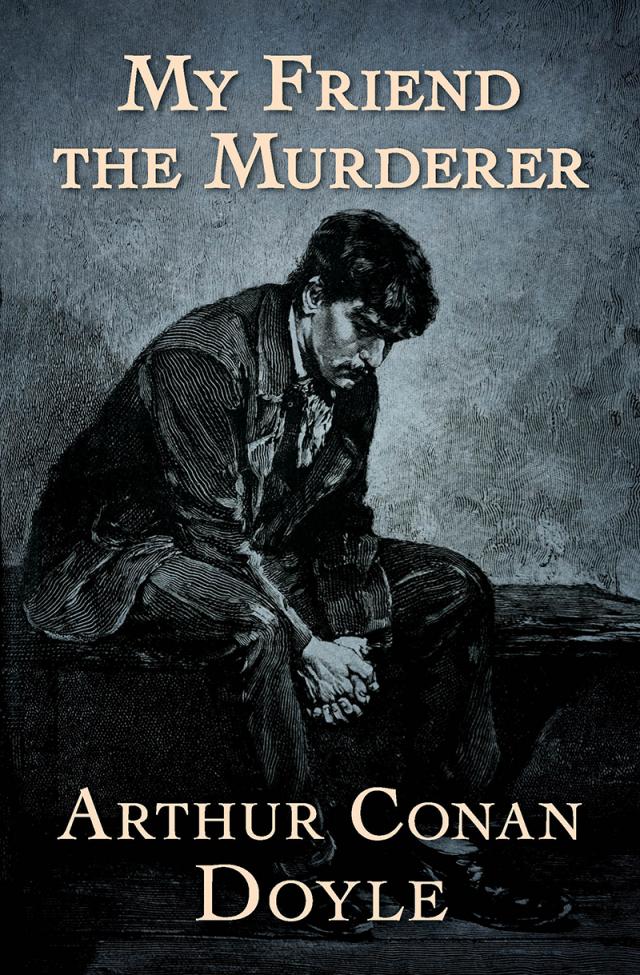


One of their own bombs could hardly have created greater surprise had it been fired in the midst of them. Every eye was fixed alternately on me and upon the newly arrived agent.
“If you are indeed Gustave Berger,” said Petrokine, “who is this?”
“That I am Gustave Berger these credentials will show,” said the stranger, as he threw a packet upon the table. “Who that man may be I know not; but if he has intruded himself upon the lodge under false pretences, it is clear that he must never carry out of the room what he has learned. Speak, sir,” he added, addressing me: “who and what are you?”
I felt that my time had come. My revolver was in my hip-pocket; but what was that against so many desperate men? I grasped the butt of it, however, as a drowning man clings to a straw, and I tried to preserve my coolness as I glanced round at the cold, vindictive faces turned toward me.
“Gentlemen,” I said, “the rôle I have played to-night has been a purely involuntary one on my part. I am no police spy, as you seem to suspect; nor, on the other hand, have I the honor to be a member of your association. I am an inoffensive corn-dealer, who by an extraordinary mistake has been forced into this unpleasant and awkward position.”
I paused for a moment. Was it my fancy that there was a peculiar noise in the street—a noise as of many feet treading softly? No, it had died away; it was but the throbbing of my own heart.
“I need hardly say,” I continued, “that anything I may have heard to-night will be safe in my keeping. I pledge my solemn honor as a gentleman that not one word of it shall transpire through me.”
The senses of men in great physical danger become strangely acute, or their imagination plays them curious tricks. My back was toward the door as I sat, but I could have sworn that I heard heavy breathing behind it. Was it the three minions whom I had seen before in the performance of their hateful functions, and who, like vultures, had sniffed another victim?
I looked round the table. Still the same hard, cruel faces. Not one glance of sympathy. I cocked the revolver in my pocket.
There was a painful silence, which was broken by the harsh, grating voice of Petrokine.
“Promises are easily made and easily broken,” he said. “There is but one way of securing eternal silence. It is our lives or yours. Let the highest among us speak.”
“You are right, sir,” said the English agent; “there is but one course open. He must be dismissed.”
I. knew what that meant in their confounded jargon, and sprang to my feet.
“By Heaven,” I shouted, putting my back against the door, “you shan’t butcher a free Englishman like a sheep! The first among you who stirs, drops!”
A man sprang at me. I saw along the sights of my Derringer the gleam of a knife and the demoniacal face of Gustave Berger. Then I pulled the trigger, and, with his hoarse scream sounding in my ears, I was felled to the ground by a crashing blow from behind. Half-unconscious, and pressed down by some heavy weight, I heard the noise of shouts and blows above me, and then I fainted away.
“When I came to myself I was lying among the debris of the door, which had been beaten in on the top of me. Opposite were a dozen of the men who had lately sat in judgment upon me, tied two and two, and guarded by a score of Russian soldiers. Beside me was the corpse of the ill-fated English agent, the whole face blown in by the force of the explosion. Alexis and Petrokine were both lying on the floor like myself, bleeding profusely.
“Well, young fellow, you’ve had a narrow escape,” said a hearty voice in my ear.
I looked up, and recognized my black-eyed acquaintance of the railway carriage.
“Stand up,” he continued: “you’re only a bit stunned; no bones broken. It’s no wonder I mistook you for the Nihilist agent, when the very lodge itself was taken in. Well, you’re the only stranger who ever came out of this den alive. Come downstairs with me. I know who you are, and what you are after now; I’ll take you to Mr. Dimidoff. Nay, don’t go in there,” he cried, as I walked toward, the door of the cell into which I had been originally ushered. “Keep out of that; you’ve seen evil sights enough for one day. Come down and have a glass of liquor.”
He explained as we walked back to the hotel that the police of Solteff, of which he was the chief, had had warning and been on the look-out during some time for this Nihilist emissary. My arrival in so unfrequented a place, coupled with my air of secrecy and the English labels on that confounded portmanteau of Gregory’s, had completed the business.
I have little more to tell. My Socialistic acquaintances were all either transported to Siberia or executed. My mission was performed to the satisfaction of my employers. My conduct during the whole business has won me promotion, and my prospects for life have been improved since that horrible night, the remembrance of which still makes me shiver.
Bones
The April Fool of Harvey’s Sluice
Abe durton’s cabin was not beautiful. People have been heard to assert that it was ugly, and, even after the fashion of. Harvey’s Sluice, have gone the length of prefixing their adjective with a forcible expletive which emphasized their criticism. Abe, however, was a stolid and easy-going man, on whose mind the remarks of an unappreciative public made but little impression. He had built the house himself, and it suited his partner and him, and what more did they want? Indeed he was rather touchy upon the subject. “Though I says it, as raised it,” he remarked, “it’ll lay over any shanty in the valley. Holes? Well, of course there are holes. You wouldn’t get fresh air without holes. There’s nothing stuffy about my house. Rain? Well, if it does let the rain in, ain’t it an advantage to know it’s rainin’ without gettin’ up to unbar the door. I wouldn’t own a house that didn’t leak some. As to its bein’ off the perpendic’lar, I like a house with a bit of a tilt. Anyways it pleases my pard, Boss Morgan, and what’s good enough for him is good enough for you, I suppose.” At which approach to personalities his antagonist usually sheered off, and left the honors of the field to the indignant architect.
But whatever difference of opinion might exist as to the beauty of the establishment, there could be no question as to its utility. To the tired wayfarer, plodding along the Buckhurst road in the direction of the Sluice, the warm glow upon the summit of the hill was a beacon of hope and of comfort. Those very holes at which the neighbors sneered helped to diffuse a cheery atmosphere of light around, which was doubly acceptable on such a night as the present.
There was only one man inside the hut, and that was the proprietor, Abe Durton himself, or “Bones,” as he had been christened with the rude heraldry of the camp. He was sitting in front of the great wood fire, gazing moodily into its glowing depths, and occasionally giving a fagot a kick of remonstrance when it showed any indication of dying into a smoulder. His fair Saxon face, with its bold simple eyes and crisp yellow beard, stood out sharp and clear against the darkness as the flickering light played over it. It was a manly, resolute countenance, and yet the physiognomist might have detected something in the lines of the mouth which showed a weakness somewhere, an indecision which contrasted strangely with his herculean shoulders and massive limbs. Abe’s was one of those trusting, simple natures which are as easy to lead as they are impossible to drive; and it was this happy pliability of disposition which made him at once the butt and the favorite of the dwellers in the Sluice. Badinage in that primitive settlement was of a somewhat ponderous character, yet no amount of chaff had ever brought a dark look on Bones’s-face, or an unkind thought into his honest heart. It was only when his aristocratic partner was, as he thought, being put upon, that an ominous tightness about his lower lip and an angry light in his blue eyes, caused even the most irrepressible humorist in the colony to nip his favorite joke in the bud, in order to diverge into an earnest and all-absorbing dissertation upon the state of the weather.
“The Boss is late to-night,” he muttered, as he rose from his chair, and stretched himself in a colossal yawn. “My stars, how it does rain and blow! Don’t it, Blinky?” Blinky was a demure and meditative owl, whose comfort and welfare was a chronic subject of solicitude to its master, and who at present contemplated him gravely from one of the rafters. “Pity you can’t speak, Blinky,” continued Abe, glancing up at his feathered companion. “There’s a powerful deal of sense in your face. Kinder melancholy too. Crossed in love, maybe, when you was young. Talkin’ of love,” he added, “I’ve not seen Susan to-day;” and lighting the candle which stood in a black bottle upon the table, he walked across the room and peered earnestly at one of the many pictures from stray illustrated papers, which had been cut out by the occupants and posted up upon the walls.
The particular picture which attracted him was one which represented a very tawdrily dressed actress simpering over a bouquet at an imaginary audience. This sketch had, for some inscrutable reason, made a deep impression upon the susceptible heart of the miner. He had invested the young lady with a human interest by solemnly, and without the slightest warrant, christening her as Susan Banks, and had then installed her as his standard of female beauty.
“You see my Susan,” he would say, when some wanderer from Buckhurst, or even from Melbourne, would describe some fair Circe whom he had left behind him. “There ain’t a girl like my Sue. If ever you go to the old country again, just you ask to see her. Susan Banks is her name, and I’ve got her picture up at the shanty.”
Abe was still gazing at his charmer, when the rough door was flung open, and a blinding cloud of sleet and rain came driving into the cabin, almost obscuring for the moment a young man who sprang in and proceeded to bar the entrance behind him, an operation which the force of the wind rendered no easy matter. He might have passed for the genius of the storm, with the water dripping from his long hair and running down his pale, refined face.
“Well,” he said, in a slightly peevish voice, “haven’t you got any supper?”
“Waiting and ready,” said his companion cheerily, pointing to a large pot which bubbled by the side of the fire. “You seem sort of damp.”
“Damp be hanged! I’m soaked, man, thoroughly saturated. It’s a night that I wouldn’t have a dog out, at least not a dog that I had any respect for. Hand over that dry coat from the peg.”
Jack Morgan, or Boss, as he was usually called, belonged to a type which was commoner in the mines during the flush times of the first great rush than would be supposed. He was a man of good blood, liberally educated, and a graduate of an English university. Boss should, in the natural course of things, have been an energetic curate, or struggling professional man, had not some latent traits cropped out in his character, inherited possibly from old Sir Henry Morgan, who had founded the family with Spanish pieces of eight gallantly won upon the high seas. It was this wild strain of blood no doubt which had caused him to drop from the bedroom window of the ivy-clad English parsonage, and leave home and friends behind him to try his luck with pick and shovel in the Australian fields. In spite of his effeminate face and dainty manners, the rough dwellers in Harvey’s Sluice had gradually learned that the little man was possessed of a cool courage and unflinching resolution, which won respect in a community where pluck was looked upon as the highest of human attributes. No one ever knew how it was that Bones and he had become partners; yet partners they were, and the large, simple nature of the stronger man looked with an almost superstitious reverence upon the clear, decisive mind of his companion.
“That’s better,” said the Boss, as he dropped into the vacant chair before the fire and watched Abe laying out the two metal plates, with the horn-handled knives and abnormally pronged forks. “Take your mining boots off, Bones; there’s no use filling the cabin with red clay. Come here and sit down.”
His gigantic partner came meekly over and perched himself upon the top of a barrel.
“What’s up?” he asked.
“Shares are up,” said his companion. “That’s what’s up. Look here,” and he extracted a crumpled paper from the pocket of the steaming coat. “Here’s the Buckhurst Sentinel. Read this article—this one here about a paying lead in the Conemara mine. We hold pretty heavily in that concern, my boy. We might sell out to-day and clear something—but I think we’ll hold on.”
Abe Durton in the mean time was laboriously spelling out the article in question, following the lines with his great forefinger, and muttering under his tawny mustache.
“Two hundred dollars a foot,” he said, looking up. “Why, pard, we hold a hundred feet each. It would give us twenty thousand dollars! We might go home on that.”
“Nonsense!” said his companion; “we’ve come out here for something better than a beggarly couple of thousand pounds. The thing is bound to pay. Sinclair the assayer has been over there, and says there’s a ledge of the richest quartz he ever set eyes on. It is just a case of getting the machinery to crush it. By the way, what was to-day’s take like?”
Abe extracted a small wooden box from his pocket and handed it to his comrade. It contained what appeared to be about a teaspoonful of sand and one or two little metallic granules not larger than a pea. Boss Morgan laughed, and returned it to his companion.
“We sha’n’t make our fortune at that rate, Bones,” he remarked; and there was a pause in the conversation as the two men listened to the wind as it screamed and whistled past the little cabin.
“Any news from Buckhurst?” asked Abe, rising and proceeding to extract their supper from the pot.
“Nothing much,” said his companion. “Cockeyed Joe has been shot by Billy Reid in McFarlane’s Store.”
“Ah!” said Abe, with listless interest.
“Bushrangers have been around and stuck up the Rochdale station. They say they are coming over here.”
The miner whistled as he poured some whiskey into a jug.
“Anything more?” he asked.
“Nothing of importance, except that the blacks have been showing a bit down New Sterling way, and that the assayer has bought a piano and is going to have his daughter out from Melbourne to live in the new house opposite on the other side of the road. So you see we are going to have something to look at, my boy,” he added as he sat down, and began attacking the food set before him. “They say she is a beauty, Bones.”
“She won’t be a patch on my Sue,” returned the other decisively.
His partner smiled as he glanced round at the flaring print upon the wall. Suddenly he dropped his knife and seemed to listen. Amid the wild uproar of the wind and the rain there was a low rumbling sound which was evidently not dependent upon the elements.
“What’s that?”
“Darned if I know.”
The two men made for the door and peered out earnestly into the darkness. Far away along the Buckhurst road they could see a moving light, and the dull sound was louder than before.
“It’s a buggy coming down,” said Abe.
“Where is it going to?”
“Don’t know. Across the ford, I s’pose.”
“Why, man, the ford will be six feet deep to-night, and running like a mill-stream.”
The light was nearer now, coming rapidly round the curve of the road. There was a wild sound of galloping with the rattle of the wheels.
“Horses have bolted, by thunder!”
“Bad job for the man inside.”
There was a rough individuality about the inhabitants of Harvey’s Sluice, in virtue of which every man bore his misfortunes upon his own shoulders, and had very little sympathy for those of his neighbors. The predominant feeling of the two men was one of pure curiosity as they watched the swinging, swaying lanterns coming down the winding road.
“If he don’t pull ’em up before they reach the ford he’s a goner,” remarked Abe Durton resignedly.
Suddenly there came a lull in the sullen splash of the rain. It was but for a moment, but in that moment there came down on the breeze a long cry which caused the two men to start and stare at each other, and then to rush frantically down the steep incline toward the road below.
“A woman, by Heaven!” gasped Abe, as he sprang across the gaping shaft of a mine in the recklessness of his haste.
Morgan was the lighter and more active man. He drew away rapidly from his stalwart companion. Within a minute he was standing panting and bareheaded in the middle of the soft muddy road, while his partner was still toiling down the side of the declivity.
The carriage was close on him now. He could see in the light of the lamps the raw-boned Australian horse as, terrified by the storm and by its own clatter, it came tearing down the declivity which led to the ford. The man who was driving seemed to see the pale set face in the pathway in front of him, for he yelled out some incoherent words of warning, and made a last desperate attempt to pull up. There was a shout, an oath, and a jarring crash, and Abe, hurrying down, saw a wild infuriated horse rearing madly in the air with a slim dark figure hanging on to its bridle. Boss, with the keen power of calculation which had made him the finest cricketer at Rugby in his day, had caught the rein immediately below the bit, and clung to it with silent concentration. Once he was down with a heavy thud in the roadway as the horse jerked its head violently forward, but when, with a snort of exultation, the animal pressed on, it was only to find that the prostrate man beneath its forehoofs still maintained his unyielding grasp.
“Hold it, Bones,” he said, as a tall figure hurled itself into the road and seized the other rein.
“All right, old man, I’ve got him;” and the horse, cowed by the sight of a fresh assailant, quieted down, and stood shivering with terror.
“Get up, Boss, it’s safe now.”
But poor Boss lay groaning in the mud.
“I can’t do it, Bones.” There was a catch in the voice as of pain. “There’s something wrong, old chap, but don’t make a fuss. It’s only a shake; give me a lift up.”
Abe bent tenderly over his prostrate companion. He could see that he was very white, and breathing with difficulty.