Sherlock holmes mystery.., p.8
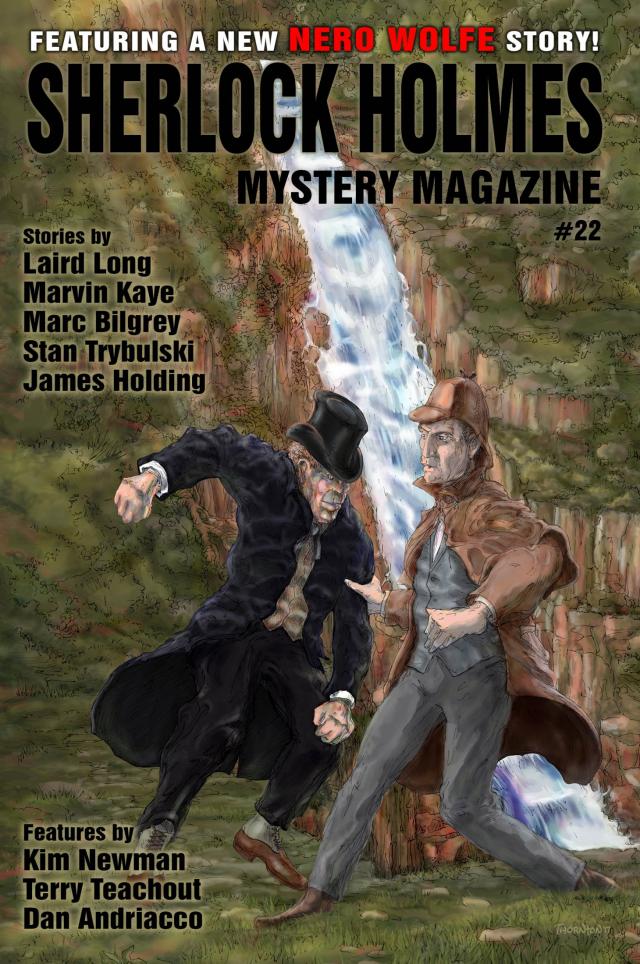
Sherlock Holmes Mystery Magazine, Volume 22,
p.8


But his sweetheart was close enough to hear him. “Larry,” she said, “don’t you remember? Harold gave them to you a few days ago to pass along to Mason, who got here late because the subway he takes got backed up.”
Larry slapped his forehead. “That’s right!” He turned to Wolfe. “I only had them briefly. Mason got here maybe five or ten minutes later.”
“Very well,” said Wolfe. “Now I have a few things to ask you, Ms. Andelman.” He beckoned to Moultrie. “Do you have an office where I can talk to her and then Mr. Russell?”
Moultrie nodded. “I should have thought of that. Right this way.” We followed him to his own headquarters, a modest-sized room with a mahogany desk and swivel chair, but before I shut the door he said to Wolfe, “I forgot to mention something. It might be important.”
“I’m listening.”
“About a week ago I received an offer to buy the platypus from the museum. It came from J. Nelson Barnett, an enormously wealthy art, curio and jewelry collector. He offered us one hundred thousand dollars. I almost took him up on it, but the platypus really belongs here.”
“I see. If you have Mr. Barnett’s address and other contact information, please give them to Archie.”
“I’ll have them for you when you come out.”
He left and I shut the door. Wolfe invited Linda Andelman to sit down. There was no chair large enough for him, so he perched on the edge of Moultrie’s desk.
“Ms. Andelman—”
“Please call me Linda.”
“Very well. Linda, have you seen the missing figurine?”
“No, I never saw anything in the museum except for the gift shop and Mr. Moultrie’s office.”
“Never?!”
“It doesn’t interest me. This is just a job, one I like, though.”
Wolfe looked thoroughly minused (I’d taunted him once by using it instead of nonplussed). “I don’t suppose,” he said, “that you’ve ever been in possession of the museum’s keys.”
“That’s right, I haven’t.”
“Do you get along with the rest of the staff? Obviously you do with Mr. Winters.”
“Well, yes, he and I have been dating for a few months. I’m on a first-name basis with Mason and Hal—Harold, but I seldom run into Marc Porterfield and when I do, if I say hello, he just grunts. I mean he grunts in a mildly friendly way … I think.”
“Thank you for your time,” Wolfe said. “Could you ask Mr. Russell to come in here, please?”
She nodded and left. The daytime security guard arrived less than a minute later.
He wore a uniform with a cap that bore the initials M–S–O–P. What hair could be seen was salt-and-pepper black. He had an amiable smile and stood a little taller than me.
Wolfe gestured for him to sit down but he declined. “Thank you, but my uniform is a bit tight. I’ve been meaning to take it to my tailor for refitting.”
“May I ask how long you have been a security guard for the museum?”
“From the first day it opened about nine years ago.”
“Has there ever been a burglary before this one?”
“Never!”
Wolfe thoughtfully mulled it over, then said, “I have a hypothetical question. If you could steal anything in the museum and get away with it, what might it be?”
“That’s an interesting question. It certainly would not be the platypus.”
“Why not?”
“It would be nearly impossible to sell. The easiest way to turn a profit would surely be by taking complete runs of some of the comic books. The radio premiums would also be easy to get rid of on eBay.”
Wolfe asked about his keys and then we were done.
* * * *
We got back just before four o’clock. Wolfe went up to the plant rooms, much, I’m sure, to Theodore’s relief. Theodore, who is Wolfe’s plant nurse, is convinced that all of the orchids will die if Wolfe misses a session.
I sat down at my desk just as the phone rang. It was Moultrie. He said both guards would be there at nine, thanks to Mason Russell, who agreed to stay for the night shift till Harold Johnson returned. Michael Faraday, the museum’s treasurer, would also come at the same time. My instructions were that if he got there early I would show him to the front room, where he would wait till Wolfe finished questioning the security guards.
After he hung up I dialed the number he’d given me and I spoke with the collector J. Nelson Barnett. I asked him whether I could meet him the next day. When I told him why, he became quite cordial. “The platypus? By all means! Do you have my address?”
“Yes, I do.”
“Then if you come at 11:30, I promise you won’t have to wait. I’ll tell my secretary to send you right in.”
I thanked him, hung up and began catching up on the germination and blooming records. When Wolfe came down shortly after six, I reported my conversations with Moultrie and Barnett. It earned me a “Satisfactory.”
* * * *
Faraday arrived at ten of nine. He is slim, trim and well-dressed. I estimated him to be in his early forties. I told him that he would have to wait for a while and led him to the front room. I offered him a drink and he asked if we had any single malt. When I said yes, he asked which ones. Answering took several seconds because we’re well stocked with both single and blended scotch. He was delighted to learn that one of them is Edradour. “A brandy snifter, please,” he said, then added, “Did you know it’s the smallest distillery in Scotland?”
I said no.
“Of course it’s been quite some time since I last visited Pitlochry, that’s where they are, but when I did I found out that they only had two employees. There’s also a rumor that Edradour is owned by the Mafia.”
I brought him a snifter, napkin and the bottle so he might have a refill. He sat back contentedly with an expression that was positively beatific.
Just as I closed the door to the front room, the doorbell sounded and I saw that the two guards were there. Harold Johnson is quite tall with skin so light he could pass for Caucasian. He was in his MSOP uniform. Marc Porterfield wore a dark featureless suit, ditto tie. He nodded hello through spectacles so thick that I figured he has some kind of eye condition.
In the office, I offered libations and Johnson thanked me and asked for beer. The dour weekend guard went over to the bar and poured himself at least three ounces of Demerara rum, which made me shudder because it’s 151 proof.
Wolfe entered and sat. Fritz brought him his usual two bottles of beer and one for Johnson. He had them on a tray so he could also manage two pilsner glasses. After thanking them for coming at such short notice, Wolfe repeated the same questions he’d put to Marc Russell. When asked what they’d steal from the museum, Hal, as he asked us to call him, agreed with Marc that the comic books would be the easiest to sell for a good profit. Porterfield, though, said he’d go into the medical room and help himself to some of the strange medicine there.
“Why?” Wolfe asked. “Would you sell them to a doctor or a hospital?”
“No, I don’t need the money. I’d keep them.”
“Are you talking about drugs? Narcotics?”
He shook his head. “Those might be salable, but I could be caught. No, I’m more interested in the poisons.”
“For what reason?”
“Whatever.” And that’s all he would say.
Wolfe, exchanging a worried glance with me and Hal, decided to drop it. After I showed them out, but before I brought in Faraday, the boss beckoned to me. “We should find out about Mr. Porterfield.”
“Why?”
“I’ve got a bad feeling about him. Call Saul later. Whatever he may find might need to be passed along to Inspector Cramer. Now let’s see what Mr. Faraday has to tell us.”
I brought him in. He almost shook Wolfe’s hand but suddenly realized it was a bad idea. I told him to sit in the red leather chair, which he did. He immediately complimented Wolfe on the Edradour.
“Thank you, sir, but I seldom drink anything but beer and wine. The credit for stocking the bar belongs to Mr. Goodwin. I hope this visit isn’t an inconvenience.”
“Not at all. I’ve always wanted to meet you.”
“May I ask why?”
“Two reasons. Orchids fascinate me and I should dearly love to see your collection.”
“I will be delighted to do so after we talk. And why else have you wished to meet me?”
“I have a copy of your splendid cook book.”
Wolfe chuckled. “Again, I do not deserve any credit. It was prepared by Ms. Barbara Burn, an editor at Viking Press. She, of course, spent a lot of time conferring with my chef, Mr. Fritz Brenner. But now let’s get down to business. I presume that you are aware of the museum’s theft?”
“Yes,” he said with a sigh. “I’ve told Ben again and again that we must have plenty of insurance, but he only bought the bare minimum.”
“Let me reassure you that the figurine will be found. Did you know that an offer has been made to buy it?”
“Oh, yes. I initiated it. Nelson Barnett is an old friend. I’m his financial advisor.”
“Have you spoken to him since the theft?”
“I have,” Faraday replied. “When he learned that Ben hired you to find it, he said it’s the best thing he could have possibly done. He then told me, ‘When—not if—it’s found, I’ll raise my offer to a quarter of a million.”
Wolfe paused to open and pour his second bottle of Nordik Wolf. “I have one more question. Where do you keep your museum keys and how often do you use them?”
He took them out of his pocket. “They’re always with me. I’ve never used them.”
“Thank you for your time and assistance. Perhaps you’d like to have dinner with us sometime soon?”
“It would be an honor.”
After he left, I called Saul and Wolfe picked up and told him what he wanted. What I heard made good sense.
* * * *
Next morning at 10:30 I introduced myself to Barnett’s secretary, who showed me into his office and brought me coffee and a dimply smile. It was a large corner room on the 35th floor of a building at 47th and Madison. I sipped an excellent cup of Kona as J. Nelson Barnett entered. He wore a dark three-piece business suit and a necktie that I thought was black, but when he moved it caught the light and thin red slants glinted.
Barnett is so short I couldn’t decide if he’s a dwarf or a hobbit.
“Mr. Goodwin—”
“Just Archie.”
“Archie, I’m glad you could meet me here, though I would have liked to visit Mr. Wolfe at his office.”
“That could be arranged.”
“Please be seated. Has the platypus been found?”
“Not yet,” I said, “but Mr. Wolfe is confident that it will be. Why does it mean so much to you?”
“Well, I’m a collector, but I am not a hoarder. I feel that the platypus is too important historically for such a small, though excellent, museum. If I buy it, I plan to offer it to the Smithsonian.”
“Did you have it stolen?”
He laughed. “No, Archie. But I know who did.”
* * * *
When I reported later, Wolfe said, “It’s just as I expected.”
“Meaning?”
“It’s show time. Or will be soon. Arrange a meeting, hopefully tonight at nine and ask Mr. Moultrie to come, also Messrs. Barnett, Faraday and Winters, as well as Ms. Andelman. And you might as well invite Faraday for dinner.” Which shows that it’s good to ask Wolfe to see his orchids.
“Might I suggest also inviting Barnett?”
He nodded. “I’ll ask Fritz what we should serve.”
I suggested braised platypus stuffed with crabmeat. He pretended not to hear me.
Dinner featured Beef Wellington, which Wolfe once said is a fine dish, “though it’s not serious gastronomy.” During the meal, he held forth on Dickens’s final incomplete novel, The Mystery of Edwin Drood. “The problem,” he contended, “is reasonably easy to solve if you are a competent detective. Have you read it?” Both guests said they had. “Good, then I won’t ruin the experience for you. Here’s what really happens and why.” I excused myself and took my plate into the kitchen. I’d been meaning to read Drood and didn’t want any spoilers.
* * * *
The museum director arrived promptly at nine along with his cashier and gift shop manager. They joined Wolfe and our guests in the office. Faraday relinquished the red chair to Moultrie. Drinks were distributed and Wolfe began.
“I was hired to find the platypus and identify the thief. It was soon apparent where the figurine was hidden, but I could not yet prove who took it.”
“Never mind that for now,” said Moultrie. “Where is it?”
Wolfe produced the photos I’d taken and passed them around. They all looked, but Moultrie said, “I don’t see it!”
“That’s because it’s disguised. Tell me what you do see.”
Moultrie stared with narrowed eyes. “It’s some of the Disney statuettes.”
“Yes. Which are most prominent?”
“Daisy and Donald Duck.”
“Exactly. Can you tell me why I’ve asked you this?”
A bright light suddenly glowed in Moultrie’s eyes. “Both of them have the same kind of bills as the platypus.”
“That’s right,” said Wolfe. “Donald is the perfect camouflage. So you see, the platinum figure never left the museum. It should be there right now concealed behind Donald.”
Barnett and Faraday both applauded. Wolfe nodded his appreciation, then continued. “Finding it is only half my job, though. Now I’ll tell you who the thief is.”
He looked pointedly at Larry Winters.
“Me?” he exclaimed. “Why me?”
“For two reasons,” Wolfe answered. “First, there are only three sets of keys to the museum. One is held by your employer and the second by Mr. Faraday, who never uses them.”
“How do you know that?”
“He told me so.” He held up his hand to stop the next question. “Yes, I believe him. I asked my operative Saul Panzer to investigate both him and Mr. Barnett, also Ms. Andelman. They all have often been declared completely trustworthy. So you are the only one who had access to the platypus’s display case.”
“I told you I only had them for a few minutes.”
“That’s all it would take,” Wolfe said. “Though you had longer. The day guard, who arrived late that day, says it was at least half an hour before he got to the museum.”
“And what about the three guards?”
“I questioned them. None are even remotely interested in stealing it and for a good reason—it would be almost impossible to sell. Which brings me to my second reason. There is one person who wants to buy the platypus and he’s sitting right here.”
Winters looked at Barnett and sighed. “OK, you’ve got me. I offered it to him, but he refused. That’s when I should have left town.” All the while, I noticed that he was avoiding looking at Linda.
“Why did you want so much money?” Wolfe asked.
“So I could afford a house where Linda and I could live after we married.”
She got up, approached him and slapped his face. Very hard.
* * * *
Of course Moultrie fired him, but said he would not turn him over to the police. “Furthermore,” he said, “before you did this I was pleased with the excellence of your work. If you find employment elsewhere, I will give you a favorable letter of reference.”
The cashier’s jaw dropped, as did almost everyone else’s. Not Wolfe, but I saw that our client’s gesture made a great impression on him. “Mr. Moultrie,” he said, “you are the soul of generosity. I am going to do something quite rare for me. With two conditions, you are released from paying the rest of my fee.”
“Thank you! I agree to your conditions.”
Wolfe waggled a finger. “You’d best hear them first. I want you to give the rest of my fee to the museum so that you can create the new rooms you told us about.”
“Again, thank you! And what else?”
“Please allow me and Mr. Goodwin to visit at any time without charge.”
“Done, sir. What about your expenses?”
“Archie will send you a bill for two parking lot costs and Mr. Panzer’s fee, which, like mine, will be somewhat dear.”
People began to rise to go to the front door (the cashier practically ran out).
But Faraday asked Wolfe if he could use the front room. When told that he could, he went in with Moultrie and Barnett. They were there for maybe two minutes. When they came back Moultrie said somewhat sadly, “I’ve decided to sell the platypus to Mr. Barnett.”
* * * *
Two more things. When Wolfe found out what Saul learned about the weekend security guard, he had me call Cramer at once. It seems that though Porterfield was not married, he had been when he lived in Knoxville, Tennessee. His wife died soon after he took out insurance on her. Naturally he was suspected of killing her, but no one could figure out what did her in. The coroner put it down to the universal catch-all, heart failure. Cramer got in touch with the Tennessee police and worked out that she’d been given an almost undetectable poison. So the museum had to hire a new weekend guard.
Lastly—and this may have been a joke on me, though that’s not Wolfe’s style—I actually overheard him asking Fritz whether he thought an acceptable meal could be prepared with platypus meat.
But so far, I have not tasted any.
d
Marvin Kaye is the author of seventeen novels and numerous short stories, as well as the editor of Sherlock Holmes Mystery Magazine, Weird Tales magazine, and many best-selling anthologies. A native of Philadelphia, he is a graduate of Penn State, with an M.A. in theatre and English literature.