Sherlock holmes mystery.., p.9
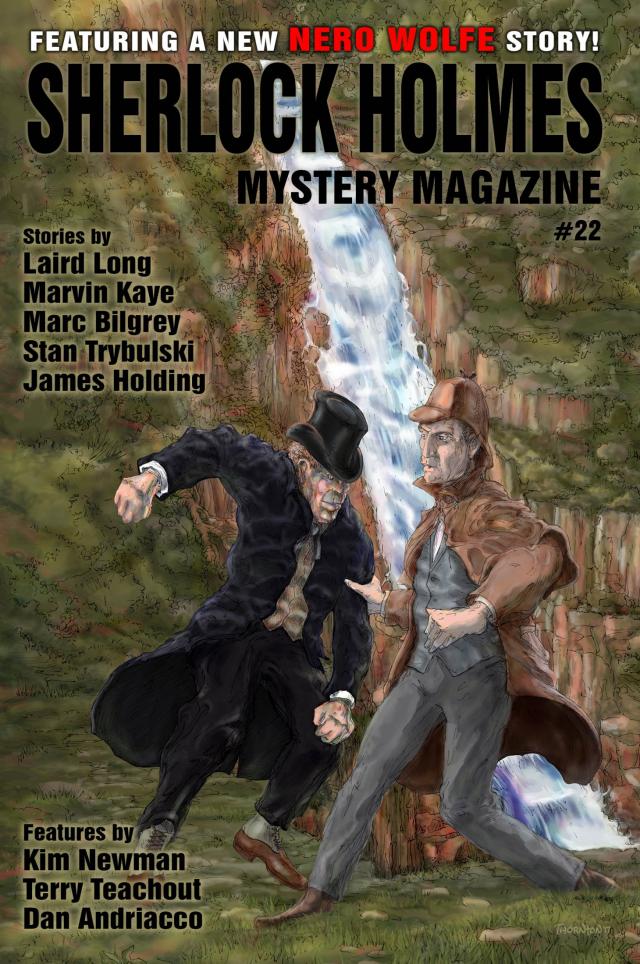
Sherlock Holmes Mystery Magazine, Volume 22,
p.9


221B
by Vincent Starrett
Here dwell together still two men of note
Who never lived and so can never die:
How very near they seem, yet how remote
That age before the world went all awry.
But still the game’s afoot for those with ears
Attuned to catch the distant view-halloo:
England is England yet, for all our fears--
Only those things the heart believes are true.
A yellow fog swirls past the window-pane
As night descends upon this fabled street:
A lonely hansom splashes through the rain,
The ghostly gas lamps fail at twenty feet.
Here, though the world explode, these two survive,
And it is always eighteen ninety-five.
A RUDE AWAKENING
by Stan Trybulski
Kozhevnikov came out of the Metro at the Place du Colonel Fabien station and trudged slowly down the Boulevard de La Villette. The late afternoon April sun was bright in his face but not strong enough to take the chill out of the air. He tightened the wool scarf around his neck and turned up the collar of his pea jacket. Standing at the corner of the Rue Burneuf, he paused and then turned into that street and started a slow climb up the hill. The climb was steep and even though Kozhevnikov was a pudgy man with short, squat legs he did not find it difficult after years of cross country skiing in the hills outside Moscow. It was just that it was, well, a boring walk past boring houses on a boring street. A boring oblique path to another of the boring routine tasks he had been given since his arrival in Paris four months ago.
When he reached the Avenue Mathurin, he crossed and turned downhill, returning to his starting point, the Place du Colonel Fabien, but from the opposite side. On the other side of the Avenue was the French Party headquarters: six stories of sinuous glass, guarded by a squat, semicircular domed structure almost shoved into the ground as if it were some sort of slapdash futuristic military bunker. The dome covered the French Party’s subterranean conference center.
Kozhevnikov shrugged. An underground hideout was more like it. It fit their clandestine mentality, a holdover from the Great Patriotic War. Now the French comrades were in a retreat, in fact you could call it a rout, but they were too stubborn to take our advice. What is one to do with them? Oh, they listened to us all right, but then they just went ahead and did things their own way.
Officially, he was a Soviet liaison to the trade unions and one of his tasks was to travel out to Poissy and meet with selected union leaders at the sprawling Peugeot car works. The shop stewards were Party members and politely listened when he would encourage them to support the brave Nicaraguan and Salvadorian comrades fighting the American imperialists. But when it came to talking about the plant and its production techniques and design, they were as animated as any of their big capitalist bosses. He had to confess he was as enthusiastic as they were for he had studied automotive technology back in Moscow. But when he included the technical comments in his first reports, Comrade Grubkin, the Embassy’s second secretary, head of the KGB residentura and his Service boss, crossed them out and insisted that the reports be rewritten with more “information” about French worker support for the struggle of the oppressed peoples of Central America against American imperialism.
“Filip, you must pay stricter attention to what Moscow wants,” Grubkin said. “Paris is a cushy job; be glad you’re not in Afghanistan, surrounded by Abduls looking to slice your nuts off.”
He had followed Grubkin’s advice and it had paid off. A month earlier Grubkin had called him into his office and greeted him with a broad smile. “I know your formal training was cut short and that you never received the full syllabus of case studies, but I have a task for you that perhaps is the best way to develop you as a streetman.”
Grubkin assigned Kozhevnikov what he called “important work for the Service” and a “sensitive task” involving the French comrades. He knew enough not to comment but only listen and did not even smile when Grubkin told him there would be an increase in his field allowance for the duration of the task. When Grubkin reminded him that, of course, all expenditures would have to be accounted for, Kozhevnikov solemnly nodded agreement. He had grown up poor and his only luxury had been a pair of handcrafted Norwegian cross-country skis that he had bought at a flea market. Now in Paris he was still poor and the skis were still in Moscow. So if he could only have a beer or two on the Service, he would not complain. And this day, that was exactly what he intended to do.
He stopped and looked at his watch. Thirty minutes early. Good, he told himself, I will have two beers. He casually walked the perimeter of the Place until he reached a small café situated directly across from the French Party headquarters. People were sitting on the café’s tiny terrace, having a beer or a glass of wine and chatting. Kozhevnikov could tell that they were workers and would have loved to have joined them, to have a conversation about … what? He was unsure how to develop an unstructured chat. With the auto workers, he had always talked from a Moscow-approved script.
Instead, he went inside the café and sat by the window where he had a clear view of the Party building. The barman came over and Kozhevnikov ordered a large Stella Artois, while keeping his eyes on the street. This was the fifth time that he had conducted this task and had decided that it actually was important Party work. For on the first surveillance, he had seen a ZIL limousine from the Embassy pull up in front of the French Party headquarters and the First Secretary emerge from the building and get in the back.
Twenty minutes later, his target emerged: Dubos, a thin man of medium height, dressed in a dark blue suit with white shirt and black tie. Kozhevnikov hurriedly paid the barman and followed Dubos to an apartment block a few streets away. His target came out two hours later with a young woman whose long blond tresses fell onto a cashmere jacket that covered a cashmere sweater. The couple walked arm in arm down the hill and across the Canal St. Martin to the Place de la Republique and then to a restaurant on small street just off the Boulevard Voltaire. He waited on the corner until they had finished eating and then followed them back to the woman’s apartment building.
When they went inside, Kozhevnikov hurried back to the restaurant and asked to see the menu. Duck breast with honey and rabbit in mustard sauce were the specialties of the evening. How bourgeois a meal for a comrade. Yet how wonderful. He sighed, thinking of the simple meal of sausage, potatoes, and cabbage he would prepare for himself later that evening.
His report to Comrade Grubkin included a description of the woman and the name of the restaurant and its specialties, even though he felt such details might cast an unwarranted aspersion on the French comrade.
“Very good, Filip,” Grubkin had said. “Always keep the report short. We don’t want to overtax any Moscow brains. Yet make it interesting so that the Center asks for more.” The next three surveillances of Dubos were the same. He arrived at the café at the set time, nursed a single beer and watched as the Embassy car pulled up in front of the French Party headquarters, watched the First Secretary emerge from the building, get in the car and drive off. Then almost twenty minutes later, Dubos would leave and he would follow him to the same apartment block and wait until he emerged with the blonde.
When he would follow them downhill to the resto, he wished the streets were full of snow and pushed his legs forward as if he were on his cross-country skis, and while he waited for them to finish their meal he dreamed of snowy hills and remembered the pictures he had seen of posh ski resorts in the Alps. He knew that downhill skiing was merely an outdoor entertainment of the rich, capitalist ruling classes. Still he would liked to have tried it, feeling the rush of the ice-cold wind across his face as he zigzagged across a glacier face; to have a cup of chocolate with brandy and whipped cream while he looked out over a long range of snow-capped peaks; and to have that duck breast with honey and a whole bottle of a good red wine. And with a young blond woman sitting across from him, smiling a smile that was as delicious as the meal and meant only for his eyes and heart.
Now that was the kind of dream the Service was on the lookout for. A dangerous, stupidly romantic dream that if known would mean his immediate recall to Moscow. He left it quickly and returned to his surveillance. There was no doubt in his mind that the appearance of the First Secretary at the French party headquarters and the surveillance of the target were connected.
“Coincidences do not exist in our line of work. Always remember that, comrades,” the instructor back in Moscow had told them their first day in school.
The barman brought the beer and he took a long sip, first of the foam, then of the liquid, letting the sharp, cold carbonation pop on his tongue and sting it before swallowing. He would have loved to have a glass of red wine; it was far better here than in Moscow, where you could only get swill from Georgia or Bulgaria, Hungary if you were lucky. But that would be an expense too much.
Still he had much to be thankful for. Only last year his intended destiny was some outdated and freezing automotive plant. Now he was in Paris, with a warm flat, larger than the one he had shared with his mother, and even though the flat was outside Paris, in Montrouge, where the Party controlled the government, to him it was the same. And even though a glass of good wine was too dear an expense, he was able to buy fresh vegetables and plenty of meat, even though it was the cheaper cuts.
His life had changed the year before as he waited at the tram stop by the university. A man approached, a nondescript face with nondescript clothes and a soft voice. A soft voice was all he needed with Kozhevnikov for his Service shield spoke for him. The man took him to a nearby café where he bought him a beer and explained that the Service was in need of young graduates with Kozhevnikov’s talents. When he appeared puzzled, the man mentioned his ability to understand automotive technical literature printed in English, French, and German. He had sense enough not to ask how the Service knew that. As far he was concerned, they were an omniscient deity. And when he was invited to start training for intelligence work with them, he knew it wasn’t really an invitation, for if he declined he would become suspect and would be lucky if he found a technical job in Chelyabinsk, let alone Moscow.
So he went along. It was to be two years of training, but after only eight months it was suddenly cut short and he was ordered abroad.
“Do you have dreams?” a Service psychiatrist asked him just before he was posted to Paris. “Tell me about them,” the doctor continued, knowing that, of course, Kozhevnikov, like everyone else, had dreams. When he hesitated, the doctor intoned, as if he had the speech memorized: “Your dreams, like everything else, now belong to the Party and the Organs of the State. We will know them sooner or later, so it is better if you tell us now so we can decide your fitness to do important work.”
I dream of the snow, he answered.
“Well, this is winter in Moscow and that is to be expected. What about recurring dreams?”
I dream of the day that Marxism-Leninism triumphs over imperialism, he said.
The doctor casually wrote down the answer, as if he had heard it a hundred times before. Which Kozhevnikov was sure the man had.
To have a decent red wine and have the Service pay for it, now that was another dream. He laughed silently at the thought. He had not told the doctor that, nor had he told the doctor that his dream about snow included a cross-country ski trip that took him all the way to the Finnish border.
Even though he always limited himself to one beer each time he was at the café, the surveillance task had turned out to be rather enjoyable. He saw many of the same customers and while he never conversed with any of them, now by this fifth time here he felt he was blending in. Perhaps he should mention this to Grubkin, maybe it would lead to further such assignments. He mulled that idea over while he finished his beer, not coming to any conclusion.
The door opened and a blond woman came in and hugged a young man standing at the end of the bar. Kozhevnikov had seen her the last time he had been here and found her quite attractive, unlike the girls back in Moscow, who if attractive either attached themselves to powerful men or became nightclub whores. This woman, her arm around the man who was obviously a worker like himself, joked with him and the barman, giving an infectious laugh that floated across the room. She was more beautiful than any woman he had ever seen in Moscow, yet she did not seek out the powerful or look to sell her body to the highest bidder. She was perfectly happy drinking a glass of red wine in a working-class bar with other workers. This realization made Kozhevnikov happy and sad at the same time.
He watched her reflection in the window, tossing her blond hair as she laughed and joked. He also looked at his own face, square, almost brutish with its smashed-in nose, a present he received at the age of thirteen from his drunken father who came home to find his mother out and only young Filip to bash around. His father was a Party member who did his job and bought drinks for his superiors instead of buying food for his family, and so nothing was ever done about it. The next winter the old man passed out drunk in a park where Filip was sure he had gone in search some cheap whore. When the maintenance workers found him the next morning, he was frozen to death.
As the son of a deceased Party member in good standing, Filip was able to study automotive technology with an eye to a future as … as what? He turned and looked directly at the woman. She seemed to notice and smile at him. He blushed and turned back to the window and peered at his face. If he could ever get the nose fixed, he decided, he would not look half bad, and perhaps attract someone better than chunky farm girl Iliana, the only woman at the Embassy who paid him any attention, but whose appearance was more fit for driving a tractor at a collective than working in the Paris Embassy.
The barman handed her a small metal jeton for the phone. She stood and started walking back towards him. As she passed the entrance, the door opened and a small man with wire-rimmed glasses entered. He too looked at the woman. As she passed Kozhevnikov, the aisle so narrow she could barely squeeze through, he felt her hand brush along his shoulder, almost squeezing it, as if he was an old friend. He closed his eyes at the sudden thrill that ran through him and when he opened them again, the small man with the wire-rimmed glasses was sitting across from him.
“Do you mind?” the man asked in a quiet voice. “This seems the only seat available.”
He shook his head in the negative and started to look back out the window.
“She’s very beautiful, isn’t she?” The voice drifted soothingly into his ears.
Kozhevnikov suddenly turned to him in surprise. “Who?”
The Quiet Man nodded in the direction that the blonde had gone, to the telephone cabinet.
“Oh, yes, her, she is very beautiful.” He answered as the Quiet Man’s voice still hung in the air. The man’s French was colloquial, like the other patrons, yet his demeanor, the tone of his voice, even his eyeglasses indicated that he was something else. And it appeared as if he did not care who knew it.
“She is coming back.”
Kozhevnikov felt a cool hand on his shoulder as the blonde squeezed past.
“Excusez-moi, monsieur,” she said, leaning slightly against him. The smile was still on her face and it mesmerized Kozhevnikov. He could barely nod a reply and kept watching as she joined her companion at the end of the bar. When he turned his attention back to the café window and the entrance to the French party headquarters across the way, his gaze swept past the Quiet Man who was busy wiping his glasses on his sweater.
“You missed your man, comrade. How will you explain it?” The Quiet Man’s voice was so soft that Kozhevnikov thought for a split second that he had misheard him. But only for a split second.
“I don’t know what you mean. And why do call me comrade?”
The Quiet Man smiled. “We are all comrades of a sort, and yes, you do know what I mean. You know very well what I mean.”
Kozhevnikov started to rise, to hurry out of the café and chase after his target.
“Sit,” the Quiet Man said. “You cannot catch up to him.” The voice was just above a whisper, but something in it caused Kozhevnikov to slump back down into his chair. He watched as the Quiet Man signaled to the barman, holding his fingers up like the way Churchill made a V. The barman brought two glasses of red wine to the table.
“Go ahead, try this, it’s a decent Côte du Rhône.”
Kozhevnikov did not touch his glass. He sat there, silently watching as the Quiet Man sipped his wine. After swallowing, the man set his glass down and placed the tips of his index fingers on a pair of pursed lips and stared at Kozhevnikov.
Anger and fear simultaneously welled up in Kozhevnikov. “Just who are you?” He tried to put importance in his voice.
“As I said, a comrade.”
“I have not seen you at the Embassy. Have you been sent from Moscow?” His voice had lost its tone of importance.
The Quiet Man removed the tips of his index fingers from his mouth and set his lips into a wry smile. “Moscow? No, and you should thank your lucky red stars that I have not been.”
Kozhevnikov’s eyes widened and as if sensing his thoughts, the Quiet Man shook his head. “You can run if you want to. We won’t stop you. But you know it will go badly for you back at the Embassy, behind those high walls and electronic doors and the cameras watching every corridor, every entrance and every exit, and the thugs ever anxious to do whatever the Service, your Service, deems necessary in cases like yours ….” His soft voice drifted off and he sipped some more of his wine. “Your superior will be on the backchannel to Moscow Center before you can utter your first syllable of explanation. And no matter what you tell them,” the Quiet Man’s voice was suddenly firmer, “it will end very badly for you. You know their feelings on matters like this, their suspicions, their methods. No matter what you tell them, they will demand more, for they always believe there is more. And they would be right, wouldn’t they? We always have something to hide.”