Tyrant of jarl rift warr.., p.6
Tyrant of Jarl (Rift Warrior Book 4),
p.6


I had two options: try to evade the patrol by moving deeper into the forest, or continue down the road and risk being spotted. Neither seemed particularly attractive. The forest was dark and filled with who-knew-what predators, while the road offered little cover.
The decision was made for me when one of the walkers turned directly toward my hiding spot, its rider adjusting something on what looked like a scanning device.
“Got something,” he called to the others. “Thermal signature behind that big trunk.”
So much for hiding. These weren’t the primitive enforcers I’d expected—they had functioning thermal scanners, which meant they had access to at least some advanced technology.
The leader gestured, and the patrol converged on my position, the walkers moving with the coordinated precision of trained military units.
“Come out with your hands visible,” the leader called. “No sudden movements.”
I considered my options. Four armed men on mechanized walkers against one man with an axe weren’t favorable odds. But I wouldn’t survive any colony world by surrendering at the first sign of trouble.
“Move in,” the leader ordered when I didn’t respond. “Weapons ready.”
The walkers advanced cautiously, their metal legs crunching through the snow with measured steps. The riders had drawn their sidearms—chunky, utilitarian weapons that looked designed for reliability in harsh conditions rather than precision.
I waited until the nearest walker was just ten feet away, its rider leaning forward to peer into the shadows where I hid. Then I moved.
The axe flew from my hand in a spinning arc, a calculated risk born of desperation. It struck the rider’s helmet with the flat top of the blade, the impact knocking him backward off his walker.
I was already moving, sprinting toward the now riderless machine.
“Contact!” one of the enforcers shouted. “He’s making for Toric’s walker!”
A weapon discharged, the sound sharp and distinctive—not the boom of conventional firearms but the crack of something that accelerated projectiles through electromagnetic means. A railgun of sorts.
The shot went wide, splintering the trunk of a tree to my left.
I reached the riderless walker, where its former master was sprawled nearby. The man was dazed but conscious, fumbling for the sidearm that had fallen into the snow. When he started to get up, I delivered a precise strike to his temple, sending him back to the ground.
The walker skittered backward, its programming apparently including some self-preservation protocols. The machine resembled a mechanical ostrich with its long neck and two powerful legs, though the body was elongated to accommodate a rider. Close up, I could see the sophisticated joint mechanisms that allowed it to navigate the difficult terrain.
Another shot cracked through the night, this one closer. Snow exploded near my feet as a high-velocity projectile impacted the ground. The remaining three enforcers were adjusting their aim, spreading out to surround me.
“Surrender now!” the patrol leader demanded. “There’s nowhere to run.”
I dove behind the riderless walker, using it as cover. The machine shifted nervously, its rudimentary AI clearly conflicted about this unexpected situation. The enforcer I’d knocked down was still on the ground, whether unconscious or playing possum, I couldn’t tell.
“We have you outnumbered,” the leader continued. “You’re the one who assaulted the Halverson boys, aren’t you? Thought you could just rob citizens and get away with it?”
I needed to change the dynamics of this encounter quickly. The walker provided temporary cover, but I was still in trouble. My gaze fell on the enforcer’s dropped sidearm, lying in the snow just a few feet away.
Another shot, this one striking the walker’s side plating with a metallic ping. The machine flinched, a surprisingly organic reaction for a mechanical construct.
I lunged for the fallen weapon, my fingers closing around its grip just as another shot kicked up snow where my hand had been seconds earlier. The sidearm was heavier than it looked, with crude but functional sights and what appeared to be a simple charging mechanism.
“He’s armed!” one of the enforcers warned.
I squeezed the trigger, aiming at the ground near the closest enforcer’s walker. The weapon discharged with surprising force, nearly jumping out of my hand. The shot struck exactly where I’d aimed, sending a spray of snow and ice into the walker’s optical sensors. The machine reacted instinctively, rearing back like a startled horse. Its rider, unprepared for the sudden movement, lost his balance, tumbled into the snow, and lay still.
Two down, two to go.
The remaining enforcers adjusted their tactics, one circling to my right while the leader maintained position directly ahead. They’d switched from sidearms to the long-barreled rifles, which likely had better range and stopping power.
“Last chance,” the leader called. “Surrender now or we open fire with lethal intent.”
In response, I fired at the leader, aiming for his walker’s joint mechanism. The shot connected, striking a vulnerable hydraulic line. Fluid sprayed from the damaged component, instantly freezing in the cold air. The walker staggered, its mobility compromised.
The fourth enforcer fired back, his shot grazing my shoulder. Pain flared, hot and immediate, but the thick leather jacket absorbed the worst of it. I rolled to my right, coming up in a crouch and returning fire. My shot went wide, but it forced the enforcer to duck, buying me precious seconds.
The riderless walker remained nearby, still confused by the chaos around it. I needed that machine if I was to have any chance of escape.
The leader was struggling with his damaged walker, the mechanical legs responding sluggishly to his commands. “Shoot him, Klaus! Don’t let him get away!”
The fourth enforcer—Klaus, apparently—dismounted to steady his aim, preparing for a more careful shot. I couldn’t give him that opportunity.
I fired twice in rapid succession, forcing him to take cover behind his own walker. Then I charged the riderless machine, hoping its programming would accept a new rider rather than reject me outright.
The walker shied away as I approached, its behavioral algorithms interpreting me as a threat. I slowed, holding out one hand in what I hoped was a universal gesture of non-aggression.
“Easy,” I murmured, though I doubted the machine had audio recognition capabilities.
A shot from Klaus’ rifle struck the ground at my feet, sending chips of ice flying. There was no more time for subtlety. I lunged forward, grabbing the walker’s control yoke and swinging myself into the saddle.
The machine bucked once, then settled, apparently accepting my presence if not my authority. The controls were simpler than I’d expected—a yoke that could be pushed forward, pulled back, or angled side to side, with what appeared to be manual override switches for fine control of the legs.
Klaus was taking aim again, his rifle steadied against his walker’s neck. I pushed the yoke forward, and my commandeered machine leapt into motion. The sudden acceleration nearly threw me from the saddle, but I managed to maintain my grip.
The walker’s gait was surprisingly smooth, its mechanical legs absorbing the impact of each stride. The design was ingenious—a perfect adaptation to Jarl’s difficult terrain. I guided the machine toward Klaus, closing the distance and making it risky for him to get a clean shot.
His walker responded to his commands, backing away from my charge. But he’d made a critical error, positioning himself with his back to a steep embankment. As he realized his mistake, panic flashed across his face.
I angled my walker directly toward him, maintaining speed. Klaus fired hastily, the shot going wide. Then he made a decision, leaping from his walker moments before mine crashed into it. The two machines collided with a clash of metal and mechanical protests. Klaus’ walker tumbled backward down the embankment, disappearing into the darkness below.
Klaus himself scrambled to his feet, abandoning his equipment and sprinting toward where the leader still struggled with his damaged walker. My own mount had staggered from the impact but remained functional, quickly regaining its balance.
I turned toward the two remaining enforcers. The leader had dismounted, his walker now completely immobilized. He and Klaus stood shoulder-to-shoulder, weapons raised.
“This isn’t over!” the leader called. “The Tyrant will hear of this! There’s nowhere on Jarl you can hide.”
“Tell the Tyrant I’m coming for him,” I replied, guiding my walker forward.
The leader’s expression hardened. “Kill him.”
Both men fired simultaneously. I threw myself sideways, nearly falling from the walker’s saddle. One shot missed entirely. The other struck the walker’s neck housing, sending sparks flying from damaged circuitry.
The machine reacted instinctively, charging toward the perceived threat. The enforcers split up, diving in opposite directions. The leader wasn’t quick enough. The walker’s powerful front leg caught him mid-dive, the impact sending him flying. He landed awkwardly, his neck bending at an unnatural angle. He didn’t move again.
Klaus stared at his fallen commander, then at me. Whatever loyalty he felt to the Tyrant’s cause, it apparently didn’t extend to sacrificing his life. He turned and ran, disappearing into the forest.
I guided the walker to a halt, surveying the aftermath. One enforcer dead, one running his ass off, two unconscious. Not the subtle arrival I’d hoped for, but I was sure it could have been worse.
The walker shifted beneath me, its systems damaged but operational. Blood stained the snow where the leader had fallen, a dark patch in the moonlight. I dismounted, approaching his body cautiously.
The man was dead, all right—his neck broken by the impact. A bad break—I hadn’t intended to kill him. But he’d made his choice when he ordered his men to fire with lethal intent.
I searched the body, finding identification and communication devices that might prove useful. The insignia on his uniform—the fist clutching lightning—I removed and discarded. No point advertising a connection to the Tyrant’s forces.
The walker waited nearby, its damaged systems occasionally sparking. Despite the injury, it remained functional, tracking my movements with what seemed like curiosity. Its behavior was more sophisticated than I’d expected, suggesting an AI that, while not sentient, possessed advanced learning capabilities.
I approached it slowly, hands visible. “Looks like we’re partners now,” I told the machine.
It cocked its head, an oddly organic gesture for a machine. Up close, I could see the quality of its engineering—a seamless blend of salvaged technology and ingenious adaptations to local conditions. Its two legs were articulated with multiple joints, allowing for precise movement across varied terrain. The “neck” housed control systems and what appeared to be sensory equipment, while the elongated body provided both rider accommodation and storage compartments.
I examined the damage sustained during the fight. The neck housing had been compromised, exposing circuitry that occasionally sparked. Not critical damage, but it would need repair eventually. The leg hydraulics seemed intact, as did the main power source—some kind of compact energy cell housed in the walker’s chest cavity.
Returning to the saddle, I found the control interface more intuitive than it had first appeared. The machine responded to subtle pressure changes on the yoke, much like a well-trained horse might respond to knee pressure. With some experimentation, I discovered I could direct it simply by leaning in the desired direction, the control yoke serving as a manual override when needed.
I guided the walker in a small circle, testing its responsiveness. Despite its injuries, the machine moved with grace and precision, adapting to my commands with increasing familiarity. Already, it seemed to be learning my patterns, anticipating my directions.
“Good boy,” I said, patting its metal neck. The walker made a soft double-clicking sound that I chose to interpret as positive acknowledgment.
With my new mount secured, I collected the ironwood axe from where it had fallen and the fallen enforcer’s sidearm, which I tucked into my borrowed jacket. The night was growing colder, the twin moons higher in the sky. Northaven’s lights still beckoned in the distance.
The settlement’s wall presented a difficult obstacle. After this encounter, the Tyrant’s enforcers would be on high alert. But I now had transportation, weapons, and a clearer understanding of what I faced.
I settled into the walker’s saddle, adjusting to its rhythm as we moved down the mountain road. The machine picked its way carefully around ice patches and snow drifts, its mechanical legs finding purchase where human feet would slip. Its gait was smooth and nearly silent—perfect for approaching the settlement undetected.
Chapter 9
The walker and I established a rhythm as we circled through the forest and worked our way closer to Northaven. The machine moved with surprising fluidity, the two mechanical legs finding sure footing even on the most treacherous sections of the ice-covered trails. Its gait reminded me of riding an ostrich—if ostriches were made of salvaged metal and advanced hydraulics.
Dawn broke gradually, the binary stars of the Jarl system painting the sky in shades of amber and crimson. The settlement emerged from shadow, its details becoming clearer with each passing moment. Northaven sprawled across the valley floor, a collection of low-slung buildings surrounded by the primitive log-and-metal wall I’d spotted the night before.
Agricultural fields, now dormant under a blanket of snow, stretched outward from the settlement’s eastern perimeter. To the west stood structures that appeared to be processing facilities or small factories, their chimneys releasing steady columns of dark smoke. The entire colony covered perhaps a square mile—small by Earth standards, but substantial for a frontier outpost.
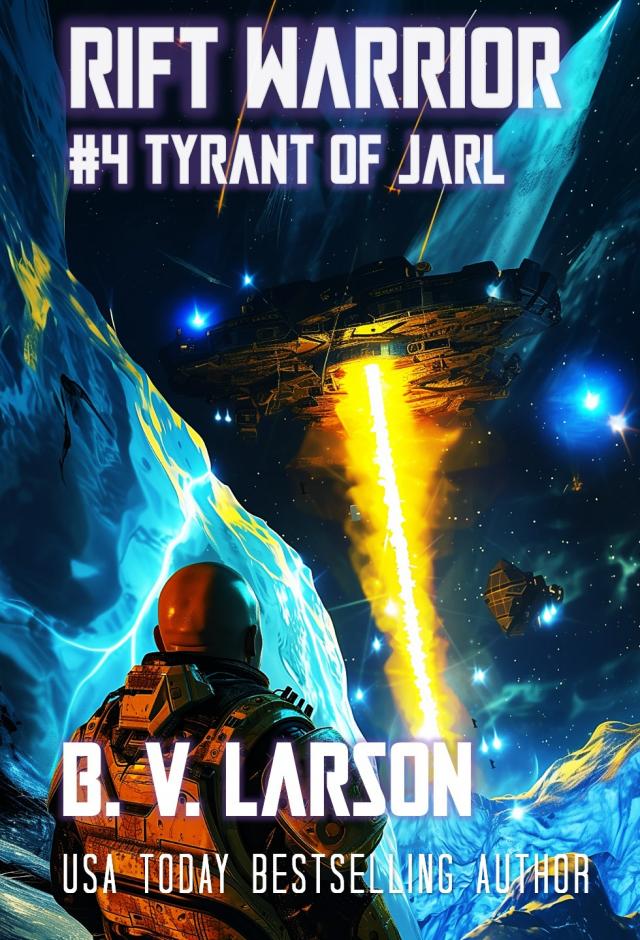
As the daylight strengthened, something caught my eye in the sky above—a massive shape hung in low orbit, partially obscured by high-altitude cloud cover. The colony ship. Even from this distance, its scale was impressive. The vessel resembled a series of connected blocks and disks, industrial rather than elegant, designed for function over form. Occasional flashes of light suggested active systems and ongoing operations.
Seeing no easy way to sneak into the town, I finally dared the road again. The road widened as it approached the settlement’s main gate—a reinforced affair of timber and salvaged metal that looked capable of withstanding significant force. Two guard towers flanked the entrance, each manned by figures I assumed were more of the Tyrant’s enforcers.
I slowed the walker to a casual pace as we approached. The machine seemed to understand the need for caution, its head swiveling slightly as its camera eyes assessed potential threats. The bond between rider and mount was growing stronger—it appeared the walkers were designed to form adaptive relationships with their primary users.
“Halt!” someone called from the left guard tower when we were fifty yards from the gate. “Identify yourself!”
I raised a hand in greeting, adopting a casual posture while keeping the enforcer’s stolen sidearm concealed within my jacket. “Name’s Malcolm,” I called back, using a false identity. “Trader from the eastern settlements.”
The guards conferred briefly, then one called down, “No scheduled traders today. And that’s an enforcer walker you’re riding.”
“Found it abandoned on the north road,” I replied smoothly. “Looks like there was some trouble up there—signs of a firefight. Figured I’d bring it in, see if there was a reward.”
The guards exchanged glances. One disappeared from view, presumably to consult with someone of higher authority. The remaining guard kept his weapon trained in my general direction—not directly threatening but prepared to respond if needed.
“We lost contact with a patrol last night,” he said after a moment. “You see any bodies up there?”
I shook my head. “Just the walker, damaged but operational. Thought someone might want it back.”
The second guard returned, accompanied by an older woman with the bearing of someone accustomed to giving orders. She wore the same uniform as the enforcers I’d encountered, but with additional insignia suggesting higher rank.
“Open the gate,” she instructed after studying me briefly. “But keep him covered.”
The massive gates parted with a groan of timber and metal. I guided the walker forward at a respectful pace, maintaining the appearance of a helpful traveler rather than a potential threat.
The interior of Northaven revealed itself gradually—a utilitarian settlement built for survival rather than comfort. The buildings were all prefabricated colony units and structures but made from local materials. Streets followed a grid pattern, muddy from foot traffic despite the frozen ground. People moved purposefully between buildings, most dressed in layers of leather and fur similar to what Kelda had worn.
The enforcer captain—that seemed to be her rank—waited just inside the gate, flanked by four of her men. All carried weapons, though none were currently aimed at me.
“Dismount,” she ordered as I approached.
I complied, patting the walker’s neck before stepping down. The machine remained still, its systems humming softly.
“Interesting that you’d happen to come along and find one of our walkers just as we lost contact with a patrol,” the captain said, her tone conversational but her eyes hard. “Even more interesting that it responds to you. These machines are typically loyal to their assigned riders.”
I shrugged. “Maybe it was grateful to be found. It’s damaged—looks to have taken a shot to the neck housing.”
The captain circled the walker, examining the damage. “Indeed it has.” She turned her attention back to me. “You said you’re a trader. From the eastern settlements?”
“That’s right.”
“Strange. We haven’t had traders from the east in months. The mountain passes are closed this time of year.”