Tyrant of jarl rift warr.., p.8
Tyrant of Jarl (Rift Warrior Book 4),
p.8


As they moved away, the merchant watched them go, stress evident in her posture. When they were out of earshot, she quickly grabbed my bundle and shoved it at me, taking me by the arm and ushering me out of her stall.
“Keep your head down,” she advised. “Don’t look up too long.”
“At what?”
Her eyes flicked skyward momentarily, then back down. “Just don’t.”
I changed into my new clothes in a public restroom facility near the marketplace—a rudimentary structure but one that offered privacy. The proper winter gear made an immediate difference, the thermal layers providing insulation against Jarl’s biting cold. The boots fit perfectly, offering traction on the icy ground that the stolen footwear had lacked.
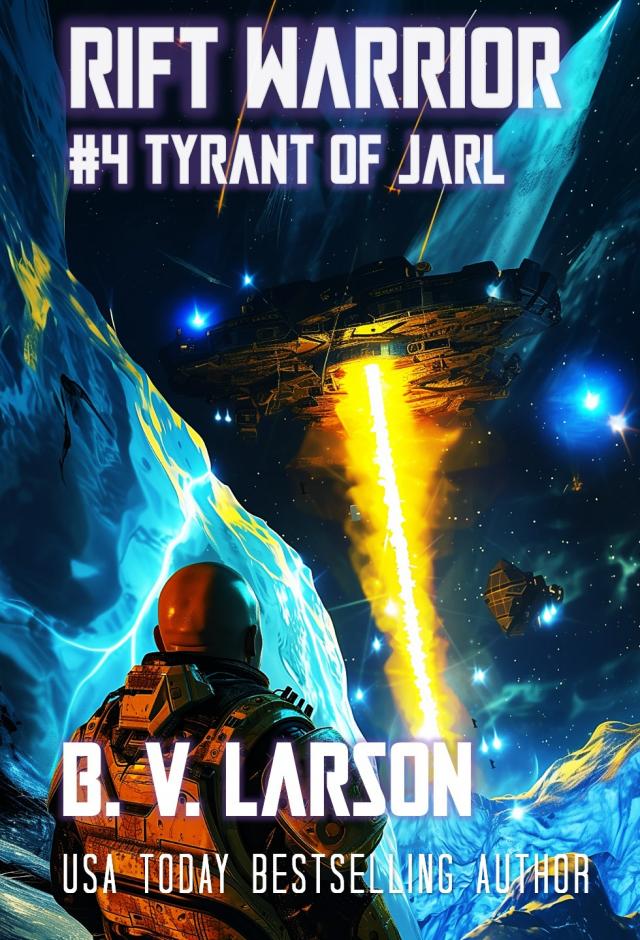
When I emerged, I caught sight of the colony ship again, now fully visible in the clear sky. The massive vessel hung in stationary orbit, close enough that details of its structure were discernible without magnification. Solar arrays extended like wings from the central habitation modules. Occasional flashes suggested active systems and possibly shuttle traffic.
“Don’t stare,” someone said under their breath.
I turned to find a young man watching me with concerned eyes. He couldn’t have been more than twenty, dressed in the drab clothing of a service worker.
“Why not?” I asked.
“Extended observation of the administrative vessel is a category two violation,” he recited, as if from memory. “The Tyrant doesn’t like to be examined.”
“Does the Tyrant have a name?”
The young man’s face paled. “That’s a category one violation!” he whispered. “Never ask about the Tyrant’s identity!” He hurried away, shaking his head, before I could respond.
These interactions reinforced Bergen’s warning about monitoring. The level of fear the locals were exhibiting suggested surveillance beyond what should be technically possible in a frontier colony. Something more was happening, here…
By midday, I arrived at Administration, as instructed by the enforcers. The building stood apart from the others. It was clearly a prefabricated structure from the colony ship rather than locally constructed. It radiated an aura of authority simply by existing, its clean lines and technological sophistication contrasting sharply with the rustic surroundings.
Inside, I found a reception area staffed by a severe-looking woman behind a transparent barrier. She acknowledged me with a curt nod.
“Name and purpose?”
“Malcolm,” I replied, maintaining my cover identity. “Here for registration as instructed by enforcement patrol.”
She typed something into a terminal. “Place your hand on the scanner.”
A rectangular panel on the counter glowed blue. I hesitated, aware that biometric identification would raise immediate flags if cross-referenced with Earth databases. But refusing would also create suspicion.
I placed my hand on the scanner, gambling that the colony’s systems might be isolated from Earth’s central records as a security measure. The panel hummed softly, light pulsing beneath my palm.
“Irregular pattern,” the receptionist noted, frowning at her display. “Scarring on the dermal layer.”
“Old injury,” I explained. “Mining accident in the eastern settlements.”
She seemed unsatisfied but continued the process. “Retinal scan next.”
This presented an even greater risk, but again, refusal would only draw attention. I leaned forward into the indicated aperture, keeping my expression neutral as light played across my retinas.
“Processing,” the receptionist announced. After a moment, her terminal chimed. “No match found in colony records.”
“That’s right. Working in the mines outside the eastern colony settlements, we were hired on documents alone and not required to be entered into the system. As I explained to the enforcers, I lost my documentation crossing the eastern range.”
“So, you’re telling me you never visited any of the primary settlements until now?”
“I prefer my own company and never had any reason to register as a proper colony member—I just didn’t care to hang around towns much. After a bad split with my girl, I needed a change of scenery, so I travelled here to explore and look for a new start. “
She studied me for a moment with open suspicion. “Wait here.”
While she disappeared through a door behind the counter, I took the opportunity to inspect the administration building’s interior. Unlike most structures in Northaven, this one featured active technology—computer terminals, communication equipment, environmental controls. Power seemed abundant here, contrasting with the resource scarcity evident throughout the rest of the settlement.
After several minutes, the receptionist returned, accompanied by an older man wearing what appeared to be a modified colonial administrator’s uniform. His bearing suggested military background, his expression one of practiced neutrality.
“I’m Administrator Voss,” he stated without preamble. “You claim to be from the eastern settlements but have no documentation and no record in our systems.”
“That’s correct.”
Voss studied me with calculating eyes. “How did you reach Northaven?”
“On foot, initially. Then I found an abandoned walker on the north road.”
“The walker registered to Enforcer Toric, who is now missing along with his entire patrol?”
I maintained a neutral expression. “As I told Captain Jern, I found the walker damaged but operational. Thought there might be a reward for returning it.”
Voss clasped his hands behind his back, a military posture if I’d ever seen one. “Where exactly were you born, Malcolm? Which settlement?”
A trap—he was fishing for inconsistencies. “Does it matter? I’m here now, looking for work, willing to contribute to the colony.”
“It matters,” Voss replied coldly, “because we have no knowledge of unrecorded births in the eastern settlements. If your statements are true, there could be a cabal of criminals out there…”
I’d been caught in a lie. I shifted strategies. “Perhaps someone made a mistake. I’ve been traveling for some time.”
“Or perhaps you’re not who you claim to be,” Voss countered. “Perhaps you’re a dissident from one of the outlying camps. Or worse, an infiltrator sent by Earth to undermine our leader’s authority.”
He pointed with a single stern finger at the sky.
“I’m just looking for work and a place to stay,” I maintained.
Voss considered me for a long moment. “You will report for your labor assignment tomorrow at dawn. Until your status is clarified, you’ll be restricted to essential work details. Category C housing will be assigned. Your movements within the settlement will be monitored.” His tone left no room for negotiation. “Understood?”
“Perfectly.”
“Wrist,” he demanded, producing what looked like a metallic bracelet.
I extended my arm, allowing him to snap the device around my wrist. It locked with a final-sounding click.
“Tracking and identification,” Voss explained. “Removal is a category six violation. Attempts to tamper with it will result in immediate detention.”
“Anything else I should know?”
Voss’ expression hardened further. “The Tyrant maintains order through obedience. Learn the categories of violation and avoid them. Ignorance is not an excuse.”
With that, I was dismissed. Before I left, the receptionist provided a crude map with my assigned housing unit circled and my labor assignment documented.
According to the paperwork, I’d be joining a maintenance crew responsible for settlement infrastructure—repairing buildings, clearing snow, and maintaining the primitive sewage system.
As I exited the administration building, I noticed increased enforcer presence in the marketplace. Several watched me openly, tracking my movements. The bracelet on my wrist felt heavier than its actual weight, a constant reminder of my monitored status.
“Nice accessory,” a feminine voice commented as I studied my map.
I looked up to find a woman observing me with amused interest. She appeared to be in her early thirties, with striking features—high cheekbones, copper-colored hair tied back in a practical braid, eyes that seemed to shift between green and gold depending on the light. Her clothing suggested a position of some authority—better quality than most, with insignia I didn’t recognize.
Her most captivating feature was her prominent bustline, which she’d made an effort to reveal with a plunging neckline. If this gap in her clothing left her cold, she gave no outward sign of it.
“Eyes up here, Malcolm.”
“Yes, ma’am.”
She stepped closer, examining my wrist bracelet without touching it. “C-class. Manual labor? Voss must not like you.”
“We didn’t exactly hit it off.”
She gave me a subtle smile. “Few do. I’m Livy. Environmental Systems.”
“Malcolm,” I offered, maintaining my cover.
Her gaze was appraising, taking in my new clothing and general bearing. “You don’t look like a manual laborer.”
“What do I look like?”
“Trouble,” she replied frankly. “The interesting kind.” Livy glanced around, noting the watching enforcers. “Word of advice, Malcolm-from-nowhere—don’t ask questions about the ship.”
“So I’ve been told. Repeatedly.”
“And yet you keep looking up.” She tapped the side of her head meaningfully. “Some things don’t need to be spoken to be heard. Understand?”
Before I could respond, Livy continued in a normal tone, “Environmental Systems inspection tomorrow at the southern quadrant. We’ll need maintenance support for panel access.” She handed me a data chip. “Coordinates and time. Don’t be late.”
As she walked away, I examined the chip. It appeared to be standard colony issue, containing work orders and scheduling information. Nothing suspicious on the surface. Yet something in her manner suggested there was more to the interaction than a simple work assignment.
Further exploration of the settlement reinforced my initial observations. Northaven operated under a cloud of fear and suspicion. Conversations in public spaces remained muted and superficial. Enforcers maintained a visible presence throughout, their walkers giving them both mobility and psychological advantage over the populace. Periodically, announcements echoed from speakers mounted on key buildings—reminders of regulations, work assignments, and warnings about unspecified “disruptive elements.”
I found my assigned housing unit—a prefabricated module on the settlement’s southern edge, designed to accommodate four occupants in spartan conditions. My roommates consisted of a taciturn miner who offered only a grunt by way of greeting, an elderly maintenance worker who eyed me suspiciously before returning to his bunk, and an empty bed that, according to the others, had belonged to someone who “asked too many questions.”
“What happened to him?” I inquired.
The old maintenance worker shook his head. “That’s a question.”
“Yeah… but… I think I deserve to know.”
He frowned at me like I didn’t get it. “Category two violation,” he whispered.
I gave him a blank look.
The old guy looked exasperated. “He questioned why the ship always stayed in orbit!”
“All right, bad topic. Where did he go?”
“Enforcers came that night. He was taken for reorientation. Never returned.”
“The ship should have landed,” I stated, testing their reaction. “Colony vessels are designed to be dismantled for initial habitat construction.”
Both men stared at me in horror. The miner actually covered his ears.
“Are you trying to get us all detained?” the older man hissed. “Never say that! Never even think it!”
“The Tyrant is always listening,” the miner added, looking at his boots.
I backed off, not wanting to traumatize them further. But their reaction confirmed what I’d begun to suspect—the colony ship’s continued orbital presence represented a fundamental deviation from standard colonization protocol. The vessel should indeed have landed shortly after arrival, its structure forming the foundation of the colony’s infrastructure. That it remained in orbit suggested either technical limitations or, more likely, a deliberate choice by the self-proclaimed Tyrant.
Later that evening, I made my way back to Bergen’s tavern, hoping to gather more information in the relatively social atmosphere. The tracking bracelet drew notice from the proprietor, who raised an eyebrow but made no comment as he served me a meal.
The tavern was more crowded than the previous night, and conversations flowed more freely as Jarl whiskey loosened tongues. I maintained a low profile, nursing a single drink while observing the interactions around me.
“You’ve made an impression,” a young woman observed as she slid onto the bench across from me. She was younger than Livy, perhaps mid-twenties, with the sturdy build of someone accustomed to physical labor. Her dark hair was cropped short in a practical style, her eyes a deep brown that studied me with undisguised interest.
“Not intentionally,” I replied.
“That bracelet says otherwise.” She nodded toward my wrist. “I’m Taryn. Agricultural division.”
“Malcolm. Maintenance, apparently.”
She smiled, a genuine expression that transformed her serious features. “You don’t seem very certain about that.”
“New assignment. Still finding my footing.”
Taryn leaned forward, lowering her voice. “Word travels fast in Northaven. They say you killed a frost-fang single-handed. And that you took on the Halverson brothers and possibly an enforcer patrol—by yourself.”
“People like making up stories.”
“Not usually,” she countered. “That’s what makes you interesting.” Her eyes tracked to the ironwood axe leaning against the table beside me. “That’s Erik Halverson’s axe. His father made it for him.”
“He attacked me… and I believe he mentioned something similar before I took the axe from him.”
Taryn’s eyebrows rose. “Erik’s a dangerous man to cross. The Halversons have connections with enforcement.”
“I’ll keep that in mind.”
She studied me openly, curiosity evident in her expression. “You’re different. You don’t act like you’re afraid of your own shadow.”
“Should I be?”
“Everyone in this town is,” she replied simply. “That’s how things work here.” Taryn glanced toward the ceiling, then back to me. “The Tyrant sees everything. Knows everything.”
“I’ve heard that.”
“But you don’t believe it?”
I shrugged. “Seems like a lot of work, monitoring an entire settlement.”
Taryn leaned closer still. “Not if you have the right technology. Not if you’ve modified the colony’s systems for surveillance rather than support.”
The conversation was venturing into dangerous territory, so I became suspicious. “Why are you talking to me? Everyone else seems determined to avoid the newcomer.”
A smile played at her lips. “Maybe I like interesting men. Maybe I’m curious about someone who doesn’t cower at the mention of the Tyrant.” She reached across the table, her fingers brushing mine. “Or maybe I just think you’re attractive.”
The flirtation seemed genuine, but I remained cautious. In environments of oppression, intimate connections often concealed ulterior motives—information gathering, entrapment, survival alliances…
“I appreciate the compliment,” I said, not withdrawing my hand. “Although it might be safer for you to admire from a distance.”
“I’m not concerned with safety,” Taryn countered. “Not anymore.” She stood, her hand lingering on mine. “I live above the grain storage facility. Eastern quadrant. If you’re interested in continuing this conversation somewhere more private.”
As she walked away, I noticed several patrons watching the interaction with expressions ranging from surprise to disapproval. Bergen, wiping down the bar, caught my eye and gave an almost imperceptible shake of his head. Was that a warning? Or just social disapproval? Was Taryn the town tart? I wasn’t sure.
Later, as I prepared to leave, Bergen approached my table.
“Word of advice,” he said quietly while collecting empty mugs. “Be careful with Taryn. She’s been through three partners in the past year. All of them began to openly question our benevolent leader—and then disappeared.”
Huh, I thought. So she was both the town tart—and dangerous.
“You think she’s working for the Tyrant?”
Bergen’s expression tightened at the direct reference. “I think survival on Jarl requires caution. Especially for newcomers who draw attention.” He straightened. “Labor assignments start early. Best get some rest.”
Outside, the night had deepened. The temperature dropping further than I expected, with a chill wind coming down from the slopes to the north. The tracking bracelet felt like ice against my skin as I made my way back toward my assigned housing unit.
Above the town, the colony ship was now invisible, hidden by clouds or perhaps a shift in its orbit. Yet its presence remained felt—a looming authority governing every aspect of life in Northaven.
Standard colonization protocol dictated that ships be landed and repurposed. The continued orbital presence represented a fundamental deviation that enabled the Tyrant’s control. Without access to the ship’s technology and resources, the colonists remained dependent and vulnerable.
My first mission, finding Ingrid, now felt more urgent. If anyone could help me understand the true nature of the situation, it would be XCU’s psionic agent.
But first, I needed to establish myself, build connections, and gather information without triggering the surveillance systems that seemed to permeate the settlement.
Tomorrow would bring my new labor assignment and perhaps the opportunity to learn more about Northaven’s infrastructure. The data chip from Livy might provide additional insights. And despite Bergen’s warning, Taryn’s invitation remained an intriguing possibility—risk balanced against potential reward.