

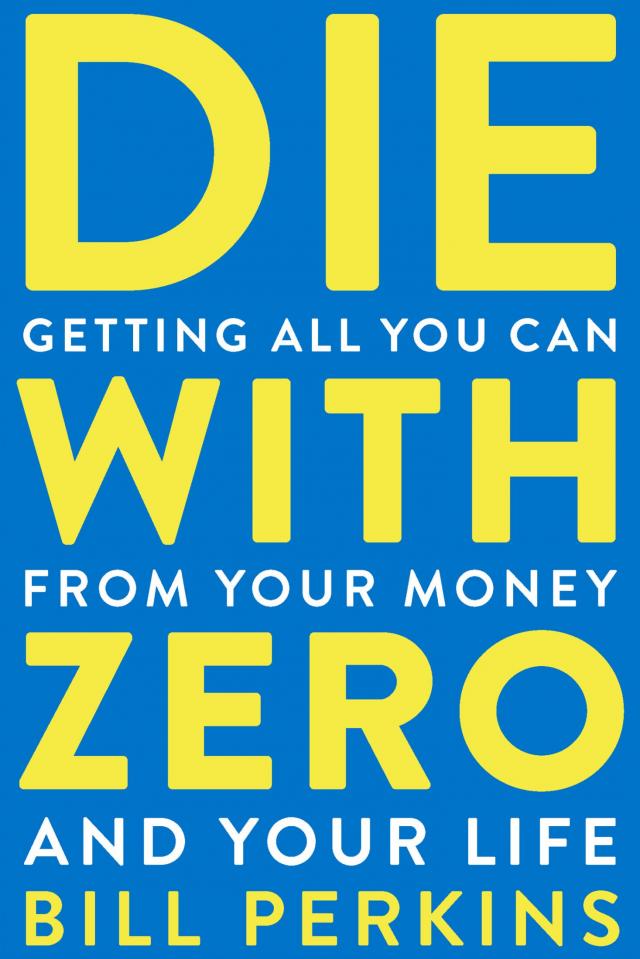
Die with zero, p.15
Die with Zero,
p.15


To understand why you should think in terms of a date, not a number, you need to recall that enjoying experiences requires a combination of money, free time, and health. You need all three—money alone is never enough. And for most people, accumulating more money takes time. So by working more years to build up more savings than you actually need, you are getting more of something (money), but you are losing even more of something at least as valuable (free time and health). Here’s the bottom line: More money doesn’t equal more experience points.
Most people forget those costs of acquiring more money, so they focus mainly on the gains. So, for example, $2.5 million does buy you a better quality of life than $2 million, all other things being equal—but all other things are usually not equal! That’s because for every additional day you spend working, you sacrifice an equivalent amount of free time, and during that time your health gradually declines, too. If you wait five years to stop saving, your overall health declines by five years, closing the window on certain experiences altogether. In sum, from my perspective, the years you spend earning that extra $500,000 do not make up for (let alone surpass) the number of experience points you lost by working for more money instead of enjoying those five years of free time.
Declining Utility of Money with Age
Your ability to enjoy experiences depends on both your economic ability (the wealth curve shown here) and your physical ability (the health curve). Continuing to build wealth doesn’t necessarily buy you more experiences, because your declining health limits your enjoyment of certain experiences no matter how much money you have.
So, beyond a certain minimum financial survival amount, do not think in terms of a dollar amount. Think of your net worth peak as a date instead.
Of course, some people already think about when to stop growing their savings in terms of a date. The most obvious dates are age 62 (the earliest date you can choose to start collecting Social Security benefits) and age 65 (when you become eligible for Medicare). And, depending on when you were born, you can start receiving your full Social Security benefits somewhere between 66 and 67. Increasingly, given rising life expectancies, retirement experts recommend that middle-income retirees wait until they’re 70 to claim Social Security benefits, at which point they can receive more than 100 percent of their full benefits. Now, the date you start collecting benefits and the date you retire don’t have to coincide—but Social Security and Medicare dates do seem to have an effect on people’s choice of retirement age, particularly because Social Security benefits make up a big chunk of most people’s retirement income. The benefits don’t tell the full story, though: Almost two-thirds of American workers say they plan to work past 65, according to 2016 research by the Pew Charitable Trusts. That is people’s projected retirement age, not their actual retirement age.
The actual retirement age is often lower, because people sometimes retire before they planned to—usually because of unexpected job loss or illness. Such involuntary retirement is not an insignificant consideration, since it appears to affect more than half of all retirees in recent years: According to a study of nearly 14,000 newly retired workers, 39 percent who retired in 2014 were forced to quit, and another 16 percent were “partially forced.” These numbers, if correct, show that many more Americans retire involuntarily than the official retirement statistics show. Age discrimination against older workers, combined with the stigma of involuntary job loss, apparently causes some workers to say they’ve retired when in fact they were merely forced out of their jobs and couldn’t find another. Whatever the reason, the most common retirement age in the United States is actually 62, as is the median—again, the age at which Americans can start collecting Social Security benefits.
So when should you actually plan to crack open your nest egg? Put another way, if your net worth peak is a date, what is that all-important date? Well, it’s tied to your biological age, which is just a measure of your overall health. If you take two 50-year-olds (that’s their chronological age), one might have the biological age of a 40-year-old while the other has the biological age of a 65-year-old. The first, “younger” 50-year-old (let’s call her Anne) not only will go on to live longer than the “older,” less healthy 50-year-old (Betty) but will also be able to enjoy both physical and mental activities until an older age. With more good years ahead in which to enjoy experiences, Anne should be aiming for a later peak than Betty—which means that Anne will need to keep adding to her savings longer than Betty does before she can start spending down her net worth on the way to zero.
In researching this topic, my colleagues and I have now run the earning and spending simulations for dozens of hypothetical people like Anne and Betty, incorporating different scenarios about one’s health, earning growth, and interest rates. Depending on all these factors, we see different net worth curves. As a result, we’ve generated lots of different net worth curves—each one optimal for a given person. In each optimal curve, the person ends up dying with exactly zero, and, because of that, each ends up with a net worth peak sometime before their death date. Here’s what we see: For most people, the optimal net worth peak occurs at some point between the ages of 45 and 60.
Accumulation of Net Worth
Traditionally, people continue to increase their net worth until they stop working, and are afraid to dip much into their principal even after retirement. But to make the most of your hard-earned money, you must crack open your nest egg earlier (starting to spend down your savings sometime between 45 and 60 for most people) so that you end, theoretically, with zero.
Let’s look at that more closely. First, let me make clear that 45 through 60 are chronological ages. As noted with the example of Anne and Betty, if a person’s health is excellent (so their biological age is lower than their chronological age), the peak is on the higher end of that range. For the ultra-healthy, the real outliers, the peak might be even higher than 60. And, obviously, if someone has an illness that portends early death, then their peak occurs before age 45. But in general, most people hit their peak between the ages of 45 and 60. That’s what our simulations show: For most people, waiting until they are past this age range causes suboptimal fulfillment results, because they end up dying with more than zero, running out of time in which to have many fulfilling experiences.
Clearly, earnings growth also has a big effect on a person’s peak. Someone with rapid earnings growth hits their peak early. At the other end of the earnings spectrum are people who need to keep adding to their savings into their late sixties, perhaps even later, if they are to have any discretionary experiences after retirement. But again, in general, most people hit their peak between 45 and 60.
What does all this mean for you? It means that unless you are an exception, you ought to start spending your wealth down much earlier than what is traditionally recommended. If you wait until you’re 65 or even 62 to dip into your nest egg, you will almost certainly end up working longer than necessary for money you will never get to spend. What a sad thought: to slave away at a job and never get the gold.
Don’t get me wrong: I’m not telling you when you should retire—as I explain in the next section—only when you should start spending more than you earn.
“But I Love My Job!” Part II
When I first talked about dying with zero, I told you about the people who will understandably protest that they enjoy their work—so what’s the harm with money earned from that kind of “work enjoyment” and seeing it going unused in your life? As I already said there, optimization doesn’t care where the money comes from—once you get the money, you owe it to yourself to spend it wisely.
A version of this question comes up when I talk about spending down once you hit your peak: “What, do you really expect me to quit a job I love just because I’ve hit some magical date?” And my answer is no. If you want to keep working, be my guest. Just be sure to ramp up your spending accordingly so that you don’t end up dying with lots of money left over. That would be a waste no matter how much you enjoyed your job.
I know there are a few lucky souls among us who are indeed “living the dream” and they are doing in life what they always dreamed of doing. These are those rare individuals who can’t wait to get to work each day and who feel bad when they have to go home at night. They truly love what they are doing. But again, those individuals are few and far between. You may be one of them. But if you’re not one of the lucky ones—if you’re more in love with the paycheck you bring home than with the daily experiences of being in your office—then the time has come to do a real gut check on your life and to determine what you really want to get out of it.
Our culture’s focus on work is like a seductive drug. It takes all of your yearning for discovery and wonder and experiences, promising to give you the means (money) to get all those things—but the focus on the work and the money becomes so single-minded and automatic that you forget what you were yearning for in the first place. The poison becomes the medicine—that’s nuts!
Look, if all you want is to have a pile of money at the end, well, I guess that’s your choice. But bear in mind that I have never seen somebody’s total net worth posted on their tombstone. Wouldn’t you rather try and figure out what unique experiences you’d like to have for your own, as personal keepsakes for down the road—not only for you but for your family and loved ones? This is precisely why I decided to splurge for that big 45th birthday party.
I have had this conversation with my friend Andy Schwartz. Andy’s a successful entrepreneur in the adhesives business—glue. He’s in his mid-fifties, married with three children in their twenties and teens, and has no plans to retire even though he could. He’s got lots of reasons: The work continues to challenge and engage him intellectually, he loves spending time with others in his industry, and he feels responsible for the financial well-being of his employees. “If I didn’t like it, if I felt like it was a chore, I would sell it and get out,” he says.
So Andy is not somebody who’s working simply because he’s afraid he won’t have enough to retire on. He loves the business, and he enjoys growing it—the business itself is a rich source of life experiences for him.
If you ask him why he likes growing his wealth, given that he is already wealthy, he’ll mention his grandchildren, for whom he wants to provide a cushion, and charities to which he’d like to give money, such as his high school and college.
“Fine,” I say. “I’m glad you’re content. So continue working and earning more money—but be sure to spend it now! If you want to give money to your high school or college, do it now. If you want to give money to your children and future grandchildren, start to do it now. (For children who are currently too young, set up a trust.) As for the rest, spend it on making the best life you possibly can for yourself.”
When I tell Andy this, he says his tastes aren’t expensive. He claims he leads a fairly quiet and modest lifestyle. To that I say, “How do you know what your tastes are if you really haven’t done much except work and raise kids?” The truth is, Andy’s business has been such a big part of his life and demanded so much of his attention that he is just not in the frame of mind to think about unique, novel, or stimulating ways to spend his money.
But if someone challenged him to spend, say, $300,000 on activities that are totally not work-related but actually fun-related, he’d be forced to think differently—and he would definitely discover new activities and pursuits he would love. And I’m not talking about spending money just for the sake of spending the money, either, but to become the fullest and most fulfilled version of Andy that he could be.
For starters, he and his wife could put their heads together and list their three favorite musical groups. Why not fly out to see them in some destination locale for a weekend? Or he could join TED as a patron member, which costs several hundred thousand dollars and gives you special access to the main TED conference, where he could meet living intellectual legends in many fields. After one trip to TED and talking to these amazing people, he could find 13 different purposes and directions he could go in!
Trust me—it’s really not that hard to spend a lot of money doing things you love. But you do have to take some time to first consciously figure out what those appealing expenditures are for you. Using himself as an example of this idea, the behavioral economist Meir Statman has said that he finds travel by business class worth every penny—but doesn’t feel that way about fine dining at all. “I can afford a $300 meal, but it makes me feel stupid—like the chef is in the back laughing uproariously.” The point is that what you spend money on is up to you. Isn’t it worth your while to think about what you value and put your money behind that?
So if you aren’t ready to quit your job but want to make the most of your money before you die, start spending more than you have been!
Another strategy for squeezing the most experiences out of your early golden years without quitting your job is to cut back on your work hours if you can. If you’re lucky enough to be working for an employer that offers a formal “phased retirement” program, definitely look into it. Unfortunately, only about 5 percent of all employers offer such programs, according to a 2017 report by the U.S. Government Accountability Office. However, the percentages are higher in some industries, such as education and high tech. The good news is that many more employers have informal programs, with managers offering phased retirement to high performers and employees with in-demand skills. It makes sense: The more valuable you are to your current employer, the more likely it is that they’ll be willing to work with you on your terms.
In short, be careful not to be constantly seduced by money. Sure, it’s nice to feel appreciated and to be paid well, and employers who value you might tempt you to work longer hours than would be optimal for you. It’s easy to succumb to such temptation: After all, if you are 55 and a valued worker, chances are you’re earning more per hour than you’ve ever earned before. But remember that your goal isn’t to maximize wealth but rather to maximize your life experiences. That’s a big turnabout for most people.
The Challenge of Decumulation
Once you’ve finally determined your net worth peak, you must start spending down, or decumulating. This means you will be spending more in your real golden years, when you are in reasonably good shape in both health and wealth—between 45 and 60—than people usually do, because most people who save money for the future save for too late in life.
Spending Over Lifetime
Whether you are spending optimally or spending the way most people spend, your spending in old age is lower than in the middle years, because older people usually don't have the health needed to spend as much on experiences. As a result, unless you spend significantly more in your middle years than most people do, you will fail to die with zero.
Now think back to the concept of time buckets. When I first introduced that tool, I urged you to set aside any concerns about money so that you could see that most experiences naturally fall on a bell-shaped curve that leans a little to the left, your younger years. But what happens when you do begin to put price tags on the experiences you want to have? At that point, the curve will right itself a little, because as your health starts its natural decline, your wealth tends to increase, which means you have more discretionary income for higher-quality experiences. For example, if you enjoy both movies and live theater, you can do either at just about any age, which means you can happily spread them out throughout your life. But once you start thinking about money, you can no longer ignore the fact that theater tickets usually cost a whole lot more than movie tickets, which means that, to get the most enjoyment, you’ll want to shift some of the experiences of live theater to the right, when you’re older and wealthier. But you don’t want to shift them too far to the right, to the point where you’ll be too old to hear the actors or to stand in line for the restroom; at that point in your life, you’d just as soon stay home watching Jeopardy or reruns of The Golden Girls.
There’s another conclusion you’ll probably reach when you start putting price tags on these experiences: The amount of money you’ll need in retirement is often a lot lower than what you’ve been advised to save. For example, if you’ve been told that during each year of retirement you will need 80 percent or more of your annual pre-retirement income, you will probably discover, after looking at the activities you’ve bucketed for your seventies, eighties, and beyond, that these really don’t cost that much—far less than 80 percent of your previous spending. (Recall the research on the no-go years from chapter 3.) It’s true that some physically undemanding activities—like attending the opera—can be pricey, but you probably don’t even want to go to the opera 70 times within a period of just five years. At a certain point in life, you simply won’t be able to consume above a certain amount of savings—so don’t save too much, and instead plan to enjoy spending that money sooner.
But even when you include money as a consideration, the curve won’t skew right—you will find that the vast majority of the experiences you want to have will have to happen within about 20 years of midlife, in either direction—in other words, roughly between 20 and 60. People so often talk about saving for retirement. But there are far fewer conversations about saving for excellent and memorable life experiences that need to happen much sooner than the typical retirement age. If you look at the activities that are advertised in retirement commercials—a couple holding hands while strolling on a beautiful beach, a man holding a youngster on his shoulders—you’ll find that you actually want to do most of those things before you’re retired.


