

Die with zero, p.16
Die with Zero,
p.16
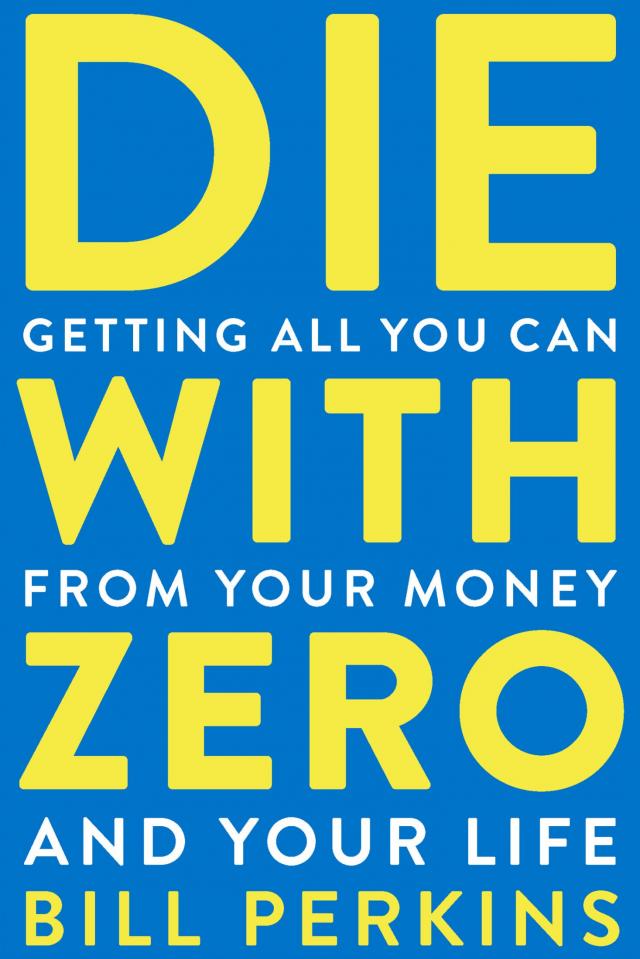


Am I telling you to blow all your money before 60? No. You’ll definitely need income when you’re older, too—so while you’re still working to earn money, you’d better save for that time in your life when you’ll no longer be working. Just realize that time moves in only one direction, and that as it passes it sweeps away opportunities for certain experiences forever. If you keep that in mind as you plan your future, you’ll be more likely to make the best use of every year of time in your life.
Knowing that you have enough money to last you the rest of your life (by doing some survival calculations) should give you the peace of mind to start spending more aggressively now. But even so, the psychological shift from savings mode to spending mode won’t be easy. Changing one’s deeply entrenched habits never is: If you’ve spent all your life as a good, solid, and committed saver, it’s hard to suddenly shift gears and start doing just the opposite. For people used to accumulating wealth, decumulation doesn’t come naturally. Old habits die hard.
But doing this is absolutely essential if you are going to make the most of your life energy. Remind yourself that you can’t take your money with you—every dollar you don’t spend at the right time will have far less value to you later, and in some cases it will bring you no enjoyment at all.
Remember, too, to invest in your health, even if you haven’t done much of that in the past. As I explained earlier, your health massively changes your ability to enjoy all kinds of experiences. So it’s well worth your while to spend time and money improving or at least maintaining your health, whether by joining a ritzy gym (the kind you actually look forward to visiting), hiring a personal trainer, or following along with fitness videos.
One of my sisters, Tia, has really taken this advice to heart. At 57, she still works in her family’s business, but she redesigned the way she does her job so she no longer sits in a chair for nine or ten hours a day like she used to. She understands that everyone’s muscles atrophy with age, and she’s slowing down the rate of that decline by doing resistance training several times a week. She also regularly swims and takes a spin class. She’s on it! Tia’s not going to run a marathon anytime soon—but through these investments in her health, she’s actively changing her current and future experience of life.
Re-Bucket Your Life
As you go through life, your interests change and new people enter your life, so it’s a good idea to repeat the time-bucketing exercise every now and then, such as every five or ten years.
One of the most important times to re-bucket your life is when you’re nearing your net worth peak. Many people at midlife have forgotten what used to bring them fulfillment and have been too busy taking care of careers and children to explore new interests, either. As a result, many people enter retirement with only a vague idea of what they’ll do with all that free time. Or they have some specific ideas—typically trips they want to take—but only for the first year or two. So after a while, they tend to find themselves adrift, feeling aimless and maybe even itching to go back to work, the one place they know they’ll have a built-in sense of purpose, belonging, and accomplishment. In the worst cases, this sense of aimlessness can even lead to anxiety and depression.
So before you quit or scale back your job, really think through what you want to do once your work won’t be taking up much of your everyday time. Is there a long-dormant hobby you want to pick up again? A particular friendship you want to rekindle? A new skill you want to learn, or a club you want to join? What adventures do you really want to have—and when do you want to have them? Put those in the appropriate buckets and start making new memories.
Recommendations
Calculate your annual survival cost based on where you plan to live in retirement.
Consult your doctor to get a read on your biological age and mortality; get all the objective tests you can afford that give you the status of your current health and eventual decline.
Given your own health and history, think about when your enjoyment of those activities is likely to start declining in a noticeable way on an annual basis—and how the activities you love will be affected by this decline.
9
Be Bold—Not Foolish
Rule No. 9:
Take your biggest risks when you have little to lose.
Mark Cuban, the owner of the Dallas Mavericks and one of the investor “sharks” on Shark Tank, learned entrepreneurship at a young age. At 12, he was selling trash bags to his neighbors. At 16, he was buying stamps and then reselling them for profit. Growing up in a working-class family in Pittsburgh, he remembers his mom urging him to learn a trade, like laying carpet. Instead, Cuban went to study business management in college, which he paid for by giving disco dance lessons and eventually buying and running a campus pub. As it turned out, police went on to shut down the pub for underage drinking, and when Cuban graduated, he was still broke—but he now had the skills and confidence to make it in business. So after a short stint working for a bank in his hometown, the 23-year-old Cuban packed his meager belongings into an old Fiat and drove to Dallas, joining a friend from college who’d sung the city’s praises. There, the two shared an apartment with four other guys, where Cuban’s bed was a sleeping bag on a beer-stained carpet in the living room. But he kept hustling. He got a job as a bartender, and another as a salesman in a software store.
And when he got fired for defying the boss at the store, he hatched plans for his own company—a computer consulting business called MicroSolutions. A few years later, when he was 32, he sold that company for $6 million and retired for five years.
Bet When You Have Nothing (or Little) to Lose
Eventually, Cuban came out of his early retirement and started the business that made him a multi-billionaire—but that’s really beside the point here. What’s most interesting to me about Mark Cuban’s experience is that none of the bold moves that led to this success felt risky to him—not the move to Dallas or the jobs he took there, not defying his boss, and not the business he started after getting fired. “I had nothing,” he recalled. “So I had nothing to lose, right? It was all about going for it.”
What Cuban is saying is that he was facing a situation of asymmetric risk: when the upside of possible success is much greater than the downside of possible failure. When you face asymmetric risk, it makes total sense to be bold, to grab the opportunity at hand. At the extreme, when the downside is very low (or nonexistent, as in the “nothing to lose” case) and the upside is really high, it’s actually riskier not to make the bold move. The downside of not even taking a chance is emotional: potentially a lifetime of regret and wondering What if? The upside of taking a chance always includes emotional benefits—even if things don’t work out. There’s a great sense of pride at having pursued an important goal wholeheartedly. If you’ve given something your all, you’ll get a lot of positive memories out of the experience no matter what happens. That’s just another form of the memory dividend I talked about earlier: When you look back from any point during your life, you will remember your actions in a positive light. In other words, even experiences that don’t end the way you’d hoped can still yield positive memory dividends. So being bold is an investment in your future happiness—and therefore another way to maximize the area under the curve.
Most opportunities don’t present an extreme asymmetry of risk, but if you think them through, you’ll often see that the downside isn’t as high as you might think.
The Younger You Are, the Bolder You Should Be
Bear in mind what I said about investing in experiences, especially when you’re young. The idea is that it’s always good to invest in experiences—but it’s especially good to do it when you’re young. Well, a similar logic applies to being bold: When you’re older, some risks become more foolish than bold.
This is easy to see with physical risks. When I was a kid, I used to jump off the roof of my garage. It was fun, and I never got really hurt. It didn’t even feel like a risk. But I’d be a fool to try jumping off a roof now, with my 50-year-old body: I’m heavier, and my knees aren’t as good at absorbing shocks. So if I did jump, I’d probably end up in the doctor’s office—and even if the injury didn’t cause lasting damage, I would take a long time to recover from it. In other words, I have much more to lose than to gain from a jump like that. So my days of leaping off the top of my garage are behind me.
That happens in a lot of areas, where the balance between risk and reward changes with time—until the window of opportunity is gone forever. When you’re young, every risk you take can pay off in a big way if you succeed: Your upside is huge. At the same time, the downside (in other words, what happens when you take the risk and fail) is low, because you have a lot of time to recover. In poker, for example, you can sometimes buy more chips, or “reload.” Well, when you’re young, you’re at a stage in the game of life when you can reload and reload and reload.
As a result, the long-term impact of any failure ends up being pretty low. When I was 23, I got fired from my job as a junior trader at an investment bank. In that job, I had been in training for the career I wanted, but one day I came in to work tired and was caught resting my head in the booth. Well, that was the end of that job. I was scared and uncertain about what I’d do next, and it was no fun being unemployed for the next month. My unemployment ended when I took a job as a broker—a job that paid well but was not what I really wanted to do, which was trading. Still, I knew I had to do something, and I figured I would see where this broker journey led. I was 23—it was easy to correct course. Even if I hadn’t found the broker job, even if I were an abject failure, I wasn’t going to die, and I wasn’t heading for a soup line.
Notice that I’m not saying that being bold in situations of asymmetric risk always leads to success, the way it did for Mark Cuban. Sometimes things don’t go your way, no matter how hard you try. What I’m saying is that the “loss” is worth it—it was still a good bet because I knew I had little to lose, I had plenty of time to course-correct, and I still acquired some great memories.
Career Choices
Let’s say you want to become an actor, but you know it’s an intensely competitive field: Most people who move to Hollywood never make it and end up waiting tables between auditions. Your alternative to pursuing a career in acting is a safe office job that doesn’t excite you. So should you leave your safe job behind to move to Hollywood? Well, it depends almost entirely on your age—not on what your parents are expecting of you or what your friends think you should do. If you’re in your early twenties, you should go for it! Give it your all, really exhaust yourself trying for what you want. You can give yourself a few years, and if it doesn’t work out, you can still go back to an office job—or to school to learn a trade.
That’s exactly what former actor Jeff Cohen did when his acting career didn’t pan out. If you’ve ever seen The Goonies, the 1985 movie about a group of kids on a quest for lost treasure, you probably remember the character named Chunk, the chubby member of the gang of misfits. Chunk was Cohen’s breakthrough role—until that point, his career had consisted of small parts in TV shows and commercials. After The Goonies, the exuberant, funny Cohen seemed on track for a big career in Hollywood—but new roles failed to materialize. What happened? Puberty had turned him “from Chunk to hunk,” Cohen likes to say with a laugh. Hollywood is full of sad stories of former child actors, but fortunately Cohen’s story isn’t one of them. He went on to college and law school, specialized in entertainment law, and is now a partner in his own firm. So what that his acting career fizzled?
If you’re in your fifties, on the other hand, moving to Hollywood is not a great plan. At that point, chances are you now have people in your life who are truly depending on you, like a spouse and children. If that’s the case, your failure is no longer your own—it affects other people. It’s for the same reason that I stopped riding motorcycles and taking flying lessons once I had kids: In my mind, I no longer had the right to put my life on the line for the sake of those thrills. And so it is with all kinds of risks: The older you get, the more you have to lose. But it’s not just that the stakes are higher. The potential rewards are also lower! So even if you’re a lone wolf, or your kids are grown and flown, the risk/reward balance still isn’t in your favor when you’re older. In the best-case scenario, where things go spectacularly well for you, you’ll have fewer years to enjoy that success. Wouldn’t you rather have taken the big risk earlier in life?
I can’t say it’s foolish for anybody to start pursuing their dreams in their fifties, because everybody’s circumstances are different; and if you missed your chance to do what you wanted when you were younger and you see your upcoming retirement years as your last chance to follow your dreams, I’d say it’s better late than never. But if we could go back in time, I would say: Don’t wait. Do the bold thing now, rather than in retirement, because the go-go years are very short. In general, this whole “I’ll wait to do this when I’m retired” is a massive blunder. But if you’ve already made that blunder, go ahead and make the most of the time you’ve got.
But so many people don’t take advantage of those times when they can easily take risks. And I think it’s because they magnify the downside in their minds—they think of the absolutely worst-case scenario, like homelessness, even if that scenario is not remotely realistic. As a result of that kind of fearful thinking, they don’t recognize the asymmetry in the risk they are facing: In their minds, it’s as if disastrous failure is as likely as any kind of success.
A couple of years ago I was talking to a young person I know named Christine who had a job selling plastic countertops. There’s nothing inherently wrong with selling countertops, plastic or otherwise, and I’m sure some salespeople get great satisfaction from helping customers find exactly the right countertop for them. It’s just that Christine wasn’t one of them, mainly because her employer wasn’t giving her recognition for all her hard work. She also had very few days off. The job was making her so unhappy that I urged her to take a bold move and just quit. Just quit, without even waiting to line up another job, because holding down that sales job left her with very little time to look for anything better. She was very afraid, though, that not having a job would make it hard for her to get a new job. It’s true that employers are often wary of hiring people who are unemployed—so quitting her job was a risk. But I persuaded her that at 25, she was young enough to take the risk. She could get a job tomorrow waiting tables if she needed to, until she figured out what she really wanted to do. Her downside, in other words, was not as bad as she imagined. Besides, if she couldn’t take the risk now, when could she take the risk?
She took my advice and quit without having another job lined up. She’s since held a series of positions, including another job she hated but that paid $150,000 a year. (That job made her so miserable that she quit—but then came back to it two weeks later.) The point is that when you’re young you can afford to take a lot of risks because you have plenty of time to recover—you can stumble and stumble your ass off and come back just fine.
Of course, it’s always easier to quit when you have another job already lined up—but, as I said to Christine, what’s easy shouldn’t determine what you do. Don’t let difficulty dissuade you from living your best life!
Quantify the Fear: The Case for Moving
One of the biggest ways people avoid bold action is an aversion to moving and travel. Many people won’t even consider moving to a different city, and when an opportunity far from home does arise, I often hear them saying things like “I won’t know anybody there” or “I want to stay close to my mom.” It’s amazing to me that people will root themselves and not seek any new life adventure because they are fearful of moving away from two or three people; if you do that, it’s like letting those two or three people choose where you live.
It’s not that you shouldn’t care about maintaining relationships. It’s that if you think about the problem rationally, you might discover that you can have the adventure and still maintain wonderful relationships, in addition to making new friends where you go. How do you think through this question rationally? My answer is to quantify every single fear.
For example, let’s say you have an opportunity to move across the country (or across the world) for an exciting job that pays $70,000 a year more than your current job. But you’re afraid you’ll lose touch with your friends and family.
When I hear something like that, I ask a couple of questions. One is: How much time do you spend with these people? Often it’s not that much time at all, because we tend to take for granted what is readily available. The other question I ask is: How much is a round-trip first-class ticket from here to there on no notice? This is the highest price you would have to pay to see the people you’d be moving away from. So how does that price compare with your salary gain, not to mention everything else you stand to gain from moving? Even after doing these calculations, people still sometimes decide to stay put. That’s their choice, of course, but I want to point out that what they are doing is saying that they are willing to pay $70,000 for the comfort of not having to move.
If I had never been willing to move, I would have passed up the biggest career opportunity of my life. This happened when I was 25 and working as an over-the-counter broker, the job I was hired for after getting fired two years earlier. As a natural gas broker, I was making good money, about 10 to 15 times what I was earning in my first job out of college. And I was having fun with my higher salary—but I hated that job. I hated having to cold-call people, and I found it distasteful that my success was so dependent on whether a particular person I was calling liked me or not. Also, the nature of being a broker was that my upside was capped no matter how well I performed. I had some control, but not as much as I wanted. That’s why I wanted to be a trader. If a broker is like a real estate agent, a trader is like the person who buys and sells houses: As a trader, you take all the risk and get all the reward.


