Firewind, p.6
Firewind,
p.6


He was trying again to convince himself that he had done the right thing in declaring his love, when the night erupted with such force that the ground shook and the concussion almost pitched him out of the saddle.
The roan whickered in terror, reared, and buck-jumped; Kincaid fought to say on, managed to settle the horse enough so that he could rein it around. In disbelief he stared at the flame and smoke soaring skyward from inside the mill compound.
Sweet Jesus!
He put the skittish roan into a run back down the road, cut across toward the wide-open mill gate. Inside, shouting men were streaming toward it from the sawmill. Drawn up just outside was the big freight wagon Kincaid had noticed a few minutes earlier on his way past; it had just been turning onto the mill's access track, a curious sight at this late hour. Its six-yoke of oxen were pawing in the traces, bawling their heads off. The teamster wasn't even trying to hold them; he stood off to one side - a heavyset, bearded man - and gawked at the flames with a slack-jawed fixity, as if he'd been enthralled by them. His face, under a black cap, glistened with sweat, and the reflected firelight made his eyes seem huge, glassy.
Kincaid dismounted and ran past the man and the bawling oxen, dodged through the outpouring of mill workers to the watchman's shack inside. From there he could tell that the main source of the blaze was some sort of shed across the compound… Christ, the powder shed? And he could see that the entire west side was rapidly sheeting with flame. Fire raced through the trees around Austin Trace's house, had already torched its roof and another shed farther east, was jacketing the kilns and making them glow a hellish cherry red.
The last of the mill hands ran toward him, and he recognized Jack Bennett, the foreman of the night crew. Kincaid shouted, "Jack, what happened?"
Bennett slowed. "Don't know. We were all working inside-"
The rest of his words were lost in the roar of another, smaller explosion muffled somewhat by the thrumming of the fire. A gout of flame and gray-black smoke burst upward a few hundred yards across the compound.
"Coal-oil tank!" Bennett shouted. "We got to get out of here, we don't have much time!" He rushed ahead to the gate.
Kincaid started to follow, held up when something over by the tin-roofed train shed caught his attention. He wheeled that way, squinting - and saw that it was a man running in awkward strides, outlined blackly against the high, shimmering glare.
Kincaid raced over to help him, thinking that it must be Austin Trace. The air was furnace-hot now, and the billowing smoke made it difficult for him to breathe. He held one arm crooked in front of his eyes to protect them. When he was twenty yards from the running man, he saw that it wasn't Trace after all, that it was a lean stranger dressed in the same dark clothing as the teamster outside. Cinders smoldered on his shirt and trousers; most of his hair had been singed off. He was gasping, choking on smoke. Tear streams made glistening patterns on cheeks flushed brick-red by the heat.
He didn't seem to see Kincaid, nearly collided with him. Kincaid sidestepped, got a grip on the man's arm to steady him; he could smell the sickening, pungent odor of scorched hair and flesh. For a second the stranger fought him in a panicky way, trying to pull free, but when Kincaid said in urgent tones, "Easy, mister, I'll help you out," the man blinked, focused on him, and stopped his struggles. Together, they plunged ahead for the gate..
The stranger stumbled twice but Kincaid still had hold of his arm, kept him from falling. They skirted the watchman's shack, went through the gate. The teamster was still there, staring at the fire, but now the big freight wagon was gone; Kincaid saw it lying broken on its side a short way up the east road, where the spooked oxen had overturned it. His roan was gone, too, likely chasing its own terror back to the ranch.
With the stranger in tow, he pounded away from the gate in the wake of the running mill hands. When he glanced back, he saw that the fire was feeding itself now on the walls and roof of the sawmill.
The explosion wrenched Denbow up out of sleep and into a half-sitting, half-crouching position on the bed. His heart raced wildly, his head throbbed with hangover and the heaving return to consciousness. He shook himself, listened. Quiet again. But too quiet, as if there were more sounds he was unable to hear yet.
Outside the southwest window, the sky was tinged with a suggestion of flickering reddish light.
Beside him, Rose said, "My God, what was that? It sounded like-"
"An explosion, yeah."
"The mill?"
"Go outside and look."
She swung out of bed immediately, caught up her robe, pulled it over her shoulders as she hurried out. Denbow pressed his hands to his temples, dragged them down over his stubbled cheeks. Grimaced at the sour aftertaste of the beer he'd drunk and stared at the faint, shimmery light beyond the window. Fire?
Fire?
He was fully awake then. He pushed himself off the bed. Doors had begun to slam in neighboring houses and there was the muted babble of voices raised in alarm. Enough moonlight came through the window to let him see his wooden leg lying against one wall, where he had hurled it earlier. He hopped over there, caught up the contraption, hopped back to the bed again.
He was buckling the harness when Rose came rushing back in. "Will, it is the mill - it's on fire! The whole mill!"
"Throw me my clothes. Hurry up!"
When he had his pants buttoned and his shirt on, he hobbled past Rose, who was still struggling into her own clothing, and on outside. At the foot of the porch steps he stood staring toward the mill. A pall of twisting black smoke obliterated most of the sky in that direction; below it, where the mill buildings stood, firelight stained the night a ruddy orange. The whole mill was afire, all right - but that wasn't all. The woods on the northwestern slope were flaming, too, the blaze feeding on dry needles and pitch-heavy wood.
God, he thought in awe, it'll wipe out the town, the valley, everything.
He propelled himself ahead to the gate, yanked it open. The streets had come alive with men, women, and children, running alone and in groups. One man had managed to get his buckboard hitched, but he was having a time holding his horse; the commotion and the smell of fire had frightened it. The panic would get worse, Denbow knew, for people and animals both. The thought was in everyone's mind that they had to get out of the valley before the fire spread and blocked off the two main roads. Urgency and fear were as palpable in the air as the sharp, wind-carried smell of smoke.
The screen door banged behind Denbow as he stepped out to the edge of the road. Rose came running to join him, said something he couldn't hear over the racket. He wasn't paying her much mind, anyway; his attention was on the fire.
It was spreading with incredible speed, aided by gusts of the thin night breeze. Firebrands leapt from treetop to treetop on the slope above the mill, igniting pine and spruce needles in bursts of rolling flame. Fountains of sparks fanned up and out against the backdrop of smoke, showered down like a grotesque fireworks show.
There was no bitterness in him now, no feeling of emptiness or uncaring. For the first time since his accident he was facing a tragedy far greater than the loss of his leg, and it was having a profound effect on him.
It was making him care again.
***
Beside the Espenshied, Morley Patch stood in thrall of the fire raging across the compound. Part of his mind was aware of where he was and what he was seeing and hearing - men rushing past him, shouts, the clouds of smoke and the moaning whisper of the flames - but another part of his mind had turned inward, opened his memory so that he was also staring with horror at that other fire long ago, seeing it through ten-year-old eyes and hearing again the dying screams of his father.
Big man, his father, quick-tempered, drank too much and whored around, but still his father, still the man his mother loved. Running away from the burning barn that last night with the fire eating at his clothes and his flesh - horse kicked a lantern into him, that was what they said later must have happened - while he beat madly at the flames. And his mother shrieking, himself crying, helpless, watching his father run on fire and then fall into the barnyard and writhe around on the ground, screaming, "Help me, help me!" Racing over there with his mother to try to put him out, try to put his father out like you would a burning torch… too late. Too late. And then seeing him charred and dead there in the yard, little wisps of smoke curling up, and hearing his mother say, "Don't look, Morley, don't look," and having his head pulled around and held tight against her breast.
He'd been terrified that night and he was terrified now.
Someone came up close beside him. "Come on," a voice said, "get away from here, for God's sake!"
Patch just stood there.
"Come on, mister! What's the matter with you?"
He couldn't move, couldn't speak. The flames held him like the devil's own hand.
Fingers gripped his arms; he felt himself being turned away and half dragged down the road. He didn't struggle, but his head kept snapping around because the fire was a magnet for his eyes. He watched it all the way down the track and across the joining of the two main roads and onto the grassy flat beyond.
The human hands released him there and the man who had helped him kept on running. But Patch stood again as he had by the gate: rigid, staring. Dimly he heard more shouting, the bawling of kids and animals. Saw, at the edge of his vision, two more men run out of the mill gate and come toward him on the road.
Inside his head, his father screamed and screamed.
When the last two men reached him, he realized that one of them was Clee Rudabaugh. Most of Rudabaugh's hair had been burned off; his face looked burned and there were scorched holes in his clothes. Fire had almost got him, almost done to him what it had to Patch's father.
The other man looked at Patch and then said to Rudabaugh, "You be okay now?"
"I'll manage."
"What about you?" the man asked Patch. "You all right?"
A craziness was inside him now. Words came out of his throat in a thick rush: "I ain't gonna die the way he did."
"The way who did?"
"All in flames," Patch said. "Screamin'." He swung around, looked into town. "Get out of here, get away from the fire!"
Rudabaugh said, "Chrissake, Patch, what's the matter with-"
But Patch was already running for the intersection.
***
Kincaid took out after the heavyset teamster, Patch, the other stranger running beside him. The entire mill was blazing now, and the fire had overrun its eastern boundaries; the high timberland to the northwest, north, and northeast was coated with capering flames that cast weird, shifting patterns across the sky. Smoke partially obliterated the west road and was beginning to undulate across the east road as well.
Any second now it'll jump both of them.
The thought put fear-cold on Kincaid's neck. He swiveled his gaze to the town; saw people and a couple of conveyances swarming onto Main Street, heading this way. All of them and all the buildings had a glazed look in the flickering reddish light: unreal, monstrous.
He looked over at the west road again, just as a firebrand hurtled out of the blaze on the northwest side, across the road. One of the trees there flashed with sudden fire that flung twigs and branches straight up into the air, consumed them before they could fall. A second later that tree became a black, smoldering skeleton while the fire raced on to the ones surrounding it.
Ahead, the heavyset teamster reached the intersection, tried to launch himself aboard an already packed spring wagon. Some hands sought to help him; others pushed him away. By the time Kincaid got to the wagon, the west road was shrouded in smoke and walled on both sides by crackling flames. And when he swung around, he saw the same thing happening to the east road.
Patch was clawing at the driver of the spring wagon, trying to take the reins from him; the driver struggled with him and his panicked horse, and was losing to both. Kincaid got a grip on the back of Patch's shirt, heaved him backward off the wagon, and wrapped his long arms around him. Patch struggled frantically, mewling; the lunging of his body staggered Kincaid. He tightened his hold, managed to get his legs braced wide apart, and the straining teamster jammed backward against his left knee.
The other stranger helped him by catching the front of Patch's shirt and slapping him sharply across the face with his other hand. "Snap out of it, Patch, goddamn you!"
Patch quit struggling; his muscles stiffened, then relaxed. He was breathing hard through his nose and mouth, still making those mewling sounds. When Kincaid eased his hold, Patch no longer tried to pull away. Kincaid let him go, stepped back. Patch stood still now, looking at the fire; he seemed to be transfixed again.
The townspeople were no longer swarming in this direction. The smoke and the fire's nearness had stopped them, frozen them for a few seconds. Their faces had an unnatural look in the firelight - twisted and shapeless with fear, like mummers' masks stained red-orange and sooty black.
Rose, Kincaid thought.
He looked for her, couldn't find her in the ragged mass of humanity. A feeling of desperate helplessness came over him. He wheeled around again to face the fire.
Flame swept across the tops of the trees from northwest to northeast. Less than three hundred yards upslope, both roads were invisible beneath dense coagulations of smoke. Growing wider and hungrier by the second, the blaze was already spread out before them like a gigantic wall a thousand yards long.
Wildfire.
And both roads to safety impassably blocked…
CHAPTER SEVEN
Any second now there was going to be mass panic.
Sam Honeycutt could see it in the faces of the men and women around him, hear it in their shrill voices and in the cries of the children. Feel it clogging the air as thickly as the scorching firewind and the choking smoke. And if it were allowed to ignite, it would spread with the same destructive speed of the fire.
Trapped, we're trapped!
No, he thought, no, by God, we're not!
He stepped quickly away from his wife, cupped his hands to his mouth to make himself heard above the crackling roar. "Listen, all of you!" he bellowed. "Listen to me! There's still a way out! By rail - we can get out by rail!"
For a moment it seemed that none of them comprehended what he was saying. Confusion and mounting panic still had control of them.
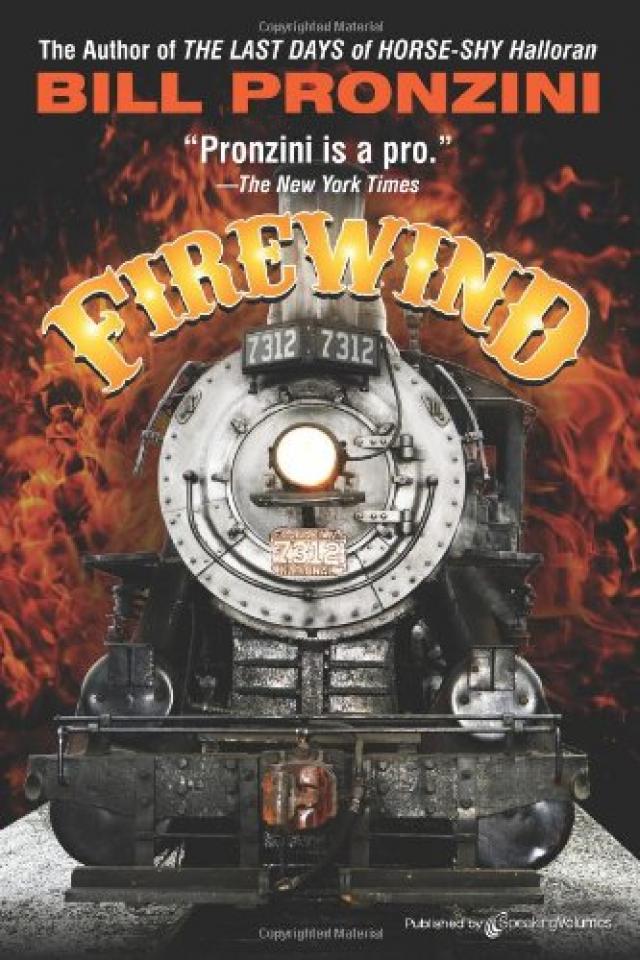
"I've got the Baldwin runnin' again!" Honeycutt shouted. "We'll couple it on to the passenger coaches, we'll outrun the fire to Springwood!"
The sense of the words finally got through to them. Heads and bodies had turned in his direction; there was a rising babble of voices. And the panic shattered like glass, and the shards were swept away in a surge of desperate hope.
"To the yards! Run for the yards!"
In a body, men and women scooping up the younger children, they rushed headlong back down Main Street. In their midst, Honeycutt watched the fire rage along the ridge to the northeast, beyond the siding where the coaches were. Blocks of flame streaked through the treetops, fragmented, and erupted forward like howitzer shells that landed fifty, a hundred yards ahead of the main blaze and exploded everything they touched. But there were better than three hundred yards of open ground between the fire's perimeter and the coaches, nearly all of it hard-packed dry earth that was grassless and treeless. Nothing much there for the blaze to feed on - unless a firebrand hurtled out and scored a direct hit on one of the cars.
When he came past the livery stable at the end of Main, Honeycutt veered over past the platform and work building to where the Baldwin sat under the water tower. A ragged group of others followed him. He brought his breathing under control, began barking out the names of men who worked on the rail crews at the mill.
"Purdom, Ashmead, Kimbrough, Murdock! You stay with me. The rest of you move on south, spread out along the tracks; we'll pick you up there. Hurry, hurry!"
No one questioned the orders. They had all accepted his authority, tacitly placed the responsibility for their salvation in his hands. But Honeycutt didn't let himself think about the burden of that. He turned for the Baldwin, while the rest of his friends and neighbors rushed away to the south.
He yelled to Purdom, "Ben, man the spigot." And to Ashmead, "Joe, you climb up and get the boiler tank open." And to Kimbrough and Murdock, "Ollie, you and Webb work the siding switches."
The five of them moved as one, Honeycutt swinging up inside the cab. Plenty of cord-wood in the tender, enough to get them the fifteen miles to Springwood; he's stacked in a fresh supply a few days ago, in anticipation of his downtrack test run. He leaned down to open one of the tank boxes, pulled out an oilcan. Which of the others for fireman? he was thinking. Ben Purdom was likely the best choice; he'd been head of the rail crew at the mill for the past couple of years. But Ben had weak lungs-
A voice said from below, as if its speaker had been privy to his thoughts, "You're gonna need a fireman, Sam. And I'm your man."
Honeycutt straightened, looked out and down.
The voice belonged to Will Denbow.
***
Denbow caught the handbar on the side of the cab, got his left foot anchored on the running board, and launched himself up through the gangway to the deck inside. He limped past Honeycutt to the tender, half turned then to face the old man.
"There's no time to argue, Sam," he said grimly. "I can handle the job, don't worry. I'm gonna handle it."
Honeycutt's seamed face was expressionless. His eyes bored into Denbow's for three or four seconds; then he nodded once, said, "All right, son, load her up," and turned immediately and climbed down from the cab to oil up.