Firewind, p.7
Firewind,
p.7
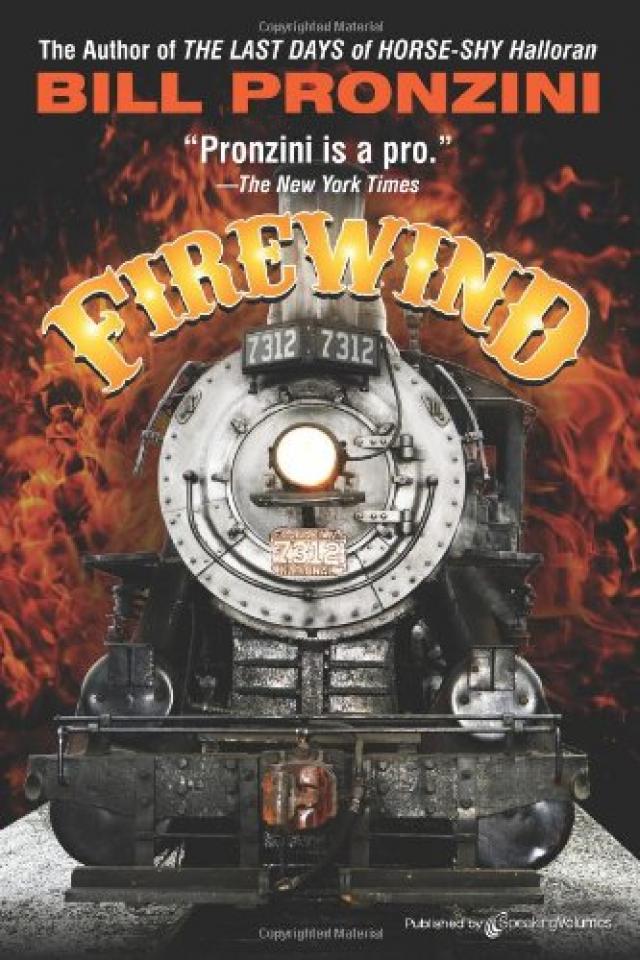


Denbow was relieved and a little surprised. He'd expected an argument. The need to take the fireman's job had come over him when he'd stumped up outside - Rose on one side of him and Pete Weidenbeck on the other, helping him run - and Honeycutt began shouting out his orders. The lives of ninety people were at stake, people who'd once been his friends - that was part of it. But there was more to it than that. He wanted the fireman's job, had to have it, because it was something he could do even with one leg; it meant being useful again. His home was about to be wiped out; what else did he have left except the chance to be a whole man again for a few hours?
He took an armful of cordwood from the tender, pivoted on his good leg, and drove his wooden one against the pedal on the floor in front of the firebox. The butterfly doors slapped open. He dumped the cordwood in, turned back to the tender to repeat the process. The peg leg wasn't any problem now, but he'd have to be careful to watch his balance once they were in motion. He was not going to let the stump keep him from seeing this through.
Through the side glass and the narrow, oblong front glass panels, he could see Murdock and Kimbrough manning the siding switches. He could also see that the entire eastern slope beyond the yard was ablaze. Columns of smoke danced above the heaving span of flames, altering direction high up in the thin gusts and drafts of wind. The smoky heat burned in his lungs; he tightened his jaws to keep himself from coughing.
Fleetingly he thought of Rose, wondered if she was all right. She'd tried to stop him when he started for the locomotive, but he had pushed her away, yelled at her to go with the others. That damned Kincaid had taken her arm and pulled her along. She would never stop thinking of him as a helpless cripple, would never stop believing he had to be watched over and protected. Well, for a little while he was going to be the one to do the protecting.
Water began gushing into the boiler tank; he could hear the hissing metallic sound it made. He had the firebox half full now. He was dumping in another armload of wood when Honeycutt came up beside him again. The old man fired up the boiler, lit the lamp that hung from the paneling on the front bulkhead, and began turning valve handles and opening cylinder cocks and checking the manifold gauges. When the water gauge told him the tank was full, he leaned out of the side window to shout at Purdom and Ashmead, "Okay, shut her down!"
Denbow watched the steam gauge, high on the boiler butt. The needle climbed slowly. The glow inside the firebox flared a hotter and brighter red each time he pedaled open the butterfly doors, and the cab filled with an increasing volume of noise - the blast of the firebox, the stuttering clamor of the valves, the staccato beat of the exhaust.
He called across to Honeycutt, "About ready, Sam?"
"Pretty soon. Keep loadin'."
Another half minute went by. Then Honeycutt took his eyes off the steam gauge, called, "Ready!" to Denbow, put the headlight on, released the brakes, and wrapped his left hand around the throttle. Gave her some steam to get them moving. The drivers clanked and commenced to turn; the Baldwin jolted forward, hissing steam, its wheel flanges sliding noisily on the rails.
They rolled over to the main track, through the open switch, and uptrack a ways past the switch for the east siding. Now Denbow could see the rest of the townspeople strung out on the west side of the right-of-way, their bodies outlined in the hellish glow of the fire. He dragged his free arm across his sweating face, swung around to the tender for more wood.
Murdock came running up alongside the cab as Honeycutt slammed the throttle shut and notched open the reverse lever between his knees. The big Baldwin shuddered, came to a stop for an instant with smoke feathering back from its stack, then began to grind backward.
"Sam!" Murdock shouted. "What about those two boxcars? They're blocking the coaches. Haul 'em out of the way, or couple 'em on and then pick up the coaches?"
"No time to waste," Honeycutt yelled down to him. "We'll have to take the boxcars with us. Couple 'em on!"
CHAPTER EIGHT
From the south side of the yard, where he was clustered with the others, Kincaid watched through watering eyes as the locomotive reversed its course and headed onto the siding to the two sealed boxcars. Smoke belched from its stack, blending with the sooty pall that undulated across the sky. It seemed to be moving without sound, rendered mute at this distance by the hum and roar of the conflagration.
The fire was awesome now. The slopes and ridges to the west, north, and east were solid masses of flame; red-tipped tongues licked toward the backs of the houses and cabins on the hillside beyond Main Street; patches of dry grass on the valley floor had already been blackened and some of the shade oaks had blazing crowns. Holocaust - one almost biblical in its destructive force. It made him feel as though the entire world were being incinerated.
In his mind was an image of what would soon happen to his little valley over east - his cabin, his cattle, his horses, everything he owned and everything he had built. Destroyed in one rushing sweep of flame, as if none of it had ever existed. He felt a bitter sense of loss. And yet, if he survived this night, there was nothing to stop him from rebuilding it all somewhere else, on a different piece of ground. He had started with nothing before; he could do it again. Easily, if he had a woman like Rose Denbow to build it for…
The wind and heat beat against his face. The smoke not only stung his eyes but swelled his throat and made breathing painful, as if he were trying to draw a fiery semisolid matter into his lungs. All around him men and / women and children were coughing, gagging, retching.
One of those bent double not far away, he realized suddenly, was Rose.
He went to her, took her shoulders gently, and held her until she was able to stop the paroxysms and straighten up. When she looked at him, he saw that her eyes were dulled with pain and fear, her face streaked with dried sweat, dried tears. A tenderness welled up inside him, so sharp that it was like a physical ache.
"Rose," he said.
She stepped back out of his grasp. "Please, Matt - don't."
Mutely he watched her turn to stare up-track at the locomotive. He sensed she wasn't so much watching the work there as looking for her husband. Fretting about Denbow because, after all, she still loved him?
If I had a woman like her to build it for…
Kincaid's hands clenched. Impotently he stared uptrack himself, past Rose's rigid body. Silouetted against the smoky firelight, the locomotive was coupling onto the forward of the two boxcars. He could see one man working there, another man back where the coaches were, Sam Honeycutt leaning out of the cab. Honeycutt. Couldn't be a better man in charge. He had spent his entire life on and around trains, and he had already proved that he was capable of an iron will and a clear head. If anyone could get them out of Big Tree alive, Honeycutt was that man.
But Kincaid couldn't just keep on standing here, wanting to do something, feeling helpless because there was nothing for him to do. He turned, hacking, trying not to gag, and moved away along the tracks to the south.
Some of the people were kneeling or sitting on the dusty ground; others were jackknifed forward, racked by spasms of lungs and bellies. Melissa Weidenbeck convulsed beside her husband and vomited at his feet. One of Ollie Kimbrough's young daughters screamed hysterically in his arms. The edge of panic, dulled by the hope Honeycutt had given them, was sharpening again as the seconds ticked away and the smoke and heat intensified and the fire closed in around them.
Kincaid saw the two rough-clad strangers standing apart from everyone else, remembered that the heavyset one, Patch, had a crippling horror of fire. Patch still seemed to be transfixed, his eyes wide and staring at the inferno on the east slope. His mouth hung open and a glistening trail of saliva ran from one corner of it down over his chin, onto the front of his shirt. He was coughing steadily, with sounds that were like the barks of a feeble dog. The other man stood with his knuckles against his thighs, and on his face was an expression of anger and the same sort of helplessness Kincaid was feeling.
The lean man grew aware of Kincaid's gaze on him, met it for a few seconds, then deliberately shifted his body around and walked over closer to the right-of-way. Kincaid frowned, started after him, changed his mind when he remembered something else: He hadn't seen Austin Trace anywhere among the townspeople, hadn't seen him at all tonight.
Frank Bixby, the night watchman on the mill gate, was down on one knee nearby. Kincaid went to him, helped him up. "Frank," he said, "what happened to Trace?"
Bixby looked at him in a half-stunned way, said between coughs, "The old man? Christ, I don't know. Isn't he here?"
"No."
"Maybe the explosion got him."
"Maybe so," Kincaid said. "Tell me this: Why was that big freight wagon coming in so late?"
"Delivery of personal goods. Driver had a note from Trace."
"A delivery an hour past midnight?"
"It's happened before."
"What kind of personal goods?"
"I didn't ask. None of my business."
"How many men on the wagon when it drew up?"
"Just the driver."
"Heavyset, bearded man?"
"That's right."
"You didn't see anybody else?"
"No."
"How about inside, over by the powder shed?"
"I was opening the gate for the wagon," Bixby said. "Everything was quiet, then the shed just blew. What-"
A sudden shout went up from the people uptrack. Somebody yelled hoarsely, "They're coming!"
Kincaid swung around, and the things Bixby had told him were crowded into the back of his mind. Uptrack, the locomotive, its headlight glaring through the roiling smoke, was on its way out of the east siding with the two boxcars and the two coaches coupled on behind.
***
When the old Baldwin cleared the open siding switch onto the main spur, Honeycutt opened the throttle another notch with his left hand and then dropped the hand to the knob of the air-brake lever inside its slotted disk. He put his head out the side window, looked back along the string. Kimbrough and Murdock were hanging out on that side, one standing on the coupler knuckles between the second boxcar and the first coach, the other on the plates between the coaches. They both swung their free arms high over their heads to let him know everything was all right back there.
Honeycutt brought his head back inside, craned his neck to look past the throttle bar at Will Denbow. With the firebox full for the moment, Denbow was sitting on the cab seat, resting, his body bent forward tensely. His face, backlit by the glow of the fire, looked grim and capable.
Honeycutt nodded to himself. He had had to make a snap judgment about Denbow earlier: Could he handle the job? What he'd seen when he stared into the young man's eyes convinced him that he could. He was even more convinced of it now.
He smothered a cough, ducked his face against his shirtfront, and squinted through the front panel. Ahead, most of the townsfolk were packed together in a long, ragged queue, moving, gesturing urgently; a few of them had splintered off and were staggering uptrack toward the oncoming Baldwin. The fire had surged beyond them to the west, was racing toward the southern end of the valley. Back north, some of the buildings and the few abandoned wagons along Main Street were burning. Honeycutt forced himself not to think about his own house, everything he and Martha had in the world except their lives. Concentrated instead on the lay of things downtrack.
In another few minutes the way through the pass between the southern slopes would be blocked by converging walls of flame. And inside a half hour there wouldn't he much left of Big Tree except charred and fiery rubble. But getting clear of the valley didn't end the threat to them, not by a long shot. They still had to run a twelve-mile gantlet of dense timberland, still had to cross a couple of short bridges over creek beds and washes and the spidery trestle that spanned the Miwok River. The more momentum the fire gained, the faster it would spread. When it got hot enough, it would hurl whole trees, like gigantic torches, a mile or more ahead of it, build enough speed so that even a train would be hard-pressed to outrun it.
The Baldwin was something else to worry about. She ran along fine at low speeds, with gentle handling; but he was going to have to push her most of the way, keep the steam up to its full working pressure of two hundred pounds as long as the water lasted. The repairs he had made were intended only to get her running again, so she could be worked on proper at the roundhouse in Springwood. Aged and little-used rods and valves might blow, the boiler might blow, a dozen other things could strand or wreck them…
Honeycutt shook himself. No damned use in dwelling on what could go wrong. Take things as they came, one minute at a time.
The Baldwin's blunt nose was coming in on the first of the running people. The headlamp bathed them and the clustered line of the others beyond in a smoky white glare. Honeycutt closed the throttle, jerked the whistle pull to signal Kimbrough and Murdock, who were manning the hand brakes on the cars, and then worked the air-brake lever. He saw the rest of the townsfolk surge toward him in a body, some of them with their mouths agape, making sounds that he couldn't hear for the hoarse intake of the air pump, the low shriek of the brake shoes binding against wheel rims, the constant barking of the exhaust. Then the Baldwin was past them all, and he brought it to a hard, jolting stop.
He set the brakes, swung off his seat. "Stay put and watch the firebox," he called to Denbow. Then he caught the side bulkhead, levered himself out through the gangway, and dropped down amid thin jets of steam.
A wave of heat and acrid smoke buffeted him; his lungs constricted and he was racked with a fit of coughing. He dragged his handkerchief out, held it up to his mouth, then started uptrack to where his friends and neighbors were massed at the darkened cars. He stopped abruptly, relieved, when he saw that they weren't fighting each other, that they were letting the women and kids in first. Matt Kincaid seemed to have taken charge, and Ashmead and Purdom and Cletus Boone were helping him hand people up the portable side steps on each of the coaches. Steam and smoke swirled around them, half obscured the tracks and the yard.
Honeycutt retreated, climbed onto the running board again, and hung there looking back. All the women and kids were aboard now; the men were starting to clamber in after them.
When there were fewer than twenty men left outside, Honeycutt pushed back up onto the cab deck. Denbow was stoking again; the butterfly doors on the firebox were open and his bent-backed frame was limned in the bright, ruddy glow from within. Honeycutt slid his buttocks onto the seat, peered through the glass to the south. The fire fronts were converging rapidly on the low granite walls of the pass - too damn fast.
We've still got time, he thought. We'll make it.
But it's goin' to be close.
He laid his hand on the air-brake lever, muscles knotted and aching with tension, and took a look back to the rear. The last few of the men were just disappearing inside the cars. Seconds later he saw Kincaid lean out of the forward coach, Cletus Boone out of the rear one. Both men signaled with frantic waves of their arms.
Honeycutt pulled the whistle, released the brakes, and opened the throttle.
The Baldwin jerked, began to roll again.
Couplers banged and rods clanked and smoke poured from the stack. Watching the steam gauge, he opened her out one notch, two, three - felt her begin to hum and pound around him, creating a thunderous pulse that drowned out the thrumming of the fire. His blood began to pump faster, as it had in the old days when he was at the throttle and commencing a highball run. He gritted his teeth, put his head out again to stare downtrack.
The end of the yards loomed ahead. Beyond, to the west, where the last of the houses and cabins were located, the fire had churned to within sixty yards of the right-of-way. And on the east side, the rolling meadowland that stretched away to the pass was sheeted with flame all the way down to within twenty yards of the tracks. The pass's fractured rock walls dead ahead shone a pulsing, reflected red, like superheated metal in a forge.
Honeycutt opened the throttle another notch, watched the flames and the glowing walls hurtle toward them.
***
Rudabaugh was thrown back hard against the cracked leather seat when the train jerked into motion, then thrown hard forward and to the right as the coach shuddered and swayed. His shoulder jarred into Patch, sitting next to him at the window, and Patch made a grunting noise but didn't look his way. Didn't even turn his head from the window glass and the fire raging outside.
The train picked up speed. Rudabaugh grabbed on to the seat in front of him, steadied himself as the coach commenced to vibrate. Glass panes rattled, the floorboards and walls creaked and chattered. Firelight flickered through the cars, created twisting shadow patterns that gave the people around him an unreal look. Kids wailing, women sobbing, everybody else choking and gasping… it was all like a crazy nightmare.
There were burns on his arms and legs, on his face, on his scalp - none serious, but all of them together making his body ache and sting. But at least the smoke and heat weren't so bad in here. Not yet, anyway. He could almost breathe again without pain and he didn't feel as if he were going to puke at any second, the way he had outside.
He tried to pull his thoughts together. He'd never been afraid of much except a hangrope, and he wasn't afraid now. Yet that fire out there, the way it moved and ran wild… he'd never seen anything like it and he couldn't seem to come to grips with it. He felt confused, powerless, as if he didn't have a handle on his own life anymore - the same way he'd felt those two years in Deer Lodge, his only time in prison.
Then there was Patch. Bastard's fear of fire was so strong, he was out of his head; couldn't think or talk, didn't even know where he was, seemed like. If he stayed that way until they got clear, it wouldn't make any difference. But if he panicked again the way he had earlier, he might do or say something that would give them away. Rudabaugh had tried to talk to him while they were waiting beside the tracks, make him understand the need for caution. But Patch had just stood there, staring at the fire. Hadn't even moved when the spasms came and he puked on himself.