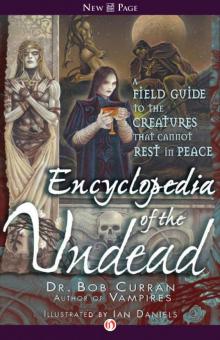
Encyclopedia of the unde.., p.6
Encyclopedia of the Undead,
p.6


Disease was also rampant in this new land. Following the War of Independence in 1775, epidemics of tuberculosis, cholera, and typhoid swept through the fledgling settlements scattered across the developing areas of early America. For many, the sicknesses were the work of Satan who was lurking in the wilderness. Normally healthy individuals suddenly began to inexplicably waste away, and eventually die. There was no warning—they simply turned pale and feeble, withering away before their demise. It could only be the result of some form of supernatural evil. Both English and German immigrants brought with them tales of ancient terrors from their own homelands and gradually these melded into the folklore of the New World. One element in this folklore was that of the vampire that had been brought to America mainly by immigrants from Central Europe. Even in an increasingly enlightened age, an explanation for such diseases was not sought in the fly-ridden bogs or in the scummy wells, which might have lain near to the early settlements; rather communities looked towards something uncanny which hovered around, just out of sight. The very primordialness of the landscape itself suggested that such things were possible. In such a place, the idea of the vampire that many Europeans had carried with them to America seemed all too real.
The vampire capital of the New World was not, as might be supposed, New York (Niew Amsterdam under the Dutch) or San Francisco (as it often appears in the movies). Instead it was the small state of Rhode Island. Amongst the isolated farms and communities, old ways lingered on and old tales were often repeated along the lanes that wound their ways amongst the apple orchards of the state. Rhode Island had experienced heavy fighting during the War of Independence and remote, often overgrown cemeteries were filled with corpses from that time. There were also stories that some corpses lay unburied, hidden away in the woods where wounded British, German, and American soldiers had crawled away to die. There were legends of ghosts haunting lonely gravesites and of ancient beings from the time before the settlers that still dwelt in the deep woodlands. Memories of ancestral European terrors added a fresh edge to these fears and whispers.
Disease swept through Rhode Island towards the end of the 18th century. The arrival of tuberculosis was coupled with a fear that the British might try to reinvade the Colonies (this happened in 1812) and illness struck sporadically in communities that teetered on the edge of public panic and hysteria. The tiny state was to produce a tradition that was to become known throughout America (and further afield) as “the vampire ladies.”
Sarah Tillinghast
The horror began in 1796 with Sarah Tillinghast, daughter of Stukely Tillinghast, an apple farmer from the South County area of the state. Nineteen-year-old Sarah was a quiet and demure girl, but exceptionally dreamy and given to wandering in old cemeteries where the buried Revolutionary War casualties lay. In the autumn of 1796, she suddenly fell ill, with what the local doctor diagnosed as consumption (tuberculosis) and died. Shortly afterward, other members of the Tillinghast family also became ill and died, wasting away in an inexplicable manner. Oddly enough, they had dreamed of Sarah a number of nights before their actual death. Fear spread through the community—not of tubercular contagion—but of vampire activity. Old stories were stirred up again and many became convinced that Sarah and some of her siblings had become vampiric creatures. These stories were perhaps fanned by the local minister, Benjamin Northup, who saw the Devil’s hand in the deaths. As the hysteria mounted, Stukely Tillinghast became more and more unsure of what to do. He was losing members of his family on a regular basis to an unknown but relentless evil against which he and the church seemed powerless. In desperation, he travelled out to the lonely churchyard where his daughter lay and together with one of his farmhands unearthed her coffin. Opening it, he found Sarah lying, just as fresh and beautiful as when she had been interred. Taking a large hunting knife, he cut out her heart and set fire to it. He’d heard about an old legend that said it was the only way to destroy a vampire. After that, the deaths in the Tillinghast household stopped, as did the dreams, but Stukely had lost half of his large family.
Nancy Young
Things were quiet in Rhode Island until 1827 when the “vampire epidemic” surfaced again. This time it was near the small town of Foster and it afflicted the household of Captain Levi Young and his wife, both natives of Sterling, Connecticut who had bought land in the area. Levi Young had been a captain of militia but had settled down to become a farmer in the Foster area. He had done rather well and was reasonably prosperous. He and his wife Anna Perkins had eight children and the Foster farmhouse rang with the sound of a happy and contented family.
In the spring of 1827, things changed. Levi and Anna’s eldest daughter Nancy, began to sicken with what seemed, at first, to be a passing cold. It grew steadily worse—Levi thought she had taken a severe influenza—and she took to her bed, eventually becoming completely bedridden. She died shortly after.
As with Sarah Tillinghast, a few months after Nancy Young’s death, other members of her family also began to sicken. Some of them complained that they too had dreamed of Nancy visiting them at night and had experienced an extraordinary weight upon them as they lay in bed. Stories of Sarah Tillinghast began to resurface in Rhode Island society and the chilling word “vampire” was on many lips. Again hysteria was bubbling just beneath the surface of the Foster community. Something had to be done. An elderly Foster resident known locally as “Doc” Lennox suggested that Nancy’s body should be exhumed and burned. This was done by Levi Young himself, on a chilly autumn morning in the town’s new churchyard and in full view of his neighbours. Doc Lennox had suggested that other members of the Young family should stand in the smoke from the pyre in order to protect themselves from former vampiric attentions. After Nancy was burned, the deaths stopped. Things would remain quiet in Rhode Island for almost fifty years.
Juliet Rose
The next of Rhode Island’s “vampire ladies” is generally taken to be Juliet Rose, the daughter of William G. Rose, a businessman and civic leader in South County. Her story follows the now-established pattern of both Nancy Young and Sarah Tillinghast. A lively youngster, and the child of William’s first wife Mary Taylor (who had died some years before), Juliet suddenly and inexplicably succumbed to what was described as a “harsh fever” and died in the early autumn of 1874. Shortly after her death, William’s other daughter, Mary Griswold, began to show signs of an illness, wasting away. Almost immediately old stories of the earlier vampire ladies rose to the forefront of William Rose’s mind. He was convinced that the vampire scourge had returned. Armed with his suspicions, he confronted his local minister, the Reverend Amos Cabot, but was told that he was still grieving for Juliet and was imagining things. Still convinced of the awful plague, William Rose went to the family cemetery deep in the Rhode Island woods. There, according to his own testimony, he beheld the form of his daughter standing over what was her grave. Although it extended its arms to him, begging for his warmth, the apparition vanished before his whispered prayers and William Rose commenced to dig up Juliet’s coffin. Pulling back the lid, he saw to his horror that the winding sheet, in which the body lay, was badly stained with fresh blood. With a cry of despair, he drew his hunting knife and plunged in into the cadaver’s heart. A scream rang through the graveyard. When he returned home, he found his young daughter recovering slowly from whatever it was that ailed her. This was taken to be indisputable evidence of vampire activity that was now laid to rest.
Mercy Brown
The area stayed quiet until 1892, when the last and most famous of Rhode Island’s vampires made her appearance. This was Mercy Brown, daughter of George Brown, who owned a small farm between the settlements of Exeter and Wickford in the south of the state. The story had started, however, much earlier, with the death of George’s wife Mary in 1883. Shortly after her death, his daughter Mary Olive began to complain of strange and terrifying dreams and of a crushing weight on her chest. She began to exhibit some of the signs of the strange sickness that had taken away her mother until June 1884 when she succumbed to the same death. Things remained quiet for about five years until George’s only son Edwin also began to display the same ghastly symptoms that had carried away his mother and sister. He too experienced terrible dreams of suffocation and crushing, turning from a hearty young man into a pale and shambling wreck. His doctor suggested that perhaps the airs of Colorado might be good for him and so Edwin travelled there to recover his failing health. His health returned almost immediately, and he decided to stay there for a while. Whilst he was there, however, he received word that his younger sister, Mercy Lena, had been seized with a similar disease and was sinking fast. Edwin rushed home but was too late—Mercy was already dead. Notions of the vampires began to re-emerge from the shadows and a number of local people complained of feeling weak, adding that they had also dreamed of Mercy Brown on a number of consecutive nights. The people feared another outbreak of the “vampire plague” and decided that something had to be done.
On the morning of 18th March 1892, a group of town elders, headed by the local doctor, Harold Metcalfe, made their way to the tiny cemetery where Mercy Brown had been taken to rest. Because she had died in the winter when the ground was still hard with frost, Mercy had not actually been buried, but lay in a squat stone crypt on the edge of the burying ground. The coffin that contained Mercy Brown’s body lay just inside the door, balanced on a cart. With due solemnity, the men opened the casket and threw back the lid. Mercy lay inside just as fresh and pretty as she’d ever been, with no sign of decay upon her. There were also traces of fresh blood on the inside of the coffin. Stepping forward, the doctor made a small incision in the cadaver and removed her heart and liver. These were ritually burned and water and vinegar were poured into the cavity from which they’d been removed. The men then left the cemetery and returned to their homes, praying that the scourge of vampirism which had afflicted Rhode Island was at last over. And indeed it appeared to be.
Edwin Brown himself died shortly after these macabre events. However, one of the local newspapers, The Providence Journal, seized upon the incident and carried a rather lurid account of the gathering in the churchyard in its issue of 19th March 1892. It followed the story in its 21st March issue, claiming that vampires were not a native Rhode Island superstition but “settled here,” brought in by immigrants to the state. The article was lifted by some of the New York papers who used it to poke fun at the “superstitious” Rhode Islanders and the story became widespread all across America. The Mercy Brown case may have been yet another influence on Bram Stoker as he wrote his vampire novel. He had been touring part of the United States as secretary to the actor Sir Henry Irving and, it is thought, could not have failed to come into contact with some account of the incident. Indeed, after his death, his wife found cuttings from some of the American newspapers relating to the case amongst his possessions.
Nelly Vaughn
Mercy Brown more or less marked the end of the “vampire ladies,” although there is one more that has not been mentioned. In a secluded graveyard, near Coventry, Rhode Island, stood a funeral marker bearing a curious inscription. The grave was that of Nelly Vaughn, who died in 1889, aged nineteen years and the inscription reads: “I am waiting and watching for you.” The message may have been quite innocent—to a loving family or a secret lover but in the remote Rhode Island cemetery and with the alleged history of vampirism in the state, they took on a rather chilling aspect. In 1967, a teacher at Coventry High School informed his class that there was a vampire buried somewhere in the locality. After a degree of research, interest fastened on Nelly Vaughn’s tombstone with its peculiar message. There was a myth in the area that no vegetation would grow on Nelly’s grave though this may arguably have had more to do with the number of visitors at the site than with any supernatural agency. Besides the peculiar inscription, little is known about Nelly Vaughn’s brief life and virtually nothing is known about how she died. However, the gravesite generated a massive amount of interest in vampires and ghosts in that remote corner of Rhode Island. In the 1980s, Yankee magazine ran an article entitled The Words on Nelly’s Tombstone, which generated a fresh and more widespread interest in Rhode Island vampires. There were more visitors and Nelly’s funeral marker became so desecrated and broken that it had to be removed in 1990. Perhaps poor Nelly can finally rest in peace.
Horace Ray
Rhode Island was not, of course, the only American state to experience an alleged vampire phenomenon. In neighbouring Connecticut, there were also suggested instances involving the Undead. In Jowett City, between the years 1847 and 1852, it was suspected that some sort of vampiric agency was at work in the locality. The vampire was supposed to be the unquiet revenant of Horace (sometimes given as Henry) Ray who had died early in 1847 and who was said to be preying on two of his sons who had survived him. When they too died, a number of people around the Jowett City area dreamed of them and awoke, experiencing exhaustion. Certain religious factions believed that vampires were at work and the bodies of Horace Ray and his sons were exhumed and burnt, whereupon the dreams and exhaustion stopped.
In the town of Griswold, historians investigated a local building site after some children had found a human skull there. The place was found to be a very old burying ground that included a stone vault. Here, the historians found a coffin containing some human remains that had obviously been treated for vampirism—dismembered in a very deliberate fashion. The skull had been placed amongst the bones of the chest and both arms and legs had been systematically broken. A closer examination of these bones revealed a tubercular-like condition. The coffin was marked “JB 55”—the “JB” being taken to refer to the occupant of the coffin and the “55” to his or her age. The skeleton was placed back in its coffin and no further examination was carried out, although anthropologists have suggested that this method of burial was not native to Connecticut but rather was common in Eastern Europe.
The Corwin Brothers
In Woodstock, Vermont, two brothers named Corwin were struck by an inexplicable illness towards the end of 1834. Before the year was ended, the eldest of the brothers had died and the other was starting to sicken. Stories concerning vampires who had been living in the forests which cloaked the Vermont mountains were suddenly remembered, and it was considered that the elder Corwen might be the victim of one of these, and that he had even become a vampire himself. His body was subsequently dug up and burned, the ashes placed in an iron pot and buried directly beneath the town square. A later account tells of how some youths attempted to dig them up late at night but were assailed by unearthly cries and screams, so they abandoned the idea.
Rachel Burton
An earlier and even more curious tale comes from Manchester, Vermont, concerning jealously and vengeance that reached out from beyond the grave. In the late 18th century, Isaac Burton, a naval officer, watched his young wife Rachel slip away with the ravages of a strange disease that resembled consumption. Distraught by her illness, he vowed that she was the love of his life and that if she died, he would never marry again. He laid her to rest in the Manchester cemetery. For a while, he mourned her loss, but then became attracted to pretty Hulda Powell who lived in the town. Soon the pair of them were married. Hulda made Isaac a good wife. A year or so after the wedding however, Hulda began to sicken with the same illness that had carried off Rachel. Significantly, she claimed to have dreamt of Isaac’s first wife and a meeting of the town fathers including the local clergyman concluded that Rachel Burton was somehow drawing off Hulda’s strength from the other side of the grave. Her body was exhumed and though she had been dead for over a year, her body was found to be remarkably fresh. The cadaver was ritually burned, but in 1793, Hulda Burton died, seemingly a victim of Isaac’s former wife. The tale only added to the building corpus of Undead lore. Down through the years, the shadow of the vampire lingered on both sides of the Atlantic and all across Europe.
Dracula and other Vampire Fiction
In 1897, the Irish writer Bram Stoker published what was to become one of the seminal books of vampire fiction—the novel Dracula. Although he would produce other works, none would catch the public imagination as much as his tale of the vampire count, drawing as it did upon a number of social issues but also on a corpus of folklore. Indeed, the novel has supposedly never been out of print since the day that it was first published. Allegedly, the only book that can rival that record is the Bible. It established the idea of the Undead firmly in Eastern Europe, a part of the world to which Stoker had never been (although it’s possible that he may have been aware of Dom Calmet’s work in that region) and inextricably linked the vampire motif with a medieval Wallachian warlord. It also created the image of the Undead as the cloak-swathed aristocrat with which we are all familiar today.
The book and the ideas that it produced were so successful that it inevitably spawned a number of imitations, not least of all in the developing cinematic industry of the early 20th century.
Nosferatu
The most famous of all the early vampire films was produced by a small German film company, Prana Film. This had been set up around the end of 1919 to produce and promote films (then silent, black and white films) that had a supernatural theme. In the end, the studio produced only one film, but it was destined to become a classic. This was F.W. Marnau’s Nosfertu, ein symphonie des gruens (a symphony of horror). Although the title was “nosferatu” (a German word for vampire) the action of the film was set in the Carpathian Mountains of Eastern Europe. Marnau used a largely German cast, including the Berlin-born actor Maximillian Schreck, who had initially made his name on the German stage but was now increasingly seen in films. Schreck’s own name is interesting—it is the German word for “terror” or “fight” and it led to the legend that it was not his name at all. In fact, he was at one time said to be an English actor named Alfred Abel, but this rumour was put to rest when the two men appeared together. Because he was a rather private man and not a great deal was known about his background, weird and unsubstantiated tales grew around him.