Blue storm, p.3
Blue Storm,
p.3
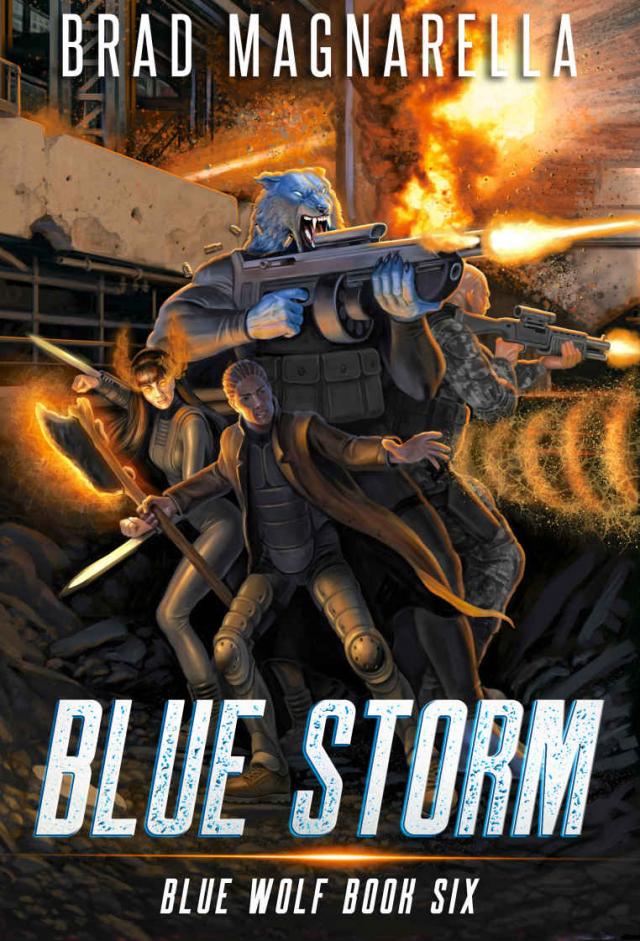


“Does Dabu have any thoughts on the prophesies?” I asked, taking lead back up the cargo ramp and into the hold’s shade. The heat gathering in my wolf body was radiating from my ears and forcing me to pant.
Yoofi hurried to catch up, the flasks in his coat clinking. “Dabu does not like to think about such things.”
“He’s still a god of the dead, right? Seems like that would be solidly in his wheelhouse.”
“Souls are very valuable in the Dea-Dep, yes,” he said, referring to Dabu’s underworld. “But whatever is coming will claim the souls for itself—the souls of the whole world, yes? To do this, it must be very strong. Very scary. I think Dabu is afraid it will go to the Dea-Dep and take his souls too.”
“He’s not planning on hiding, is he?” I growled.
In the last months, Yoofi had been asserting himself more with Dabu, overcoming an early problem of his god turning tail when we needed him most. I was proud of Yoofi. It couldn’t be easy reining in a god that had cut his teeth as a trickster. But I’d be damned if we were going back to square one.
Yoofi shrank from my gaze. “I will be honest, Mr. Wolfe. I cannot say for sure what he will do. I brought his favorite cigars and brandy. I believe he will stay as long as possible for these.” He pulled a thick stogie from a coat pocket and lit it as he puffed. From the growing cloud of foul smoke, he chuckled. “Yes, Dabu likes this one very much. And who can say? Maybe it is not the end of the world.”
But he didn’t sound very certain.
With the vans loaded, we spent the next several minutes checking each other’s helmets, boots, and gloves to ensure they were properly sealed to our suits. Though the components were lightweight, including my helmet’s extra-large breathing apparatus to accommodate my muzzle, the wolf in me didn’t like the confinement. He wasn’t alone.
“I feel like a microwave dinner,” Rusty complained, squinting through his tinted visor.
“The suits provide full protection against contagions,” Sarah said. “We’re to keep them on at all times in the reservation.”
“Even if I have to drop a deuce?” he asked, incredulous.
“There will be a process for that,” she said.
Grumbling, Rusty took the wheel of the cargo van, Olaf riding shotgun. The rest of us climbed into the passenger van. I’d mounted a medium machine gun on the rooftop and now I strapped myself in front of its console. Sarah pulled the van from the airfield, eventually joining up with a deteriorating two-lane road. The reservation was close, and I used the short commute to go over mission essentials.
“Purdy has arranged a house on the reservation for us to base,” I said. “Once we’re set up, Sarah and Yoofi will head to the clinic. Olaf and I will meet with Chief Buffalo. Rusty, you’re on air support.”
“Roger that, boss,” he radioed from the other van.
“Remember,” I stressed, “we’re not Legion this mission. We’re an infection containment unit. Stick to the script.” The DAWA team had provided us with fake credentials, and Purdy assured me we had the reservation’s full cooperation.
On the gun’s monitor, something appeared in the road ahead. I zoomed in. When the feed sharpened, I swore.
“What is it?” Sarah asked.
“We’ve got an armed roadblock.”
4
The dozen-odd men stood in front of a cluster of pickup trucks. Their dark hair and facial features marked them as members of the Chocasukee, by all accounts a peaceful tribe. As we slowed, they leveled shotguns at our vehicles.
“Are you sure they know we’re coming?” Rusty radioed from behind us.
“We’re at the boundary of their sovereign territory,” I said. “They’re probably just controlling traffic in and out.”
Either that or Purdy’s team had royally screwed the pooch.
When we’d pulled to within fifty meters, I had Sarah stop. We’d been on enough missions to know not to take anything at face value, and our machine gun would provide better cover at range. Telling Olaf to take my position, I unstrapped myself from the weapon console and opened the side door.
“Stay inside,” I ordered everyone.
The men tracked my approach with double barrels and hard gazes. Their unofficial uniforms were denim jeans and shirts that featured traditional woven patterns. Most wore cowboy hats and leather boots. As I came nearer, I sensed their apprehension. Whether over me or the illness that had hit their reservation, it was hard to tell. I opened my gloved hands to show I was unarmed, but their weapons remained raised.
“Go home,” one said.
The speaker was a tall man with a bristly beard, his cheeks pocked with old scars. He stepped forward in a sleeveless shirt, the lean muscles in his arms tensing as he made a shooing motion with his gun.
“We’re the infection control unit,” I said. “We’re here to help.”
“We don’t want your help. We don’t want anything from you.”
“Are you speaking for Chief Buffalo?”
“Go home,” he repeated.
Beyond the roadblock was the start of their reservation as well as whatever was ravaging it. The thought of a doomsday clock ticking down to death and destruction filled my mouth with a mean taste. I saw myself ripping guns from grips and upending vehicles. I could clear them out of the way in seconds. But our investigation depended on the tribe’s cooperation, and treating them and their roadblock like a bowling alley was no way to earn it. I cycled down my breaths until the violent images dispersed. The men remained with their shotguns aimed.
“No worries,” I said, backing away. “We’ll get this cleared up.”
A ring tone sounded. The tall man who’d shooed me away drew a phone from his back pocket. I stopped and attuned my preternatural hearing to the voice on the other end. It was sharp and in a range that could have been a man’s or a woman’s. As they conversed in their native tongue, I checked my tablet, but we no longer had access to Centurion’s full suite of software. The translator couldn’t make heads or tails of the man’s end of the conversation.
After another minute, he returned the phone to his pocket and spoke to the group around him. One by one, they lowered their weapons. Several climbed into trucks and started them up. It wasn’t until they’d created an opening in the roadway that the tall man returned his gaze to mine.
“Follow me,” he said.
Without further explanation, he climbed into a silver Ford F-450. I returned to the van and filled in the team on the odd standoff. “We have access now, anyway,” I finished. “But caution is still the watchword.”
As we followed the Ford through the roadblock, Yoofi whistled. “Those are some nice rides, man.” He meant the Super Duty trucks, many of them new. As the roadblock closed behind us, a pair of them separated and accelerated to catch up.
“Do you know why they’re tailing us?” Sarah asked.
“If the posse’s any indication, the reservation is on edge.”
“I would be too, boss,” Rusty radioed. “I mean, heck, you saw that lady in the pictures. Something ate her alive while she was just lying there!”
Olaf grunted in what sounded like agreement.
Trying not to think of Dani in her own hospital bed, I peered out at the landscape, releasing my helmet enough to pick up the scents of standing water and decaying vegetation. Swamp smells.
The lead truck turned off the main road and down a dirt causeway. South Florida pine and palmetto soon closed around us. According to the mission info, the reservation covered three thousand acres of forest and wetland. I checked our progress against the map on my flex tablet. Houses appeared before long, most of them new constructions with gleaming metal roofs and two-car garages. Airboats bobbed beside docks.
“I hope this doesn’t come off wrong,” Rusty said, “but I thought these people were supposed to be dirt poor.”
I’d been operating under the same assumption. But not only were they well off, they appeared to be thriving when swaths of the country were still clawing their way back from the Crash of years earlier.
“Heck, they live better than most of Kentucky,” Rusty said. “Except for this poor bastard.”
The lead truck stopped in front of a dilapidated house that stood well apart from the others. The two tailing trucks remained on the road behind us. When the tall man got out, I understood we’d arrived at our base. So did Rusty.
“Aw, crap,” he muttered.
“You’ll set up here,” the tall man said when I got out to meet him. “Anywhere you need to go, Shayne and Paco will show you.” He nodded at the two idling vehicles. With that, he prepared to get back in his truck. But I needed contacts on the reservation, people I could talk to besides officials.
“Do you have a name?” I called.
“Ace,” he said without turning, and closed the truck door behind him.
That was a start.
Mossy carpet squished underfoot as we negotiated a minefield of toppled furniture and broken glass. When Yoofi grunted, I looked over to find him jerking his hand from a wall layered in mold. In the kitchen, half the linoleum was ripped away, and ferns poked through the rotten floorboards. It also sounded like we had squirrels in the attic. I checked the final room in the back and lowered my weapon.
“All clear,” I announced.
I emerged to find Sarah working a tap in the kitchen. It hacked mud before settling into a tan-colored stream. “No electric, but we have water,” she said. “Sort of.”
“They couldn’t give us one of the new houses?” Rusty complained.
But something told me we were lucky to have been let on the reservation at all.
“Listen up, everyone,” Sarah announced. “In addition to the standard prep, we’ll need to dry and disinfect the rooms and set up a decontamination station in the front hall.” When Rusty moaned, she said, “That will allow you to remove your suit indoors. Do you want to be able to use the bathroom or not?”
“I don’t know, boss.” He winced through his visor. “Have you seen the toilet?”
We’d packed high-powered fans in anticipation of the humidity. For the next hour we went to work setting them up and spraying areas with disinfectant. It meant extra time, but we couldn’t risk equipment failure. Access points were secured, computers set up, drones sent airborne, the armory stocked, and plastic partitions hung in the front hall to Sarah’s specs. The whole time, the two trucks idled in the road.
“Purdy didn’t mention anything about minders,” Sarah said.
There were a few things he hadn’t mentioned to Legion. That the team sent to the other reservation was a competing monster-hunting unit, for one. And his directive that we stay under the radar had more to do with keeping Centurion ignorant of our mission than anything. He’d confided both to me that morning, but now Sarah’s comment had me wondering what he hadn’t told me.
“He might not have known,” I said.
“Are you sure he went through the proper channels to set up our investigation?”
I thought about the armed roadblock and mysterious phone call. “I guess we’ll find out.”
Yoofi emerged from the back, smoke drifting from the end of his staff. “They are done,” he announced of his protective lingos. “And done well, if I may say. Nothing with the bad magic can come into this space.”
“Good, because you and I have to get to the clinic,” Sarah said.
“And we have a meeting with the chief,” I told Olaf.
“I need ammo.” He plodded toward the room we’d appointed as our armory.
I joined him, selecting a few mags and grenades. As I stowed them in my vest pouches, I thought about how Dani would be finished with her treatment by now and in a recovery room. It killed me that I wasn’t with her, holding her hand, talking her through her pain, her fear.
“I’m sorry,” Olaf said.
I looked over in surprise. “Sorry about what?”
He regarded me with his dull blue eyes. “That you’re sad.”
“Why do you say that?”
He stared for another few seconds before plodding from the armory. I watched him go, wondering what was going on in that scarred head of his. Eight hours since I’d learned about Dani’s cancer, and our supposedly “nonliving” teammate was the only one who could tell I wasn’t myself.
5
I pulled the van over in front of a wooden administrative building that sat in the shade of a giant oak tree. The truck that had led the way stopped in front of us. Through its tinted glass, I could make out our minder, Shayne. He was on his phone, probably alerting the chief to our arrival.
When Olaf and I got out, he remained in his vehicle.
“I’m not sure what kind of reception we’re in for,” I said in a lowered voice. “Be ready.”
Olaf’s grunt would normally have been accompanied by hefting his MP88, but we’d locked our big guns in the van and were carrying only holstered sidearms. After the confrontation at the roadblock, I didn’t want to give the tribe any more reason to feel apprehensive about our presence. An electronic tone sounded as Olaf and I entered the building. A moment later, a low voice called, “In back.”
We followed the voice to a basic office. A large man with long black hair sat behind a desk flanked by file cabinets. He wore a denim shirt buttoned to his throat and a colorful woven vest. Lifting his broad face, he peered at us through a pair of bifocals. The desk was notable for the absence of a computer. Folders and small stacks of paper fluttered in the breeze of a rotating fan. I waited for some indication that he knew who we were, but the silence only stretched into more seconds.
“Chief Buffalo?” I said at last.
He nodded once, still watching us with his unreadable eyes.
“I’m Captain Wolfe, and this is Olaf Kowalski,” I said. “We’re with the decontamination team that arrived this morning. We’re investigating your disease outbreak.”
He looked from my helmet to Olaf’s holstered sidearm. “Do you have credentials?”
I handed him the paperwork the DAWA team had prepared. He inspected it with a slight frown, his eyes seeming to linger on every word. Though a pair of chairs faced his desk, he didn’t invite us to sit. I pretended to study the native art on the walls while listening into the rest of the building. We had the place to ourselves. After several minutes, the chief returned the papers, giving no indication whether or not he considered them legit.
“Do you mind if we ask you a couple questions?” I said, taking a seat and scooting it forward. It was a subtle show of assertion, partly to make it harder for the chief to say no and partly to observe his reaction. I angled the other chair out for Olaf. With a grunt, he sat down heavily.
The chief only watched us, his heart rate the slow, steady thud it had been upon our arrival. I wasn’t picking up hostility—or any other emotion, for that matter. I decided to take his silence as consent and started right in.
“How many people have fallen ill on the reservation?” I asked.
“Twelve.”
“And how many have died?”
“Ten. Two are being treated at the clinic.”
His responses lined up with what we already knew, which was good. He was shooting straight so far.
“Our doctor is there now,” I said. “But do you have any idea what’s causing the illnesses?”
“No.”
“It doesn’t have to be a medical reason,” I said. “Any idea at all?”
The clinic was run by a team of Chocasukee. Through a grant from Indian Affairs, they’d gone to medical schools and been provided state-of-the-art equipment. But I still wanted to make allowances for the tribe’s beliefs. After all, a belief-analyzing algorithm was the reason we’d been sent here.
But Chief Buffalo simply repeated his negative response.
“Any unusual events prior to the outbreak?” I asked.
He appeared to consider this question more carefully before shaking his head.
“How about anything the victims have in common?”
“We are all Chocasukee,” he said. “Our history is shared hardship.”
The mission info had included a brief background on the tribe. Refugees from early European settlement, they later became targets of the U.S. Army, surviving by withdrawing farther into Florida’s swamps. Even after federal recognition, they’d suffered decades of raw-dealing.
“Your houses and cars do not look like hardship,” Olaf said.
I started to give him a stern look, but that had been puzzling me too. I awaited the chief’s response.
“Our casino still makes money,” he said.
The mission info had also mentioned a 300-room resort and casino in Miami-Dade that the tribe operated. And Miami supposedly remained a playground for the ultra-wealthy, even during the recession. Seemed a reasonable explanation, but for the first time I was picking up defensiveness. I decided to push.
“Do you mind if Olaf and I look around the reservation?”
“Look for what?” He’d recomposed himself, but he remained on his back foot.
“Contaminants,” I said. “Anything that might have started the outbreak.”
The chief peered between us, then released a heavy sigh. “You must understand, we are in a very difficult time. Something is killing our brothers and sisters. And yes, we want very much to learn what it is, to stop it. But every time the Chocasukee allow the Americans onto our land, we seem to suffer more.”
“I am from Poland,” Olaf stated, without a hint of irony.
That broke the tension. The chief grunted a small laugh and sat back. “You are both good people, I can see this. You mean to help, and for that we are appreciative.” I felt the but coming, the denial of our request. He considered us for another moment. “You may look,” he decided. “We ask only that you have escorts.”
I still didn’t like the idea of being minded, but at least we had the official stamp of approval. “Thank you.”