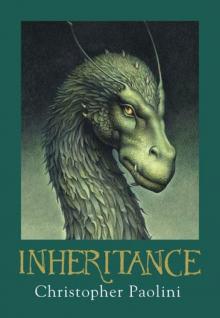
Murtagh, p.33
Murtagh,
p.33


After a minute, Bachel said, “Do you dance, Kingkiller?”
He gave her a courtly nod. “Quite well, I’m told.”
“Then dance for me, if you would. Let my children see the high styles of the land.”
“You make a fair request, Lady, but my armor is ill suited for such sport, and I’ll not remove it.”
He thought his refusal would displease her. But instead, she merely picked up her chalice again. “No matter. You will dance for me another time, Kingkiller.”
“Will I?”
“It is foreseen, foretold, and thus fated.” And she returned to watching Alín and the bearers.
More grey-robed servants came with platters of food: bread and milk and butter and salted meats. Grieve joined them on the dais and, after a deep bow to Bachel, said, “Dragon Thorn, we have goats and sheep and cows for you. Which would you like?”
I ate before we set off north. At the moment, I am not hungry, but I thank you for your offer.
Grieve bowed again. “Of course. As you so desire. If you change your mind, you have but to ask, and our herds shall be yours to choose from as you please.”
Thorn’s eyes glittered in response. That is most kind of you.
The dancers continued without letup, and before long, the villagers brought cooked meats to the dais and the feast began in earnest.
Murtagh was hungry, but he took only a few bites from each course, just enough to be polite, and he drank sparingly. The witch, by comparison, was immoderate in her consumption; she ate a constant stream of dishes, displaying the sort of appetite common to soldiers after days of forced marching. Her manners were fastidious, although—also to his surprise—she forwent fork and knife and devoured her food using nothing but fingers and teeth. It made for an odd mix of refinement and barbarity. Along with her food, she drank chalice after chalice of wine. And yet she remained alert and bright-eyed throughout, and Murtagh could detect no slurring of her speech.
Either she has the constitution of a Kull or she has spells protecting her, he said to Thorn.
Or some combination of both.
When Bachel held out her chalice for the seventh time, Murtagh gave an incredulous chuckle and shook his head. “You are amused, my son?” Bachel asked.
“It’s only that…well, I’ve never seen man or dwarf who could hold their own with you when it comes to drink. Perhaps an Urgal might, or an elf, but I’ve never had chance to match cups with either of their races.”
Bachel nodded, unperturbed. “It is because my mother was indeed an elf. That is why my blood runs hot and I have the strength and quickness I do. There is no one like me in all the world.”
Murtagh’s mind raced. Growing up, he’d heard stories of half elves, but they were always spoken of as something out of myth and legend. It had never occurred to him that such a thing might be possible…though considering it now, he supposed it wasn’t that surprising. Elves and humans were more closely related than, say, humans and dwarves—dwarves, like Urgals, had seven toes on each foot—and given enough time living in the same land, it was inevitable that some intermingling would occur.
She could be lying, said Thorn.
But then how to explain…her?
The dragon had no answer.
Murtagh looked back at Bachel. “Is your mother still—”
“She died long ago,” the witch said in a bland tone. “She came here when she was heavy with me, and she died. Is that what you wanted to know, my son?”
He wet his lips. “And your father? He was human, I take it?”
Bachel gave a languorous wave. “A woodcutter, I’m told. He too is long since dead.”
“I see…. My condolences.”
Bachel looked at him with a glittering gaze, as if he’d grown a horn from his forehead. “Why your condolences? They are in no pain. They sleep the long slumber, and were they here, they would be honored to know that I of all people was anointed Speaker. That I was chosen by fate to read and interpret and share the truth of ages. Do not mourn for me, Murtagh son of Morzan. I have no sorrows here, only triumph, glorious and inevitable.”
Then she lifted her chalice and again returned to watching those moving to the music.
In the distance, a crow uttered its harsh cry.
* * *
The feast dragged on, course after course, and the players continued to weave their savage melody throughout. It was a strange celebration. None of the villagers spoke to Murtagh or Thorn, not even when they waited upon Murtagh. Only Bachel conversed with them, and she seemed more interested in indulging in food and drink than talk.
Murtagh didn’t mind. The many months he’d spent traveling alone with Thorn had accustomed him to sitting and watching and thinking. And there was a certain pleasure in being served, as he had been at Galbatorix’s court; he heard the careless clip of authority harden his voice when he spoke to the man attending him.
It fit with his armor.
Nevertheless, Murtagh recognized his own feelings, and he knew them for a trap that could lull him into complacency. So while he welcomed the treatment due his rank, he also made an effort to observe the villagers and attempt to deduce something of their nature.
One point in particular struck him: when Bachel issued an order, the villagers scurried about like mice before a cat, almost desperate to please her. And yet they didn’t seem afraid. Or if they were, it was an odd sort of fear. Mostly, he saw deference and respect in their actions. If he could understand the reasons why, he felt he would understand the mystery at the heart of Nal Gorgoth.
Shadow filled the valley, and the stars were cold sparks in the night sky when Bachel finally pushed away her plate, dabbed her lips, and leaned back in her throne. Her skin glowed from the rubbed-in grease, and her whole being, face and body together, seemed swollen from the vast amount of food she had ingested.
“A most bounteous feast,” said Murtagh. “Your cooks are to be commended.”
Bachel nodded in a satisfied manner. “I thank you for your kind words. Such a feast as this, and more besides, are your rightful reward. Yours and Thorn’s. Were it within my power, I would set a thousand days of celebration in your honor. It is only what you deserve.”
Murtagh eyed her, wondering at the praise. Was it possible that the rumors about the Dreamers, and Bachel herself, were falsities? Or else misleading? Perhaps Bachel was not as he had thought. After all, were someone to judge him on hearsay, they would deem him a villain fit to frighten even the stoutest of hearts.
Then: “My Lady, we have eaten and eaten well. Might we now talk?”
“Of course, my son. What would you speak of?”
So many questions had Murtagh, he was almost at a loss to begin. “I have heard your people called the Dreamers. Would that be correct?”
A stillness took Bachel’s face, and with a single draft, she emptied her chalice and placed it beside her litter. “It is.”
“And what is it you dream of?”
“Of remaking the very face of the land.” Bachel turned her dark-rimmed eyes upon him. “As has been fated since the beginning of time. And as you and Thorn are destined to help bring to pass.”
The certainty with which she spoke chilled him. Partly because it reminded him all too much of Galbatorix’s ironclad conviction—a conviction born of the king’s own delusions and untrammeled power. And partly because he wondered if she spoke the truth.
“You speak with great confidence about our future actions.”
“Of course. Because I am a seer. A soothsayer. A prophet, if you will. The gift of foretelling what shall be is mine, and before me, all paths are laid bare.”
Ice poured down Murtagh’s spine. Prophecy was a real thing, but rare, very rare, and—to his knowledge—limited to the near future. If the witch could see further than that, then she might very well be the most powerful being in Alagaësia.
I do not believe in fate, Thorn said to him. We make our own way through the world.
Yes, but if she can predict what we choose to do next, how could we possibly counter that? And what exactly has she foreseen as our future? A fierce desire to know burned within Murtagh.
“Is that why your people call you Speaker?” he asked. “Because you speak to them of the future?”
Bachel smiled slightly. “No, not quite. I am the chosen voice of the Dreamer of Dreams, from whom all wisdom flows. For the Dreamer I speak, and thus the Speaker I am.”
When she failed to elaborate, he said, “And who is—”
“Some secrets are not to be shared with outsiders.” She gave him a long look, her gaze hard and evaluating. “Although perhaps you shall be a rare exception, my son.”
Murtagh frowned. Just because court intrigues had accustomed him to evasion didn’t mean he liked it. “My Lady…if an oracle you are, might you provide us with a demonstration of your powers, that we may marvel at your gift?”
For the first time, Bachel did appear offended. She said, “What visions I have are granted to me for sacred purpose, and I would risk the wrath of the Dreamer were I so presumptuous as to demand them merely to satisfy my own selfish desires. It would be a desecration of my role as Speaker.”
How convenient, Murtagh thought, but before he could voice his doubt, the witch continued:
“However, I will tell you this much, Rider, and I speak the truth, for I have seen what is to come. Ere long, you and Thorn shall fly forth, and you shall redden blade and claw in service of this cause. This I promise you.”
Thorn growled slightly, and Murtagh felt his skin prickle and crawl. “And what else have you seen of our future? Why do you call us the saviors of the land?”
Bachel’s mouth twisted further askew with an enigmatic smile. “We shall speak of that anon and more besides. This also I promise. But it is late, and you must be tired from your travels. For now, you should rest. My people will see to it that you are well cared for. If there is anything you need, you have but to ask. Grieve!”
The goateed man shambled over. “Speaker?”
“Escort our guest to the chambers overlooking the Tower of Flint. Sleep well, Kingkiller, and may your dreams bring you understanding. Tomorrow we shall talk of the new age that is dawning.”
Then Bachel gave word to her armor-clad servants, who lifted her litter and carried her from the courtyard back into the temple. Once she had left, the players ceased plucking the lyres, and the drums fell silent too. Soon the crackling of the fires was the loudest sound in the square.
Grieve approached Murtagh and bowed. In a condescending tone, he said, “This way, Rider.”
His mind full of thoughts, Murtagh stood, stiff and unsteady. He didn’t want to sleep indoors, alone and isolated from Thorn, but he feared it would be unwise to refuse Bachel’s offer of hospitality.
Go, said Thorn, sensing his deliberation.
Murtagh put a hand on the dragon’s neck. I’ll sneak back out once they’ve left me. And then maybe we can look around a bit and see what we can discover.
Thorn hummed with agreement, but Murtagh could tell the dragon wasn’t entirely happy with the plan. They’d talk more later, when there was less of a chance their thoughts might be overheard.
“After you,” said Murtagh, gesturing at Grieve.
The goateed man turned and, with his heavy, flat-footed tread, led Murtagh beneath the arcade of faceted columns and through a small side door along the northern wing of the temple. The hallway inside was cool and dark; no torches or lanterns were lit, but Grieve moved with surety, and Murtagh followed the sound of his steps while probing for the minds of any who might be lying in wait to attack.
Up a flight of stairs they went, to a landing where the temple’s narrow windows let through enough moonlight to see along the wall flat carvings of…of what, Murtagh did not know. His eyes refused to settle on the confusion of figures that adorned the stone. Bodies, human or beast, distorted structures, strange honeycomb patterns that melted one into the next…It felt as if the sculpture were an attempt to physically depict madness. The frenzied, half-formed shapes reminded him of the twisted mindscapes of the Eldunarí whom Galbatorix had enslaved, as well as the disjointed logic of nightmares. Malevolence emanated in great waves from the wall. The sensation was so tangible, it made him recoil. The sculpture was a grotesquerie—a mockery of grace and art and all things beautiful. He felt a strong urge to break it. If he were to look at the carvings for too long, Murtagh feared they would infect him with whatever insanity had inspired such a malformed creation.
“Who made this thing?” he asked. In the night air, his voice sounded as an unlovely croak.
Grieve did not pause as he lurched down the landing. “The First Ones made it when they discovered the sacred well.”
“You mean the Grey Folk?” asked Murtagh. The long-dead race had been the ones to bind the ancient language and magic in the first place. He could easily imagine them building Nal Gorgoth, although he had never heard of their kind having set foot in Alagaësia. But then, there was much he did not know, and much that was hidden by the passage of years.
Grieve snorted. “I mean the First Ones. The first of the Dreamers to find this place. Many races they were, but all of them of a single mind.”
“I see. And the well you mentioned? What makes it sacred?”
“That is not for me to say, Rider.”
“What is for you to say?”
With a stiff-legged step, Grieve stopped, his shoulders and neck hunched like those of a bear readying himself to charge. “Do not expect me to provide you with aid, Rider. You are an outsider, an unbeliever, and your kind are neither needed nor wanted in Nal Gorgoth.”
He turned on Murtagh. His moonlit eyes were silvered chips of ice, hard and full of hate, and Murtagh—despite all his wards and skill at arms—felt threatened enough that he put a hand on Zar’roc’s hilt.
“But,” Grieve continued, “in her wisdom, Bachel has chosen to tolerate your presence. That is her right.”
“She tolerates my presence, does she?” said Murtagh, his voice deadly calm. “What other choice does she have, servant?”
Grieve’s mouth split apart to show the yellow stakes of his teeth. “That you shall learn, Rider, and you will wish you hadn’t. Your power holds no sway here. If Bachel wishes, she will use the Breath on you, and then we will see who is servant and who is master.”
“I don’t think I like you, Grieve.”
“The words of unbelievers are as dirt beneath my feet.”
“I’m glad we have an understanding. Lead on. I grow weary and would rest in my chambers.”
The malice in Grieve’s eyes intensified, but he turned and continued along the landing. Murtagh let the man put several steps between them before he followed. He kept his hand on Zar’roc and made sure the blade was loose in the sheath. Jealousy or overprotectiveness? he wondered. Or was it zealotry that fueled the hostility of Bachel’s right-hand man?
At the end of a hall, they arrived at a set of closed wooden doors. “Here,” said Grieve, and, without another word, departed.
Murtagh waited until he was sure he was alone and then pushed open the doors.
CHAPTER III
The Tower of Flint
The corner chambers Bachel had given him would have been considered poor accommodations in Urû’baen. But by the standards of a rustic, out-of-the-way village, they were sumptuous. The inside of the temple was in better repair than the outside: the stone walls were clear of moss and lichen, the floor was well swept, and there were no cobwebs to catch in his hair.
A stone fireplace was set against one wall. Facing it was a four-poster bed of black walnut, with blankets that seemed clean and a sheepskin laid on top that smelled only faintly of the animal it had been cut from. An iron candlestick with an unlit taper stood by the bed, along with a bare side table and, a few feet past, a plain wardrobe. A bearskin with the head still attached lay in the center of the floor.
Adjoining the space was a small washroom with a stone basin, a porcelain chamber pot, and a bucket of fresh water for his ablutions. There were no carvings or banners upon the walls of either room, but the washroom floor had a mosaic made of chips of colored glass, and it contained the same branching patterns that adorned the rest of the village.
Several shuttered windows marked the walls on either side of the bedroom’s outer corner. Murtagh checked to make sure that no one was hiding in the chambers, and then he went to the windows and unfastened the shutters.
The dragon sculptures that lined the upper part of the building extended past the sides of each window, the exaggerated shapes of their snouts hooked downward like overgrown corbels.
To the east, the windows opened onto the temple courtyard. The villagers had already—with unexpected speed and efficiency—cleared the tables, braziers, food, and skins from around the ruined fountain.
Thorn sat crouched on the flagstones, eyes open and alert. He saw Murtagh, and the dragon’s tongue slipped out as he tasted the air. There you are.
Here I am. By the entrance to the yard, Murtagh spotted a pair of bored-looking villagers sitting next to a glowing brazier. The men carried spears and had swords at their waists, but Murtagh couldn’t imagine that Bachel expected the guards to stop him or Thorn if they chose to leave. Their only purpose, he decided, was to keep watch and inform the witch as to the activities of her guests.
Guests. His lip curled.
The guards glanced up at him and then returned to talking amongst themselves.
One moment, Murtagh told Thorn, and went to the north-facing windows. Not far from the temple, he saw the narrow structure that Bachel had called the Tower of Flint. It stood tall and stark in the moonlight: a spear of rough-hewn stone, velvet grey, with belfry-like openings beneath the domed roof. From the tower, he thought he heard a faint murmur of sleeping birds, but the sound might as easily have been a trick of the imagination.