Murtagh, p.5
Murtagh,
p.5


Confusion furrowed Sigling’s brow. “No, not if it came to such. Why?”
“That’s what I thought,” said Murtagh. Then he presented Essie with the fork. It looked perfectly clean, without so much as a drop of blood on it. “I’m giving this to you. It has a spell on it to keep it from breaking. If Hjordis bothers you again, give her a good poke, and she’ll leave you alone.”
“Essie,” her mother said in a low, warning voice.
But Murtagh could see that the girl had already made her decision. She nodded in a firm manner and took the fork. “Thank you,” she said, solemn.
“All good weapons deserve a name,” said Murtagh. “Especially magical ones. What would you call this one?”
Essie thought for a second and then said, “Mister Stabby!”
Murtagh couldn’t help it; a broad smile split his face, and he laughed, a loud, hearty laugh. “Mister Stabby. I like it. Very apt. May Mister Stabby always bring you good fortune.”
And Essie smiled as well, if somewhat uncertainly.
Then the girl’s mother said, “Who…who are you, really?”
“Just another person looking for answers,” said Murtagh.
He was about to leave when, on a sudden impulse, he reached out and put a hand on the girl’s arm. He spoke the words of a healing spell, and the girl stiffened as the magic took effect, reshaping the scarred tissue on her arm.
Cold crept into Murtagh’s limbs, the spell extracting its price in energy, drawing off the strength of his body to make the change he willed.
“Leave her be!” said Sigling, and pulled Essie away, but the spell had already done its work, and Murtagh swept past them, cloak winged out behind him.
As he moved through the kitchen at the back of the inn, he heard Sigling and his wife utter sounds of astonishment, and then they and Essie started crying, but with joy, not grief.
Murtagh wasn’t done. While Essie’s parents were so distracted, he reached out with his mind and slipped unnoticed into their stream of thoughts. He was subtle, and no probing was needed. The very thing he sought was forefront in each consciousness: the moment, three years ago, when Essie had bumped into her father in the kitchen while he was carrying the dented iron stewpot with the crooked handle that had been full of water boiled for washing. Essie had been running about, not looking, not paying attention, and she had been where she wasn’t expected. From Sigling now, guilt and relief intermixed. From his wife, relief and sorrow and a relaxation of close-held resentment over how her husband had caused, though unintentionally, the accident.
Murtagh withdrew. His fears had been unfounded, and for that, he was glad. Essie and her siblings were safe with their family. There was nothing more he needed to do here.
He felt tears in his own eyes. At least he’d been able to accomplish some good today. No child should have to grow up with a scar like Essie’s…or his own. For an instant, he imagined smoothing his back with magic as he’d smoothed Essie’s arm, but he shook off the thought. Some hurts went too deep to heal.
He was his father’s son, and he could never pretend otherwise.
* * *
In the alley outside the Fulsome Feast, Murtagh lifted his head and took a deep breath of the night air. It was still snowing, soft flakes drifting down in a tumbling veil, and the whole city felt calm and quiet.
His pulse began to slow.
How long had it been since he’d last killed a man? Over a year. A pair of bandits had jumped him as he was returning to camp one evening—foolish, uneducated louts who hadn’t the slightest chance of taking him down. He’d fought back out of reflex, and by the time he knew what was happening, the two unfortunates were already lying on the ground. He could still hear the whimpers the younger one had made as he died….
Murtagh grimaced. Some people went their whole lives without killing. He wondered what that was like.
A drop of blood—not his own—trickled down the back of his hand. Disgusted, he scraped it off against the side of the building. The splinters bothered him less than the gore.
Even though he hadn’t gotten a specific location from Sarros, at least he now knew that the place Umaroth had warned him of existed. He would have far preferred disappointment. Whatever truth lay hidden beneath the field of blackened earth, he doubted it would herald anything good. Life was never so simple.
A questioning thought reached him from outside Ceunon: Thorn fearful for his safety.
I’m fine, Murtagh told him. Just a bit of trouble.
Do I need to come?
I don’t think so, but stand by in any case.
Always.
Thorn subsided with cautious watchfulness, but Murtagh still felt the thread of connection that joined them: a comforting closeness that had become the one unchanging reality in their lives.
He started down the alley. Time to go. The city watch would soon arrive to investigate the disturbance, and he’d lingered long enough.
A flicker of motion high above caught his attention.
At first Murtagh wasn’t sure what he was seeing.
Sailing down from the underside of the firelit clouds was a small ship of grass, no more than a hand or two in length. The hull and sail were made of woven blades, and the mast and spars built from lengths of stem.
No crew—however diminutive—was to be seen; the ship moved of its own accord, driven and sustained by an invisible force. It circled him twice, and he saw a tiny pennant fluttering above the equally tiny crow’s nest.
Then the ship turned westward and vanished within the veil of descending snow, leaving behind no trace of its existence.
Murtagh smiled and shook his head. He didn’t know who had made the ship or what it signified, but the fact that something so whimsical, so singular, could exist filled him with an unaccustomed joy.
He thought back to what he’d told the girl, Essie. Perhaps he should take his own advice. Perhaps it was time to stop running and return to old friends.
His smile faded. Wherever he’d gone in the year since Galbatorix’s death, he had heard the poison in people’s voices when they spoke his name. Few there were, aside from Nasuada, who would trust him after his actions in service to the king. It was a bitter, unfair truth—one that circumstances had long since forced him to accept.
Because of it, he had hidden his face, changed his name, and kept to the fringes of settled land, never walking where others might know him. And while the time alone had done both him and Thorn good, it was no way to live the rest of their lives.
So again he wondered. Had the time come to turn and face their past?
No. The thought arrived with decisive immediacy. He wasn’t sure if the conviction was his own or Thorn’s or a combination thereof. Even if they attempted to rejoin polite society, Murtagh couldn’t imagine how they would ever be seen as anything more than murderers and traitors.
Besides…Murtagh looked down at the object he was holding: the bird-skull amulet he’d taken off Sarros’s neck. A crow’s skull, by the look of it.
Who was the witch-woman Bachel? Murtagh had never heard of her. Casting spells without words was a wild, dangerous thing, and rare was the magician brave, foolish, or talented enough to risk it. Even with the proper training, he wouldn’t have dared do so in the Fulsome Feast, not with so many innocent bystanders nearby. And what of the Dreamers that Sarros had mentioned? Were they associates of Bachel? Always more mysteries.
No, before anything else, Murtagh wanted to know where the gleaming stone had come from, and he wanted to find the witch-woman Bachel and ask her a few questions.
The answers, he suspected, would be most interesting.
A brassy alarm bell sounded elsewhere in Ceunon, jarring him from his reverie. He tucked the amulet into his cloak and set off at a quick pace for the southern gates, determined to escape the city before the watch found him and he had to kill someone he would regret.
CHAPTER IV
Conclave
Fugitives again, thought Murtagh as he ran through Ceunon’s open gatehouse. It seemed like he and Thorn were always having to flee one place or another. Unwanted. That’s what we are.
A horn rang out within the city, and he ducked his head, half expecting a flight of angry arrows to land about him. He heard such horns in his dreams: dread-inducing clarions that heralded the approach of faceless hunters, relentless in their pursuit.
He ran faster.
Past the stables outside the city walls, he swung off the road and into rows of snow-dusted barley, heading east toward where Thorn waited for him.
The night was descending into total blackness. Even once his eyes adjusted to the dark, he could barely see where to put his feet. Nevertheless, he maintained his pace as best he could, determined to put distance between him and Ceunon.
Several molehills caused him to stumble, and he nearly twisted his ankle in a badger hole.
“Son of an Urgal,” he muttered.
At the far end of the fields, he paused to look back. The city gate had been closed, and lamps bobbed along the outer walls as soldiers patrolled the battlements, but he saw no sign that anyone had left Ceunon to give chase.
He started to relax. But only slightly.
As he continued on his way, he risked summoning a small werelight with a whispered “Brisingr.”
The werelight was a drop of bloody flame wavering in the night, just bright enough for him to see the ground. It hung several feet in front of him and held its distance no matter how fast he ran.
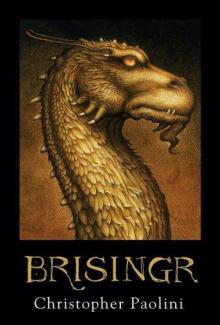
Brisingr. Eragon had taught him that word of power, as he had many of the words in the ancient language during their travels together, in the brief period when they had been friends and allies. For all the stresses of that time—they had been evading the Empire the whole while—it had been one of the most enjoyable chapters of Murtagh’s life. He remembered it with a curious mixture of gratitude, regret, and resentment: a short, shining span of freedom, bracketed by his initial escape from Galbatorix’s tyranny in Urû’baen and his subsequent recapture at the hands of the king’s minions outside of Tronjheim. Following which, Galbatorix had bound him with the ancient language and forced brother to fight brother.
Murtagh found himself clenching his teeth. Brother. It was still strange to think of Eragon as such. Half brother, in truth, for while they shared a mother, Murtagh was the son of Morzan, first and foremost among the Forsworn—the thirteen Dragon Riders who had betrayed their order to aid Galbatorix in his campaign against the Riders over a century ago. I am the traitor son of a traitor, thought Murtagh, and the knowledge burned like acid dripped upon his heart.
Eragon was also the son of a Rider, but in contrast, his father, Brom, had bitterly opposed Galbatorix and all his servants. A fact that had a deeply personal outcome, for it was Brom who had slain Morzan and his dragon when Murtagh was still a young child.
His lip curled. Their family history was as tangled as a briar patch and just as painful to wade through. He wished their mother were still alive that he might question her about it, but she had died shortly after giving birth to Eragon. And while Murtagh knew it was irrational, he could not help but blame Eragon for the loss: one more reason for resentment among so many others.
With an extra-deep breath, Murtagh cleared his lungs and lengthened his strides. It was true that stepping outside the main current of events in Alagaësia had helped calm his mind, but he still felt twisted up inside, him and Thorn both.
It might take years for either of them to unknot, if ever they did.
An owl hooted from a nearby tree, and somewhere in the brush, an animal darted away. Maybe a rabbit. Maybe something worse. A Svartling perhaps. The small, dark-skinned creatures were said to help with household chores if given gifts of bread and milk, but they were also said to treat travelers with cruel and often dangerous tricks.
Whatever the sound, Murtagh didn’t want to meet its author in the middle of a night-bound field.
He slowed as he climbed the hill where they’d landed earlier, weaving between the crags of rock and the thickets of hordebrush.
At the crest, he found Thorn crouched, ready to spring into the air. The dragon’s eyes outshone the werelight, and his scales flashed and flared with renewed brilliance. Great furrows scarred the earth around him: the tufts of grass torn, hordebrush uprooted, rocks split.
Thorn’s tail twitched when he saw Murtagh, and he shivered with an excess of unburnt energy. A snarl wrinkled his muzzle.
Murtagh eyed the furrows but made no comment.
“I’m fine,” he said. “Seriously.” He turned in a circle, arms outstretched. “The blood isn’t mine.”
Thorn sniffed him and growled slightly before settling back on his haunches. His muzzle smoothed, but Murtagh could still feel his fear, frustration, and anger. I should have come to help you.
“It’s all right. Really.” He stroked Thorn’s neck before continuing to the saddlebags, where he removed Zar’roc, unwrapped the crimson sword, and—with a sense of relief—strapped the weapon to his waist.
“We’d best find somewhere else for the night,” he said, climbing up Thorn’s back to the saddle strapped between the large spikes on the dragon’s shoulders. Once in place, he snuffed the werelight.
Always you stir up the ant-nest cities, said Thorn.
“I know. It’s a bad habit. Let’s go.”
Another growl, and with a great gust of wind and surge of steely muscles, Thorn leaped into the night air, the thud of his wings an invisible hammer blow.
Three more beats carried them into the clouds. The mist was cold against Murtagh’s cheeks, but not unpleasantly so after his run. It tasted of moss and fresh-cut grass and new beginnings.
* * *
Thorn flew east for a seemingly endless while. At last, they descended to settle on a flat-topped knoll with a commanding view over the landscape. Dark though it was, Murtagh could just make out the forest of Du Weldenvarden farther to the south—a long black smear that extended across the land, like a great arm pointing back toward Ceunon.
The cold stung his skin as he dropped his cloak and pulled off his bloodstained shirt, trying to avoid touching the spots of gore. “Hvitra,” he murmured as he imposed his will on the garment.
The cloth shimmered slightly, and the blotches of red faded.
Murtagh stroked the linen. It looked clean enough, but he still intended to wash the shirt before he wore it again.
He stored the shirt in a saddlebag and removed his one other garment: a thick woolen top—knitted, not woven—dyed a dark brown with interlaced patterns of red along the wrists and neck. The wool was itchy, but it was his preferred wear for flying, as it was far warmer than the linen.
Eager to cover his skin, he donned the top and again wrapped himself in his cloak.
Since a fire might draw attention, Thorn curled into a tight ball, nose to tail, and Murtagh crawled under his right wing and laid out his bedroll next to the smooth scales of Thorn’s underbelly.
Was it worth it? Thorn asked.
“I think so,” said Murtagh. Opening his mind more than felt safe around strangers, he shared his full memories of Ceunon.
They were not very good, said Thorn, fixing on an image of Sarros’s guards.
“No, they weren’t. Lucky for me.”
A faint growl, and the dragon drew his wing tighter around Murtagh. I see now there is a storm set before us.
“But how big, how bad? We still don’t know.”
But it exists.
“Yes.”
Thorn’s plated eyelid closed and opened with a slight nack. You wish to fly into the storm.
“Maybe not into it, but toward it, yes. What say you?”
The dragon coughed with his peculiar laugh. That we should take the stone to Tronjheim and have the dwarves carve it into something pretty for us.
Murtagh snorted. “With our heads on pikes to watch?”
A faint scent of dragon smoke filled the space around them as a thread of crimson flame flickered in Thorn’s nostrils. No? Then I say we should sleep and speak of it in the morning.
“I suppose you’re right.”
Behind him, Thorn’s belly vibrated with a low hum, and Murtagh crossed his arms and let his chin sink to his chest. Underneath the wing, all was still, and it felt as if he and Thorn were the only two creatures in existence.
Before sleep took him, Murtagh did as was his nightly habit and, in a silent voice, spoke the words in the ancient language that were his true name. Hearing them was never easy; to know your true name was to know your faults as surely as your virtues. Yet he said the name every day so as to be assured that he still understood his own nature and that no one besides Thorn held claim over him. For a true name granted power to those who heard it, and even as a magician might command an object with the proper words, so too might they command a person.
As Murtagh and Thorn had learned to their sorrow and despair during their subjugation in Urû’baen.
Thorn too spoke his true name, a deep singing sound that made Murtagh’s skin feel as if laved with warm water. Then the day’s tensions ebbed from their limbs, and they fell into close slumber.
* * *
Morning brought freezing fog from the ocean and a thick layer of feathered frost. Ice crystals cracked loose as Murtagh crawled out from under Thorn’s wing and squinted toward the pale disk of the rising sun, thin and rose pink above the edge of Du Weldenvarden. Streamers of mist ribboned upward from the treetops, the entire forest steaming with stored warmth from the previous day.
Murtagh shivered and pulled his cloak closer. The morning cold never got any easier.