Consider this, p.15
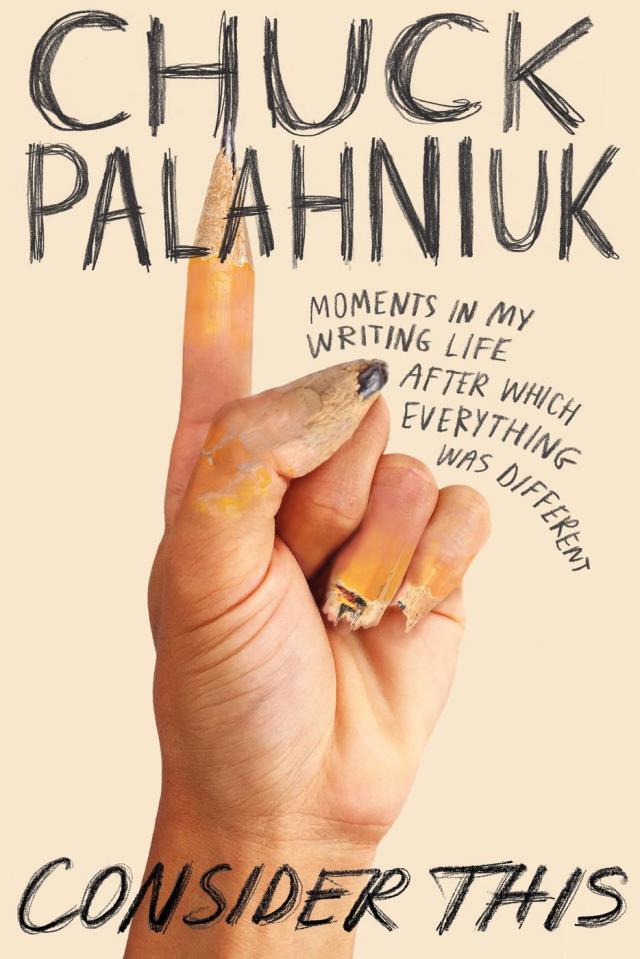
Consider This,
p.15


Give the monkey mind a big arbitrary task that will keep it busy. By inventing a fictional crisis, you’re asking the robot to compute pi to the last digit. And not only does the monkey mind have to resolve the problem, it’s also required to create and develop the problem. When you harness that chattering, problem-solving little voice in your head, a strange sense of peace takes over your life.
If you’re a worrier, writing can make your nervous anxiety into an asset.
Why: The Little-Big Stuff
The Pacific Northwest of the United States is lousy with beavers. Beavers denuding watersheds. Beavers gnawing down newly planted saplings. This is a century after trappers had driven the beaver almost to extinction in order to supply pelts for beaver-fur hats. What saved the beaver? Not an animal rights campaign or protests. No endangered species litigation. No, what rescued the local beavers was a shift in fashion.
Silk hats came into style. Beaver became passé. Here’s just one example of how a seemingly foppish, silly change in the narrative—Nobody wears beaver anymore!—can model a new way of being. Fiction can offer a new way to live, with new goals and values that serve readers better than what’s currently in place.
Why: The Big-Big Stuff
A friend of mine told me about his father dying. My friend sat at his father’s deathbed with a tape recorder and prompted him to tell old family stories for posterity. Near the end, it was just the two of them and the tape recorder, my friend Rick coaxing his dad to keep talking. A point came when his father paused and said, “I know you want more stories, but I need to see what Charlie wants.”
He said his brother Charlie, Rick’s uncle, had been standing in the corner of the room waiting patiently for some time. Of course, to Rick the corner in question looked empty. It was only Rick and his father in the room. Plus, his uncle had been dead a long time. He waited as his father bid Charlie hello and asked his business. And at that point Rick’s father, without another word, closed his eyes and died.
The scene is recorded, but Rick has never had the nerve to rewind and listen to the tape.
I love to tell that anecdote because it attracts stories so similar. Lisa tells of her brother’s deathbed, where his dog began to howl at the moment of his demise. The dog fell silent, but gazed upward at something, then turned and seemed to follow this something, always gazing up at the ceiling, through room after room until the dog reached the open back door. There the dog stood on the porch and stared as if following the path of something into the sky.
In school I took Ecstasy with some friends and went out clubbing in Vancouver, British Columbia. This was pre–World’s Fair Vancouver, when it was cheap, and flophouse hotels lined Granville Street. We were a bunch of kids too buzzed to sleep, sitting around a dark hotel room, each telling about the strangest things that had happened in his life so far. A friend, Franz, whom I hadn’t met until my junior year, talked about the summer his parents had sent him to work for family friends. He’d lived in Butte, Montana, but they sent him four hundred miles west to work at a florist shop. He lived with the owners, and one morning before dawn they loaded a fleet of vans with flowers and took off into the dark.
They drove into the desert, a wasteland of sand and sagebrush, until they arrived at an isolated railroad siding. No train, just train tracks that appeared out of the darkness. They waited. As dawn lit up the horizon an Amtrak passenger train appeared. It stopped beside their vans, and Franz’s boss instructed his crew to decorate the train. They draped swags of flowers down the sides of the railcars and hung wreaths of flowers on the locomotive. The passengers were bleary-eyed and grousing about the delay, shouting complaints that Franz could only answer with a shrug.
By now a caravan of automobiles had arrived. A bagpipe player climbed to the top of the locomotive and began to play, there in the first light of day, sand in every direction. In that desert cold that people forget is the flip side to the day’s sweltering heat. A bride emerged from another car, as did a groom, a wedding party. Franz distributed the bouquets and boutonnieres. The wedding party clambered up onto the locomotive along with a minister and joined the bagpipe player, and a wedding took place.
The moment the bride and groom kissed, Franz and his team began to strip the train of flowers. The newlyweds drove off. The caravan followed, and the train got under way for St. Louis.
Hearing this story among my stoned friends in a fleabag hotel, I was astounded. It wasn’t just the Ecstasy, but I thought Franz was pranking me, big time. The wedding he’d described had taken place a decade before, and I’d only known Franz for the past few months. I knew the date of the wedding because I’d been there. It had been my father’s second wedding, and he’d been determined to make it a stunt to annoy my mother who hadn’t remarried since their divorce. I’d been a kid in a denim leisure suit—look it up—and a kid-aged Franz had pinned the white rosebud to my lapel with the scream of bagpipes filling the vast, flat, freezing-cold landscape.
So many years and miles later, he’d be among my best friends at the University of Oregon. What were the chances? This isn’t only my story. It’s the bait or seed I use to coax ever more astonishing stories from people.
This is another reason to bother collecting stories. Because our existence is a constant flow of the impossible, the implausible, the coincidental. And what we see on television and in films must always be diluted to make it “believable.” We’re trained to live in constant denial of the miraculous. And it’s only by telling our stories that we get any sense of how extraordinary human existence actually can be.
To shut yourself off from these stories is to accept the banal version of reality that’s always used to frame advertisements for miracle wrinkle creams and miracle diet pills. It’s as if we’ve denied the real magic of life so that we can sell each other the sham magic of consumer products. Another example of the shop replacing the church.
If you were my student I’d tell you to reject the “believable” and go looking for the actual wonders that surround you. I’d tell you to read “The Harvest” by Amy Hempel and discover all the truth she deemed too fantastic for the reader to accept.
I’d urge you not to use fiction as a vehicle for social engineering. Readers don’t need to be fixed or repaired. Instead, I’d remind you of Tom Spanbauer’s directive: Write about the moment after which everything was different.
A Postcard from the Tour
His coat wasn’t a coat you’d normally see at the Dollar Tree. That’s why I saw it. First in aisle seven at Candles, he appeared again in aisle four at Bath Products, the young man wearing a coat with a stand-up collar, like a little fence, like a wall around his neck. That and the length, a Dr. Zhivago length, hitting his legs below the knee. Then this coat walked around to aisle nine and stood at Household Fasteners. When it showed up in aisle eleven at Gift Wrap, then, then it had to be following me.
It’s a wonderful warm feeling, being watched and pretending you’re not aware of the attention. Being stalked, but in a nice way. It’s the opposite of being a suspected shoplifter, and I’ve had that feeling, too. Plenty of times. No, when you’re a public figure the feeling is like when you’re a little kid, demanding, “Mom, watch me! Mom, are you watching?” The eyes on you are a validation. They turn any ordinary errand—to buy a ribbon and a box to wrap a birthday present—into a graceful performance.
It used to be different. If a television interviewer needed B-roll footage. Told me to relax and walk casually across some grassy lawn, for example, my every step faltered. My arms flailed.
Anymore, the greedy, attention-whore part of me soaks up the spotlight. It bestows upon me a noble calm. Even at the Dollar Tree.
The remarkable coat stood just at the edge of my vision.
We all want to be pursued. The way every dog tries to get chased by other dogs at off-leash. Now the coat’s getting bigger until he’s standing at my elbow. My mouth prepares something gracious to say. Something self-effacing, maybe with dulcet tones of gratitude. These encounters always feel like you’re accepting an Academy Award.
One time, this one time in Barcelona with David Sedaris, I complained that I never knew what to say to readers who approached me. And Sedaris looked at me and shrugged. “Don’t say anything,” he told me. “You’ve shared so much with them through writing. When you meet a reader, it’s your turn to listen.”
David Sedaris
I prepared myself for the shower of accolades. The gushing.
“Mr. Palahniuk?” The coat guy. Young. Shorter than me. “I was at your reading at Broadway Books…”
He had to mean the first time we’d staged the Adult Bedtime Stories. We being Monica Drake, Chelsea Cain, Lidia Yuknavitch, and me. A sold-out crowd had come wearing pajamas and bathrobes as requested. A television station had shot a segment as we’d made everyone run a race around the block. For the Broadway Books event I’d ordered cases of oversize stuffed animals. Carnival-big giraffes. Amusement-park-prize big. Lions and white tigers and the like, so big they dwarfed the adults holding them. Chelsea had bought us all bunny slippers. It was a bitch to run down a sidewalk in bunny slippers.
I was listening.
“The day before that reading,” the coat guy said, “my brother had died.”
I was really listening.
“I was so close to him,” the man said. “I was in shock. But I had a ticket. I didn’t know what else to do. I just went.”
Those words reduced me to nothing but my ears.
“I didn’t know how I could go on with my life,” he said.
What to say wasn’t an issue. All I could do was listen.
“I was standing there,” the man said, “and you gave me a giant stuffed penguin.” He smiled. “Then I saw that life still had some surprises left. Good things could still happen to me.”
Tom always told us, “Write about the moment after which everything is different.”
Our lives are saved by such ridiculous moments. Language isn’t any help. Especially the words part.
Maybe we shook hands then. Who knows? I’m sure we shook hands. A transcendent moment was taking place in the Dollar Tree. Instead of being starry-eyed and tongue-tied, this stranger was the gracious one. I sputtered and stammered. My throat, go figure, but my throat had gotten so tight. I needed to say something. I stood in shock.
He’d stolen my part.
“Language,” as Tom always taught us, “is our second language.”
The young man was about to walk away. Then he was walking away, aisle ten, aisle nine.
I called after him. I wanted to say, “Thank you.”
You have to talk, otherwise your head turns into a cemetery.
I called out, “That is a great coat!”
Reading List: Fiction
In the first writing workshop I attended we were required to read John Gardner’s The Art of Fiction, which we never discussed or referred to in any way. Thank God. Its constant references to classic literature were lost on me. I’ve found that most writers fall into one of two camps. The first rise from academia and write gorgeous stuff with very little plot momentum or drive. The second camp of writers emerge from journalism and use simple, clear language to tell stories rich in action and tension.
My degree is in journalism. My method, journalistic. Instead of reading John Donne I was reading Jacqueline Susann. More people are well read in a lowbrow way, and I wanted this book to appeal to people swamped by books such as Gardner’s. Likewise, the fiction I suggest here will be mostly story collections and short novels. It’s easier to reverse-engineer short fiction. You can hold the total story in your mind and discover the purpose of every word.
In alphabetical order, they are:
Airships by Barry Hannah
Campfires of the Dead by Peter Christopher
Cathedral by Raymond Carver
Drown by Junot Díaz
Faraway Places by Tom Spanbauer
Generation X: Tales for an Accelerated Culture by Douglas Coupland
Heartburn by Nora Ephron
Honored Guest: Stories by Joy Williams
Jesus’ Son by Denis Johnson
Miles from Nowhere by Nami Mun
Slaves of New York by Tama Janowitz
The Acid House by Irvine Welsh
The Collected Stories of Amy Hempel by Amy Hempel
The Folly of Loving Life by Monica Drake
The Ice at the Bottom of the World: Stories by Mark Richard
The Informers by Bret Easton Ellis
The Night in Question: Stories by Tobias Wolff
The Pugilist at Rest: Stories by Thom Jones
Through the Safety Net: Stories by Charles Baxter
A Postcard from the Tour
It was David Scholl who showed me the future. As proof of how small the world is, I’d known David in Portland where he’d been roommates with friends who’d thrown me my first—and I hope last—surprise birthday party. Dave had been among the seven partners who’d originally opened the restaurant Wild Abandon, insisting the plates should be white when other partners wanted to use an eclectic mix of plates and cups from Goodwill. The business had almost closed after failing to withhold enough for payroll taxes. When we’d first met I hadn’t put pen to paper much less joined a writing workshop. Later I’d be an author on tour, and David Scholl would be an executive who traveled the world opening new branches of the Borders bookstore chain. He would be living in Ypsilanti, and when my tour took me through Ann Arbor he would show up for old times’ sake.
Borders asked me to shoot a short video that consisted of browsing through a store and touting the books I recommended as good reads for the upcoming summer. I made them a counteroffer. Instead, I’d pretend to be making a training video about how to prevent “stock shrinkage.” Doing so, I’d select books and tell the camera each was so good it would be a likely target for thieves. Then I’d pretend to shoplift by stuffing the book down my pants, and move on to the next recommendation.
Our tagline was: “Do you have Jesus’ Son in your pants, or are you just happy to see me?” Dave and I worked it out, and afterward he showed me the future.
By this he meant the prototype for the new chain of space-age bookstores Borders would soon be building. This first, full-size mock-up stood in the suburbs, a drive from the original brick Borders in downtown Ann Arbor. The new store would occupy maybe one-eighth the total footprint of a current big-box store. He took me inside a single room, not much larger than a 7-Eleven. A couple of walls held shelves of the current bestsellers, but no other books were present. Instead, a large machine, like an oversize photocopier, would print any book a customer might want. It would be bound in a cover of the customer’s choice. All within a few minutes.
Maybe half of the store’s floor space was dedicated to author appearances. It was all very wood-paneled and carpeted. Rows of chairs faced a screen. Beneath the screen was a sort of built-in desk. “It’s for the LongPen system,” he explained. This was the brainchild of Margaret Atwood, who didn’t want to tour herself into the grave but did want to interact with readers. The way it worked, Atwood—or any writer—could sit at home and present her work to an audience at the store in real time. A camera mounted above the screen would relay the audience to Atwood’s monitor. She could answer questions, read selections. Best of all, and here’s the pen part of LongPen, readers could align their books on this fixed desk and the author could inscribe and sign long-distance.
Atwood or whoever would hold a computer stylus. At Borders a computer-guided pen would descend to the book. Atwood would write whatever, and the system would direct the pen to inscribe and autograph the book.
A video of the reader-author interaction would be archived online for the reader to later download and keep as a souvenir.
The major hurdle, Dave explained, was convincing the world’s authorities on autographs that this remote-controlled signature would constitute an actual, legal autograph. The convincing had taken a few years, but LongPen was finally ruled to be a real autograph. Borders was about to revolutionize the author event.
In these right-size stores around the world authors would be appearing on screens and computers would be signing books. The print-on-demand machine would eliminate the hassles of shipping and stocking books. And Margaret Atwood could stay home in Toronto and not have to drag herself around the world. Dave was justifiably proud. The future was so bright.
And then Borders collapsed.
And then we lost Dave to pancreatic cancer. The problem with loving so many people is that you lose so many.
To Margaret Atwood, I’ll continue to look for you on the road. May your investment in LongPen someday pan out. To date its success has been, for the most part, limited to allowing convicted criminals to do author appearances from prison.
Bless you, David Scholl, may one of your many, many graves always be inside my head.
Reading List: Nonfiction
Be forewarned. I was asked to read at a charity dinner and read the story “Romance” and noticed how one man seated at one table among many tables of well-dressed donors, this man was laughing very hard at the story, particularly at a sad joke about cancer. Go figure, but when I was shown to my seat, it was at this same man’s table. As our salads arrived he described his flight arriving earlier that afternoon. As they’d begun their descent into the Portland airport he’d been drinking a glass of wine while a very chatty woman beside him had said how much she loved wine. She’d loved wine all of her life. She’d enjoyed at least a glass of wine every evening until a few months before. Even back then the smallest sip of wine had begun to burn her throat. Soon the pain was so intense she’d given up drinking altogether. Wine, beer, liquor, it all burned her throat. So…she’d decided that God no longer wanted her to drink alcohol, and that was fine so long as that’s what God wanted. Eyeing the man’s glass of wine, she told him she still wished she could drink.