Consider this, p.16
Consider This,
p.16
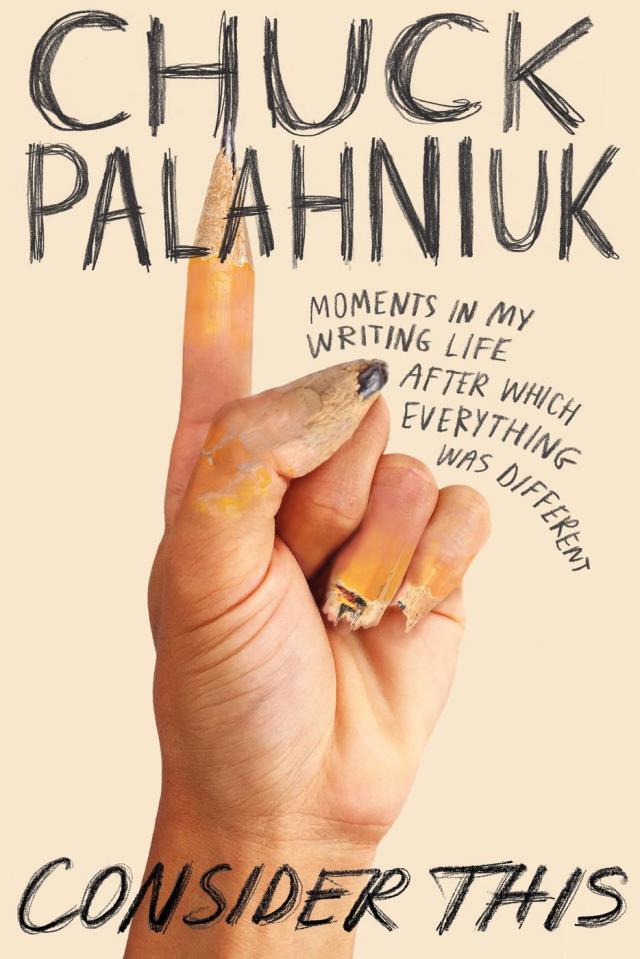


The man at the charity dinner was loud and knew how to work a story. Such people are worth studying. Even if the story doesn’t pan out, you can still pick up tricks in pacing and voice. I listened.
In response to the chatty seatmate on the airplane he’d finished the last of his wine. He’d explained that he was an oncologist who specialized in rare cancers. What she’d just described to him—that burning sensation when she drank alcohol—was what cancer doctors call “a canary indicator.” It was an early and unmistakable sign that she’d developed Hodgkin’s lymphoma. He’d advised her to call her lawyer as soon as the plane landed. Her lawyer, not her doctor, because if the symptoms had begun so long ago she had only a few weeks left to live. She needed to write her will and arrange for her funeral.
He told us that the woman was a lot less chatty after that. He gave her his card, and a day later her primary care physician called him to say, “You’re right. She’ll be dead soon. But you could’ve been a little less of a prick in the way you told her…”
That’s how fast a piece of information can change your perception forever. For the rest of your life, your first sip of alcohol will be about as pleasant as having a biopsy taken. But your second sip—it will taste better than any second sip has ever tasted. That second sip will taste like good health.
The following books will have a similar effect. They will spoil some default part of your thinking, but they will give you a greater appreciation of something you’ve heretofore taken for granted.
Death in Yellowstone by Lee Whittlesey
Forbidden Words: Taboo and the Censoring of Language by Keith Allan and Kate Burridge
From Ritual to Theater: The Human Seriousness of Play by Victor Turner
Hard Core: Power, Pleasure, and the “Frenzy of the Visible” by Linda Williams
MFA vs. NYC edited by Chad Harbach
Page Fright: Foibles and Fetishes of Famous Writers by Harry Bruce
The Gift by Lewis Hyde
The Program Era by Mark McGurl
The Rites of Passage by Arnold van Gennep
The Ritual Process: Structure and Anti-Structure by Victor Turner
The Sovereign Outsider: 19th Century American Literature, (Non-) Discursive Formation and Postanarchist Politics by Mathias Hagen König
Trickster Makes This World by Lewis Hyde
Another Postcard
from the Tour
Every so often I ask myself, “Is this where you stop?” I avoid reading reviews because, good or bad, they mess with my head. Triggering mania or depression. But every so often someone brings one to me, laying the best or worst at my feet. The day Salon posted its response to my book Diary, I asked myself, “Is this where you stop?”
Teaching is always an option. God bless my parents, but when I quit my last real job, at the Freightliner Corporation, where I mostly loved my work and my co-workers for thirteen years, my mother and father insisted I take a withdrawal from the union instead of quitting full out. So I’m still a member in good standing with the autoworkers’ union, with the laminated card to prove it. Writing is a blast, a career beyond anything I’d ever imagined as a kid. But shit happens.
Bad shit, beyond anything even a writer can imagine.
My publisher told me to never tell the story about what went on in San Diego. They promised to provide bodyguards after it happened, and for a while I’d be flanked by security guys who’d whisk me out of stores and into a waiting car the moment a book event was over.
And over the past decade-plus I’ve tried to unpack the San Diego mess. To tweeze out my responsibility in the disaster.
Maybe I showed too much belly. San Diego, I say here, but really it was in El Cajon. But who knows El Cajon? The bookstore in question had hosted Dr. Laura Schlessinger shortly before me, back when Dr. Laura was still a thing. The manager kept telling me, “You’ve got more people than Dr. Laura.” Who’d gotten eight hundred people. In a big store in a shopping center of big-box stores, still daylight, I had to stand in the center of everyone and turn a little to see them all.
Not a couple of words into my blather, I could see people at the edge of the crowd. Certain persons, spaced at more or less equal distance apart, held up large sheets of poster board. The boards were fluorescent hot pink, pale blue, pale green. The people held them in both hands, overhead. They’d written something on these signs, and they kept turning in place, slowly, displaying the messages. Each time I risked looking, a particular sign was turned the wrong way. Was I reading? Answering questions? I forget, but I was giving people these heavy gilded crowns as reward for asking things. Different colors of glass jewels ran around the outside of the crowns, and white satin padded the inside. This was a couple dozen big crowns I’d shipped to the store beforehand. I’d autographed the satin. I thought they looked snazzy.
Between doing something and saying something, I caught sight of a neon poster board sign. It read: DID YOU KNOW THAT CHUCK PALAHNIUK RAPED AND KILLED A NINE-YEAR-OLD BLACK GIRL IN 1987?
This wasn’t just one sign. All the signs held aloft, turning slowly, stationed throughout the bookstore…they all made that claim.
A tricky situation, to say the least. I felt too shocked to take offense. It occurred as some prank. After years watching the Cacophony Society prank whole cities. Like doctoring an Apple billboard that showed a huge close-up of Amelia Earhart so that it read, “Think Doomed.” Or one Easter morning staging a passion play and crucifying a gigantic stuffed pink Easter bunny on a telephone pole immediately outside the front doors of a packed Baptist church. I knew that sometimes pranks can go too far and fall flat, and I didn’t want to harsh on these young aspiring pranksters.
No, I’ve never raped or murdered anyone, black or white, just to settle that question. So I did a callout to the sign holders and asked them to stow the signs, and they did. The event moved on, and someone…somebody asked me what I’d never bring myself to depict in fiction.
My response has always been the same. I’d never depict the senseless torture and killing of an animal. Even in make-believe. The scene in David Foster Wallace’s Girl with Curious Hair where the characters douse the little puppy with lighter fluid and set it on fire and laugh as it runs around a basement screaming until it dies…that had done a number on me. Consensual violence I can get behind, hence Fight Club with all of its structure and rules. But the moment that novel’s characters veered into attacking someone—the mayor’s special envoy on recycling—and the moment we see Marla’s black eye, that’s when I stopped liking the story and could happily bring it to an end.
So I gave my speech about consent and about animals being innocent victims of everything. I showed belly. I showed my belly to the crowd. Then I showed too much belly by reciting a John Irving poem about a beloved dog. Old and dying, the dog was so obedient that as it died and began to lose control of its bowels it painfully dragged its dying self onto a spread-out patch of newspapers so it wouldn’t soil the carpet. And there it died.
By then I was on my back, showing full belly in public. That poem kills me, as does Amy Hempel’s essay “A Full Service Shelter,” written about the volunteer work she does in Manhattan animal shelters. There she describes, as a cost-cutting measure, how each doomed dog is given its lethal injection of phenobarbital in full sight of the heap of dead dogs. The dying dog is dragged by a leash and forced to climb this soft, still-warm heap of dead animals, so that it will die on the pinnacle, atop the previous dog that’s barely died, and all of this brutality is shelter policy because it prevents the risk of back injury to any employee who’d otherwise be forced to lift and carry any fully dead animal.
Fuck me. I was stupid. I showed full belly, something no one onstage is supposed to do. Instead of making the emotion occur in my audience I got myself choked up. With all this talk about the suffering of poor beasts, I’d gotten misty-eyed and tight throated. A self-indulgent, cardinal no-no for the writer of Fight Club.
My point is that I can own what happened. I called down the bad mojo on myself.
The blah-blah presentation ended, and the book signing began. With such a big turnout the store’s staff had to run the registers. I sat alone in a back corner, and a line of patient readers queued up to say hello. Among them was the group who’d brought the rape/murder signs. I asked about their motive, and they seemed sheepishly to say they thought it would be funny in a Project Mayhem way. A prank. No point in shaming them. Shit like this happens when you’re pushing the envelope. I’ve pulled some boneheaded moments, too, told some cheap-shot jokes and been booed by vast crowds. We shook hands.
One among them gave me a book to sign. A shaggy blond beach type, maybe he was a surfer? He looked like a surfer. A surfer or a skater, he stepped forward like their leader and gave me a novel by Don DeLillo.
The book’s cover was defaced with scribbles and hash marks in thick black felt-tipped pen, but it was still a DeLillo book. People bring me all kinds of books to sign. Usually Bibles. Usually they ask me to write “I suck Satan’s cock” in their family Bible and to sign it. More than a handful of these Bibles looked to be ancient, bound in leather and gilded, with Dore illustrations and faded family genealogies, so elegant they look positively Gutenberg. And I always give a polite no. A handshake follows. There’s no game in embarrassing anyone.
As usual, I said I didn’t sign books by other authors.
And the blond said, “This is one of your books.”
This is while hundreds of people wait in a line that snakes up and down the aisles of bookshelves.
I point out that Don DeLillo’s name is on the cover.
The guy insists I sign. I don’t sign. The surfer and his crew of pranksters depart. No big deal.
It can occur as a tragedy, to meet a writer. Physical proof of the author means you’ll never meet the characters you’ve come to accept as friends or heroes. I’ve experienced this so many times that I avoid meeting people whose work I enjoy. And understanding this disappointment, I try to control the damage.
Me, the faggoty, animal-loving, poetry-spouting, choked-up writer who turned out not to be the living embodiment of Tyler Durden, I got back to meeting people and signing books. People step up to the table with such excitement, it’s impossible not to try and match it smile for smile. Hug for hug. Some readers have hyped themselves almost to tears. The quiet people have to be coaxed to say hello. Pictures have to be posed for. I ask questions and listen for key words I can mimic in funny inscriptions. A person is meeting me for the first time, and I try to meet each as if he or she is the only person I’m meeting that evening. This leaves no attention for anything beyond the little bubble of me and the person to meet next.
For years my longest signing had been at Barbara’s Bookstore in Oak Park, Illinois. Eight hours. Torture at the time. Now eight hours would be light duty. My book signings regularly stretch to twelve and fourteen hours. David Sedaris signs books until after four in the morning. Stephen King will sign only three or four hundred items and bookstores hold a lottery to choose the lucky readers.
Do you see what I’ve done here? I’ve shifted to big voice, describing similar events in a general way to suggest time passing that night in El Cajon. One person I do remember, a mom came forward in line to thank me. I’d made presents and sent them to her teenage son and daughter. At first she seemed angry, but she was actually a little speechless that a stranger would do something that would make her children so happy.
She hadn’t stepped away a moment before the fire alarms began to wail. Something soft struck me on the chest. Soft thuds pelted down on the signing table and on the carpet around me. With that backdrop of loud sirens, only the few people at the head of the line could see what had happened. Most of the line snaked into the distance. The store staff was busy, far away, at the cash registers.
People who witnessed the evening have since created an online discussion thread. They report that the blond young man—the prankster with the mutilated DeLillo novel—when I’d refused to sign his book he’d left the store with a compatriot, riding a motorcycle. Soon after, the two had come back, parking the motorcycle on the sidewalk directly in front of the store’s main doorway. They’d returned carrying a large mailing tube.
According to witnesses, the two men had swung the tube to launch whatever was packed inside it.
White mice had struck me. The mailing tube had been filled with those pink-nosed, red-eyed, little white mice that pet stores sell to feed snakes. These mice hit me. They rained down on the floor and the table with such force. They weren’t dead, but they were dying. Their bodies twisting slowly. Their necks and spines, broken on impact. Their legs trembled and blood ran from their mouths. People stood in line, stunned. Sirens wailed.
There was nothing to do but apologize for the delay. No one came to help. I started to gather the mice. In my hands, some arched their backs for the last time, twitched against my palms and died. Some were dead but still warm by the time I found them shattered against bookshelves and scattered down aisles. There were so many. I collected them all and carried them to a stockroom to lie in peace.
The young men who’d thrown them had escaped through the fire exits. That explained the alarms. Fire alarms. Once I’d moved the dead and dying little animals to the back, the store fell quiet. Crowded but silent. Some four hundred people still stood in line, and few had had a clear view of what had taken place. Blood smeared my hands and spotted the signing table. In the bathroom I washed. I went back and finished my job.
According to the witnesses, no one realized what would happen until it was too late. No one could stop the action so they’d descended on the motorcycle and torn it to pieces. No police were called. The men escaped on foot. I’m still in contact with the booksellers, and they tell me the miscreants were locals. On occasion, the blond man still continues to drop into the store. He must be nearing middle age.
Since then I collect stories about blood at author appearances. Like the time in Seattle where fans bullied Stephen King into smearing his blood in fifteen thousand books. Or the kid at Tower Records who slashed his wrists with a razor blade while standing next to Clive Barker, shouting, “Clive, this is for you!” Or in New Orleans, at the venerated music venue Tipitina’s, when a young man fell and fractured his skull during my reading of “Guts,” the bookseller later explaining to me that after the decades of punk rock shows and heavy metal mosh pits the club had hosted, a book reading had caused the worst injury the venue had ever seen. That same night Monica Drake had appeared with me, making the crowd laugh so hard that no one noticed when she cut her leg on a piece of stage equipment. We’d all been so jazzed with excitement that none of us noticed how we were slipping around in a puddle of Monica’s blood all night.
Such stories are a comfort.
That, and sometimes reader pushback amounts to payback. A good author bullies the reader, when justified. The author’s job is to challenge and frighten the reader when necessary, at least to surprise the reader. Often to charm the reader into experiencing something he or she would never voluntarily submit to. It should come as no shock that an offended or bullied reader would seek revenge. There is that.
My publisher advised me never to tell the story about the dead mice. They were afraid of copycats. For a while I got bodyguards. I felt like Bret Easton Ellis.
I asked myself, “Is this where I stop?” Now I’ve told the story about the mice.
I didn’t stop.
Troubleshooting Your Fiction
When I played high school basketball, a coach made me wear ankle weights. These consisted of several pounds of lead buckshot sewn into a leather pouch that fastened with Velcro. Only bell-bottom jeans could hide these fat collars strapped around my ankles, and I wore them from waking until bedtime, every day for months.
Later in life I hired a trainer who made me tie a string around my waist and wear it under my clothes at belly-button height. The ankle weights chafed and made my feet sweat. The string left a red groove by the end of each day. But my legs got stronger, and I learned to always (usually) engage my core muscles.
So if you were my student I’d tell you, yes, someday you can go back to using “is” and “has” verbs, as well as abstract measurements and “thought” verbs. You can occasionally use passive voice and summaries. Eventually you can use the received text of clichés, if appropriate. But first I want you not to. For the next couple of years, at least, I want you to follow the rules of this book. By doing so you’ll be forced to invent new ways of telling a story. You’ll learn to stay within a scene and move your characters through their world in a physical way. Above all, you’ll grow beyond the easy “default” ways of writing that rob your work of its power.
Writing is nothing if not problem solving. These rules that hobble you now will ultimately strengthen your work.
The following is a quick diagnostic check. Find what seems to be your weakness, and consider the possible cause and solution.
Problem:
Your narrative voice is boring.
Consider:
Read it aloud. Do you vary sentence length and construction? Do you balance dialogue with physical action and gesture? Do you mix different textures of communication?
Problem:
You fail to build tension.
Consider:
Have you established a clock? Do you limit and revisit your story elements (settings, characters, objects)? Does introducing new elements force you to use passive verbs such as “is” and “has”?
Do you use tennis-match dialogue that instantly settles the tension raised by every question?