Era of ruin, p.1
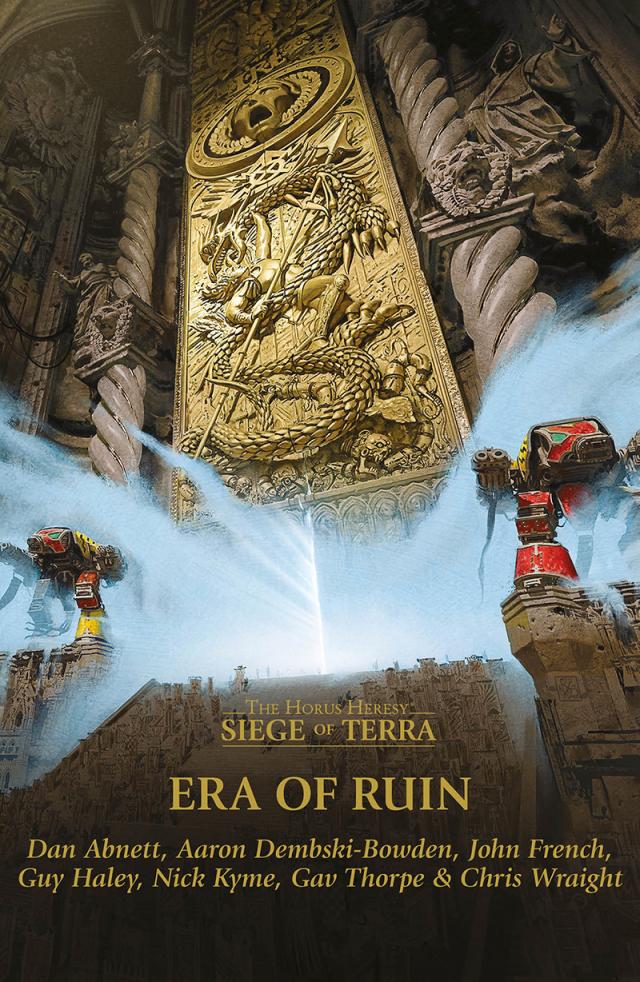
Era of Ruin,
p.1


BLACK LIBRARY
Books | eBooks | MP3 Audiobooks
To see the full Black Library range visit
blacklibrary.com and warhammer.com
Contents
Cover
The Horus Heresy: Siege of Terra
Era of Ruin
Introduction
ANGELS OF ANOTHER AGE
Quote One
FULGURITE
FRAGMENTS (ALL WE HAVE LEFT)
EX LIBRIS
Quote Two
SYSTEM PURGE
AFTER THE DAWN, THE DARKNESS
HOMEBOUND
THE CARRION LORD OF THE IMPERIUM
About the Authors
An Extract from ‘Dark Imperium’
Backlist
A Black Library Publication
eBook license
It is a time of legend.
The galaxy is in flames. The Emperor’s glorious vision for humanity is in ruins. His favoured son, Horus, has turned from his father’s light and embraced Chaos.
His armies, the mighty and redoubtable Space Marines, are locked in a brutal civil war. Once, these ultimate warriors fought side by side as brothers, protecting the galaxy and bringing mankind back into the Emperor’s light. Now they are divided.
Some remain loyal to the Emperor, whilst others have sided with the Warmaster. Pre-eminent amongst them, the leaders of their thousands-strong Legions, are the primarchs. Magnificent, superhuman beings, they are the crowning achievement of the Emperor’s genetic science. Thrust into battle against one another, victory is uncertain for either side.
Worlds are burning. At Isstvan V, Horus dealt a vicious blow and three loyal Legions were all but destroyed. War was begun, a conflict that will engulf all mankind in fire. Treachery and betrayal have usurped honour and nobility. Assassins lurk in every shadow. Armies are gathering. All must choose a side or die.
Horus musters his armada, Terra itself the object of his wrath. Seated upon the Golden Throne, the Emperor waits for his wayward son to return. But his true enemy is Chaos, a primordial force that seeks to enslave mankind to its capricious whims.
The screams of the innocent, the pleas of the righteous resound to the cruel laughter of Dark Gods. Suffering and damnation await all should the Emperor fail and the war be lost.
The end is here. The skies darken, colossal armies gather.
For the fate of the Throneworld, for the fate of mankind itself…
The Siege of Terra has begun.
INTRODUCTION
Welcome, dear reader, to the Era of Ruin anthology.
Presented here is the final instalment of the Horus Heresy series. Those words feel strange to write. In scale and longevity, the Horus Heresy is one of the most ambitious science fantasy narratives ever published. Its concept dates back to 1988, when it was first mentioned in Chapter Approved: Book of the Astronomican. Since then, Black Library has developed the story, and over the last two decades a score of different writers have contributed countless words, threading together an epic tapestry of a bloody and chaotic civil war.
It took fifty-four books to finally arrive at the epochal battle of that war, the Siege of Terra. Given the weight of its history, it was both curious and expected that we all so eagerly anticipated an ending that had already been long established. And though the duel between the Emperor and Horus was a long time coming, it was undoubtedly well worth the wait.
The story of the Heresy has always centred around a clash of gods, powerful beings with enormous influence and agency, battling for the fate of the universe. Indeed, when asked to epitomise the Horus Heresy, often the first thing that comes to mind is Adrian Smith’s iconic artwork depicting the confrontation between father and son. Ultimately, it is that infamous moment that the Heresy boils down to. Though we have picked up a few meaningful extras along the way…
To me, this is a crucial part of what has made the Horus Heresy so enjoyable. Every single character is on a unique journey of self-discovery and self-assertion, fighting their own battles, getting lost, forging new and different paths. Not one character ends the series how they began it, and many are fundamentally changed. Of course, the gods and demigods needed to be balanced with more relatable, lower-agency characters, especially to demonstrate the impact these larger-than-life figures wrought on the world around them. But so many of these ‘secondary’ characters quickly became fascinating in their own right, and naturally this led to the issue of what to do with them as the series came to a close.
The Siege of Terra is the Heresy in a microcosm. That grand tapestry of blood and strife is condensed into one, relatively speaking, small warzone. Of course the Imperial Palace is utterly enormous! But it’s still dwarfed when compared to, say, the five hundred worlds of Ultramar… When such a space is filled with the mightiest armies the galaxy has ever seen, alongside their demigod warlords – all of whom demand their minute in the limelight – it becomes impossible to tie off every last strand. So, due to the inexorable march of the narrative, and despite the completion of the Siege of Terra, there remained beloved characters who hadn’t had their final moment. This didn’t feel right. And so, the Era of Ruin anthology was born.
At its heart, this is a collection of endings. It’s an earnest goodbye to a series we have all come to cherish for differing reasons. It is not exhaustive, but it does showcase a strata of memorable characters and how they cope with the end of an era. For many, like Ilya Ravallion or Diocletian Coros, the siege is over, and they must find their place amidst the shattered world they now inhabit. Others, like Gaellon and Baeron, must come to terms with the end of a more spiritual journey. Yet, Era of Ruin is so-called because it typifies what is to come. Decay and stagnation define the impending 40K setting, and each story in this series plays its part in foreshadowing those horrors. After all, the Horus Heresy was originally viewed as a mere prequel to Warhammer 40,000. Well, what a legacy that prequel became.
It is with bittersweet pleasure, and more than a touch of gratitude, that I offer you this final farewell to the series that has guided us all through the fiercest conflicts, the toughest betrayals, the most poignant of reunions, and some truly remarkable triumphs.
It has certainly been quite the journey.
Jacob Youngs, Nottingham,
August 2023
ANGELS OF ANOTHER AGE
JOHN FRENCH
‘Pity the dead. Pity that they will not see the ages to come, and all the wonders that their acts have wrought.’
– Words etched on the Stones of Remembrance,
Dome of Unity, the Imperial Palace, Terra
Kystos Gaellon is on the remains of Marmax South, Section 52, Hold Point 78, when his father dies. He’s been there for thirty-five minutes. That time is an estimate. Everything in the Wasteland is an estimate. He has started to think of the Wasteland as a state rather than a description: a land wasted, burnt, and starved, and cut, and beaten down to the root. A place where dead souls walked.
Gaellon came to Hold Point 78 with two other warriors. Neither of them is of his Legion. There is… There is Su’lok of the White Scars, and Nerron of the Imperial Fists. Gaellon must repeat their names under his breath to remember them. The Wasteland takes names, just like it takes everything else. None of them have any ammunition left. Gaellon is a Blood Angel. He has been killing with his sword alone for… a length of time that he cannot estimate. Su’lok has a chainglaive, but the teeth have broken and the mechanism that turns them has jammed. Nerron has a mace that hangs in his one arm. The other side of the son of Dorn’s body is a ruin. Every armour plate from thigh to shoulder is shattered. Burnt flesh is visible in the gaps, and bits of bone through the flesh. He has no arm from the shoulder down – the Wasteland took it. Soon it will come for the rest of him.
Hold Point 78 was one of the many emplacements built during Rogal Dorn’s fortification of the Palace. It was part of the line of battlements called Marmax South. It had been a district of habs and institutes for the mortals who studied the Great Crusade. The war masons kept the shells of the buildings and filled them with rockcrete to make a string of artificial cliffs. On top of those they set crenellations and gun emplacements. Now the whole line is rubble, and Hold Point 78 is a tor of smashed rockcrete and girders rising from the cratered ground. The only reason Gaellon knows where they are is because one of the remaining wall sections still has its line-location code stencilled on it.
‘You know this place?’ asks Su’lok. The White Scar has come to stand beside Gaellon.
‘I was here before,’ says Gaellon without looking around. ‘It’s part of the Southern Marmax line.’
Su’lok grunts at that. In the recent past he would have asked how it was possible that they had found themselves on the edge of the Anterior defences that were several hundred kilometres from where they had been fighting. Now all of them know there is no point asking the question. This is the Wasteland. Time, space and distance no longer mean what they once did here.
‘I was on this section of the line,’ says Gaellon, quietly, half to himself. For a second he thinks of Baeron. If this really is Hold Point 78, then his brother died near here. The thought should not surprise him; Gaellon is rarer now for being amongst the living. The Imperial Palace that was, and the Wasteland it has become are a land of dead angels. To be alive here and now is the aberration.
The land around them is rippled o
chre as though a soft blanket of dust has been laid over the devastation. The sky is a rust haze which blends with the land at the point where there should be a horizon. Gaellon lifts a finger and slides it across the distance. In his mind he sees a brush dip into ink and then drag across parchment.
‘What are you doing?’ asks Su’lok. The White Scar is looking hard at Gaellon. He’s watching to see if the Blood Angel is still on the right side of sanity. That’s what the Wasteland does – it eats reality and then it eats trust.
‘A brother died close to here,’ says Gaellon. ‘I was thinking how he would have looked at this.’
In his mind the brush dips in another shade of ink.
‘Kinder to have died already than to see things come to this,’ says Su’lok, and spits. The White Scar has not had a helm since they broke out of Hasgard Fort. Tracks of dried blood mark his scalp and cheeks.
‘Something is coming!’ It’s Nerron, who is looking out from next to a slumped firing lip. The son of Dorn is standing straight, refusing the offer of the tumbled wall as a support. Blood is slowly oozing from his wounded side. Gaellon and Su’lok go to stand beside him.
‘I don’t see anything,’ says Su’lok.
Nerron does not answer. He is scanning the murk, helm moving from side to side. There are cracks in his eye-lenses, and a cobweb of fractures across the helm’s crown. Whatever he saw before is gone now. That does not mean it was not there, or that it’s not there now. All it means is that the Wasteland won’t let them see it yet.
The world has been empty and still for Gaellon for the last three hours. Both the emptiness and time are subjective, he knows. They could have walked past battle and slaughter and not realised it. Similarly, it is not actually quiet. It just seems that way to them. These are the last moments of the greatest battle ever fought by humanity. The Eternity Gate has closed. The Legions and allies of Horus are in ascendancy. Bombs are falling in a deluge. Titans are roaming the maze of ruins that were once cities. Billions remain alive outside the last defences, waiting to die or fighting on in defiance. All that slaughter comes with noise: the screams of the dying, the shriek of weapons inhaling to fire, the thunder of falling towers. That sound is not here. Not in this part of the Wasteland.
Gaellon squints at the distance, and murmurs to himself.
‘A heap of broken images, where the sun beats, and the dead tree gives not shelter…’
‘What?’ snaps Su’lok.
Gaellon shakes his head but does not look around.
‘A fragment of ancient poetry,’ he said. ‘It came to mind. I am not sure why.’
Su’lok grunts.
‘The sons of Sanguinius are a strange breed.’
‘I recall many poets of great worth amongst the Fifth Legion,’ says Gaellon.
‘There are, but this war demands laughter and scorn and nothing else.’
‘There must always be art and beauty, even when all seems broken.’
‘Are all of your kind high-minded poets then?’
‘No,’ says Gaellon dryly. ‘Some of us are painters.’
Su’lok laughs then. The sound cracks through the quiet like the fall of a lightning bolt.
Gaellon is about to speak again when he sees movement in the distance. Su’lok sees it at the same time and points.
‘There!’ says the White Scar.
Six hundred and forty metres out, a ripple rises in the ochre-dust softness of the landscape. Gaellon activates the power field on his sword. The lightning crackles down the tongue of steel. Nerron and Su’lok do not move. Their weapons have no power. None of them posture or seek cover. They are here to sell their lives.
The ripple in the dust is gathering pace, broadening, curling into a crest of powdered red.
Gaellon feels the need to say something, to add a frayed piece of poetry to the moment. He is a poet as well as a warrior. All the Blood Angels are masters of a craft or art. Words are his, and to give them voice now, in the face of the slow murder of this world, seems as great an act of defiance as drawing a sword.
He opens his mouth…
Then he feels his father die.
Black fills his sight. Pain steals his words.
There is blood falling in the dark somewhere far away. Blood and feathers.
‘May I confess something?’ Baeron asked. The vox crackled with static. It had been doing that more and more in the last few days. The cheers for the victory at Saturnine were only a few hours old, but there had already been an assault on the lines since then. The fresh dead lay in steaming heaps on the maze of obstacles and wire at the base of the Marmax South fortifications. Two kilometres of crenellated wall separated the two Blood Angels, but the vox let them talk and their helm sight let them pick each other out across the distance. Two figures in scuffed and scratched crimson amid the grey rockcrete and clusters of drab human troopers.
‘Confess what?’ Gaellon asked. Baeron cocked his head and looked away. It was a gesture that he had made when they were both youths scrabbling for survival in the dust of Baal. It meant the same now as it had then. ‘You are thinking of the future again,’ Gaellon said. Baeron did not answer and kept his gaze on the horizon.
It was dawn. The clouds and dust had peeled back from the fresh blue of the sky. The towers and buildings of the Anterior stood out against the gold of the new day. Plumes of smoke rose to smudge the sun, as if someone had trailed black ink into orange. It was as though the skies of Terra were gilding the victories of the day before. Even the smell had changed. A fresh wind had diluted the reek of spilled fuel, corpses and burning plastek. For this small slice of time, one could almost dream of peace. It would be a brief moment, Gaellon knew. Another attack would come soon. As line adjutants both Baeron and Gaellon were linked into the main command interface. They knew that the analysts for this section had said that it was likely to suffer persistent main-force attacks in perpetuity. In perpetuity – the battle had given the phrase a new meaning: for the duration of conflict, until the enemy broke through, or were defeated. The war had redefined eternity just as it had everything else.
There were not enough Legion warriors to hold this line. That was a fact. So, Sanguinius had placed hundreds of his veterans amongst the human units. One angel to ten thousand humans, sometimes more. They were there to ensure smooth execution of commands, but more than anything else they were there to fight and be seen. The soldiers in their trenches and gun emplacements would hear the war cries of Baal, and see that angels fought beside them. The moments where the line adjutants would see each other were rare. The dawn of that morning was one such moment.
‘I am still waiting for a confession,’ said Gaellon.
‘I find myself thinking what the echo of these times shall be,’ Baeron said. ‘All times have an echo. The plagues that almost killed mankind before it had even left this earth led to the flowering of art that we struggle to match. Even the Imperium is a work of art crafted from the trauma of Old Night.’
‘And you are wondering what will come from these times?’
‘Attack incoming.’ The voice from the command bastion came from the vox. The human officer’s voice was calm, but the signal squawked with static. ‘All line sections. Marmax South. Attack incoming. Main force, infantry, armour, full air-support element. Expect contact imminent.’
The only answer that Baeron would give to the last question Gaellon asked him was an echo of the shout he bellowed to the human soldiers around him.
‘Rise! Weapons ready! Rise!’
Can a death echo across the sky? Can it fill an instant, and an eternity? An absence that collapses the world around it. An implosion in being.
To others, the death of Sanguinius, primarch of the IX Legion, the Archangel of Baal, is not yet a fact. It will become real to them soon. Rogal Dorn and the Emperor will see the broken Angel, and the blood that flows from the wounds. For others, it will never be a physical truth. It will be words coming from a mouth struggling to speak…
‘Sanguinius is dead…’
It will become a fact printed on a signal scroll…