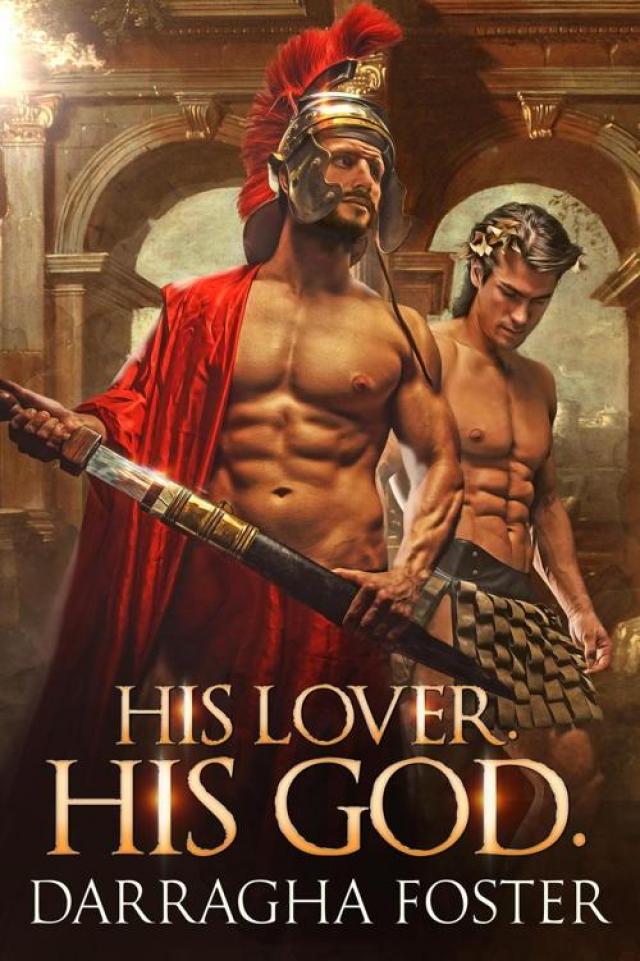
His lover his god, p.6
His Lover. His God.,
p.6


The same tourist spoke out. “How many times have you visited, son?”
“I lived here for quite some time. Years ago.”
“You don’t look older than twenty. Your parents live here?”
“No. My parents are Greek. I...came here for a job. Then fell in love and stayed.”
“Where’s your lady friend now?”
Antinous looked at the tourist and without hesitation replied, “I am gay.” He motioned toward Adrian. “That is the correct word, is it not?”
Adrian nodded.
The red-faced tourist settled back into his seat. “Well, good for you.”
Antinous frowned. “Is this how things are accepted now? With indifference?”
“If you’re lucky, sure. Sometimes non-traditional lifestyles are an uphill battle.”
“The gods of Egypt and Rome are no longer worshipped here, are they? I recall that Abrahamic faiths have taken precedence. Is it within those faiths that being gay is taboo?”
Adrian nodded. “Often, but love is love. And that is a plain and simple truth.”
“I loved Hadrian.”
“I know.”
Antinous continued. “This is the anniversary of my death. I feel the pull of the Nile, my lungs burning as they filled, and the blackness of death overtake me. He was my last thought before I passed into the arms of the underworld.”
“He held you in his arms along the bank of the Nile and wept. Caesar wept. His overt display of mourning was not well accepted by Rome. Many who wished him to be a more active husband to Vibia Sabina ridiculed him harshly, but in that grief, you became legend.”
“I became a god.”
“Your influence still holds after nearly two thousand years. Statues, poems, admirers—even a constellation and a flower.”
“The statues make me too young in appearance. I assure you I had pubic hair when Hadrian and I began our life together. I think, perhaps, that the sculpturers of the day merely worked with tradition and not reality. It was the Greek style for art. Hadrian did not have boy lovers.”
“I saw that—in the dream.”
“It wasn’t a dream, Adrian. It was a real. I took you there.”
“You are called beautiful boy by many. And right now, it’s better I do not dwell on this time travel romance you’ve set in motion.”
“I was a man. I am a man.”
“But you are beautiful.”
“I believe that we can choose to live here—or then. I’m not quite certain of all the parameters yet.”
“My life is here,” Adrian replied.
“Then, if you will have me—after whatever courtship is necessary in this era—my life shall be here too.”
Chapter Eleven
Adrian tuned out the chatter of his guests as his driver sped through the streets to the Cairo Church of Antinous. The lifeforce radiating from Antinous nearly had him gobsmacked. He tried to listen to the tonal inflections of a question from the others in order to be an accommodating guide, but truly, was lost in the aura of a god. He pulled his thoughts away from those self-depreciating ones of self-loathing and lack of self-worth. If I am Hadrian reincarnated, then within me is all he was. The strength of Rome and love beyond measure. I am being given a gift. The gift of a lifetime. Of a dozen lifetimes. Please don’t be a trickster god. Please.
The temple of Antinous was small and built into the side of an alley in Old Cairo. It had a non-descript sign in three languages—Egyptian Arabic, English, and Greek. “Church of Antinous.” The chief priest lived in a tidy apartment above the sanctuary and kept a low profile. A homosexual in Egypt...there was need to be secretive. Though not expressly unlawful under Egyptian law, certain groups did not express acceptance. The priest ran a performing arts troupe, which reenacted the events of Antinous’ death along the Nile—very close to where Hadrian was said to have pulled the body of his lover ashore. It was quite a passion play.
Adrian put on his game face and led the tourists into the building. “And this is the Cairo Antinous temple. Songs are sung and his story retold in this place. A candle is lit 24/7 and the priest and a few others make their way to the shrine at El-Shaikh Ebada to make offerings.” Adrian reverently left the small vials of salt and water at the offering table by the door. “Because of the significance of today’s date, they will perform a passion play—a reenactment of Antinous’ death and subsequent deification. There’s really nothing left of the original city. Everything was torn down to create other structures. Napoleon did a number on it. We can see the shrine and the outline of what the great circus of Antinoöpolis was once. Long ago. There are, naturally, beautiful mosques and some interesting apartments overlooking the Nile. Not a huge population. Street vendors. It’s a mud city—but the ruins of Antinoöpolis do exist. Oh, and should you come here at night. A telescope has been set up on the roof that one may catch sight of the constellation Aquila, which is the modern-day constellation of Antinous.”
“Welcome! We offer water and prayers to Antinous, and he is remembered.” It was the priest. He wore a simple white kaftan without adornment. “I am Nasser, priest of Antinous. Would you like to hear a prayer?”
The tour group murmured positively. Adrian moved next to Antinous, who whispered, “Well, I do hope the prayer is succinct. I’ve never been a god to demand elaborate ceremonies.” Adrian hushed him.
Nasser raised his arms and said softly, melodically, “To our divine Antinous, we give our prayers and thanks. May all be blessed by him, the beautiful, just, and benevolent. May he forever dwell in our hearts and minds.” He paused. “Yes, it is simple, but Antinous doesn’t need too much pomp. We remember him by our actions. By whom we honor and who we love. He was the most important person in Hadrian’s life. He was lover and god.”
Antinous whispered, “Hail Hadrian, divine emperor.”
Adrian didn’t look up but quickly squeezed Antinous/Alexander’s hand.
Nasser continued, “I urge you to sit quietly in this place and consider the vast contributions of Antinous and Hadrian. Why, the two were influential in ways that have continued for nearly two thousand years. Have you questions?”
A member of Adrian’s group rose his hand and spoke, “Antinous is the gay god. The god of homosexual love. Of healing. Of those who put others’ needs before their own. He gave his life for Hadrian—or at least that is one belief surrounding his death.”
Antinous spoke up. “It is true. He gave his life to ensure Hadrian would not feel the blade of assassination. He bargained with Osiris at the Nile’s edge and the price was his life. As he died, he was lifted on high by the Nile god, and by Caesar’s own words, proclaimed divine. There, in that state of non-substantiality between life and death, Antinous waited for Hadrian’s return through reincarnation that they might once again live and love on this mortal plain. He waited nearly two thousand years.”
Nasser laughed. “Indeed! Hail Osiris-Antinous! I believe as you, sir. So great was his love for Hadrian that he gave his own life. Though I do not know of Antinous’ reincarnation—or Hadrian’s—but wouldn’t that be miraculous and the stuff of legends?”
Adrian chimed in. “Some believe Antinous was intoxicated and fell from the barge where he and Hadrian toured the Nile.”
“That is an appalling scenario,” Alexander replied. “And false. It is as completely ridiculous as to say he was eaten by Nile crocodiles.”
Adrian sighed. “No one knows for certain.”
“Then every historian and scribe shall, heretofore, be instructed to record the truth that future generations will know of Hadrian’s love and Antinous’ long wait in the shadow lands. He refused to reincarnate—though he was given several opportunities. If Hadrian was not already reborn and ready to accept the return of his lover, Antinous refused to return. He would not settle to be reborn as an infant and have Hadrian grow old without him.”
“You have quite a mythos developed, friend.” Nasser laughed. “It is welcome, as are all stories and experiences with our Antinous. Those experiences are referred to as UPG or unverifiable personal gnosis. They are valid in our eyes.”
Adrian spoke up, “We shall see Nasser at the Nile for the recreation of Antinous’ ascension. We have a little more time here. I encourage you to enjoy the paintings adorning the walls and perhaps purchase a book compiled by Nasser and the temple. There’s a coffee bar next door. Meet outside in thirty minutes.” He turned to Antinous. “You, come with me.”
Nasser held out his hand to Antinous. “Sir, you are known to me.”
“How so?”
Adrian, nervous, sidled in close to Antinous.
“You look like my god. I see him in you.”
“The depictions of Antinous are familiar to me, and it has been remarked before the strong resemblance I bear the god. Good genes.”
“Remarkable. Will I see you at the Nile’s edge?”
“He’ll be there,” Adrian said, pulling Antinous outside. He sequestered Antinous in the vestibule of a closed shop. “I have always believed myself to be an open-minded guy, but you here—like this—and having memories that are not mine—and the sex and the wound...I’m about to have a meltdown. I worked as a trauma nurse for ten years and I know how to compartmentalize shit. This, however, is blowing my mind.”
“Ah, you were a healer. Far more spectacular occupation than when you were a laundress. Adrian, I have little experience in the shapeshifting abilities of godhood, but I can adapt. Whatever is easier for you to accept. Would you prefer a woman? If Hadrian and I are together, gender doesn’t really matter. Everything will make sense. I assure you.”
“I am not Hadrian.”
“You were. If you wish, I can give you the identities of everyone into whom you’ve reincarnated over the last two thousand years. You were a laundress in 14th century France. Died of the plague. They didn’t find your body for over a week. Let’s see...you died in 1820 in the very early years of the American Civil War too. That was again by disease. Dysentery. Hadrian has reincarnated with some avoidance of politics or power. Perhaps his reign as Caesar soured him on being in charge.”
“I am not Hadrian. If I was, then so be it.”
“How can I convince you?”
Adrian took a deep breath. “After the tours...take me on another journey. To Libya. To when you and Hadrian killed the lion. To Hadrian’s wall, perhaps.”
“I was at the wall briefly with my beloved in AD 122. Then we set out for other realms. Britannia is a cold, damp, and dark place. The wall promised to bring security and trade in that wild place.”
“To the lion then.”
“He was a bristling thing. Angry. I think rabid with rage. Hadrian struck him, and though we were on horseback, that lion attacked. That lion was so aroused with life and death that when I struck him down, he tore Hadrian’s horse and the emperor’s thigh.”
“I will see that battle.”
“You may come away with further scars.”
“If I do, then I accept that I am the reincarnation of Hadrian and that you...you waited for me for two thousand years.”
“I could have returned at any time, but circumstances were poor. I was not interested in being a homesteader or washwoman. I love the Nile. I had to wait until you, Adrian Alcaraz, a kind man of Spanish descent, born in a place called New Hampshire and now living and working in Cairo, made your appearance.”
“I never knew my father. I got his name and that’s about it. He died shortly after my birth. My mother never remarried.”
“I’m sure you come from good stock.”
Adrian laughed. “That’s what my mother always said.”
Antinous leaned in for a kiss. “I want you, my love.”
Adrian hesitated. I do not seek physical relationships. He pressed his lips against Antinous’—for a moment. “This is new to me.”
“Have you laid with a man?”
Adrian nodded. “And women. I used to be omnisexual. I loved who I was with. I’ve been with lots of people—sometimes it seems all of them at the same time. It eventually wore me out and I became who I am today—uninvolved. It wasn’t healthy.”
“My reincarnation agent said you were prone to a solitary life. That you did not find attraction in others.”
“My past behaviors were not conducive to lasting relationships and brought only suffering. I needed to make changes from my attitude on down. I did. I’m happier now.”
“Do you never want to fall in love?”
“Being in love for more than three weeks at a time would be exceptional. I’ve never experienced it.”
“Perhaps when you embrace the part of you that is Hadrian you will also grasp the deepest nature of true love.”
“We can speak of this later. I need to keep frosty for the tour.” Adrian paused. “I believe you are who you say you are. You are a spiritous being returned to Earth in some alternative form of reincarnation. You look like Antinous. I have parasomnia injuries, and this ring.”
“It is good to assess all that has transpired and that which is yet to come.”
“Antinous, I think this will take some time.”
“I am a god. Time is my ally.”
Adrian didn’t reply. He refocused his attention to the tour and loaded the van.
Chapter Twelve
He depressed the PA system call button. “When we reach Sheik Abada, the ruins of Antinoöpolis are very close by and you are welcome to walk the ruins at your leisure. Although I am leery of street vendors, they will be out en force—especially today—with Antinous-related trinkets. Some may sell olive leaves and fruit that can be left as offerings. Others may have delightful little plastic statues of Antinous that are made in China for the Egyptian tourist trade. We’ll have about an hour at the site before the ceremony and then a three-hour drive to the pyramids.”
“Antinous is not fond of plastic. Any other offering would be well-received.”
“Thank you, sir—for your continued UPG of the gay god.”
“You’re welcome.”
“Will there be lunch?” another tourist asked. A large man with a red face, fishing cap, and Bermuda shorts. “I’m diabetic.”
Antinous replied, “There is a Pizza Hut quite near Giza.”
“As stated on the itinerary, Mr. Raymond, a light lunch will be provided during our visit to the ruins. When we reach the pyramids, we’ll have a box-lunch style dinner, and you will meet the bus taking you back to the city while I do the evening tour. And on that bus, adult beverages are allowed.”
“Hallelujah,” Mr. Raymond said. The others laughed.
Antinous turned in his seat to face Mr. Raymond. “What means hallelujah? I do not know this word.”
“Well, son...it’s a praise word. It’s a way to thank God for little things. In this case, beer on the bus.”
“Which god?”
“The only God.”
“There are many gods. Why, I—”
Adrian cut Antinous off. “If you look closely, just off in the distance facing east, is the ruins of an obelisk. Some scholars believe it may have originally been erected as a marker at the entrance to Antinoöpolis.”
The driver slowed the van, then stopped at a pre-planned vantage point suitable for photos.
“At one time, this obelisk stood at the center of a racetrack. Chariot races. Can you imagine the spectacle? Devotees of Antinous flocked to the races. Though Hadrian’s health declined after Antinous’ death, I’m sure he was here from time to time. He returned to Tivoli—and constructed another obelisk and surrounded himself with images of his lost love. At one time, it is estimated that in this area alone, there were over a hundred statues of his lover and god.”
Antinous agreed. “Theirs was a love to last the ages. So deeply in love were they the world vanished when they were in each other’s arms. Nothing mattered to Antinous, except Hadrian’s embrace. And to Hadrian, Antinous was the air he breathed.”
“And stars,” Adrian added. “The constellation, now called Aquilla. And if you look along the east bank of the Nile, you may see a blush-colored lotus that is named for Antinous. It sprang from the spot where Hadrian held his lover’s corpse and blooms in honor of Osiris-Antinous.”
“You are waxing poetic, sir.”
“Yes, Ms. Blakely. I do that from time to time. Antinous had a huge impact on history. Stars, flowers, an asteroid, a crater on one of Jupiter’s moons, even a blue spider. He was a young man from modern-day Turkey, a Greek citizen, but not yet formalized as a Roman citizen, potentially the heir of Hadrian and half of one of the world’s greatest love stories. Oh, and there is poetry—notably by Fernando Pessoa.”
“Can we get closer to the ruins?”
“Of course. Driver?”
Across the desert and nearer the Nile stood the ruins. Dusty, dry, impressive in their once vast magnificence. “His name is inscribed in hieroglyphics here. And there was hope that a dig would reveal a lost temple.”
“That spot is farther ahead.” Antinous pointed north of their location. “Not too far. The city was built where it was because the ground was better suited for it. The flood waters don’t come this high.
Reynolds chimed in. “How do you know that lad?”
Antinous smiled politely at the tourist. “Research.”
Adrian continued, “There is a cistern, columns, remains of roadways. And the spirit of Antinous resides in this place. At Abada—I feel him far less for the hustle and bustle and plastic trinkets. I’d like to add that the cult of Coptic Mary also has claim to this area. At some point, ruins of Antinous’ city were deliberately buried. Either by that cult or perhaps as crops were planted. We have about an hour here, so please explore. Points of interest are listed in the guidebook I provided.”
“Getting mystical on us there, bud?”
“Yes, Mr. Reynolds. My love of Roman history took me to understand a deep connection to the story of Hadrian and Antinous. Sometimes the way I feel in this place is...mystical.”