Ryan and avery, p.3
Ryan and Avery,
p.3


“It was fun,” he admits. “I kept correcting people—they wanted me to be Minnie and I was like, no, do you see any bow on this head? I’m Mickey.”
Ryan reaches for his hand. Holds it.
“But you’re so much cuter than Mickey.”
Avery laughs. “Oh, thanks!”
The photograph no longer has their attention. Now it’s their hands, their fingers. The epicenter of their calm, the point of most connection.
Each in his own way experiences a small shock of surprise within the comfort of their pleasure. When you have to fight for your identity and win your identity, there is always a part of you that thinks there has to be a trade-off, that by stepping away from the norm you have been sentenced, you risk stepping away from happiness as well. You feel you will have to fight harder for someone to love you. You feel you will have to bear the risk of more loneliness in order to be who you need to be.
And yet.
Much more often than not, with that small shock of surprise, the fight will come loose, and the risk will fall aside like a broken cocoon, and you will find yourself completely unalone, not only seen by someone else, but felt. This was part of what you were trying to get to, and now it is here.
Avery closes his eyes and leans into Ryan. Ryan closes his eyes and leans into Avery. For a few minutes, they let that be their lives. From the parents’ bedroom, there is the indistinct sound of some TV show. Outside, there are the fairy footsteps of snow. Avery can feel Ryan breathing. Ryan’s eyes are closed, but in his mind, he is seeing them on the couch, is imagining what it looks like with Avery’s head on his shoulder.
Then: a squeeze on Ryan’s hand. Avery sitting up. Ryan opens his eyes, turns to him, and sees him smiling.
“Outside,” Avery says. “We need to go outside.”
* * *
—
There is no way Avery’s old boots will fit Ryan, so Ryan borrows Avery’s father’s. (Avery swears it’s okay.) They bundle one another as best they can—Avery wrapping the scarf around Ryan so fervently that his neck is temporarily mummified; Ryan insisting on zipping Avery up, on putting the hat on his head. Just so his hands can linger on Avery’s cheeks. Just so it can lead to a kiss.
All the paths—even the driveway—have disappeared with the hours. When Avery and Ryan step outside, it is into a crystalline silence, a white darkness. The snow still falls, but almost as an afterthought, a gentle patter.
Avery takes Ryan’s mitten in his own mitten and leads him into the yard. Ryan thinks for a moment of the neighbor across the street, of any neighbor…but then he chooses to put those thoughts aside. He focuses on the way his boots sink into the surface with every step. He focuses on the frosty filaments that land on his cheek. He focuses on mittens, and Avery, and the depth of the quiet around them. This is a world without cars, a world without any alarms set for the next morning.
Avery lets go. He can’t help himself—the snow is just too perfect to be ignored. Ryan doesn’t understand until too late what he’s doing. By the time Avery has formed the snowball, Ryan is only just reaching for his own scoop of ammunition. Avery takes aim. Fires.
Bull’s-eye.
Ryan retaliates, but Avery dodges, then fires again and hits. Ryan assembles a snow boulder and moves closer to pounce. Avery tries to wrangle away, but is only half successful. More salvos are lobbed. More footsteps cover the yard.
Finally, Ryan can’t take it any longer, and tackles Avery to the ground. Their coats are so thick, it’s almost like a pillow fight, only with the boys acting as the pillows. It’s a soft landing, a soft tackle. Avery tries to wriggle out of Ryan’s grip, and then he stops trying. He lies there in the snow and Ryan lies there next to him, and then they are kissing again, snowflake eyelashes and cold-flush cheeks.
Ryan rolls onto his back and they both face the sky, watching the snowflakes fall. Like stargazing, only the stars come when they are called. Ryan’s head is next to Avery’s head, his hip next to Avery’s hip. Avery puts his legs together, in the shape of one leg. And Ryan, knowing what Avery is doing, does the same. His left mitten finds Avery’s right mitten and they hold. Then, on the count of three, they extend their other arms, lift their way to wings. A single snow angel, larger than either of them could be on their own.
“This is not what I thought I’d be doing right now,” Ryan says. On a regular night, he probably would have been driving back at this hour.
“I know,” Avery whispers.
Ryan can feel the damp cold seeping into his jeans. He can tell his nose is unpleased and ready to run. The crack between the back of his hat and the back of his coat is allowing an unkind chill to set in at the back of his neck, despite the scarf. But still, he has no desire to move.
Avery blinks away the snow that gathers around his eyes. He listens hard and can’t hear anything but snow language (faint), tree language (fainter), and the tiny rustle of Ryan’s jacket against his.
“We are the only people in the world,” he says.
“We are,” Ryan agrees.
They move their legs. They pull in their wings. They turn in to each other. And as they do, they lightly alter the surface of the ground, the shape of the world. They don’t realize this, not in these terms. But they feel it nonetheless.
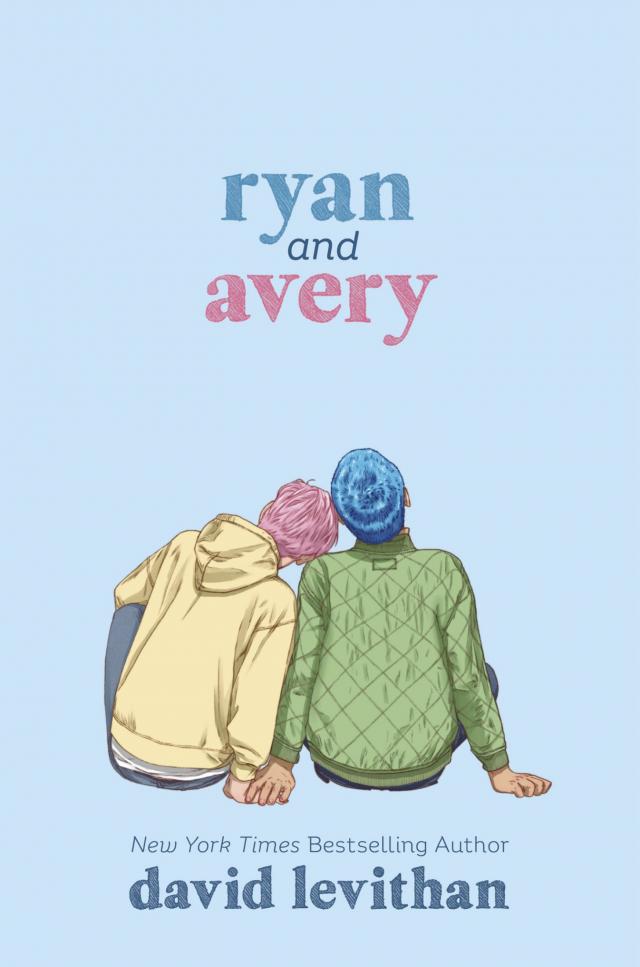
Strands of pink hair peek out from underneath Avery’s hat. Damp pieces of blue hair cling to the side of Ryan’s face, curving around his right eye. Ryan wants to kiss Avery again, but his nose is now too runny. Avery is happy to listen to the quiet, to look at this boy in front of him.
They hold there.
Snow absorbs into their jeans. Snow gathers on their coats and their hats. Ryan wipes his nose with his mitten, then wipes his mitten off in the snow.
“If I’m not mistaken,” Avery says, “I think this is how people die of hypothermia.”
He sounds exactly like his mother. He does not notice this. Ryan does, in a good way.
“Time to return to the real world,” Ryan says.
“No,” Avery corrects. “This is the real world, too.”
Is it? Ryan asks himself, not entirely free from doubt.
“It is,” he answers aloud.
Avery stands up, then extends a mitten to help Ryan up. Ryan doesn’t really need the boost, but takes it anyway.
He also uses it as a decoy to take Avery’s attention away from the snowball he’s formed in his other hand.
* * *
—
Coming in from the snow: At no other time does home seem so much like hearth. Avery and Ryan don’t appreciate how wet and bedraggled they are until the door is closed and they are shucking off their coats and slicking off their boots. Their shirts are fine—maybe a little sweaty—but their jeans and socks are soaked through.
“Let’s get those pants off you,” Avery purrs, and they both laugh, because neither of them aspires to turn this particular moment into porn.
It’s not that Avery isn’t curious. It’s not that he hasn’t scrutinized every bare moment of skin that Ryan has ever shown.
It’s not that Ryan isn’t tempted. He is so far away from his parents, so far away from any restriction. But he is also wearing an embarrassingly shoddy pair of briefs. And it is so quiet that he feels if he undid his fly, the sound of the zipper would ricochet throughout the house and cause Avery’s parents to come running.
“I’ll be right back,” Avery says. He runs to the small laundry room off the garage, and is relieved to find the dryer has been run, not yet emptied. He pulls out a pair of his father’s sweatpants and a dry pair of his own jeans. Quickly, he changes into this new pair of jeans, then empties out the dryer and puts the old pair inside, along with his socks. Then, barefoot, he returns to Ryan, offering the sweatpants and pointing him in the direction of the bathroom, where his dry towel awaits. Now it’s Ryan’s turn to say, “I’ll be right back,” before he tiptoes off to change.
They aren’t separated for longer than five minutes, but each of them feels the separation, feels the other one in another part of the house, waiting. In the bathroom, after bunching up the ankles of the sweats so they won’t drag on the floor, Ryan looks at his watch and is amazed to see it’s ten-thirty. But he can’t figure out if he’s amazed that it’s so early or already so late. They seem to be the same thing in the snowbound night.
When Ryan returns to the family room, he finds Avery has transformed the sofa into a bed, and is besheeting it. For a second he stands in the doorway and watches as Avery throws his body over the bed to tamp down the fourth corner of the fitted sheet. Without a word, Ryan puts his wet clothes on the floor and goes over to help.
“Here,” he says.
Avery unfolds the top sheet and throws half of it over to Ryan. The truth is, he never, ever makes his bed if he can get away with not making it—but since this is where Ryan will be sleeping, he feels he should make it right. So there they are, smoothing the surface, making parallel movements to tuck it in, make it even.
Next, the blanket. The same teamwork of two.
Pillows are put in place, and the job is done. Avery looks across the bed at Ryan and wants to crawl right over, pull Ryan down, mess up everything they’ve just made.
But Ryan doesn’t catch the signal. He feels bad about his wet clothes sitting on the carpet. So he moves and picks them up again, asks Avery where they should go.
“I got it,” Avery tells him.
“No, no, it’s fine—just tell me where they go.”
“In the dryer. Here.”
Avery walks Ryan to the laundry room and opens the dryer for him, as if he’s its doorman. Ryan bows his thanks and throws his jeans and socks on top of Avery’s. With the press of a few buttons, they begin to tumble.
“So what now?” Avery asks, hoping the answer will be a return to the bed they’ve created.
“I want to see more of your room,” Ryan replies. His way of saying I want to know your room, which is another way of saying I want to know you.
“Okay.” If there is any disappointment in Avery’s voice, Ryan doesn’t hear it.
Once they’re in the room, Avery expects Ryan to sit down, stay awhile. But instead he remains standing, surveying.
“What’s the most embarrassing thing that you’re proud of here?” Ryan asks. As soon as he says it, he doesn’t think he’s made any sense. But Avery knows what he means.
“Over here,” he says. He walks over to his bookshelf, where a pink plush unicorn is guarding the collected works of Beverly Cleary. “This is Gloria. And she was, without question, my best friend for a very long time. We were never apart for long. She used to be much brighter, but she’s mellowed. I guess we both have. My parents did not know what to make of my deep affection for her. They thought I could aim higher in the best friend department. There was no way for them to understand that I’d made her into the part of me that I needed to hear…even if it was in unicorn form. But, hey, my parents had to unlearn a lot of things. Which is just another way of saying they had to learn a lot of things. We all did. We all still do. You do. I do. We’re all really new at this.”
Ryan walks over to Avery, stands right in front of him. “I’m definitely new at this,” he says. He isn’t talking about what Avery is talking about. Instead he is saying that all those things can be unlearned and learned, but the really hard part, the really awkward and scary and wonderful part, is being in a room with someone you like and trying to find the right things to say, the right things to do with your body, the clearest signal to send to say that this means a lot, that this really means a lot.
Avery raises the unicorn so its horn touches Ryan’s nose. Ryan laughs.
“She approves,” Avery assures him.
* * *
—
We find someone to love, and in finding that person, we find our own capability to love them.
Most of the time—no, all of the time—we have no idea what we are capable of.
* * *
—
Two boys kissing in a room.
One boy pausing to tell the story of the time he brought a unicorn to school.
The other boy talking about his own brush with unicorns, this one on a folder he had to keep hidden under his bed. When his parents found it, he told them it belonged to a girl from school, that she had used it to give him her part of a joint assignment. Which was true, but not the reason he’d kept it long after the assignment was done.
Both boys talking about unicorns and parents and erasers shaped like stars. Both boys debating whether there was really anything guilty about guilty pleasures. Both boys taking pleasure in deciding there was not.
Everyone here has forgotten about laundry, about bedtime, about snow.
* * *
—
Midnight is just another minute, when you’re not looking at the clock.
* * *
—
It is Avery who yawns first, and the moment he starts, something is set off in Ryan, and he yawns, too.
They are leaning against Avery’s bed when this happens, but they know this is not the bed where they will end up. They promised. Plus, the bed in the family room is bigger.
Avery’s mother has put out a new toothbrush for Ryan, from her dentist-visit stash. This means Ryan and Avery can stand side by side at the bathroom sink, brushing and spitting together. This is a first for both of them, and they share the intimacy of it, the significance of such a quotidian joy. It’s no big deal, and that’s why it’s a big deal.
They do not talk about the sleeping arrangement; they simply go to the bed and arrange themselves for sleep. Ryan wasn’t sure this would happen; Avery wasn’t sure Ryan would want it. Their uncertainty shows, but so does their want, their almost existential want. They lie beside each other, but it isn’t like it was in the snow. There are layers between them, but the layers are thin. They lean in and kiss, and the longer they kiss, the more feverish it becomes. Kissing with their lips, yes, but also kissing with their hands, their skin, their whispers and their heat. Ryan reaches around Avery, pulls his body close, and Avery reaches around Ryan’s back and pulls his body close, too, and together they feel like they are fusing, feel like they are both two and one. No clothes need to be shed. No lines have to be crossed. This is everything, this closeness. This sensation of one another. This sense that touch can generate such feeling.
Then the slowdown. The lighter touches. The lying there and breathing. Wondering how the heartbeat can spread through so much of the body. Feeling the heat subside, but not entirely.
The drifting of voices and the approach of sleep. Avery watching Ryan fight it, blinking out and blinking back, and then coming unmoored again. Avery wishes him a goodnight. Ryan smiles, cuddles in. Wishes him a goodnight back. Then falls—the gentlest kind of fall.
Avery cannot slip into sleep as easily. Avery needs to think about this as it’s happening. Avery needs to understand it in order to enjoy it. So he watches Ryan through the blue-black darkness, watches as his chest rises and subsides, extraordinary machine. How did this happen? Avery asks himself. How is this possible? Because this is a room he knows well. His parents are asleep down the hall, allowing this. The snow keeps falling outside, the sole reason Ryan is still here. All of it. This. You watch this person you are just getting to know, this person you want to tie possible futures onto, and suddenly the world is no longer a conspiracy of forces against you. There are good conspiracies, too; there are forces that will help you, that want you to find this remarkable form of personal peace, this four-letter universe of a word.
In Avery’s head, this all translates into I really like you and I want this to work and I don’t believe this and I want to believe this and This is real. This is real. This is real.
There is no way to fall asleep to such thoughts. You have to wait for them to slow. You have to wait for them to cool.
While you do, you watch the person across from you. And somehow, you watch yourself, too, and gasp at how everything seems to fit.
* * *
—
There is no way of knowing this, and no way of proving this, and there will certainly be no way to remember this, but the moment Avery falls asleep, the snowfall stops.
* * *
—
Just before dawn, Ryan hears tanks scraping through the streets. His first instinct is to think the alien invasion has begun…but then he hears the sound some more and realizes it isn’t tanks, it’s a snowplow.
Go away, he thinks. Stop doing that.
* * *
—
Later, Ryan is the first to wake for real. Disoriented by the house, by the room, by the bed—but then grounded by the pink hair just a few inches from his eyes, the soft truth of the sleeping body at his side. And not just at his side—sometime in the night, Avery’s arm reached for Ryan’s arm and stayed there, once again overlapping.
The room is lit only by the sunshine filtering in from outside. Ryan stands up and walks to the window, bends back the shade and looks at the blanketed landscape. Icicles, some the length of swords, dangle from the edge of the roof.
“Is it still snowing?” Avery asks from behind him.
“No,” Ryan answers, turning. Watching as Avery slowly sits up, impulsively stretches—those early-morning infant movements, when we see if everything is still working, and if we remember how it all works. Even though Avery’s hair is a pink nest and his eyes are scrunched up and his cheek bears the imprint of a pillowcase’s seam, in this light, this pale morning filter, Ryan feels such a remarkable attraction toward him—desire, yes, but also a profound fondness, a deep cherishing.
“Let’s build a snow dragon,” Avery mumbles, eyes closing.