

Familiaris, p.103
Familiaris,
p.103
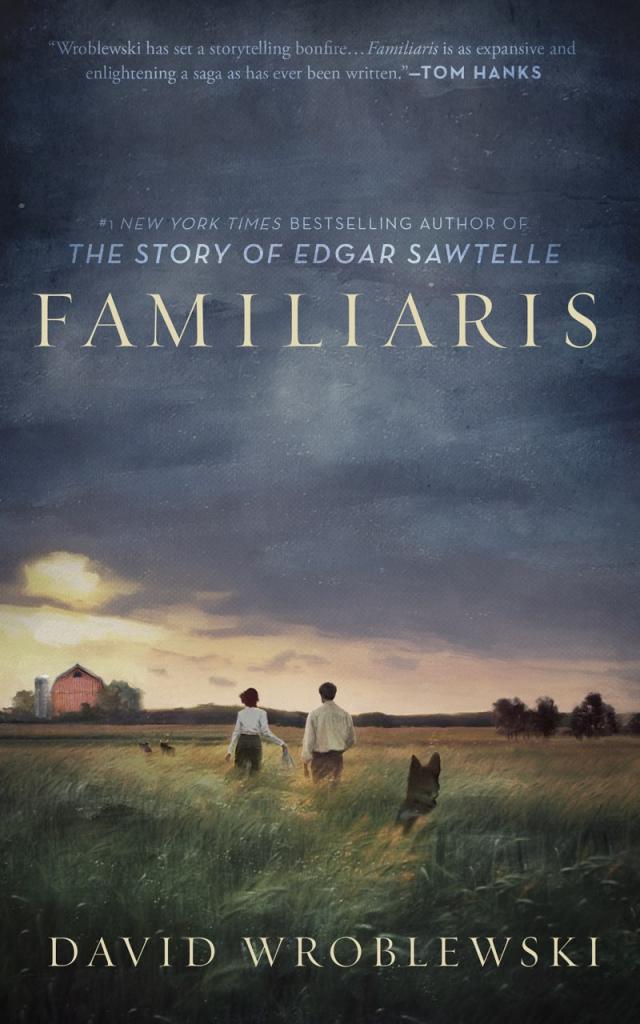


“Free,” Harold Berglund snorted. “Armanaleg and then all we done is pour money into that dog from the day we brought her home. Cheaper if she ate paper dollars. Food. Veterinary. Medicine. Now she’s old, everyone’s upset half the time looking at her. She’s aged ten years in the last year!”
Gar nodded. “Well, she’s fifteen. I wish they lived longer, Harold. No one more than me. And if things get to a point where you can’t take care of her, we’ll have her back, happily. You know we’re set up for it.”
“Oughta been in her prime two more years. Three. That’s all I’m saying. Consideration for our trouble.”
Gar recalled his father once saying that with Harold Berglund, the negotiation was too important to skip—that Harold Berglund was one of those people who needed the world to try to take something away from him, even if it was something he didn’t yet own, before he understood whether he truly wanted it. Money was just the tangible evidence. What could be argued over.
“Name one thing that costs less than it did thirteen years ago,” Gar said.
“Overpaid once don’t mean we stayed dumb.”
“You can amortize Tiss in your sleep, Harold. She cost you what? Five bucks a month? Tops? Well, the bad news is, this next dog is going to cost you closer to eight bucks a month.”
“Giving pups away free all over the place.”
“Well do that then. A lot of people are happy that way. Most are.”
Most people—but not people who’d had a dog like Tiss, Gar knew. He’d looked her records over. She’d been scored under the old system as a Talent: in her case, Consoler/Searcher, with Challenger a strong secondary. There was only one place to find another dog like Tiss, though even their dogs weren’t like Tiss anymore. Under the old system, they’d all have been scored as Talents, which was why the old system was old.
Harold kept looking back and forth between Tiss and Almondine.
“Milk prices are down. Some say they won’t come back.”
“I’m sorry to hear that,” Gar said.
“Who was it who told us Harold bought another forty from George DeAnglis?” Trudy said to Gar. “I guess that was just one of those rumors.”
“What?” Harold said. “Oh. That’s, uh.”
“Look,” Gar said. “I know what you’re saying, Harold: they cost a lot of money. And they do. But we stopped apologizing for that a long time ago. You’ve seen our place. Do we look rich?”
“I’d go high as a hundred, maybe,” Harold said. A laughable amount.
“I always think it’s better for a dog to go with people who understand what they can do. We’d be proud to see another dog here alongside Tiss. But it’s up to you.”
Harold was shaking his head. He kept looking at Tiss, then Almondine, then Tiss again.
“Don’t matter. Changed my mind. Don’t care if—”
Then Harold Berglund’s face turned red and he struggled with his breath as if fighting a case of the hiccups. But it wasn’t hiccups. Gar was struggling too, though in his case he was trying to keep from smiling, because he knew it might look as if he was laughing at Harold Berglund while Harold fought off the blubbers. But the smile was just pride in Tiss, seeing how long ago and how thoroughly she’d cracked the old skinflint. Gar knew very well from his conversations with Papineau that Harold and Anna were doing a fine job of caring for Tiss, especially in her dotage. He didn’t dare make eye contact with Trudy. He quelled the smile by thinking about the entry he was going to have to make in Tiss’s file when he got home. Not her last entry, but close, and therefore not one he would enjoy writing.
“—don’t care if you’ve taught them to milk cows and play piano,” Harold finally managed to say. “Still not going to be as good as Tiss. Still not going to be able to—”
“Oh, Harold, hush up,” Anna Berglund said. “You wrote the letter to them, they didn’t write to you.” She turned to Gar and Trudy, shaking her head. “Would tomorrow afternoon be okay?”
moonless that night. When the back door of the little grocery store tipped open and the old woman stepped out, there was only starlight to guide her through the field behind the barn. After she passed into the woods, no light at all except the foxfire green of mushrooms on rotting logs. It presented no difficulty. She stepped along, barefoot, conversing with a companion only she could hear, passing deeper and deeper into the woods, until at last she entered a broad clearing of fern and fireweed, and there she stood with her head hanging as if asleep on her feet.
“To the trees for now, but no further,” she said. “Tell me how I will punish you if you go outside this clearing.”
She listened, motionless, still the standing sleeper.
“That and worse,” she said. “Now will you keep your side of the bargain? What I’m asking will only take a minute. Then you have the night.”
When the old woman looked up again, she was wide awake and there were two in the clearing. And she was not an old woman anymore. She drew a breath and tilted her face at the stars and the sound she made was long and low, an ancient call from an archaic wild.
A few miles away, in a boy’s bedroom in an old farmhouse on a farm once known to its inhabitants as Relaxalot, a dog named Almondine woke, tipped her head, and moving carefully in order not to wake the boy, walked to the foot of the bed and peered out the window at the night. Downstairs of that same farmhouse, the four yearling dogs on house rotation rose from their blanketed stations and gathered on the porch. Out in the kennel, once just a big red barn that could have been used for anything—building zeppelins, maybe—eighteen dogs peered out of canvas-flapped openings in the barn wall, then pressed through to stand in their outside runs. In Chicago, in the guest room of Frank Eckling’s brownstone, where Elbow and Audie lay sleeping, Jug padded through a set of windblown curtains to join Forte, already standing on the ironwork balcony.
And three hundred forty-two more dogs, in many places, at many times of day, for no reason apparent to those nearby, rose to their feet and looked toward something far in the distance.
Listened.
Replied.
ACKNOWLEDGMENTS
The trouble with acknowledgments is that a writer is forced to pick a threshold for inclusion, when in fact his debts—or in any case, this writer’s debts—extend to the horizon in every direction.
My thanks to the early readers of this book: Glen Deiner, Carol Engelhardt, Dot Engelhardt, Tim McCandless, Cherie McCandless, and Colum McCann. My sister, Bobbie Bohen, allowed me to quiz her endlessly on what worked and what did not; no reader should have to suffer such intrusions, and it was tremendous fun for us both. Andrea Dupree and Michael Henry not only read and helpfully commented on drafts, they spent countless evenings listening to my frets and apprehensions while we battled over the canasta discard pile.
A great many people educated me on subjects integral to this story, among them Marc Beckoff, Catherine Gilbert Bishop, Bob Couvillian, Bruce McClintock, Mark Janowski, Jay Kenney, Kenny Krist, Kenneth and Keith Markee, Trev Richter, and Emily Sinclair. Mary Gielow talked horses with me, acted as guide to certain wonders in and around Milwaukee, and introduced me to Jack and Susan Hale, John and Cecily Bishop, and Jim and Sandy Pape, all of whom had stories to tell about what it takes to turn an old farm into a home. Viola MacDonald regaled me with tales of growing up in Mellen. Patricia McConnell showed me what it means in practice to dedicate one’s life to the well-being and happiness of dogs. And, over many long and pleasurable conversations, Lisa Sabichi consulted on matters of veterinary practice, legitimate and otherwise.
Eric Raymond defended this book when it needed defending. My friends and teachers Robert Boswell, Antonya Nelson, Andre Dubus, Elizabeth Lazarus, Robert McBrearty, and Richard Russo provided wise counsel, great dinner conversation, and timely laughter when laughing at the folly of writing novels was necessary medicine. In Wisconsin, Joe and Dee Barabe have been dear and welcoming friends. I wish Joe had lived to see this book in print. Besides serving as Mellen’s mayor for over three decades, he was an accomplished historian of small-town life in Wisconsin’s northwoods. My two volumes of Journey into Mellen have been an ongoing source of inspiration and remain among my most prized possessions.
This book has vastly benefitted from the astute critical attention of several world-class editors. Lee Boudreaux guided the early drafts of the first half of this novel. Judy Sternlight and Karen Lehmann provided essential editorial insight and feedback on the middle drafts. And during the final drafts, it was my great good fortune to work with Kendra Harpster, to whom I am deeply grateful for our many hours of chapter-by-chapter, scene-by-scene discussion, with no detail too small to consider, no principle too large to question. We found, it seems to me, the ideal way for a writer and editor to work together.
I am grateful as well to Vikki Warner at Blackstone, who championed this book, always prioritizing what was good for the story over what was expedient. She endured with utmost patience my habit of finding just one more thing to change. Ember Hood valiantly copyedited the text and answered my many questions on usage. Stephanie Stanton and Alenka Linaschke were models of perseverance and professionalism as we worked and reworked the cover design.
I owe an immeasurable debt of gratitude to my agent and friend, Eleanor Jackson, who never lost faith in this project, never doubted, was always a source of advice, enthusiasm, perspective, and good cheer. Thank you, Eleanor; the day you fished a manuscript about a boy and his dog out from behind your file cabinets was one of the luckiest days of my life.
And finally, my most heartfelt thanks to Kimberly McClintock, my lovely, witty partner, my first and last reader, whose keen editorial eye and unerring sense of story have shaped every page and paragraph. This work is the tangible by-product of our twenty-six-year conversation about how two people should go about living intertwined creative lives. The hours we spent together reading, discussing, laughing over, and revising side by side the story of John and Mary Sawtelle are, to me, a treasure beyond words, and the true meaning of this book.
ABOUT THE AUTHOR
David Wroblewski is the author of the internationally bestselling novel The Story of Edgar Sawtelle, an Oprah Book Club pick, Barnes & Noble Discover Great New Writers selection, and winner of the Colorado Book Award, Indie Choice Best Author Discovery award, and the Midwest Bookseller Association’s Choice award. The Story of Edgar Sawtelle has been translated into over twenty-five languages. He lives in Colorado with the writer Kimberly McClintock.
Subscribe to our newsletter for title recommendations, giveaways, and discounts reserved only for subscribers.
Join here.
David Wroblewski, Familiaris


