

Familiaris, p.6
Familiaris,
p.6
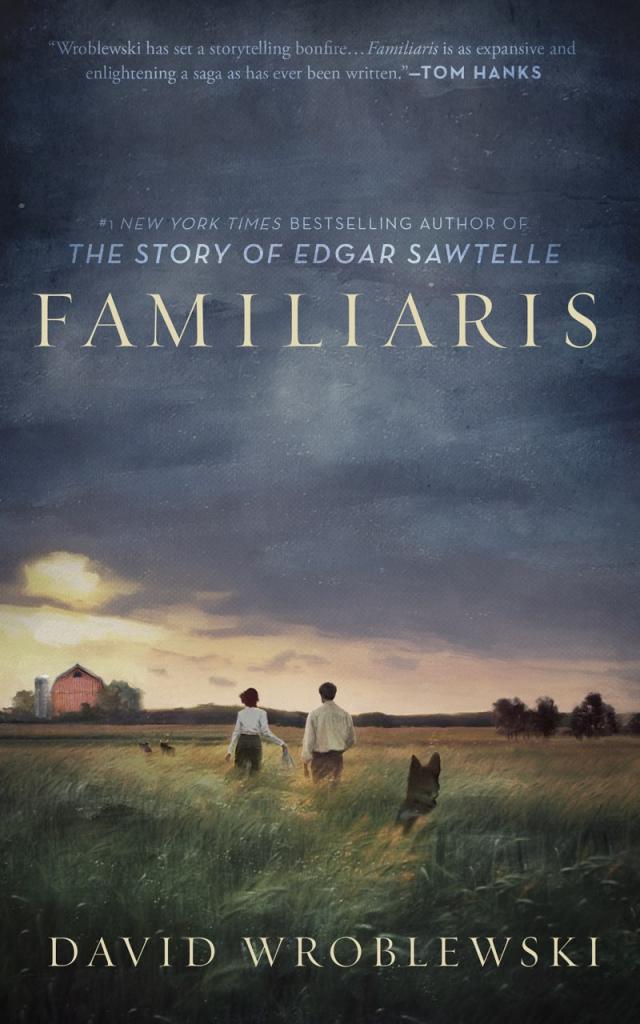


The chestnut-coated dog reappeared, sniffing at the wheels of the stalled carriage. It circled to the opposite side, then disappeared. A moment later, the horse gave a snort and kicked one hind hoof violently backward. They heard a chopped-off yelp. The rig jerked and began moving up the street again.
Mary was down the porch steps ahead of John, but they reached the street side by side. The dog lay unconscious, legs thrashing in the dirt as if running for dear life, making terrified, whispery half-barks.
Mary knelt and stroked the dog’s head while John ran his hands along the dog’s flanks, legs, feet. A female. Above her right eye an inch-long laceration seeped blood.
“The kick must have thrown her clear of the carriage or she’d have a broken leg. Or much worse.” He looked around. “Who does she belong to?”
“I’ve never seen her before. Let’s get her off the street.”
John carried the dog up the front walk and settled her on the grass at the base of the porch steps. By then her thrashing had subsided. Tiny shivers passed through her body in waves.
Mary ran into the house. While John waited with the dog, a woman walked up from the street, a barrel-shaped matron wearing a sleeveless black dress with a yellow curtain fringe along the bottom. She stood over John and took a drag off the cigarette scissored between her fingers.
“Saw the whole thing,” she said. “Smack between the eyes. He was dead before he landed.”
“She,” John said. “And she’s not dead.”
The woman bent to look. “You’d think he’d have sense enough not to put his head where it would get kicked.”
Mary emerged from the house carrying a towel and a capsule of smelling salts. “Mrs. Wilson,” she said, breathlessly. She dropped to her knees beside John, broke the capsule of smelling salts, coughed, and brought it slowly toward the dog’s nose. The dog recoiled without opening her eyes, then lay still.
“Dead,” Mrs. Wilson said. “I knew it.”
Mary looked at John so steadfastly that Mrs. Wilson dematerialized, such was the power of her gaze.
“What do we do?”
“We wait. For a while, anyway.”
They watched the dog’s chest rise and fall. Mary dabbed away the blood seeping from the cut above the dog’s eye. There was the chitter of songbirds plunging through clouds of insects, the distant eep of a car horn, the conversation of two bicyclists pedaling along Elm Street.
“Should we try the smelling salts again?” Mary asked.
“I don’t think so.”
“I don’t either.”
“She’ll wake when she’s ready. The salts just made her want to stay away longer.”
He was aware, suddenly, that Mary was looking at him. “Yes. Of course.” She lay a hand on his arm. “John, I have an idea.”
She ran up the porch steps and into the house and returned carrying a small blue crock. She knelt beside John and stirred the crock with her index finger and withdrew it gloved with honey. “Maybe this will be worth waking up for.”
She lowered her fingertip until the honey dripped onto the grass just beyond the dog’s nostrils. The dog didn’t react. She dabbed a spot of honey onto the tip of the dog’s nose. The dog didn’t react. She slid her finger beneath the dog’s upper lip and swabbed the honey along the dog’s gums.
The dog let out a long sigh.
Mary leaned down and put her mouth beside the dog’s ear. “If you’ll come back,” she whispered, “it won’t happen again. Do you hear me? I’m promising. And I can do it. I will not let that happen ever, ever again.”
A tremendous something gathered in John’s chest. He imagined the dog waking to the sight of Mary’s face, curtained by her dark hair, and beyond, the lustrous vegetable-green treetops, and yet further beyond, an unfenced sky with salmon-sided clouds, a sideways world where trees grew straight out from a big-bellied peach of a planet, where dogs ran along the boles of those trees and leapt into the blue.
Wake up, he thought. Wake up and that’s what you’ll see. Who wouldn’t want to open their eyes onto a world like that?
The dog woke.
It surprised John and it surprised Mary and it surprised the rematerialized Mrs. Wilson, who erupted into violent coughing spasms. Most of all, it surprised the dog. She lay for a moment staring in exactly the manner John had imagined. She swallowed. Her tongue swiped the honey off the end of her nose. Then she convulsed to her feet and bolted away, careening across the yard in leaping, exclamatory bounds, racing toward them, putting down all fours, reversing, nearly crashing into the porch steps before veering into Mrs. Wilson’s legs. When she reached the edge of the lawn and saw the road, she turned so quickly her hind feet slid out from under her and for a moment she lay on her side, feet paddling against the turf. Then she was past them and up the stairs and across the porch and around the side and down the stairs around back, frantic, ecstatic, acting the way John had felt some nights before coming to Hartford.
Mrs. Wilson recovered from her coughing fit and stood shaking her head. “Crazy,” she grunted. She lumbered back toward her house. The dog finally came to rest, sprawled just beyond their reach in the soft green grass, panting and watching them. They’d been rocking with laughter the whole time, leaving Mary’s face flushed, as though it had taken into itself the under-lit glow of the clouds. She was quite possibly the most beautiful creature that had ever breathed upon the earth. Tides roared in his ears. He thought the ancients had been right to insist upon a permeating soul-tissue connecting all things. How else to explain a world so vast yet fatebound? He closed his eyes. He told himself if he truly was a fool, doomed to live alone, he could bear it in peace so long as he didn’t leave unanswered this one question.
Before he could think again, the words were out.
Mary turned to study his face.
“Yes,” she said.
evening of the day of louis kissel’s shooting found John sitting on the red brick steps out back of the Elm Street house. He and Vi were watching the pups wrestle Gus, the newcomer, when he heard Mary come in the front door and walk through the house humming a ragtime tune. She peered at him through the screen door.
“Don’t you look all philosophical,” she said.
“It’s been a philosophical kind of day.”
Mary disappeared into the kitchen. Cabinet doors banged, glasses clinked. She returned carrying two glasses of lemonade, handed one down, then lowered herself onto the step beside him, letting her hip slide down his shoulder in a way that felt comforting and teasingly lascivious and about a dozen other things as well, and for the thousandth time it occurred to him that she was a kind of genius about touch.
Vi lay sprawled out in the grass now. She was at the end of her milk, and when one of the pups, the one they called Mister Needles, tried wriggling into place at her belly, she deftly flipped the pup over with her nose. Needles kicked wildly through a barrel roll, then scrambled to his feet and yapped at Vi, who gazed back, panting serenely.
“Tell ’em, Vi,” Mary said. She lifted her glass toward Vi. “To strict mothering.”
“To the National Cash Register Company,” John said, clinking her glass. “Long may their salesmen travel.” He sipped his lemonade. Mary had spiked it with brandy.
“You’re an unusual girl,” he said.
“I know what I like,” she said. “Call it unusual if you want.”
He took another sip of the lemonade and together they watched another pup, Tomato, throw himself atop Gus. The two wrestled, then abruptly stood and shook themselves and trotted off to investigate the peonies. John had guessed that Gus would have his sire’s easygoing nature.
“George Mill came by on Sunday,” Mary said. “He wanted to take Tomato home with him. When I told him he had to wait until you got back, he was in quite a huff.”
“Oh?”
“He said if we didn’t bring him over by the end of the week, he’d find another pup. Which was funny, because he kept stomping off, then turning around to call Tomato over one last time, then picking him up and talking to him.”
“I got fired today,” John said. “By Louis Kissel.”
“The old man? That’s impressive. You’ve only been fired by foremen up until now.”
“He was a lot better at it than anyone else. Very efficient.”
“Which line are they moving you to?”
“No line. I was fired-fired. But that’s not the worst part.” He took a fortifying sip of lemonade and told Mary about Gerbier, the gun, Mr. Kissel’s final word, and the pandemonium that had followed. The only thing he glossed over was the Hentzler Betrayal; he didn’t want to admit that he’d trusted Dale, a known snake, not to bite. “At first there wasn’t much blood,” he said. “Then all of a sudden there was a lot. They carried him out on a stretcher, in bad shape.”
“It’s awful,” Mary said. She sounded stricken but looked fascinated. “He could have shot you.”
“He sure could have. I just stood there, rooted to the ground.”
“What happened to—Gerbier, you said his name was?”
“Hauled him off to jail, I guess. In the meantime, I spent three hours in Kissel’s office explaining over and over again what happened and why I’d been there when it did. Then I had to go down to the police station and repeat it all to a secretary, who wrote up a statement for me to sign. And after all that, they just said, go home. By then it was four o’clock. There was a crowd standing around the station door. I half-imagined you’d heard about it in the store.”
“I didn’t and I’m glad. I might have been genuinely worried about you for the first time.”
“I want music. Loud music. Something to get the sound of that gunshot out of my head.”
“Should we play a record?”
“No, never mind. How angry are you with me for coming home with Gus? Tell the truth.”
“I was planning to wring your neck after you fell asleep,” Mary said. “But after the day you’ve had it seems like too much. I think I’ll wait until the weekend.”
“That’s very considerate.”
“You know, they’ll probably ask you to come back. After all, you did save the man’s life.”
“I wouldn’t count on that.”
“What does it matter? You’ll get another job. John—look at me. I’m glad you’re done working shakeout. It was dangerous.”
“It was a good job. And I was good at it.”
“But not passionate. At least not anymore.”
Tomato came bounding over. John set his lemonade on the stoop and stretched out on the grass. The pups were dazzling to him, mesmerizing. Pure potential. Shortly his hand came scrambling and poking through the blades of grass, index finger aloft like a probing trunk. The pup reared back in surprise, then came forward rowing with one paw.
“Eight weeks ago my hand was as big as he was. Bigger. It probably looked like a monster. Now he wants to squash it with his foot. I wonder what it feels like to grow so fast.”
“Mmmm,” Mary said, sipping her lemonade. “I wonder.”
“All your life so far things have been shrinking. You wouldn’t know if it was ever going to stop. You’d wonder if eventually you’d be bigger than everything. Maybe you’d wake up one morning with wings. Maybe overnight the trees would turn purple. Anything could happen. Nothing would be impossible.”
“If the trees turned purple,” Mary said.
He lay watching the pup. “They don’t even suspect about snow.”
“You know, you’re more interested in these pups than you ever were in shakeout,” she said after a while. “Just think about that. You were a day late to work because you were bringing home a pup from the other end of the state. And you were supposed to be giving a pup away.”
All at once his arms and legs felt filled with lead. He’d been driving like a maniac since long before sunrise, worrying about how to explain Gus to Mary—worrying most of all about how to tell Mary that he’d done something impetuous, exhilarating, potentially unforgivable: he’d offered to purchase the farm he and Gus had stumbled upon up north.
Then, practically before he’d caught his breath, he’d been summoned, fired, and stood witness to calamity in Louis Kissel’s office, an event barely more conceivable than awakening to a world of purple trees. It was too much for one day, maybe too much for a lifetime. He felt certain he hadn’t gotten a single thing right about any of it, and equally certain that if he tried to explain his impulsive act in this moment, feeling this weary, he’d botch that, too. Something significant had happened to him while he and Gus had explored that tenantless farm; he had to be sure he could explain that clearly. All he had the strength to do right now was lie on the grass with his face on his arm, watching this pup, Tomato—who he’d soon abandon like he’d abandoned good little Boot—maul his fingers.
He felt Mary settle herself on the grass beside him. She rested her hand on his neck, then on the small of his back, where it lay heavy and comforting. She moved her hand across his shoulders. Remarkable. Reviving.
“Sooner or later you’ve got to let them go,” she said.
“I know. You’re right. I’ll talk to George tomorrow.”
She kissed his neck behind his ear.
“Welcome back, Sawtelle,” she said. “I missed you terribly.”
CHAPTER 3
PARIAH
The town of hartford had prospered during wartime, due in no small part to the Kissel plant, which for years now had run three shifts a day, seven days a week, fulfilling its contracts for army ambulances and field vehicles. After the armistice, operations switched full steam to civilian manufacture. Hartford hadn’t started out as a factory town, but it was a factory town now. All the little feeder-fish machine shops around town, partaking of their patron industry’s boom times, were advertising jobs in the Hartford classifieds or sporting bright red Help Wanted cards in their windows. And yet the moment John told any proprietor his name, their face closed like a steel roller door coming down. The window cards turned out to be a mistake, the advertised jobs already filled.
His efforts had been doomed from the beginning, he discovered late on Wednesday, the day after the shooting, when he picked up the morning edition of the Milwaukee Sentinel. The front-page headline read, louis kissel shot by angered employee, followed by three breathless subheads: “Aged Hartford Businessman May Recover—Bullet Penetrated Abdomen; John Gerbier, Angered By Being Laid Off, Fires Three Shots, Two Missing Mark; Second Employee, John Sawtelle, Either Samaritan or Accomplice.”
Why the Sentinel named John, when the police had dismissed him as an innocent bystander—possibly even the hero of the situation—was a mystery, as was their decision to omit any further mention of him. But by nine o’clock on Wednesday morning, every shop owner in town had read the headline and seen his name. The word “Samaritan” never penetrated their consciousness; instead, “Accomplice” was all but tattooed on John’s forehead.
He hadn’t given up easily, though. By five o’clock he’d been turned away twenty-seven times. Walking home, he decided to stop at the Creamery Saloon, crowded and echoing with the shouted conversations of a hundred men fresh off their shifts.
Before John could flag the barman over, a thin, hungry-looking man materialized beside him. “Congratulations, friend,” the man said, pumping John’s hand with an excited and strangely secretive shake. “Thank you for your help. That was inspired. Pivotal.”
Over the last few days John had met a lot of people, but he was damned if he could place this fellow, who, from the looks of him, had recently (though not triumphantly) been in a fight. The long raw scrapes furrowed into the man’s right cheek and ear were freshly scabbed, and beneath his hat brim, a purply-green bruise swelled in a crescent across his forehead.
John extracted his hand from the man’s grasp. He dismissed the notion that this skinny, sweaty man was one of the rare Hartfordians who truly understood what had happened in Louis Kissel’s office.
“Thanks. But I think you think I’m someone else.”
“Oh, we know who you are.” The man leaned closer and added, in a confiding rasp, “And we’re with you, brother.”
We? Brother? Before John could reply, a half-dozen men stood up from their table near the front window and began filtering through the crowd toward them.
“You!” one of the men shouted. “Wobbly. Back again?”
“Ah, crap,” the man said. He pressed a sheaf of fliers into John’s hand. “Post these if you get back inside,” he said. Then he walked—in fact, fled—out the side door.
John watched in the bar mirror as the men formed a semicircle behind him. He swiveled on his barstool, attempting to look curious and friendly rather than scared.
“Hey, isn’t that the guy that killed Louis Kissel?” someone said.
“No, no, no, no, no,” John said. “He’s not dead, just wounded.” Thinking, Shut up, Sawtelle. Just look them in the eye and explain what happened. And whatever you do, don’t look at the fliers. Then he looked at the fliers. He had time to see “IWW” printed in boldface across the top of each page before one of the men snatched them from his hand.
“I heard they shot him in the face.”
“I heard he died screaming.”
The man who’d grabbed the fliers said, “Boys, take a good look at an anarchist.”
“I had nothing to do with that,” John said. He tapped his foot around to locate the bar’s footrail and hook a heel over it, knowing what he had in mind was never going to work because it was impossibly stupid and obvious, and that he ought instead to be savoring these final few seconds with all his teeth. “I’ll tell you who did, though.”
“Who?”
He hoisted himself up on the footrail and jabbed a finger over the men’s heads.
“That’s who!” he cried.
To a man they turned to look where he was pointing, and with an agility that amazed even himself, John oozed between the two men on his right and hit the door at full stride.


