The deep silence, p.11
The Deep Silence,
p.11
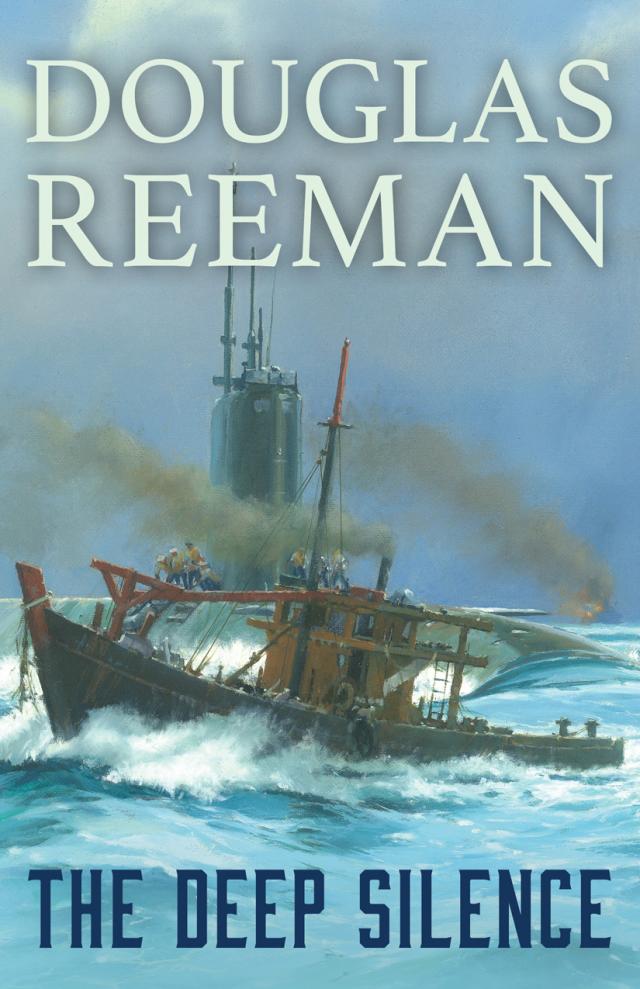


Archer shrugged and moved the hacksaw on to one hip. Against his tanned and tattooed body Colquhoun seemed frail and delicate. He had volunteered to accompany the officer not out of loyalty but for the sheer guts of the thing. He was proud of his strength, and was always ready to match it against the other seamen.
Slipping and sliding they moved away from the swaying fin, each step taking them nearer the deeply shelving whaleback towards the stem where the angry water boiled across the steel like a mill-race.
Colquhoun winced as the backwash surged around his legs. It was very cold in comparison to the rain, and he could feel his breath wheezing in his lungs with each precarious movement. Once when he looked back he saw Able Seaman Rider taking charge of the line party and, above him, silhouetted against the sheeting rain and washed-out sky, the watchful figure of the captain.
Just this once they were depending on him, he thought desperately. Perhaps it was that thought alone which was making him keep going. Yet his father had not said a word, not even wished him luck. The memory of the admiral’s angry face in the control room made him suddenly bitter. But why should it matter? He had known their meeting would be just as it was.
A wave curled lazily over the hull and pushed him kicking against the Temeraire’s rough flank. For an instant he saw the sea right below him and felt his shins grate cruelly on the metal.
Archer pulled on the bridle and yelled, ‘You takin’ a dip then?’ He was actually grinning.
With sudden determination Colquhoun fought his way along the casing, ignoring the cuts and bruises on his hands and feet and concentrating on the tall rudder blade which seemed to cruise quite independently from the rest of the boat. He was quite frozen now, yet his senses seemed sharper instead of dulled by his constant pounding. He could see the score marks left by the snared cable and even small patterns of rust around the horizontal rudder.
He paused, sobbing for breath. Without looking at his companion he gasped, ‘We’ll jump together I For God’s sake don’t slip or we’ll miss the rudder and fall into the screw!’
Archer scowled, ‘I ain’t stupid, sir!’
Momentarily blinded by the criss-cross of surging water Colquhoun leapt towards the upright sheet of steel with its mocking halter of wire cable. For a brief instant he thought he had missed his direction and fell kicking into the maelstrom, his mouth filling with salt as he screamed meaningless words and curses into the sea itself. The bridle pulled him against the rudder fin with a savage jerk, and he saw his own blood running freely into the creamy froth around the bar-taut line. But they had made it.
Working at top speed they freed themselves from the bridle and clung on either side of the rudder, blind to everything but the cable and the job in hand.
Colquhoun sawed at the wire for a full minute and then croaked, ‘You take over!’ As Archer carried on with the muscle-wrenching work Colquhoun found his eyes drawn down and behind his perch to where the distorted sunlight cast an occasional glow on the great whirling propeller blades. One slip… He shuddered.
Back below the fin, Rider tested the lifelines and shouted, ‘Play ’em like fish, lads! Don’t jerk ’em off!’ He looked round startled as two more figures emerged from the screen door.
Lightfoot and Bruce stood staring at the drama, and then the latter growled, ‘We come up to lend a hand I’
Rider nodded, his panting making him bend over. ‘Good! It’s about time you bloody sonar people did somethin’!’
Bruce spat on his hands and seized one of the lines. To Lightfoot he said, ‘Looks like they’re nearly through.’
Lightfoot took his place behind him and braced his legs against the hull’s uneasy roll. He was almost blinded by the rain, and he stumbled awkwardly as the churned waves swept up and over the casing, trying to push the men from their hold.
He had almost lost his head when the Temeraire had tilted crazily towards the bottom. The men in the sonar compartment had stared at each other without recognition, their faces like masks of terror, too shocked to comprehend what was really happening.
There was always the risk, of course. It was mentioned in the training depots in a matter-of-fact, clinical fashion, as if it only happened on very rare occasions, and then only to others.
All Lightfoot’s past anguish, his terror of the seaman, Archer, had vanished as the boat had plummeted down. His world had been confined to the small steel room with its glittering, mocking equipment and the men who sat like caged wax-works.
Over the intercom, from another part of the sealed hull, he had heard sharp, brittle orders being passed and snatches of meaningless conversation. Then every so often the captain’s voice would penetrate his whirling mind, so that he waited for it, like the word of God,
When eventually the wire cable had slipped free from its first hold and the deck had swung slowly upwards he had felt a hand on his shoulder and heard Colquhoun say, ‘It’ll be all right now. You see!’
Perhaps he did not know what he was saying, and maybe he was not even aware he had spoken. But the quiet encouragement in his tone had made all the difference to Lightfoot.
The events were like dream sequences. Short, vivid pictures. Fierce, inexplicable sounds. And now they were out in the air, being lashed from all sides by rain and blown spray.
He wondered vaguely what Bruce was thinking as he cradled the line in his big hands. Had he been shocked out of what had gone before?
When Lightfoot had told him about Archer’s threats Bruce had been unusually quiet and calm. They had spoken in whispers as the submerged submarine had sped northwards from Singapore and the men around them slept in their bunks. Lightfoot had tried to explain his own feelings and what he ought to have done.
Bruce had said sharply, ‘Makes no difference now, wack. What’s done is done.’ Then with a flare of his old belligerence he had added, ‘Leave him to me!’
But again, nothing had happened. If anything, Bruce had appeared to make a point of avoiding Gipsy Archer. Perhaps Bruce never intended to say anything, Lightfoot thought bitterly. After all, Archer had said nothing about him at all. So if he did not know Bruce was connected with the accident and the man’s death, why should Bruce take any action at all?
A freak gust of wind cleared the rain and spray from the rudder, and Lightfoot felt a cold hand tightening around his heart. Gipsy Archer was the man on the rudder beside Colquhoun. Even through the downpour there was no mistaking hie dark features and the arrogant tilt of his head. And he was tied to the line which Bruce held with such earnest concentration.
He opened his mouth to attract Bruce’s attention, but at that moment he felt the line go slack as Bruce pulled violently, the full power of his shoulders against it.
Archer was just about to slide down the rudder blade as his last thrust with the hacksaw severed the wire. There was a loud twang and the bobbing fish-buoy curtsied free and sank in the submarine’s wake. But Archer seemed to lose his hold, and as the rest watched with fascinated horror he slithered down the blade, his legs and arms kicking madly, his skin bleeding from a dozen places as he fought to save himself.
Bruce muttered hoarsely, ‘The wire must have cut him down!’ But when he glanced round Lightfoot saw that his eyes were cold and indifferent.
Another series of shouts made him turn again, and Rider yelled, ‘Gipsy’s caught hold of the sub!’
Archer made one final effort. Reaching up he seized Colquhoun’s ankle and with all his strength pulled himself clear of the water.
Colquohoun was already weakened by the effort of holding on, and this last strain was more than enough. Lightfoot saw him struggle to reach down as if to assist the big seaman, but Archer pushed his hand aside, and using the officer like a ladder he dragged himself to safety.
Whether the strain on the lifeline was too much, or whether it had got frayed by the friction with the rudder, no one could be sure. Just before another fierce squall swept the watching men Lightfoot saw Colquhoun’s hand begin to slip, and watched sickened as his legs disappeared into the creaming water below him.
He heard Jermain shout, ‘Stop engine! Stand by with heaving lines!’
But even Lightfoot knew that would not be enough. In this weather, and allowing for the way already on the submarine, it would be some time before the captain could go about and find a single, drowning man.
Looking neither right nor left, Lightfoot ran back along the casing, and when his legs could no longer cope with the sluicing water he took a deep breath and dived clear of the hull.
Colquhoun was held afloat by his lifejacket, but limp and only half conscious he allowed his head to loll as the water washed over him. He opened his eyes and stared at Lightfoot, and tried to speak as the boy turned him on his back and trod water.
The latter said hoarsely, ‘S’all right, sir! I’m a good swimmer!’
Colquhoun retched. ‘You might have been killed!’ Then as the memory crowded his mind, ‘Is Archer safe?’
Lightfoot paddled round to peer at the submarine’s misty shape as it moved slowly out of the squall. ‘He’s okay.’ So he should be too, he thought with sudden fury. He had knocked Colquhoun off the rudder in his efforts to save himself.
A yellow liferaft splashed alongside and bobbed obediently on its line. Hands were reaching down, and familiar faces moved vaguely around the two sodden figures as they were hauled up on to the casing.
Bruce hissed at him, ‘You young fool I’ but Lightfoot could not look at him. It needed time and it needed thinking about. But whichever way you looked at it, Bruce had tried to murder Archer.
Colquhoun found himself wrapped in a blanket and sitting in the wardroom while Griffin, the doctor, poured something fiery between his lips. He became aware that he was surrounded by a quiet watching group of figures. Baldwin, the steward, grinning all over his freckled face. Lieutenant Drew giving him an admiring smile, and Griffin watching like a hen with a day-old chick.
Drew said, ‘You did a good job, Max! I thought that god-damn wire was with us for ever!’
Griffin frowned severely. ‘You’ll have to rest Too much excitement in one day for anyone!’
Then Colquhoun saw his father. The admiral was standing in the wardroom entrance, his hand gripping the curtain as if for support. He looked suddenly old, Colquhoun thought.
The admiral said, ‘I’m glad you’re all right, my boy.’ Colquhoun tried to define his feelings but could sense nothing. He replied, ‘It was damn cold, sir.’
The admiral saw the others watching him and seemed to pull himself together. ‘You should never have gone. The men could have managed it on their own!’
Colquhoun lay back and closed his eyes. That was more like it, he thought. Even now his father appeared unable to find a single word of warmth or pleasure.
The sudden realisation that it no longer seemed to matter filled Colquhoun with astonishment. It was as if his ordeal had been a test, a last chance to prove his individuality. The ideas became vague and distorted, and he heard the doctor say, ‘I’ll take him to the sick bay. I think he’s had enough!’
But Colquhoun’s eyes were shut, so he did not realise that the last remark was directed at his father.
* * *
Jermain wedged himself in the corner of the cockpit and tried to peer through the hissing curtain of rain. Through the hatch at his feet he could hear the clatter of orders, the questions and answers being passed back and forth over the intercom, but his mind still rebelled against the necessary routine and he was unable to free himself from a feeling of uncertainty.
A messenger called above the downpour, ‘Steering and hydroplane tested and answering correctly, sir!’
‘Very good!’ Jermain stared at the rain and marvelled at the way it seemed to enclose the slow-moving hull like a steel fence. It should have been a bright clear morning, yet from his perch at the tip of the swaying fin it might have been any time, on any sea.
He snapped, ‘Tell the first lieutenant to speed up the checks. I want a quick report from all sections on damage.’
The man ducked out of sight and Jermain returned to his thoughts. It was like some inner sense of danger. Something uncertain yet real.
He could feel Lieutenant Victor shifting his feet behind him and wondered what he was thinking about the Temeraire’s failure during their first real exercise.
He sighed and rested his arms on the wet steel and stared directly ahead. It was like being aloft on a small, isolated lighthouse or on some forgotten rock, he thought. There was no sense of belonging to the hull which was all but hidden by the seething water.
Victor whispered loudly, ‘The admiral’s coming up, sir!’
Jermain tightened his jaw and waited in silence as Sir John Colquhoun hoisted himself through the hatch to stand beside him. The admiral looked angry. As if he was only controlling himself with real effort.
Jermain said, ‘I understand your son is all right, sir.’
‘So it would appear.’ The admiral glared at the strange mirage of rain and spray without any sort of recognition in Ins pale eyes. ‘What the hell are you waiting about for?’
‘I’m checking for damage, sir. In addition, I’d like to get a look at those fishing boats.’
The admiral did not seem to hear. ‘What a bloody mess!’
‘I thought our people behaved very well, sir. And your son made a fine display of courage.’ Jermain’s face was impassive.
‘He was lucky!’ The admiral ignored the hardness which had crept into Jermain’s eyes. ‘Right now I’m more worried about this exercise! All I’ve got to offer the Americans is your brief sonar report. At best it will prove that we could have destroyed the attacker but for this unfortunate bit of mishandling.’
The messenger reported, ‘No damage, sir!’
The admiral snorted. ‘I hate to think what would happen on active service!’
The radio supervisor scrambled through the hatch and stood stiffly in the rain in the crowded cockpit. He seemed afraid of touching the admiral with his own body, Jermain thought.
Jermain asked flatly, ‘Well, Harris, what is it?’
The chief petty officer tried to shield his signal pad from the rain. ‘Signal from Nemesis, sir. Exercise cancelled.’
Jermain frowned. Cancelled? Surely it should have been completed?
The radio supervisor glanced quickly at the admiral’s face. ‘The attacking submarine was diverted back to base with engine trouble, sir.’ Harris gulped. ‘All units to dear exercise area.’
The admiral snatched the pad and read through it searchingly. He exploded, ‘This is the last straw, Jermain! First you disobey instructions only to get tangled in a lot of wire which a first-year subbie could have avoided!’ He waved the pad. Now this! And to think I might have believed your findings! Damn it, man, there was no submarine at all!’
Jermain said, ‘My sonar department is very efficient, sir. Every officer and rating is hand-picked.’
‘I don’t care if they are all university graduates!’ The admiral seemed unaware of the silent men around him. ‘I was prepared to overlook your efforts with an inexperienced crew and a new boat, even to the point of making some suitable signal to the Americans in the way of an apology!’ He glared at Jermain’s grave features. ‘And what a bloody fool I would have looked, eh? Telling ’em about your wonderful sonar report when there was no submarine!’
The messenger’s voice was hushed. ‘Control room request instructions, sir.’
The admiral took a grip of himself. ‘I suggest you submerge and return to base post-haste, Jermain! At least nobody outside the Service will know of your escapade!’
Jermain looked across his shoulder and said calmly, ‘Retain course and speed. We will remain at Action Stations.’ He returned the admiral’s look of open amazement. ‘I am not satisfied, sir. If Lieutenant Oxley obtained a contact, then there must be an explanation.’ His mouth tightened. ‘As you reminded me earlier when I asked for your assistance, sir, you are a passenger in this boat. I take full responsibility.’
The admiral could only stare at him for several seconds. Then he said, ‘You’ll be sorry for this, Jermain. You will pay an expensive price for your show of independence!’
Jermain allowed his stomach muscles to relax slightly as the admiral ducked through the hatch. For a full minute he allowed the rain to wash over his face and chest, like an athlete after some test of endurance. Then he said, ‘I think the squall is moving over. Be ready to dive.’ He heard Victor mumble an assent and half smiled to himself. It was as if Victor was afraid to speak too openly with him now, in case some of the shame rubbed off on him, too.
Maybe it had been a bit of useless defiance. The admiral was right about one thing at least. The Navy would have no time at all for a captain who had blotted his copybook so openly!
He watched the rain moving diagonally away from the hull. The fin and the small length of exposed casing began to steam immediately as the sun felt its way through the spray and wind-blown salt, and Jermain noticed for the first time that he had been standing in the downpour in his shirt and shorts. He felt the warmth soaking his body, and with it came another pang of uneasiness. There was something wrong with the pattern in his mind, yet he still could not explain it.
Perhaps if he had tried to describe his feelings to the admiral an open clash might have been avoided. But he recalled the man’s stony expression when his son had led his small party to cut free the treacherous wire, and knew it was pointless to continue that line of thought.
Sir John Colquhoun had been prepared to be his friend on his own set conditions. The Temeraire was not important as a weapon, nor even part of a new strategy. To the admiral it had represented only the chance of holding on to an obsolete command and the opportunity of displaying its potential in the face of the Americans, who challenged his control in the area. Not even the near death of his only son had been able to move him from the apparent realisation that his position and authority might be damaged rather than heightened by this most unfortunate of circumstances.