Mass effect, p.26
Mass Effect,
p.26
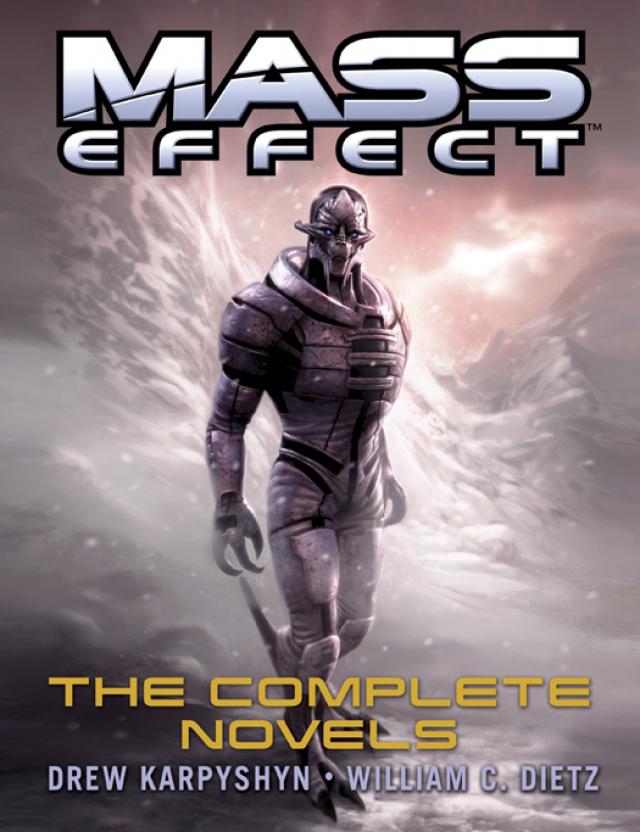


The turian looked at them in surprise, and in the glow from the fires of the burning camp behind them, Anderson was convinced he saw the Spectre scowl. He didn’t say anything as he climbed into the vehicle, and for a second Anderson thought Saren was going to drive away and just leave them there.
“Get in!” the turian shouted.
Maybe it was the sight of the automatic assault rifles they both still carried. Maybe he was afraid someone would find out if he abandoned them. Anderson didn’t really care; he was just glad the Spectre waited.
He helped Kahlee up into the vehicle, then scrambled in beside her. “Where’s Edan?” he asked as the engine roared to life.
“Dead.”
“What about Dr. Qian?” Kahlee wanted to know.
“Him, too.”
Saren slammed the rover into gear, the wheels kicking up small bits of sand and gravel as they took off. Anderson slumped back against his seat. All thoughts of the small metal case slipped from his mind as he surrendered to utter exhaustion.
The rover sped away into the night, leaving the grim scene of death and destruction farther and farther behind them.
EPILOGUE
Anderson stepped out from the offices of the Alliance embassy on the Citadel and into the simulated sunshine of the Presidium. He made his way down the stairs and out onto the green grass fields.
Kahlee was waiting for him down by the lake’s edge. She sat on the grass, barefoot so she could dip her toes. He came over and sat down heavily beside her, yanking off his own shoes and plunging his feet into the cool, refreshing water.
“Ahhh, that feels good.”
“That was a long meeting,” Kahlee said.
“I was afraid you might get bored waiting for me.”
“Nothing else to do,” she teased. “I already had my meeting with the ambassador. Besides, I figured I’d stick around.” In a more serious voice she added, “I owe you that much at least.”
“You don’t owe me anything,” he replied, and they lapsed into a comfortable silence.
It was four days since they’d fled the refinery on Camala. The first night had been spent at the medical facility near the spaceports. They were treated for smoke inhalation and possible exposure to toxins released into the air during the explosions, and Kahlee was given intravenous fluids to fight off the dehydration she’d suffered during her imprisonment.
The next morning they’d been met by a contingent of Alliance representatives: soldiers to provide protection and intel officials to gather their statements. They’d been whisked onto a waiting frigate and taken to the Citadel to deliver their reports and individual accounts to the powers-that-be in person: three days of meetings, hearings, and inquiries to determine what had happened … and who was at fault.
Anderson suspected the high-level political fallout would continue for months, maybe years. But with the end of this final meeting in the ambassador’s office, it was officially over for him. For both of them.
This was the first chance they’d had to be alone since that hellish night. He wanted to reach his arm around her shoulder and pull her close, but he wasn’t sure how she’d react. He wanted to say something, but he couldn’t figure out what to say. So they just sat there, side by side on the edge of the lake, not speaking.
It was Kahlee who finally broke the silence. “What did the ambassador say?”
“About what I expected,” he said with a sigh. “The Council rejected me as a candidate for the Spectres.”
“Because Saren screwed you,” she said, disgusted.
“His report doesn’t paint a very flattering portrait of me. He says I ignored the true goal of the mission. Claims I blew his cover by tipping off the mercs inside the base by going in too soon. He even manages to blame me for the explosion.”
“But it’s all lies!” Kahlee said, throwing her hands up in exasperation.
“With just enough truth mixed in to sell it,” he noted. “Besides, he’s a Spectre. One of their top agents. Who are they going to believe?”
“Or maybe the Council’s just looking for an excuse to keep humans out of the Spectres. Holding the Alliance back again.”
“Maybe. But that’s Goyle’s problem now.”
“And the alien technology he discovered?” Kahlee demanded.
“The Council had its own experts study the files from Sidon,” Anderson explained. “It’s all theory and conjecture. They don’t believe there ever was any alien technology.”
“What about all the research he had us doing?” she protested. “What was he trying to accomplish?”
Anderson shrugged. “They say Qian was unstable. They think he conned Edan with wild claims and false promises based on his own psychotic delusions. And they think he was just dragging the entire Sidon project deeper and deeper into his own private madness.”
“What did the ambassador say about you?” Kahlee asked after a moment’s hesitation, her voice growing softer.
“She wasn’t too happy at first,” he admitted. “I didn’t get into the Spectres, and this mission left a hell of a political mess for her to clean up.”
“What about all the civilians who died in the explosion? The Alliance isn’t trying to pin that on you, are they?” There was no mistaking the concern in her voice, and Anderson regretted not putting his arm around her earlier.
“No. Goyle’s not looking for a scapegoat. The Council sealed all the records associated with Saren’s involvement. Officially they’re calling it an industrial accident.
“Once the ambassador calmed down I think she realized the mission wasn’t a complete failure. We found out what really happened at Sidon, and the men responsible are dead. I think she’s giving me some credit for that.”
“So this won’t hurt your military career?”
“Probably not. But it won’t help, either.”
“I’m glad,” she said, reaching out to put a hand on his shoulder. “I know how much being a soldier means to you.”
He reached up gently and placed a hand on the back of her head, pulling her in slightly as he leaned toward her. Their lips brushed for the faintest of instants before she pulled back.
“No, David,” she whispered. “We can’t do this. I’m sorry.”
“What’s wrong?” he asked, puzzled.
“They offered me a new posting at my meeting this morning. They want me to join the research team on another project. Even promoted me.”
“That’s great, Kahlee!” he exclaimed, genuinely excited for her. “Where will you be stationed?”
She gave him a wan smile. “It’s classified.”
The smile on his face fell away. “Oh.”
“Don’t worry,” she told him, trying to make light of the situation. “We’re not studying anything illegal this time.”
He didn’t answer, trying to digest the situation.
“We can make this work,” he declared suddenly. “There’s something special between us. We owe it to ourselves to give this a chance.”
“With me on a top-secret project and you always out on patrol?” She shook her head. “We’d just be kidding ourselves.”
Even though it hurt to admit it, he knew she was right.
“You’re a good man, David,” she said, trying to make the rejection less painful. “But even if I wasn’t going away I don’t think we could ever be more than just friends. The military’s always going to come first in your life. We both know that.”
He nodded, but couldn’t bring himself to look her in the eye. “When are you shipping out?”
“Tonight,” she said. “I need to go get ready. I just wanted the chance to see you one last time. To thank you for … for everything.”
Kahlee stood up and brushed herself off, then leaned in and gave him a quick kiss on the cheek. “Good-bye, soldier.”
He didn’t watch her walk away, but instead stared out over the lake for a long, long time.
In the privacy of his small one-man craft, Saren had been studying the data on the flash drive inside Qian’s metal case for hours. His suspicions had been correct: the alien technology was a vessel of some sort. It was called Sovereign; a magnificent relic from the time of the Prothean extinction; an enormous warship of tremendous power.
But it was much more than a mere ship. Its systems, processes, and technology were so advanced that they dwarfed every accomplishment of the Citadel species. Its grandeur and complexity rivaled the greatest creations of the Protheans—the mass relays and the Citadel. It may have even surpassed them. And if Saren could learn and understand how it worked, he could seize all that power for himself.
He’d spent his entire life preparing for a moment like this. Everything he’d ever done—his military service, his career with the Spectres—was only a prelude to this revelation. Now he had found his true purpose; destiny had led him here.
How else to explain how perfectly everything had worked out for him? Anderson had been rejected by the Spectres. The Alliance had been politically humiliated. The Council was convinced the artifact didn’t even exist. And the only men who could have exposed him were now dead.
Their deaths didn’t come without a cost, however. Qian may have been losing his grip on reality, but just from looking at his notes it was obvious he was brilliant, a true genius. Saren understood the fundamental theories and principles of AI technology, but it was clear the human’s research was far beyond anything he could ever hope to grasp. He’d need to find someone equally brilliant to head up the study of Sovereign; it might take him years to locate a suitable replacement.
But he didn’t regret killing Qian. The doctor was in too deep. The notes on the flash drive showed a steady progression into dementia, a deteriorating mental state directly linked to incidents of exposure to Sovereign. There must have been some kind of field generated by the vessel; some kind of radiation or emission. Something that had destroyed and corrupted Qian’s mind when he went to study it in person.
It had affected Edan, too, though the transformation was more subtle. The batarian had begun acting differently from the moment he first visited the site of the artifact: consorting with humans, risking the wrath of the Spectres. Edan probably hadn’t even been aware of the changes, though looking back it was obvious to Saren.
He had to be careful. Avoid unnecessary exposure until he knew exactly what caused the mental deterioration. He’d work through intermediaries, like Edan’s research team out near the Perseus Veil.
Saren planned to contact them soon enough. Cut off from all external communications they probably had no idea what had happened to their former employer. If they were willing to work for him once they found out—and if they had shown any progress in their research—he might not have to eliminate them. At least not until the inevitable alterations to their minds and personalities began to affect their work.
There was another problem to consider, as well. The ship was just beyond the borders of the Perseus Veil, right on the edges of geth space. Eventually he’d have to deal with them … though if everything went as planned, he might be able to use Sovereign to bend the geth to his purpose.
The dangers were great, but the potential rewards were worth the risk. He’d just be cautious. Patient. He’d move slowly. It might take years. Maybe decades. But the secrets of the alien vessel, all its power, would one day be his to command.
Once he unleashed that power, everything would be forever changed. Never again would the turians be forced to bow before the will of the Council, as they had when they’d been commanded to make reparations for the First Contact War. At long last there would be a reckoning for the Alliance. Humanity would learn its place, along with every other species that paid homage to the Citadel.
And Sovereign was the key to it all.
Mass Effect: Ascension is a work of fiction. Names, characters, places, and incidents are the products of the author’s imagination or are used fictitiously. Any resemblance to actual events, locales, or persons, living or dead, is entirely coincidental.
A Del Rey Books Mass Market Original
Copyright © 2008 by BioWare Corp. All rights reserved. Used Under Authorization.
MASS EFFECT © 2008 BioWare Corp. Mass Effect, BioWare Corp., the BioWare Corp. logo, BioWare and the BioWare logo are either registered trademarks or trademarks of BioWare Corp. in the United States and other countries. All Rights Reserved.
Microsoft, the Microsoft Game Studios logo, Xbox 360, and the Xbox 360 logos are either registered trademarks or trademarks of Microsoft Corp. in the United States and other countries. All Rights Reserved.
Published in the United States by Del Rey Books, an imprint of The Random House Publishing Group, a division of Random House, Inc., New York.
DEL REY is a registered trademark and the Del Rey colophon is a trademark of Random House, Inc.
www.delreybooks.com
www.bioware.com
eISBN: 978-0-345-50775-4
v3.0
CONTENTS
Master - Table of Contents
Mass Effect: Ascension
Title Page
Copyright
Dedication
Acknowledgments
Prologue
Chapter One
Chapter Two
Chapter Three
Chapter Four
Chapter Five
Chapter Six
Chapter Seven
Chapter Eight
Chapter Nine
Chapter Ten
Chapter Eleven
Chapter Twelve
Chapter Thirteen
Chapter Fourteen
Chapter Fifteen
Chapter Sixteen
Chapter Seventeen
Chapter Eighteen
Chapter Nineteen
Chapter Twenty
Chapter Twenty-one
Chapter Twenty-two
Chapter Twenty-three
Chapter Twenty-four
Chapter Twenty-five
Epilogue
To my wife, Jennifer.
I couldn’t do this without your
never-ending love and support.
ACKNOWLEDGMENTS
This is the second Mass Effect novel, and once again I want to thank the entire BioWare Mass Effect team for helping to make all this possible. I consider it an honor and a privilege to work with such incredibly talented men and women. Without their creativity, hard work, brilliance, and passion, Mass Effect would not exist.
PROLOGUE
The news report on the vid screen flickered with a constant stream of images capturing the death and destruction Saren’s attack had wrought upon the Citadel. Bodies of geth and C-Sec officers were strewn haphazardly about the Council Chambers in the aftermath of the battle. Entire sections of the Presidium had been reduced to scorched, twisted metal. Melted, blackened chunks of debris that had once been ships of the Citadel fleet floated aimlessly through the clouds of the Serpent Nebula—an asteroid belt born from the bloodshed and carnage.
The Illusive Man watched it all with a cool, clinical detachment. Work had already begun to rebuild and repair the great space station, but the repercussions of the battle went far beyond the widespread physical damage. In the weeks since the devastating geth assault, every major media outlet across the galaxy had been dominated with the graphic—and previously unthinkable—images.
The attack had shaken the galactic powers that be to their alien cores, stripping away their naïve sense of invincibility. The Citadel, seat of the Council and the symbol of their unassailable power and position, had very nearly fallen to an enemy fleet. Tens of thousands of lives had been lost; all of Council space was in mourning.
Yet where others saw tragedy, he saw opportunity. He knew, perhaps better than anyone, that the galaxy’s sudden awareness of its own vulnerability could benefit humanity. That was what made him special: he was a man of vision.
Once he had been just like everybody else. He had marveled with the rest of the people on Earth when the Prothean ruins were discovered on Mars. He had watched the vids in amazement when they reported on humanity’s first, violent contact with an intelligent alien species. Back then he had been an average man, with an average job and an average life. He had friends and family. He even had a name.
All those things were gone now. Stripped away by the necessity of his cause. He had become the Illusive Man, abandoning and transcending his ordinary existence in pursuit of a far greater goal. Humanity had slipped the surly bonds of Earth, but they had not found the face of God. Instead, they had discovered a thriving galactic community: a dozen species spread across hundreds of solar systems and thousands of worlds. Newcomers thrust into the interstellar political arena, the human race needed to adapt and evolve if they wanted to survive.
They couldn’t put their faith in the Alliance. A bloated coalition of government officials and disparate military branches, the Alliance was a clumsy, blunt instrument weighed down by laws, convention, and the crushing weight of public opinion. Too interested in appeasement and kowtowing to the various alien species, they were unable—or unwilling—to make the hard decisions necessary to thrust humanity toward its destiny.
The people of Earth needed someone to champion their cause. They needed patriots and heroes willing to make the necessary sacrifices to elevate the human race above its interstellar rivals. They needed Cerberus, and Cerberus couldn’t exist without the Illusive Man.
As a man of vision, he understood this. Without Cerberus, humanity was doomed to an existence of groveling subservience at the feet of alien masters. Still, there were those who would call what he did criminal. Unethical. Amoral. History would vindicate him, but until it did he and his followers were forced to exist in hiding, working toward their goals in secret.