The nutcracker and the g.., p.10
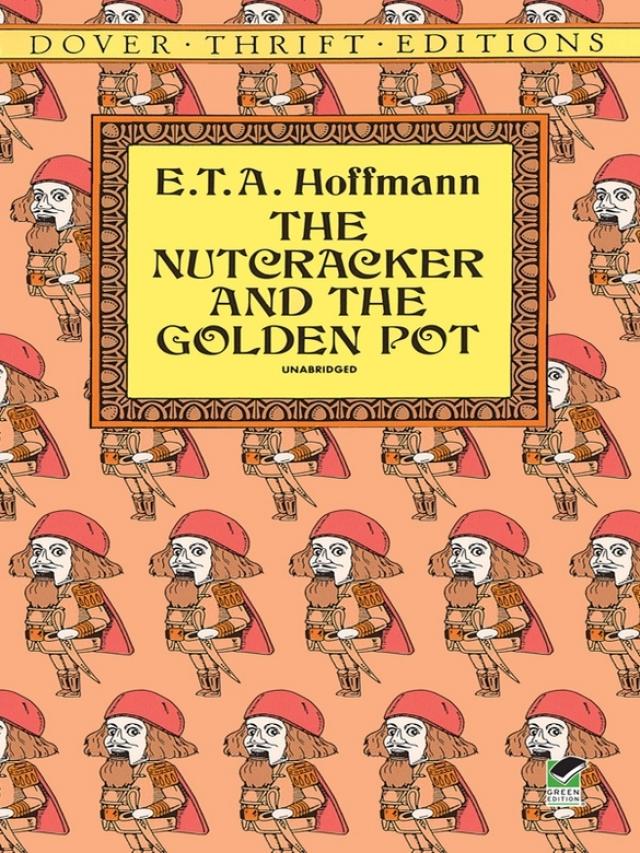
The Nutcracker and the Golden Pot,
p.10


If you would write your Twelfth Vigil, descend your cursed five flights of stairs, leave your garret, and come over to me. In the blue palmtree-room, which you already know, you will find fit writing materials; and you can then, in few words, specify to your readers, what you have seen; a better plan for you than any long-winded description of a life which you know only by hearsay. With esteem,
Your obedient servant,
The Salamander Lindhorst,
P. T. Royal Archivarius.
This somewhat rough, yet on the whole friendly note from Archivarius Lindhorst, gave me high pleasure. It seemed clear enough, indeed, that the singular manner in which the fortunes of his son-in-law had been revealed to me, and which I, bound to silence, must conceal even from you, gracious reader, was well known to this peculiar old gentleman; yet he had not taken it so ill as I might have apprehended. Nay, here was he offering me a helping hand in the completion of my work; and from this I might justly conclude, that at bottom he was not averse to having his marvellous existence in the world of spirits thus divulged through the press.
“It may be,” thought I, “that he himself expects from this measure, perhaps, to get his two other daughters married sooner: for who knows but a spark may fall in this or that young man’s breast, and kindle a longing for the green snake; whom, on Ascension Day, under the elder-bush, he will forthwith seek and find? From the misery which befell Anselmus, when he was enclosed in the glass bottle, he will take warning to be doubly and trebly on his guard against all doubt and unbelief.”
Precisely at eleven o’clock, I extinguished my study lamp; and glided forth to Archivarius Lindhorst, who was already waiting for me in the lobby.
“Are you there, my worthy friend? Well, this is what I like, that you have not mistaken my good intentions: follow me!”
And with this he led the way through the garden, now filled with dazzling brightness, into the azure chamber, where I observed the same violet table, at which Anselmus had been writing.
Archivarius Lindhorst disappeared: but soon came back, carrying in his hand a fair golden goblet, out of which a high blue flame was sparkling up. “Here,” said he, “I bring you the favourite drink of your friend the Bandmaster, Johannes Kreisler. It is burning arrack, into which I have thrown a little sugar. Sip a little of it: I will doff my dressing gown, and to amuse myself and enjoy your worthy company while you sit looking and writing, I shall just bob up and down a little in the goblet.”
“As you please, honoured Herr Archivarius,” answered I: “but if I am to ply the liquor, you will get none.”
“Don’t fear that, my good fellow,” cried the Archivarius; then hastily throwing off his dressing gown, he mounted, to my no small amazement, into the goblet, and vanished in the blaze. Without fear, softly blowing back the flame, I partook of the drink: it was truly precious!
Stir not the emerald leaves of the palm-trees in soft sighing and rustling, as if kissed by the breath of the morning wind? Awakened from their sleep, they move, and mysteriously whisper of the wonders, which from the far distance approach like tones of melodious harps! The azure rolls from the walls, and floats like airy vapour to and fro; but dazzling beams shoot through it; and whirling and dancing, as in jubilee of childlike sport, it mounts and mounts to immeasurable height, and vaults over the palm-trees. But brighter and brighter shoots beam upon beam, till in boundless expanse the grove opens where I behold Anselmus. Here glowing hyacinths, and tulips, and roses, lift their fair heads; and their perfumes, in loveliest sound, call to the happy youth: “Wander, wander among us, our beloved; for you understand us! Our perfume is the longing of love: we love you, and are yours for evermore!” The golden rays burn in glowing tones: “We are fire, kindled by love. Perfume is longing; but fire is desire: and do we not dwell in your bosom? We are yours!” The dark bushes, the high trees rustle and sound: “Come to us, beloved, happy one! Fire is desire; but hope is our cool shadow. Lovingly we rustle round your head: for you understand us, because love dwells in your breast!” The brooks and fountains murmur and patter: “Loved one, do not walk so quickly by: look into our crystal! Your image dwells in us, which we preserve with love, for you have understood us.” In the triumphal choir, bright birds are singing: “Hear us! Hear us! We are joy, we are delight, the rapture of love!” But anxiously Anselmus turns his eyes to the glorious temple, which rises behind him in the distance. The fair pillars seem trees; and the capitals and friezes acanthus leaves, which in wondrous wreaths and figures form splendid decorations. Anselmus walks to the Temple: he views with inward delight the variegated marble, the steps with their strange veins of moss. “Ah, no!” cries he, as if in the excess of rapture, “she is not far from me now; she is near!” Then Serpentina advances, in the fullness of beauty and grace, from the Temple; she bears the Golden Flower Pot, from which a bright lily has sprung. The nameless rapture of infinite longing glows in her meek eyes; she looks at Anselmus, and says: “Ah! Dearest, the Lily has opened her blossom: what we longed for is fulfilled; is there a happiness to equal ours?” Anselmus clasps her with the tenderness of warmest ardour: the lily burns in flaming beams over his head. And louder move the trees and bushes; clearer and gladder play the brooks; the birds, the shining insects dance in the waves of perfume: a gay, bright rejoicing tumult, in the air, in the water, in the earth, is holding the festival of love! Now sparkling streaks rush, gleaming over all the bushes; diamonds look from the ground like shining eyes: strange vapours are wafted hither on sounding wings: they are the spirits of the elements, who do homage to the lily, and proclaim the happiness of Anselmus. Then Anselmus raises his head, as if encircled with a beamy glory. Is it looks? Is it words? Is it song? You hear the sound: “Serpentina! Belief in you, love of you has unfolded to my soul the inmost spirit of nature! You have brought me the lily, which sprang from gold, from the primeval force of the world, before Phosphorus had kindled the spark of thought; this lily is knowledge of the sacred harmony of all beings; and in this I live in highest blessedness for evermore. Yes, I, thrice happy, have perceived what was highest: I must indeed love thee forever, O Serpentina! Never shall the golden blossoms of the lily grow pale; for, like belief and love, this knowledge is eternal.”
For the vision, in which I had now beheld Anselmus bodily, in his freehold of Atlantis, I stand indebted to the arts of the Salamander; and it was fortunate that when everything had melted into air, I found a paper lying on the violet-table, with the foregoing statement of the matter, written fairly and distinctly by my own hand. But now I felt myself as if transpierced and torn in pieces by sharp sorrow. “Ah, happy Anselmus, who has cast away the burden of everyday life, who in the love of kind Serpentina flies with bold pinion, and now lives in rapture and joy on your freehold in Atlantis! while I—poor I!—must soon, nay, in few moments, leave even this fair hall, which itself is far from a Freehold in Atlantis; and again be transplanted to my garret, where, enthralled among the pettinesses of existence, my heart and my sight are so bedimmed with thousand mischiefs, as with thick fog, that the fair lily will never, never be beheld by me.”
Then Archivarius Lindhorst patted me gently on the shoulder, and said: “Softly, softly, my honoured friend! Do not lament so! Were you not even now in Atlantis; and have you not at least a pretty little copyhold farm there, as the poetical possession of your inward sense? And is the blessedness of Anselmus anything else but a living in poesy? Can anything else but poesy reveal itself as the sacred harmony of all beings, as the deepest secret of nature?”
The Nutcracker
CHRISTMAS EVE
On the twenty-fourth of December, Dr. Stahlbaum’s children were not allowed on any pretext whatever at any time that day to go into the small drawing-room, much less into the best drawing-room into which it opened. Fritz and Marie were sitting cowering together in a corner of the back parlour when the evening twilight fell, and they began to feel terribly eerie. Seeing that no candles were brought, as was generally the case on Christmas Eve, Fritz, whispering in a mysterious fashion, confided to his young sister (who was just seven) that he had heard rattlings and rustlings going on all day, since early morning, inside the forbidden rooms, as well as distant hammering. Further, that a short time ago a little dark-looking man had gone slipping and creeping across the floor with a big box under his arm, though he was well aware that this little man was no other than Godpapa Drosselmeier. At this news Marie clapped her little hands with joy, and cried:
“Oh! I do wonder what pretty things Godpapa Drosselmeier has been making for us this time!”
Godpapa Drosselmeier was anything but a nice-looking man. He was small and lean, with a great many wrinkles on his face, a big patch of black plaster where his right eye ought to have been, and not a hair on his head; which was why he wore a fine white wig, made of glass, and a very beautiful work of art. But he was a very, very clever man, who even knew and understood all about clocks and watches, and could make them himself. So that when one of the beautiful clocks that were in Dr. Stahlbaum’s house was out of sorts and couldn’t sing, Godpapa Drosselmeier would come, take off his glass periwig and his little yellow coat, gird himself with a blue apron, and proceed to stick sharp-pointed instruments into the inside of the clock in a way that made little Marie quite miserable to witness. However, this didn’t really hurt the poor clock, which, on the contrary, would come to life again, and begin to whirr and sing and strike as merrily as ever; which caused everybody the greatest satisfaction. Of course, whenever he came he always brought something delightful in his pockets for the children—perhaps a little man, who would roll his eyes and make bows and scrapes, most comic to behold; or a box, out of which a little bird would jump; or something else of the kind. But for Christmas he always had some specially charming piece of ingenuity; something which had cost him infinite pains and labour—for which reason it was always taken away and put aside with the greatest care by the children’s parents.
“Oh! what can Godpapa Drosselmeier have been making for us this time,” Marie cried, as we have said.
Fritz was of the opinion that this time it could hardly be anything but a great castle, a fortress, where all sorts of pretty soldiers would be drilling and marching about; and then, that other soldiers would come and try to get into the fortress, upon which the soldiers inside would fire away at them, as pluckily as you please, with cannon, till everything banged and thundered like anything.
“No, no,” Marie said. “Godpapa Drosselmeier once told me about a beautiful garden with a great lake in it, and beautiful swans swimming about with great gold collars, singing lovely music. And then a lovely little girl comes down through the garden to the lake, and calls the swans and feeds them with shortbread and cake.”
“Swans don’t eat cake and shortbread,” Fritz cried, rather rudely (with masculine superiority), “and Godpapa Drosselmeier couldn’t make a whole garden. After all, we have got very few of his playthings; whatever he brings is always taken away from us. So I like the things papa and mamma give us much better; we keep them, all right, ourselves, and can do what we like with them.”
The children went on discussing what he might have in store for them this time. Marie called Fritz’s attention to the fact that Miss Gertrude (her biggest doll) appeared to be failing a good deal as time went on, inasmuch as she was more clumsy and awkward than ever, tumbling on to the floor every two or three minutes. This did not occur without leaving very ugly marks on her face, and of course proper condition of her clothes became out of the question altogether. Scolding was of no use. Mamma too had laughed at her for being so delighted with Miss Gertrude’s little new parasol. Fritz, again, remarked that a good fox was needed for his small zoological collection, and that his army was quite without cavalry, as his papa was well aware. But the children knew that their elders had got all sorts of charming things ready for them, and that the Christ Child, at Christmas time, took special care for their wants. Marie sat in thoughtful silence, but Fritz murmured quietly to himself:
“All the same, I should like a fox and some hussars!”
It was now quite dark. Fritz and Marie, sitting close together, did not dare to utter another syllable; they felt as if there were a fluttering of gentle, invisible wings around them, while a very distant, but unutterably beautiful strain of music could dimly be heard. Then a bright gleam of light passed quickly across the wall, and the children knew that the Christ Child had sped away on shining wings to other happy children. At this moment a silvery bell said, “Kling-ling! Kling-ling!” the doors flew open, and such a brilliance of light came streaming from the drawing-room that the children stood rooted where they were with cries of “Oh! Oh!”
Papa and mamma came and took their hands, saying, “Come now, darlings, and see what the blessed Christ Child has brought for you.”
THE CHRISTMAS PRESENTS
I appeal to you, kind reader (or listener)—Fritz, Theodore, Ernest, or whatsoever your name may be—and I beg you to bring vividly before your mind’s eye your last Christmas table, all glorious with its various delightful Christmas presents; and then perhaps you will be able to form some idea of the manner in which the two children stood speechless with their eyes fixed on all the beautiful things; how after a while, Marie, with a sigh, cried, “Oh, how lovely! how lovely!” and Fritz gave several jumps of delight.
The children had certainly been very, very good and well-behaved all the foregoing year to be thus rewarded; for never before had so many beautiful and delightful things been provided for them. The great Christmas tree on the table bore many apples of silver and gold, and all its branches were heavy with bud and blossom, consisting of sugar almonds, many-tinted bon-bons, and all sorts of things to eat. Perhaps the prettiest thing about this wonder-tree, however, was the fact that in all the recesses of its spreading branches hundreds of little tapers glittered like stars, inviting the children to pluck its flowers and fruit. Also, all around the tree on every side everything shone and glittered in the loveliest manner. Oh, how many beautiful things there were! Who, oh who, could describe them all? Marie gazed there at the most delicious dolls, and all kinds of toys, and (what was the prettiest thing of all) a little silk dress with many-tinted ribbons was hung upon a projecting branch so that she could admire it on all sides; which she accordingly did, crying out several times, “Oh! what a lovely, lovely, darling little dress! And I suppose, I do believe, I shall really be allowed to put it on! ” Fritz, in the meantime, had had two or three trials of how his new fox (which he had found tied to the table) could gallop and now stated that he seemed a wildish sort of brute; but, no matter, he felt sure he would soon get him well in order; and he set to work to muster his new squadron of hussars, admirably equipped, in red and gold uniforms, with real silver swords, and mounted on such shining white horses that you would have thought they were of pure silver too.
When the children had sobered down a little, and were beginning upon the beautiful picture books (which were open, so that you could see all sorts of most beautiful flowers and people of every hue, to say nothing of lovely children playing, all as naturally represented as if they were really alive and could speak), there came another tinkling of a bell, to announce the display of Godpapa Drosselmeier’s Christmas present, which was on another table, against the wall, concealed by a curtain. When this curtain was drawn, what did the children behold?
On a green lawn, bright with flowers, stood a lordly castle with a great many shining windows and golden towers. A chime of bells was going on inside it; doors and windows opened, and you saw very small but beautiful ladies and gentlemen with plumed hats, and long robes down to their heels walking up and down in the rooms of it. In the central hall, which seemed all in a blaze, there were quantities of little candles burning in silver chandeliers; children in little short doublets were dancing to the chimes of the bells. A gentleman in an emerald green mantle came to a window, made signs, and then disappeared inside again; also, even Godpapa Drosselmeier himself (but scarcely taller than papa’s thumb) came now and then, and stood at the castle door, then went in again.
Fritz had been looking on with the rest at the beautiful castle and the people walking about and dancing in it, with his arms leant on the table; then he said:
“Godpapa Drosselmeier, let me go into your castle for a little while.”
Drosselmeier answered that this could not possibly be done. In which he was right; for it was silly of Fritz to want to go into a castle which was not so tall as himself, golden towers and all. And Fritz saw that this was so.
After a short time, as the ladies and gentlemen kept on walking about just in the same fashion, the children dancing, and the emerald man looking out at the same window, and Godpapa Drosselmeier coming to the door, Fritz cried impatiently:
“Godpapa Drosselmeier, please come out at that other door!”
“That can’t be done, dear Fritz,” answered Drosselmeier.
“Well,” resumed Fritz, “make that green man that looks out so often walk about with the others.”
“And that can’t be done, either,” said his godpapa, once more.
“Make the children come down, then,” said Fritz. “I want to see them nearer.”


_preview.jpg)
_preview.jpg)